
Professional pavement marking is the specialized process of applying durable, code-compliant lines, arrows, symbols, and lettering to parking lots and roadways so traffic flows safely and properties meet accessibility law. For property owners across Denton and Plano, TX, faded or missing lines are never just cosmetic — they create liability exposure, confuse drivers, and can trigger costly compliance violations during a fire marshal or ADA inspection. This guide covers everything a property manager needs to know about professional pavement marking, including materials, equipment, costs, local codes, and how to vet a contractor before signing a contract.

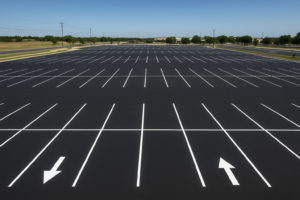
Crisp, freshly applied lines are the hallmark of professional pavement marking work.
What Is Professional Pavement Marking?
Professional pavement marking is a specialized trade that applies traffic paint, thermoplastic, epoxy, or reflective tape to asphalt or concrete surfaces to define parking stalls, driving lanes, and safety zones. Unlike a basic paint job, it requires precise layout measurements, adherence to local fire codes, and compliance with federal accessibility guidelines.
Consequently, most commercial properties — including retail centers, schools, and healthcare facilities — rely on trained crews rather than general contractors for this work. In particular, accuracy matters because incorrect stall widths or missing accessible spaces can lead to code violations and repeat inspections. For a closer look at what to expect from a qualified provider, see this breakdown of what to look for in a pavement marking company. Similarly, this overview of line marking services for parking lots explains how scope of work typically breaks down by property type.
Why Parking Lot Line Striping Matters for Safety
Parking lot line striping does more than organize vehicles — it directly affects safety. Clear lines guide drivers toward available spaces, reduce the chance of collisions, and help pedestrians find safe walking paths. In addition, well-marked fire lanes ensure emergency vehicles have unobstructed access during a crisis.
Faded or missing lines, on the other hand, create confusion. Drivers may park too close to fire lanes, block accessible aisles, or misjudge available space. As a result, property managers who neglect restriping often see higher complaint rates and, in some cases, liability exposure after an accident. According to the Federal Highway Administration’s Manual on Uniform Traffic Control Devices, retroreflective pavement markings are essential for maintaining visibility in low-light conditions. Furthermore, the Occupational Safety and Health Administration notes that clearly marked traffic lanes reduce struck-by incidents in busy commercial lots — a benefit that applies to employees and customers alike. For a deeper dive into layout best practices, this complete guide to safety markings for parking lots is a useful companion resource.
Core Components of a Professional Line Striping Project
A complete pavement marking project typically covers several components beyond simple stall lines. Understanding each element helps property owners request the right scope of work from their contractor and avoid surprise change orders mid-project.
ADA Compliance and Handicap Stall Markings
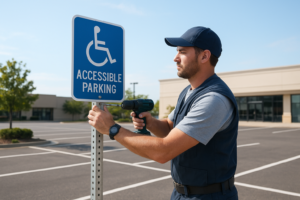
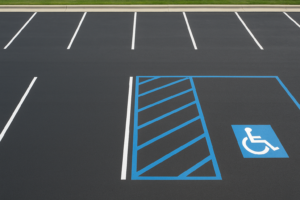
ADA-compliant markings require specific stall widths, van-accessible aisle spacing, and proper signage placement. Under the Americans with Disabilities Act standards, facilities must provide at least one accessible space for every 25 total spaces, with additional van-accessible stalls at set ratios. Therefore, an experienced parking lot striping crew will measure and paint these spaces to exact code specifications, helping property owners avoid costly fines.
Fire Lane Marking and Curb Painting
Fire lanes must remain clearly visible and unobstructed at all times. Most municipalities require red curb paint along with stenciled text reading “FIRE LANE NO PARKING.” Similarly, curb painting often extends to directional curbs, loading zones, and no-parking areas. For properties needing dedicated fire lane marking, working with a contractor familiar with local fire marshal requirements prevents repeat inspections and violations.
Directional Arrows, Stencils, and Wayfinding Symbols
Beyond stall lines, most commercial lots need directional arrows, stop bars, crosswalks, and stenciled text such as “DO NOT ENTER” or “EV CHARGING ONLY.” These elements guide traffic flow and reduce head-on conflicts between vehicles entering and exiting a lot. In busy shopping centers, above all, clear wayfinding symbols prevent bottlenecks at peak hours.
Speed Bumps, Wheel Stops, and Loading Zones
Many properties also need speed bump striping, wheel stop placement, and loading zone markings to control vehicle speed and delivery traffic. Consequently, a thorough professional pavement marking scope should address these secondary elements, not just the primary stall grid, since overlooked details often become tripping hazards or safety complaints later.
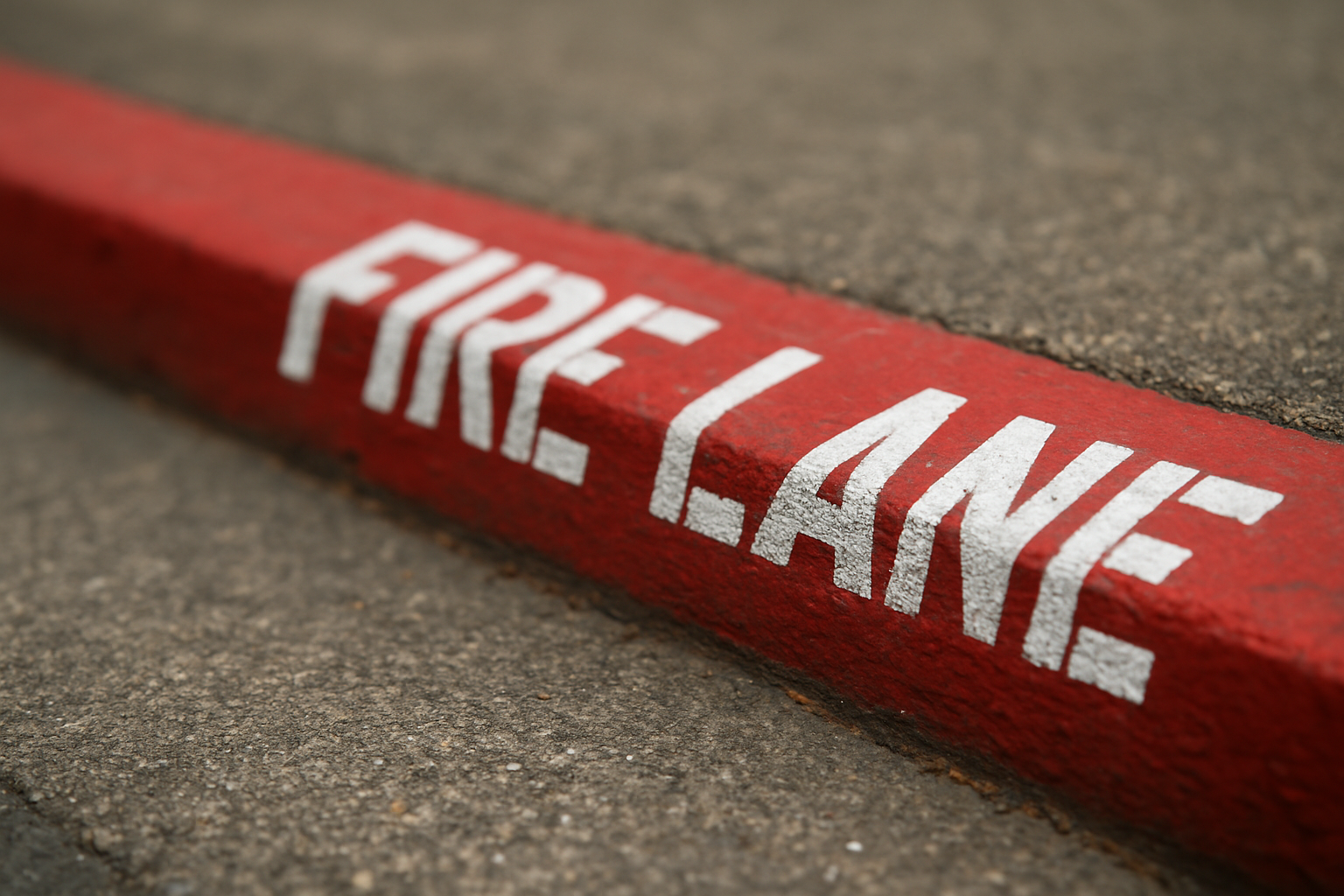
Fire lane marking and curb painting keep emergency access routes clear and compliant.
Materials and Equipment Used in Professional Pavement Marking
Not all striping materials perform the same way, so understanding the options helps property owners make informed decisions rather than accepting a generic quote.
- Water-based traffic paint: the most common option, offering good visibility and a lower cost, though it typically needs reapplication every 12 to 24 months.
- Solvent-based paint: more durable in extreme temperatures but generally higher in volatile organic compounds (VOCs), the chemical compounds that evaporate into the air as paint cures.
- Thermoplastic: a heated, melt-applied material that bonds deeply into the surface and can last three to five times longer than paint, making it ideal for high-traffic crosswalks.
- Epoxy and MMA (methyl methacrylate): premium, fast-curing options often used on concrete garages or airport-adjacent lots where downtime must be minimal.
- Reflective glass beads and tape: embedded or applied over wet paint to improve nighttime visibility, which is especially important in unlit lots.
Meanwhile, equipment matters just as much as material. Professional crews typically use truck-mounted or walk-behind line stripers with calibrated flow rates, laser or chalk-line layout tools, and stencil kits for symbols and lettering. In contrast, DIY kits rely on manual rollers or spray cans that cannot maintain consistent width or spacing across a large lot.
How to Choose a Pavement Marking Company
Selecting the right contractor for a commercial line striping project involves more than comparing price quotes. Above all, property owners should verify experience, materials, and compliance knowledge before signing a contract. The steps below outline a practical process.
- Verify licensing, insurance, and experience with commercial line striping projects similar in size and scope to your property.
- Request a detailed written quote that outlines material specifications, ADA measurements, layout plans, and an estimated project timeline.
- Confirm the contractor uses reflective, durable traffic paint rated for the local climate, expected traffic volume, and surface type.
- Ask for references or photo examples of completed fire lane marking and ADA compliance projects the company has finished nearby.
- Schedule the work during low-traffic hours to minimize disruption for tenants and customers while allowing proper paint curing time.
Furthermore, a reputable company should be transparent about timelines and weather-related delays. For example, StripesPls serves property managers, schools, and healthcare facilities throughout Denton and Plano with customized striping plans and free quotes.
Cost Factors for Parking Lot Marking Projects
Pricing for professional pavement marking depends on several variables, including lot size, layout complexity, and the type of paint or thermoplastic used. Generally speaking, larger lots with more stalls and directional markings cost more than small residential or single-building lots.
In particular, ADA compliance work often adds cost because it requires precise measurements and accessible signage. Meanwhile, thermoplastic markings last longer than standard paint but come with a higher upfront price. Below is a simplified breakdown of what typically drives the final quote:
- Lot size and stall count: more square footage and more stalls mean more paint, labor, and machine time.
- Surface condition: cracked or oil-stained asphalt may need cleaning or crack sealing before striping.
- Material choice: thermoplastic and epoxy cost more upfront but reduce how often you need to restripe.
- Symbol and stencil complexity: ADA symbols, arrows, and custom lettering add labor time.
- Access and scheduling: night or weekend work to avoid business disruption can affect pricing.
As a result, requesting a free, itemized quote remains the most reliable way to understand true project costs for a specific property. Property owners dealing specifically with worn-out lines should also review this guide to refreshing faded parking lot markings, which explains how condition affects both cost and timeline.
Professional Pavement Marking vs. DIY Striping
Some property owners consider DIY striping kits to save money. However, these kits rarely deliver consistent results. Without calibrated equipment, lines often turn out crooked, inconsistent in width, or improperly spaced.
By contrast, professional commercial pavement marking services use line-striping machines, stencils, and measuring tools designed for accuracy. In addition, professional crews understand ADA and fire code requirements that most DIY painters overlook entirely. Therefore, while DIY striping may seem cost-effective initially, it often leads to repainting sooner and potential compliance issues down the line. For further reading on general pavement marking standards, the Wikipedia entry on road surface marking offers useful background context.
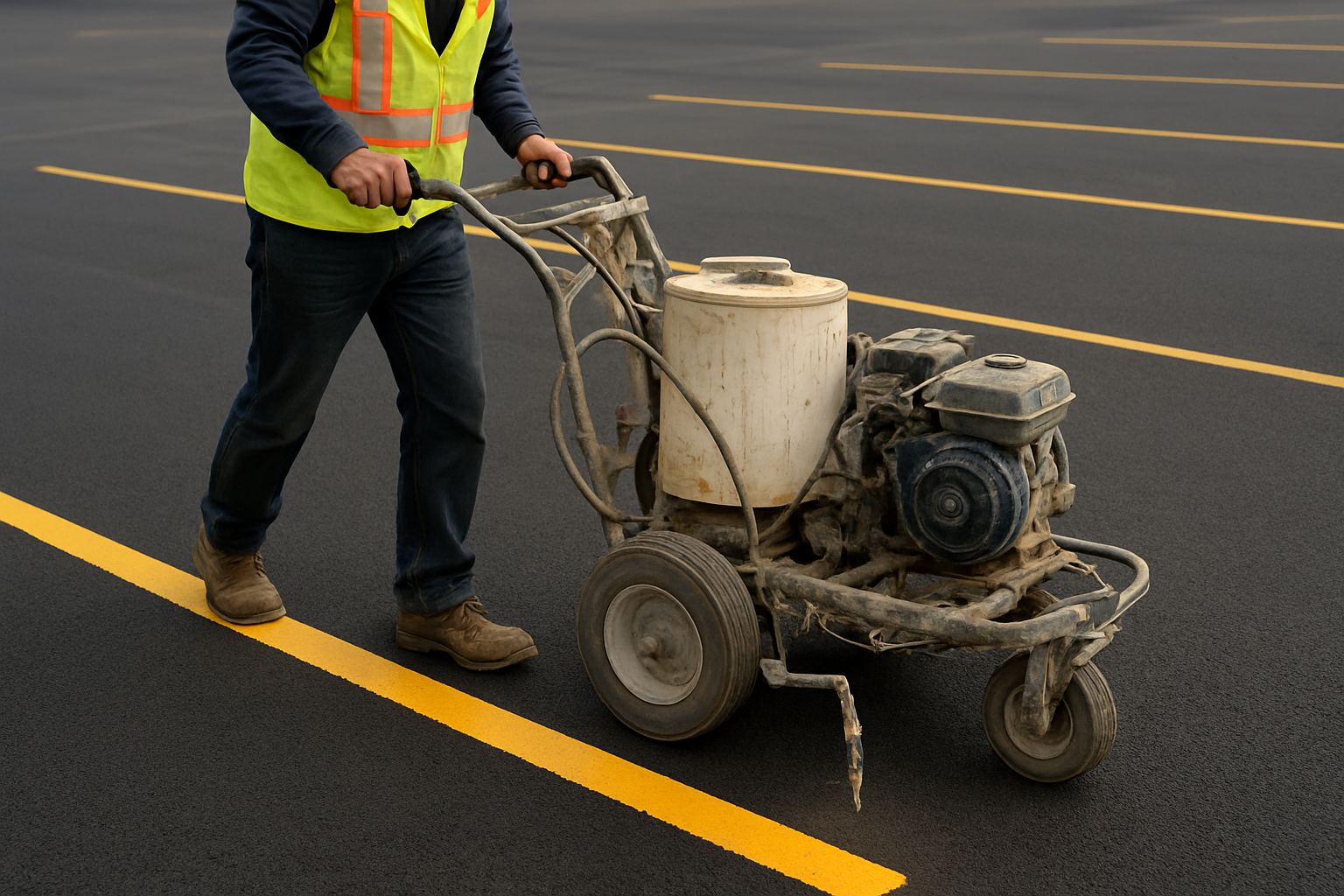
Calibrated equipment helps crews deliver consistent, code-compliant results on every project.
Maintenance Schedule: When to Restripe a Parking Lot
Most commercial parking lots need restriping every 12 to 24 months, though this varies by traffic volume, paint type, and climate. In North Texas specifically, intense summer sun and heat accelerate fading, so high-traffic retail centers often need annual touch-ups rather than waiting two full years.
Consequently, a simple visual inspection twice a year — once in spring and once in fall — helps property managers catch fading before it becomes a compliance issue. Warning signs include faded ADA symbols, ghosted stall lines that are barely visible at night, and chipped fire lane text. In contrast, thermoplastic markings on high-wear crosswalks may hold up for three to five years before needing attention.
Local Codes and Standards for Denton and Plano, TX
Texas municipalities generally follow the MUTCD for public roadway markings, but private commercial lots must also satisfy local fire marshal requirements and ADA law simultaneously. Therefore, a contractor working in Denton or Plano needs familiarity with both state guidance and city-specific fire lane ordinances, since requirements can differ slightly between jurisdictions.
In addition, healthcare facilities and schools often face stricter inspection schedules than standard retail properties. As a result, choosing a crew that already understands these layered requirements — rather than learning them mid-project — saves time and avoids failed inspections. This complete guide to parking lot safety markings breaks down these layout requirements in more detail.
Frequently Asked Questions
What is professional pavement marking?
Professional pavement marking is the application of durable traffic paint, thermoplastic, or tape to parking lots and roadways to create parking stalls, directional arrows, fire lanes, and ADA-compliant accessible spaces. Trained crews use specialized equipment to ensure straight lines, correct dimensions, and code compliance.
How often should parking lot lines be restriped?
Most commercial parking lots need restriping every 12 to 24 months, depending on traffic volume and weather exposure. High-traffic retail centers in North Texas often require annual touch-ups because sun and heat fade paint faster.
Why is professional pavement marking important for ADA compliance?
ADA compliance requires precise stall widths, van-accessible aisle spacing, and signage placement that untrained painters often get wrong. A professional pavement marking crew understands these federal and local requirements, which helps property owners avoid fines and accessibility complaints.
How much does professional pavement marking cost?
Costs vary based on lot size, layout complexity, and paint type, but most commercial projects range from a few hundred to several thousand dollars. Getting a free, itemized quote is the most reliable way to know exact pricing for your property.
What paint is used for professional pavement marking?
Contractors typically use water-based or solvent-based traffic paint formulated for asphalt or concrete durability. Some high-traffic areas benefit from thermoplastic markings, which last longer but cost more upfront.
How long does pavement marking take to dry?
Most traffic paint dries to the touch within 30 to 60 minutes in warm, dry conditions, though full curing can take several hours. Property owners should keep the area barricaded until the paint has fully cured to avoid smearing.
What is the difference between professional pavement marking and DIY striping?
Professional pavement marking uses calibrated equipment, reflective-grade paint, and knowledge of ADA and fire code requirements that DIY kits cannot replicate. DIY striping often results in uneven lines, incorrect measurements, and markings that fade within months.
What are common mistakes in parking lot striping?
Common mistakes include inconsistent stall widths, missing van-accessible spaces, painting over debris, and skipping proper layout measurements before starting. These errors can create safety hazards and compliance violations.
Do fire lanes require special pavement marking?
Yes, fire lanes typically require red curb paint and stenciled “FIRE LANE NO PARKING” text according to local fire code standards. Municipalities often inspect these markings, so accuracy and visibility are essential.
How do I choose a pavement marking company near me?
Look for a licensed, insured contractor with verifiable experience in commercial line striping, ADA layouts, and fire lane marking. Ask for references, sample photos, and a written scope of work before signing a contract.
What is the best time of year for pavement marking projects?
Warm, dry weather with low humidity produces the fastest curing and best adhesion for pavement marking projects. In North Texas, spring and fall typically offer the most consistent conditions for scheduling.
Can pavement marking improve parking lot safety and traffic flow?
Yes, clear directional arrows, crosswalks, and stall lines reduce confusion, prevent collisions, and help vehicles and pedestrians move safely through a lot. Well-marked lots also maximize usable parking capacity.
Are eco-friendly paint options available for professional pavement marking?
Yes, many contractors now offer low-VOC water-based paints that reduce fumes and environmental impact without sacrificing visibility. Property owners with sustainability goals should ask specifically about low-VOC options during the quote process.
Does professional pavement marking come with a warranty?
Many reputable contractors offer a workmanship warranty covering premature fading or peeling, typically ranging from six months to one year. Therefore, it is worth asking for warranty terms in writing before work begins.
Final Thoughts
Professional pavement marking protects both drivers and pedestrians while helping properties stay compliant with ADA and fire code standards. From ADA stall layouts to fire lane marking, directional stencils, and curb painting, each element plays a role in keeping a parking lot safe, organized, and functional. Ultimately, property owners throughout Denton and Plano who invest in professional pavement marking reduce liability risks and extend the life of their lot’s markings. Property managers ready to refresh faded lines or plan a new layout can request a free quote from StripesPls to get started.