
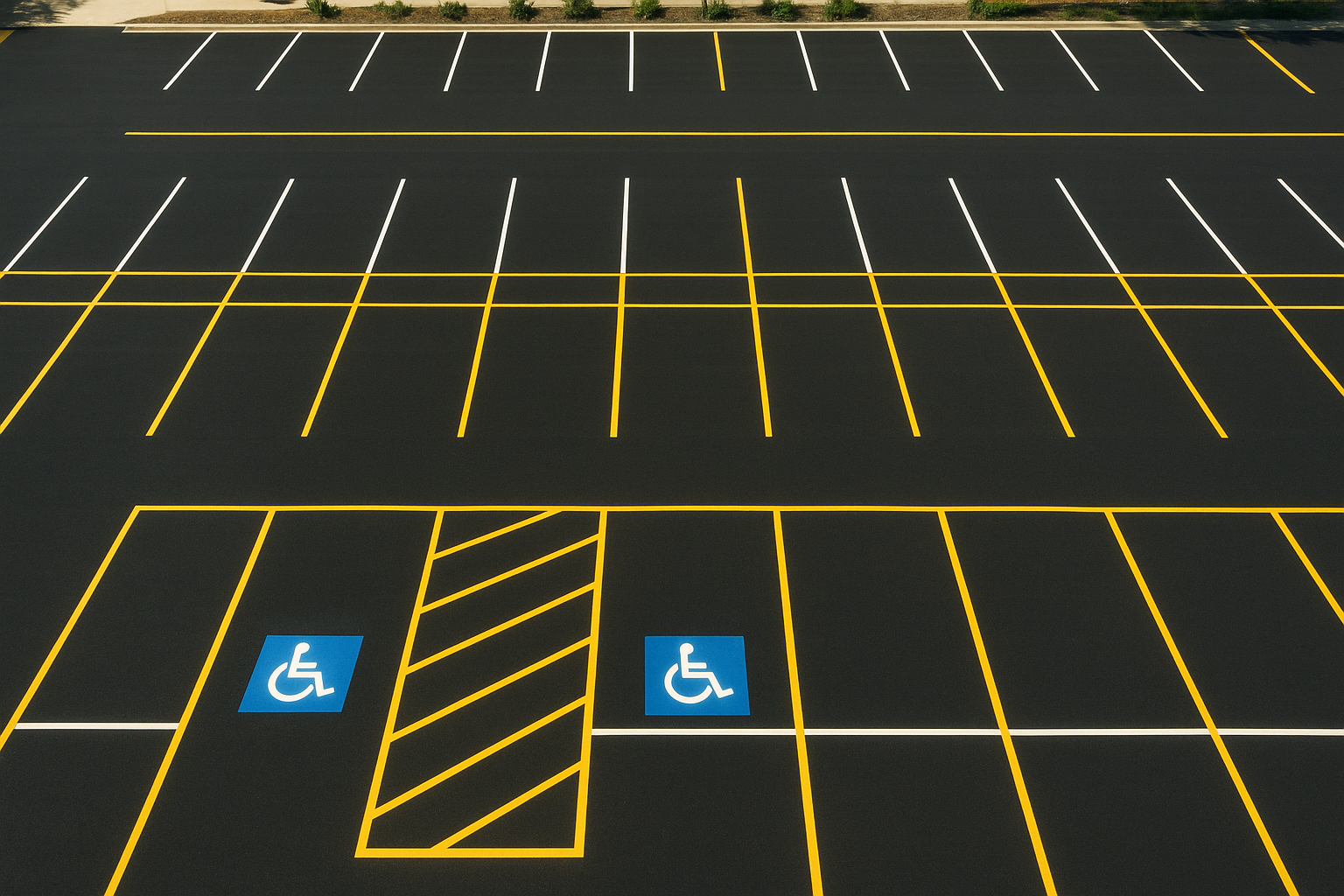
Code compliant parking facilities are parking lots and structures that satisfy federal ADA (Americans with Disabilities Act) accessibility rules, local fire-safety codes, and municipal striping ordinances at the same time. For property owners across Denton, Plano, and the wider North Texas region, maintaining code compliant parking facilities is not a courtesy — it is a legal obligation that protects visitors, avoids fines, and keeps insurance coverage intact. However, faded stripes, missing fire lane lettering, and outdated ADA signage can quietly turn a once-compliant lot into a legal and financial liability. This guide goes further than most compliance overviews: it explains what compliance actually requires under both federal and Texas-specific standards, why it matters financially, how professional striping keeps a property protected, and exactly what an inspector checks before signing off.
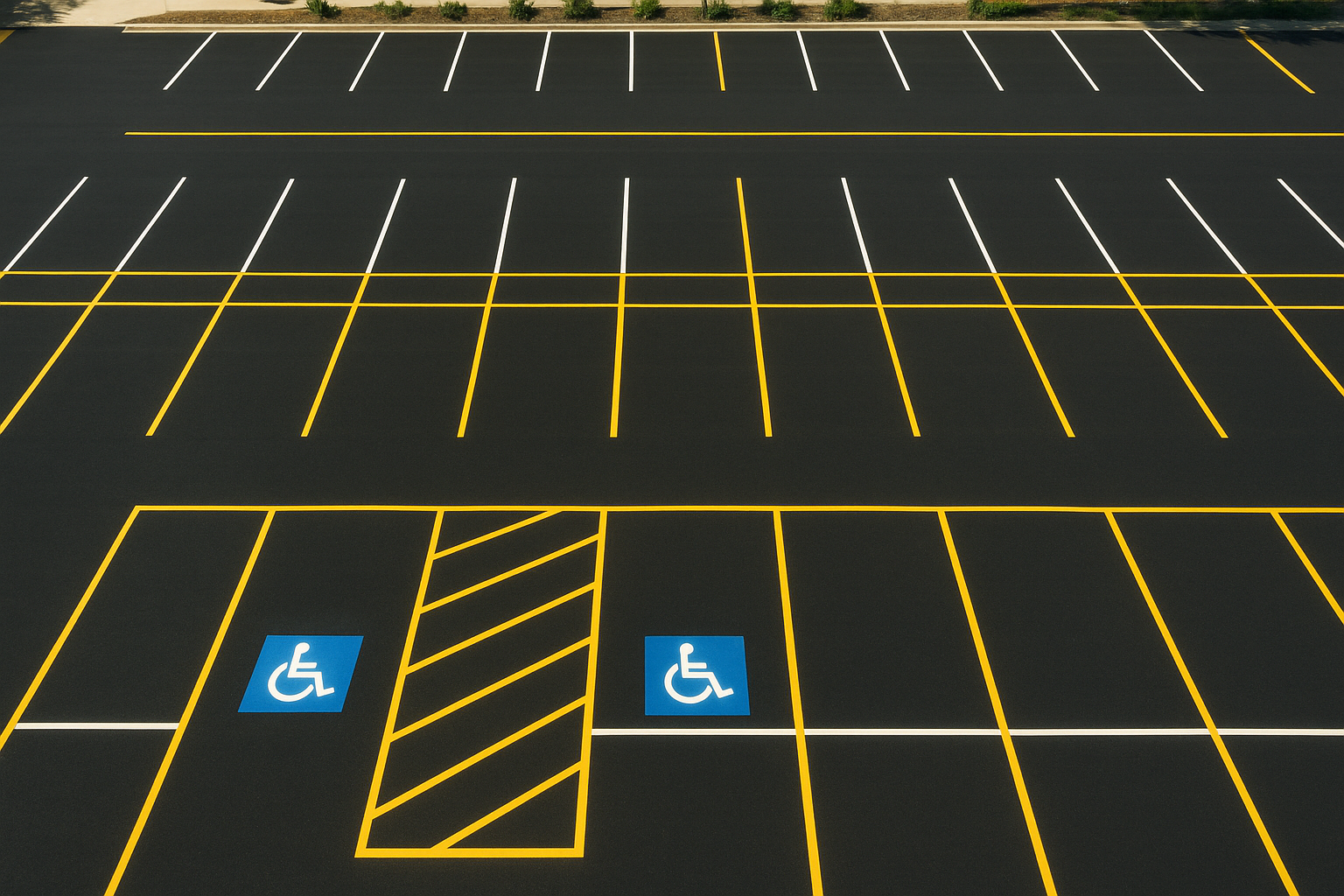
Clean, well-marked striping is the foundation of code compliant parking facilities. For a deeper walkthrough, see our Dallas Parking Lot Striping: Pro Line Marking Guide.
What Are Code Compliant Parking Facilities?
Code compliant parking facilities are lots or structures that satisfy federal ADA accessibility rules, local fire codes, and municipal zoning ordinances governing striping, signage, and stall dimensions. In practice, that means correctly sized accessible stalls, van-accessible spaces, legible fire lane markings, directional arrows, and signage mounted at the height inspectors expect to see.
Importantly, compliance is not a one-time achievement. Line markings fade under Texas heat, regulations get updated, and lots require periodic inspection to stay current. Specifically, the ADA.gov guidelines set the accessibility baseline nationwide, while local fire marshals and city codes layer on additional requirements for lane widths, signage, and stall counts. As a result, a lot that was fully compliant five years ago may no longer meet today’s standards — even if nothing about the physical layout has changed.
For a deeper breakdown of accessibility rules specifically, see this complete guide to ADA parking lot compliance, which walks through stall counts, signage, and access aisle requirements in far more detail than most general overviews.
Why ADA Compliant Parking Lots Matter for Texas Properties
Above all, ADA compliant parking lots protect people with disabilities from unsafe or inaccessible conditions. In addition, they protect property owners from serious legal exposure. According to industry ADA Title III litigation tracking, thousands of accessibility-related lawsuits are filed in federal courts each year, and parking lot violations are consistently among the most cited issues nationwide.
Legal and Financial Risk
Consequently, retail centers, healthcare facilities, and schools throughout North Texas face real financial risk when accessible stalls, signage, or access aisles fall short of code. Furthermore, insurance carriers may deny liability claims tied to accidents in a non-compliant lot, leaving the property owner personally responsible for damages. For property managers overseeing multiple sites, the ADA compliance markings service page outlines exactly which elements typically need attention first.
Reputation and Accessibility
Similarly, the U.S. Access Board publishes the technical specifications inspectors use when reviewing accessible parking design, making it a genuinely useful reference for property owners preparing for an audit. Beyond legal risk, a poorly marked lot signals neglect to every visitor who parks there — which is a reputational cost that rarely shows up on a balance sheet but affects tenant retention and customer trust all the same.
Texas Accessibility Standards vs. Federal ADA Rules
One area many general guides skip entirely is the relationship between federal ADA law and the Texas Accessibility Standards (TAS) — the state-level building code that adds requirements on top of the ADA baseline. In Texas, the Texas Department of Licensing and Regulation (TDLR) enforces TAS through its Architectural Barriers program, and most commercial construction or renovation projects must be registered and inspected under this program in addition to meeting federal ADA rules.
In particular, TAS sometimes specifies stricter dimensions, signage placement, or documentation requirements than the federal ADA minimum. Therefore, a Texas property that only checks federal ADA guidance may still fail a state-level Registered Accessibility Specialist (RAS) inspection. For property owners weighing a full striping redesign, the customized ADA striping solutions across Texas resource explains how local crews account for both standards simultaneously, rather than treating them as separate checklists.
Accessible Stall Requirements Explained
Getting stall counts and dimensions right is often where compliance efforts first go wrong. The rules are more specific than most owners expect, and small errors compound across a large lot.
Stall Dimensions and Access Aisles
Standard accessible stalls generally require a minimum width plus an adjacent access aisle that keeps the space clear for wheelchair transfer. Meanwhile, that aisle must connect directly to an accessible route free of curbs, gravel, or steps — a detail inspectors check closely because a beautifully striped stall is useless if the path to the entrance is blocked.
Van-Accessible Spaces
Van-accessible stalls require a wider access aisle, typically eight feet, to accommodate wheelchair lifts on the side of a van. In contrast, a standard accessible stall uses a narrower aisle. Every lot needs at least one van-accessible space, and the ratio increases as total stall count grows.
Signage Height and Placement
Signage must be mounted at a specific minimum height above grade so it remains visible even when a vehicle is parked in the adjacent stall. Notably, a sign lying flat on a wall or mounted too low is one of the most common — and easiest to fix — violations found during inspections.
Fire Lane Marking: A Core Piece of Parking Lot Code Compliance
Fire lane marking is just as critical to parking lot code compliance as ADA striping, yet it is often overlooked until an inspection flags it. Fire lanes must generally stay clear of parked vehicles at all times so emergency vehicles can reach a building without delay. Typically, this means red curb or pavement paint paired with bold white “FIRE LANE — NO PARKING” lettering.
In particular, lane width and placement rules vary by municipality, so a lot compliant in one North Texas city may need adjustments in another. Therefore, checking with the local fire marshal before repainting is a smart first step. Organizations such as the National Fire Protection Association publish general life-safety standards that many local fire codes reference directly, which makes NFPA guidance a useful starting point even before a city-specific review.
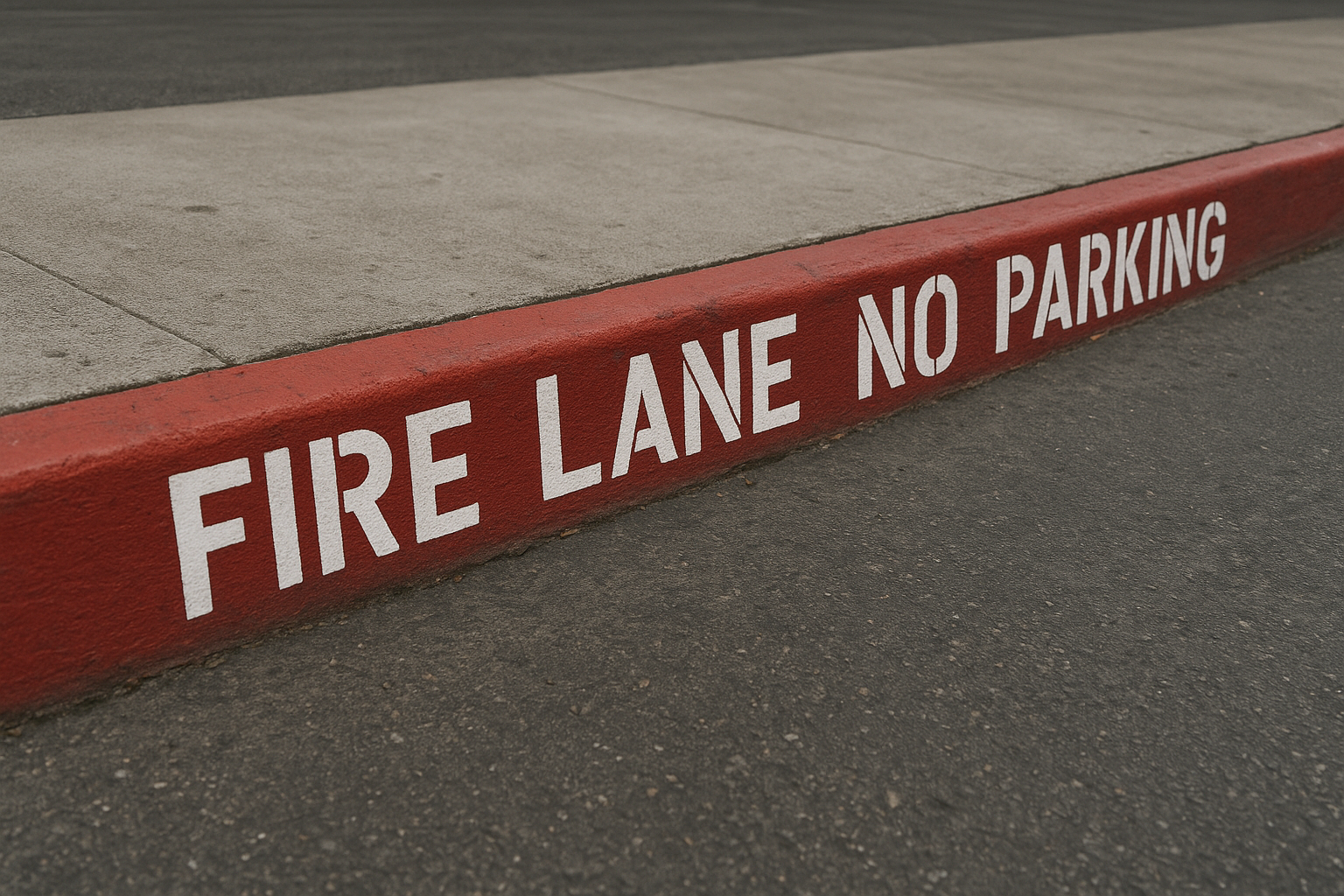
Properly painted fire lanes are a non-negotiable part of code compliant parking facilities.
How to Achieve Code Compliant Parking Lot Striping
Bringing an existing lot into compliance follows a fairly predictable process. Below is the full sequence most Texas properties follow when correcting or upgrading their markings, from first walk-through to long-term monitoring.
- Audit the current layout. Walk the entire lot on foot and document faded lines, missing signs, undersized accessible stalls, and any fire lane sections that have lost their red pigment or lettering.
- Review local code requirements. Confirm current ADA rules, Texas Accessibility Standards, and fire marshal requirements together, since these three layers of code can differ meaningfully from one city to the next.
- Calculate required accessible stalls. Base the count on total parking spaces using the ADA sliding scale, then verify the number against any stricter state-level TAS requirement that may apply.
- Plan the striping layout. Map stalls, access aisles, directional arrows, and fire lane zones on paper or in software before any paint touches the pavement, so mistakes get caught early.
- Apply durable striping and signage. Use professional traffic paint or epoxy rated for Texas heat and UV exposure, and mount all required signage at the correct height above grade.
- Document the completed work. Photograph the finished layout and keep a record of paint type, stall counts, and installation date in case of a future inspection or dispute.
- Schedule periodic re-inspection. Check visibility, fading, and any code updates at least once a year, and immediately after any remodel, expansion, or change in property use.
For properties needing bay-specific layout adjustments, the parking bay marking services in Denton and Plano page details how layout redesigns are handled for retail centers and multi-tenant properties. For a deeper walkthrough, see our How Can I Get Customized Parking Solutions for My Business?.
Choosing the Right Paint and Materials
Beyond layout and dimensions, the material used to apply striping directly affects how long a lot stays compliant. Consequently, this is one of the most cost-relevant decisions a property owner makes.
- Water-based traffic paint: The most common and affordable option, suitable for standard-traffic lots that get restriped on a regular cycle.
- Epoxy coatings: A longer-lasting, more expensive option that generally holds up better under intense Texas heat, UV exposure, and heavy vehicle traffic.
- Thermoplastic markings: Extremely durable but typically reserved for high-traffic municipal roads rather than standard commercial lots, due to higher installation cost.
- Reflective additives: Glass beads or reflective compounds mixed into paint improve nighttime visibility, which matters for fire lanes and directional arrows in particular.
Common Mistakes That Break Parking Lot Compliance
Even well-maintained properties slip out of compliance for predictable reasons. Recognizing these patterns early can prevent a failed inspection later.
- Faded or partially visible striping that no longer meets legibility standards.
- Accessible stalls that are too narrow or missing a van-accessible option.
- Fire lanes without red paint, lettering, or adequate width.
- Signage mounted below the required height or blocked by landscaping.
- Skipping re-inspection after a remodel, expansion, or layout change.
- Assuming compliance is permanent once markings are first installed.
Notably, many of these issues are inexpensive to fix when caught early, but they can become costly once a complaint or citation is filed. Owners uncertain about their current status can review this step-by-step ADA compliance checklist to self-assess before calling in a professional crew.
How Municipalities Enforce Parking Lot Code Compliance
Local governments typically enforce parking lot code compliance through a mix of routine inspections, permit reviews, and complaint-driven investigations. In most North Texas cities, fire marshals handle fire lane enforcement while planning or code compliance departments oversee ADA and zoning-related markings.
As a result, violations discovered during a permit renewal or occupancy inspection can trigger mandatory corrections on a set deadline. For a closer look at how this process works locally, this breakdown of how municipalities ensure parking lot compliance explains what inspectors typically check and how quickly properties must respond.
Cost of Code Compliant Parking Lot Striping in Texas
Pricing varies by lot size, layout complexity, and paint type, but most Texas properties pay a per-stall or per-square-foot rate rather than a flat fee. In general, water-based paint costs less per stall upfront, while epoxy costs more initially but requires restriping less often — meaning the cheaper option is not always the better long-term value.
Additional cost factors include the number of accessible signs needed, whether existing striping must be removed before repainting, and how much fire lane footage requires red paint and lettering. Requesting a free quote is the most accurate way to budget for code compliant parking facilities, since every lot’s layout and condition differ.
Maintenance Schedule and Compliance Audit Checklist
Staying compliant long-term depends less on the initial striping job and more on how consistently a property gets re-checked. Above all, a simple recurring schedule prevents small fading issues from becoming full violations.
- Monthly: Walk the lot visually and note any new fading, oil staining over lines, or damaged signage.
- Annually: Conduct a full visual inspection against current ADA and TAS requirements, checking stall counts and dimensions.
- Every 18–24 months: Restripe standard water-based paint markings before fading becomes a legibility issue.
- Every 2–3 years: Bring in a professional compliance review to catch code changes that a visual check alone might miss.
Choosing the Right Team for Code Compliant Parking Facilities
Ultimately, maintaining code compliant parking facilities long-term comes down to working with a crew that understands both paint durability and code detail. StripesPls, based in Texas, focuses specifically on professional striping, ADA compliance solutions, and fire lane marking for commercial and residential properties throughout the Denton and Plano areas. Author: StripesPls. Last updated: 2026-08-11. For a deeper walkthrough, see our Commercial Property Parking Solutions in Denton & Plano.
Because the team serves property managers, retail centers, schools, healthcare facilities, and municipal organizations across North Texas, projects range from full new lot layouts to simple restriping of faded markings. Property owners can request a free quote directly through stripespls.com to get a customized plan for their specific site.

Professional crews help properties maintain code compliant parking facilities year after year.
Frequently Asked Questions About Code Compliant Parking Facilities
What is a code compliant parking facility?
A code compliant parking facility is a lot or structure that meets ADA accessibility rules, local fire codes, and municipal striping and signage ordinances. This includes properly sized accessible stalls, van-accessible spaces, and clearly marked fire lanes.
How often should parking lot striping be repainted?
Most commercial parking lots need restriping every 18 to 24 months, though high-traffic Texas lots may fade sooner due to sun exposure. Faded lines are one of the most common reasons a lot falls out of compliance; review our striping and signage solutions for regional recommendations.
What is the minimum number of ADA parking spaces required?
The number of required accessible spaces follows a sliding scale based on total parking count under ADA design standards. For example, a lot with 26 to 50 spaces typically needs at least two accessible stalls, one of which must be van-accessible.
How wide should a fire lane be?
Fire lanes generally must be at least 20 feet wide to allow emergency vehicle access, though local fire marshals may require more. Local fire codes always take precedence over general guidelines.
Why do fire lanes need to be painted red with white lettering?
Red paint with white “FIRE LANE NO PARKING” lettering creates high visibility so drivers immediately recognize restricted zones. This standardized marking helps emergency crews reach buildings quickly during a crisis.
How much does parking lot striping cost in Texas?
Pricing varies by lot size, layout complexity, and paint type, but most Texas properties pay a per-stall or per-square-foot rate. For more detail on typical costs see our parking lot striping cost page. Requesting a free quote is the most accurate way to budget for code compliant parking facilities.
What happens if a parking lot fails an ADA inspection?
A failed inspection can trigger fines, mandatory corrections on a deadline, or civil litigation from affected visitors. In addition, insurance claims tied to accessibility incidents may be denied if the lot was non-compliant at the time.
How long does parking lot restriping take?
Most restriping projects for a standard commercial lot take one day, though larger properties may need two. Paint curing time typically adds a few hours before the lot can reopen to traffic; see our parking lot striping guide for timing and material details.
What’s the difference between van-accessible and standard accessible stalls?
Van-accessible stalls require a wider access aisle, typically 8 feet, to accommodate wheelchair lifts, while standard accessible stalls use a narrower aisle. Both must connect to an accessible route free of curbs or steps.
Who enforces parking lot compliance in Texas?
Enforcement typically comes from local fire marshals for fire lanes and city or county code officials for ADA and zoning requirements. In addition, the Texas Department of Licensing and Regulation reviews commercial projects for Texas Accessibility Standards compliance.
What are common mistakes that cause parking lot non-compliance?
Common mistakes include faded or missing striping, incorrect accessible stall dimensions, and fire lanes without proper red paint or signage. Overlooking periodic re-inspection after new construction or layout changes is another frequent issue.
Can faded striping cause liability issues for property owners?
Yes, faded striping can create liability by causing accidents, blocking emergency access, or violating ADA accessibility standards. Courts and inspectors generally treat unreadable markings the same as missing markings.
Do residential properties need code compliant parking facilities too?
Multi-family residential properties, HOAs, and apartment complexes with shared parking are typically required to meet ADA and fire code standards as well. Single-family driveways are generally exempt, but shared community lots are not.
How often should a parking lot compliance audit be done?
An annual visual inspection combined with a professional compliance review every two to three years is a reasonable best practice. Properties in high-traffic Texas climates may benefit from more frequent checks due to faster paint wear.
What is the difference between Texas Accessibility Standards and the ADA?
The ADA sets the federal minimum for accessible design nationwide, while Texas Accessibility Standards add state-specific requirements enforced through the Texas Department of Licensing and Regulation. A lot can meet federal ADA rules and still need adjustments to satisfy TAS.
Do parking garages need different compliance requirements than surface lots?
Parking garages generally follow the same ADA stall and signage rules as surface lots, but they add fire code requirements around lighting, ventilation, and emergency vehicle clearance. Structural differences also affect where accessible routes can be placed.
What paint is used for durable parking lot striping?
Most professional striping companies use water-based traffic paint or longer-lasting epoxy coatings depending on traffic volume and climate. Epoxy generally holds up better under intense Texas heat and UV exposure.
Final Thoughts on Code Compliant Parking Facilities
In summary, code compliant parking facilities protect both visitors and property owners by combining accurate ADA striping, properly marked fire lanes, correctly mounted signage, and up-to-date compliance with Texas Accessibility Standards. Because codes evolve and paint fades, compliance requires ongoing attention rather than a single project. Therefore, scheduling regular audits, budgeting for periodic restriping, and working with an experienced striping crew is the most reliable way to keep a lot safe, organized, and legally sound. Property owners in Denton, Plano, and the surrounding North Texas region can start that process by requesting a free quote through StripesPls today.


