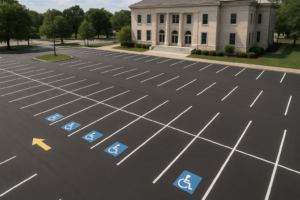

The navigational arrows parking lots use to direct traffic are more than simple painted lines—they’re essential safety tools that reduce confusion and prevent accidents. Whether you manage a retail center, school, or medical facility, clear directional markings keep vehicles moving safely through the property. In this guide, we’ll explain why these markings matter, how they’re installed, and what property owners in Denton and Plano, TX should know before scheduling a striping project. Last updated: 2026-07-27. Author: Stripes PLS. For a deeper walkthrough, see our What Should I Consider When Hiring a Line Marking Service?.
Quick answer: Navigational arrows parking lots are painted directional symbols—like straight arrows, turn arrows, and combination markings—that guide drivers through entrances, exits, and travel lanes. They’re often required alongside ADA-compliant striping and fire lane markings to keep traffic organized and code compliant. For a deeper walkthrough, see our How Line Striping Can Improve Traffic Flow in Parking Lots.
What Are Navigational Arrows in Parking Lots?
Navigational arrows parking lots are painted directional markings placed on the pavement to control how vehicles move through a lot. They typically appear near entrances, exits, intersections, and one-way lanes. In addition, arrows often pair with other markings, such as fire lane text and ADA-compliant stall symbols, to create a complete wayfinding system. See our parking lot striping guide for layout and marking best practices.
Most arrows fall into a few standard shapes: straight arrows, turn arrows, and combination arrows that indicate a lane can go straight or turn. For example, a straight arrow tells drivers to continue forward, while a curved arrow directs them toward an exit lane. As a result, well-placed arrows prevent head-on conflicts and improve your parking lot layout, which reduces guesswork for drivers in unfamiliar lots.
Navigational Arrows Parking Lots: Why They Matter for Safety
Confusing traffic patterns are one of the leading causes of minor collisions in commercial parking lots. Because drivers often move slowly while scanning for open spaces, they can miss cues about lane direction unless markings stay clear and consistent. Consequently, well-maintained navigational arrows parking lots rely on become a low-cost, high-impact safety measure.
Furthermore, arrows help emergency vehicles, delivery trucks, and pedestrians move predictably through a site. In particular, hospitals, schools, and retail centers with heavy foot traffic benefit from arrows that separate vehicle lanes from walkways. According to the Manual on Uniform Traffic Control Devices, consistent pavement markings are a core part of national traffic control standards that many municipalities reference when reviewing commercial site plans. Similarly, insurance carriers sometimes review striping quality when assessing liability after an on-site accident. To learn more about how these markings affect liability and flow, see this breakdown of why directional arrows are important in parking lots.

Clear navigational arrows parking lots use help drivers move safely between lanes and exits. For a deeper walkthrough, see our Line Marking Services for Parking Lots | stripespls.com.
Types of Directional Pavement Markings
Not every lot needs the same set of markings. However, most commercial properties use a combination of the following to guide traffic effectively.
- Straight arrows — indicate a lane continues forward without turning.
- Turn arrows — direct drivers toward an exit, entrance, or adjacent lane.
- Combination arrows — show that a lane may go straight or turn.
- Stop bars — mark where vehicles must pause before merging.
- Fire lane text and arrows — designate emergency access routes.
In contrast to arrows alone, a full parking lot striping plan also includes stall lines, crosswalks, and accessible parking symbols. Together, these elements create a cohesive traffic system rather than a patchwork of disconnected markings. For a deeper walkthrough, see our What Should I Know About Maintaining Parking Lot Striping?.
ADA Compliance and Fire Lane Arrow Requirements
Directional arrows frequently work alongside accessibility markings to keep a property compliant. Specifically, accessible routes near ADA parking stalls often need clear directional cues so drivers and pedestrians understand how vehicles and foot traffic interact near those spaces. The Americans with Disabilities Act sets the baseline standards that many local codes build upon.
Fire lanes present another common use case. Above all, fire lane arrows must clearly show the direction emergency vehicles can travel, paired with red curb paint and “FIRE LANE — NO PARKING” text. Property managers who want a deeper walkthrough of these standards can review this guide on ensuring your parking lot is ADA compliant, along with this more detailed complete ADA compliance guide.
How to Install Navigational Arrows in a Parking Lot
Installing arrow markings correctly takes more than a can of paint. Below is the typical process a professional striping crew follows. For a deeper walkthrough, see our Long-Lasting Line Striping: Tips for Durable Results.
- Assess traffic flow and layout. A crew walks the property to identify entrances, exits, and congestion points, then maps where drivers need visual guidance the most before any paint goes down.
- Choose arrow placement and style. The team selects straight, turn, or combination arrows based on lane direction, then confirms sizing meets local code and MUTCD recommendations for visibility.
- Clean and prep the pavement. Crews sweep, pressure wash, or scrape away debris, oil stains, and old faded paint so the new markings adhere properly and last longer. For a deeper walkthrough, see our What Makes Line Striping Services Durable? Materials, Prep & Technique Expla.
- Apply layout stencils and guidelines. Stencils or chalk lines outline each arrow precisely, which keeps size, spacing, and alignment consistent across the entire lot.
- Paint and allow proper cure time. Traffic paint or epoxy goes on in even coats, and the area gets blocked off so vehicles don’t drive over the markings before they fully cure.

Careful stencil work keeps each arrow consistent and code compliant.
Cost Factors for Parking Lot Arrow Striping
Pricing depends on several variables, including lot size, the number of arrows needed, and paint type. Generally, epoxy coatings cost more upfront than standard traffic paint but last significantly longer under heavy traffic. Therefore, many property managers weigh long-term durability against initial budget when planning a project. See our parking lot layout guide for design tips that affect cost.
Sizing also affects cost since larger arrows require more paint and labor time. Notably, the MUTCD recommends arrows be at least four feet long in standard travel lanes so they stay visible at typical parking lot speeds. For an accurate estimate, requesting a free quote through stripespls.com is the most reliable way to plan a budget for a specific property in the Denton or Plano area. See our parking lot layout design guide for layout and design best practices.
Common Mistakes With Parking Lot Directional Signage
Even well-intentioned property owners make avoidable errors with directional markings. For instance, letting arrows fade until they’re barely visible increases both accident risk and code violations. Similarly, inconsistent arrow placement across a lot confuses drivers rather than guiding them.
Other common issues include ignoring ADA coordination near accessible stalls and skipping fire lane arrow requirements entirely. Meanwhile, using the wrong paint for the local climate can shorten a marking’s lifespan dramatically. Reviewing a full safety and compliance striping guide before a project helps property managers avoid these pitfalls from the start. For a deeper walkthrough, see our Who Are the Local ADA Striping Experts in My Area?.

Faded markings versus a fresh restripe show why regular maintenance matters.
Frequently Asked Questions About Navigational Arrows Parking Lots
Navigational Arrows Parking Lots: What Purpose Do They Serve?
Navigational arrows parking lots use these markings to direct vehicle flow, mark one-way lanes, and guide drivers toward exits and parking stalls. They reduce confusion and help prevent collisions in busy lots.
How much does it cost to paint arrows in a parking lot?
Costs vary by lot size, arrow count, and paint type, but most contractors price arrows alongside a full restriping job. Requesting a free quote is the most accurate way to get pricing for a specific property.
Are directional arrows required by law in parking lots?
Requirements vary by municipality, but many local codes reference the MUTCD for traffic control markings, and fire lanes almost always require directional arrows. Checking with local fire marshals and building codes is recommended.
What type of paint is used for parking lot arrows?
Most contractors use water-based traffic paint or durable epoxy for high-traffic areas. Epoxy costs more upfront but resists fading and wear longer than standard traffic paint.
How long do painted parking lot arrows last before fading?
Standard traffic paint typically lasts one to two years depending on climate and traffic volume, while epoxy coatings can last three to five years. Sun exposure and heavy vehicle traffic accelerate wear.
Can a property owner paint their own parking lot arrows?
While DIY kits exist, professional striping ensures correct sizing, placement, and code compliance, especially for ADA and fire lane markings. Improperly placed arrows can create liability issues rather than solving them. For a deeper walkthrough, see our Who Does Line Striping for Healthcare Facilities in Texas?.
What is the difference between one-way and two-way arrow markings?
One-way arrows point in a single direction and indicate that traffic may only travel that way through the lane. Two-way markings typically use double-headed arrows or separate lanes to show traffic can move in either direction.
How often should parking lot arrows be repainted?
Most commercial lots benefit from repainting every one to two years, though high-traffic areas may need touch-ups sooner. Scheduling an annual inspection helps catch fading before it becomes a safety issue.
Do parking lot arrows need to meet ADA requirements?
Arrows themselves are not ADA-specific, but they often work alongside ADA-compliant accessible route markings and signage. Coordinating arrow placement with accessible paths helps properties stay fully code compliant.
What size should parking lot directional arrows be?
The MUTCD generally recommends arrows be at least four feet long in standard travel lanes so they remain visible at typical parking lot speeds. Exact sizing can vary based on lane width and local code. For a deeper walkthrough, see our What’s the Benefit of Long-Lasting Line Striping?.
How long does it take to stripe a parking lot with new arrows?
A typical commercial lot can be striped in one to two days depending on size and the number of markings needed. Weather and paint cure time can extend the schedule slightly.
What is the biggest mistake property owners make with directional markings?
The most common mistake is letting arrows fade until they’re barely visible, which increases accident risk and code violations. Regular inspections and a proactive restriping schedule prevent this problem.
Final Thoughts on Navigational Arrows in Parking Lots
In summary, navigational arrows parking lots rely on do far more than decorate the pavement—they organize traffic, support ADA compliance, and reduce the risk of accidents. From choosing the right arrow style to scheduling regular repainting, every step plays a role in keeping a property safe and code compliant. Property managers throughout Denton and Plano, TX who want durable, professionally installed markings can visit stripespls.com for a free quote and a striping plan tailored to their property’s traffic patterns. For general background on pavement marking practices, the Wikipedia overview of pavement marking offers additional context.