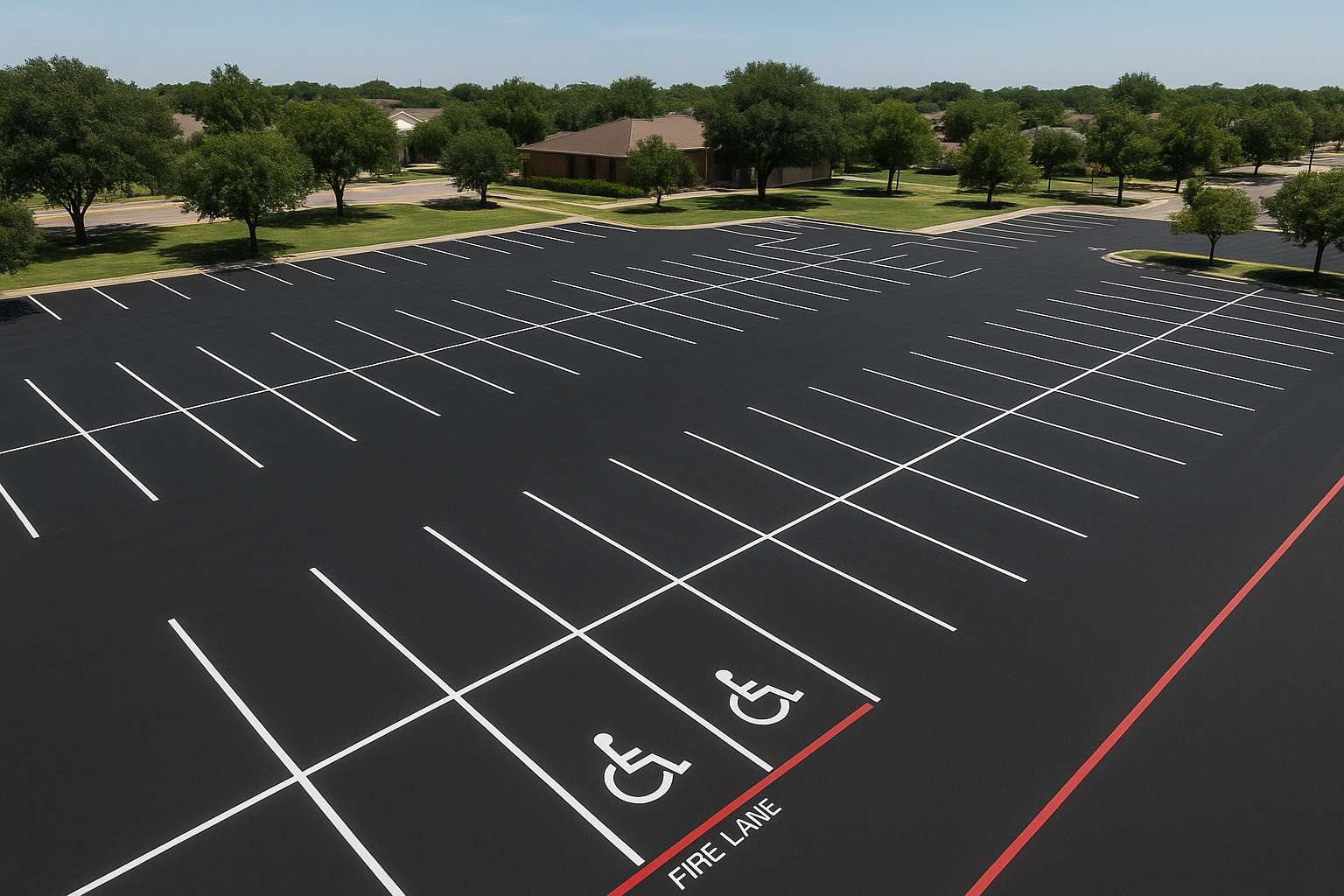
Parking lot striping is the professional process of applying durable painted lines, symbols, and markings to asphalt or concrete surfaces — organizing traffic, defining stalls, and keeping commercial properties safe and code-compliant. Whether you manage a retail center, medical office, school, or apartment complex in Frisco or anywhere across North Texas, professionally applied line marking is one of the highest-return investments you can make for your property. This guide covers everything you need to know, from ADA compliance and paint types to pricing, service steps, and how to choose the right contractor.
What Is Parking Lot Striping and Why Does It Matter?
Parking lot striping is the systematic application of paint to a parking surface — creating stall boundaries, traffic flow arrows, pedestrian crosswalks, fire lane designations, and ADA-compliant accessible space markings. Specifically, it turns an unmarked or faded slab of asphalt into an organized, legally compliant, and safe environment for both drivers and pedestrians.
The importance of quality striping extends well beyond aesthetics. According to the U.S. Bureau of Labor Statistics, parking lots and garages are among the most common sites for workplace injuries and pedestrian incidents — many of which are preventable with clear, well-maintained markings. Furthermore, faded or missing lines invite driver confusion, blocked emergency access routes, and costly ADA violations.
In high-growth areas like Frisco, Texas — where the U.S. Census Bureau recorded a population surpassing 200,000, making it one of the fastest-growing cities in the nation — the demand for expert parking lot striping continues to climb alongside commercial development.
Simply put: a well-striped lot communicates professionalism, protects property owners from legal liability, and maximizes the usable capacity of every square foot of pavement.
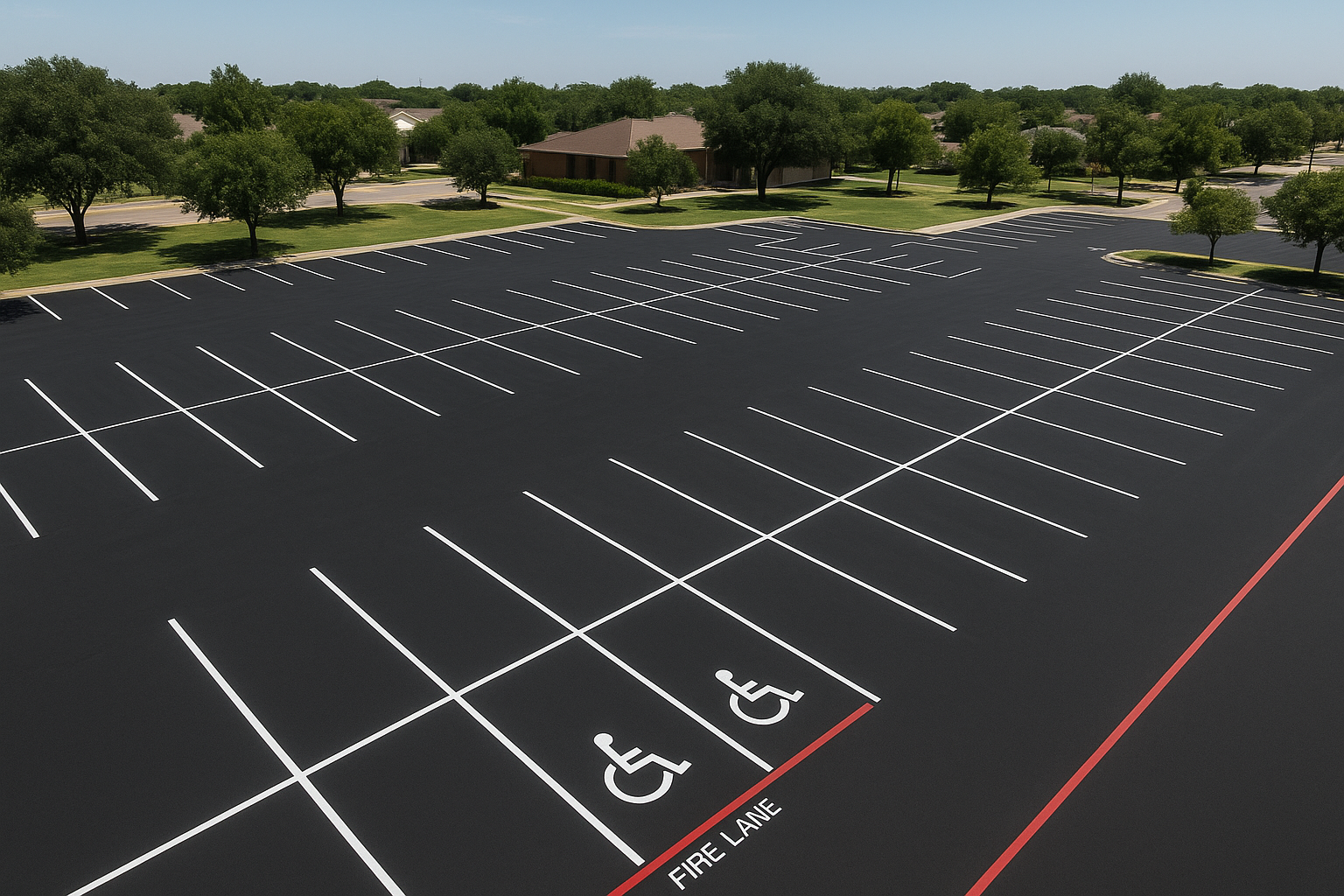
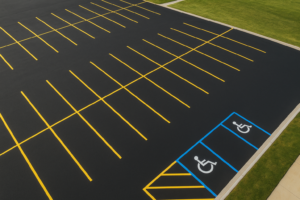
A professionally striped commercial parking lot in Frisco, TX — crisp white stall lines, ADA symbols, and fire lane markings clearly visible from above.
The Real Business Case for Professional Parking Lot Striping
Professional parking lot striping does far more than make a surface look clean. In fact, the measurable benefits touch on safety, revenue, legal compliance, and customer perception simultaneously.
Safety and Liability Reduction
Clear stall lines, directional arrows, and crosswalk markings guide drivers and pedestrians through a predictable, conflict-free path. Without them, drivers improvise — and improvised behavior leads to collisions, near-misses, and pedestrian injuries. As a result, property owners with poorly maintained markings face significant liability exposure.
Maximizing Parking Capacity
Many property managers are surprised to learn that a professionally redesigned striping layout can increase usable parking stalls by 10% to 20%. By optimizing stall angles, aisle widths, and traffic flow patterns, a skilled contractor extracts maximum capacity from the same footprint. For a retail business, those extra spaces can translate directly into increased customer volume.
Curb Appeal and First Impressions
Your parking lot is the first thing customers see when they arrive. Faded, cracked, or inconsistent markings signal neglect. In contrast, crisp, bright stripes signal attention to detail and professionalism — an impression that carries into how visitors perceive the business itself.
Why Texas Heat Accelerates Paint Fading
Texas summers are uniquely punishing on pavement markings. Intense UV radiation, surface temperatures that can exceed 150°F, and occasional heavy rainfall all work together to degrade traffic paint faster than in cooler climates. Consequently, parking lot markings in North Texas can fade significantly within 12 to 18 months on high-traffic surfaces — making regular maintenance essential rather than optional.
Complete Guide to Parking Lot Striping Services
A full-service parking lot striping project covers multiple categories of work. Understanding each one helps property managers plan projects accurately and ensure nothing is overlooked.
Standard Stall Lines
Stall lines are the foundation of any striping project. Standard commercial stalls are typically 9 feet wide by 18 to 20 feet deep, painted in white or yellow depending on local convention. Precision matters — off-angle or inconsistently spaced stalls waste space and frustrate drivers.
ADA Handicap Accessible Markings
ADA-compliant accessible spaces include the International Symbol of Access painted on the stall surface, a properly dimensioned access aisle (60 inches standard, 96 inches for van-accessible spaces), and a vertical sign meeting federal height requirements. These markings must meet both federal ADA standards and Texas Accessibility Standards (TAS).
Fire Lane Markings and Red Curbs
Fire lanes require red-painted curbs, “No Parking Fire Lane” stenciling on the pavement, and in some jurisdictions, posted signs. These designations must be clearly visible and maintained to ensure emergency vehicle access is never compromised.
Directional Arrows and Traffic Flow Markings
One-way aisle arrows, stop bars, and yield markings reduce wrong-way driving and internal conflicts. They are especially important in lots with angled stalls or complex circulation patterns.
Pedestrian Crosswalks
Clearly marked crosswalks protect foot traffic between parking areas and building entrances. Properly painted crossings alert drivers to yield and give pedestrians a predictable, visible path.
Curb Painting and Color-Coded Zones
Color-coded curbs communicate restrictions at a glance: red for no parking / fire lanes, yellow for loading zones, blue for accessible spaces. Curb painting is a cost-effective way to reinforce rules without additional signage.
Speed Bump Markings and Stop Bars
Striped speed bump warnings and bold stop bars at lot exits complement physical traffic calming features, giving drivers clear visual cues before they encounter hazards.
- Stall lines — white or yellow, standard 9×18 ft dimensions
- ADA handicap symbols — access aisle, ISA symbol, vertical signage
- Fire lane designations — red curbs, stenciled pavement text, signage
- Directional arrows — one-way flow, stop bars, yield markers
- Pedestrian crosswalks — high-visibility striped paths to entrances
- Curb painting — color-coded zones for loading, restricted, and accessible areas
- Speed bump and safety markings — visual warnings for traffic calming features
- Reserved and specialty stalls — employee, visitor, EV charging, and delivery zones
For a full breakdown of available services, visit the parking lot striping services page at stripespls.com.
For a deeper walkthrough, see our Parking Lot Striping DFW: Expert Line Marking Services.
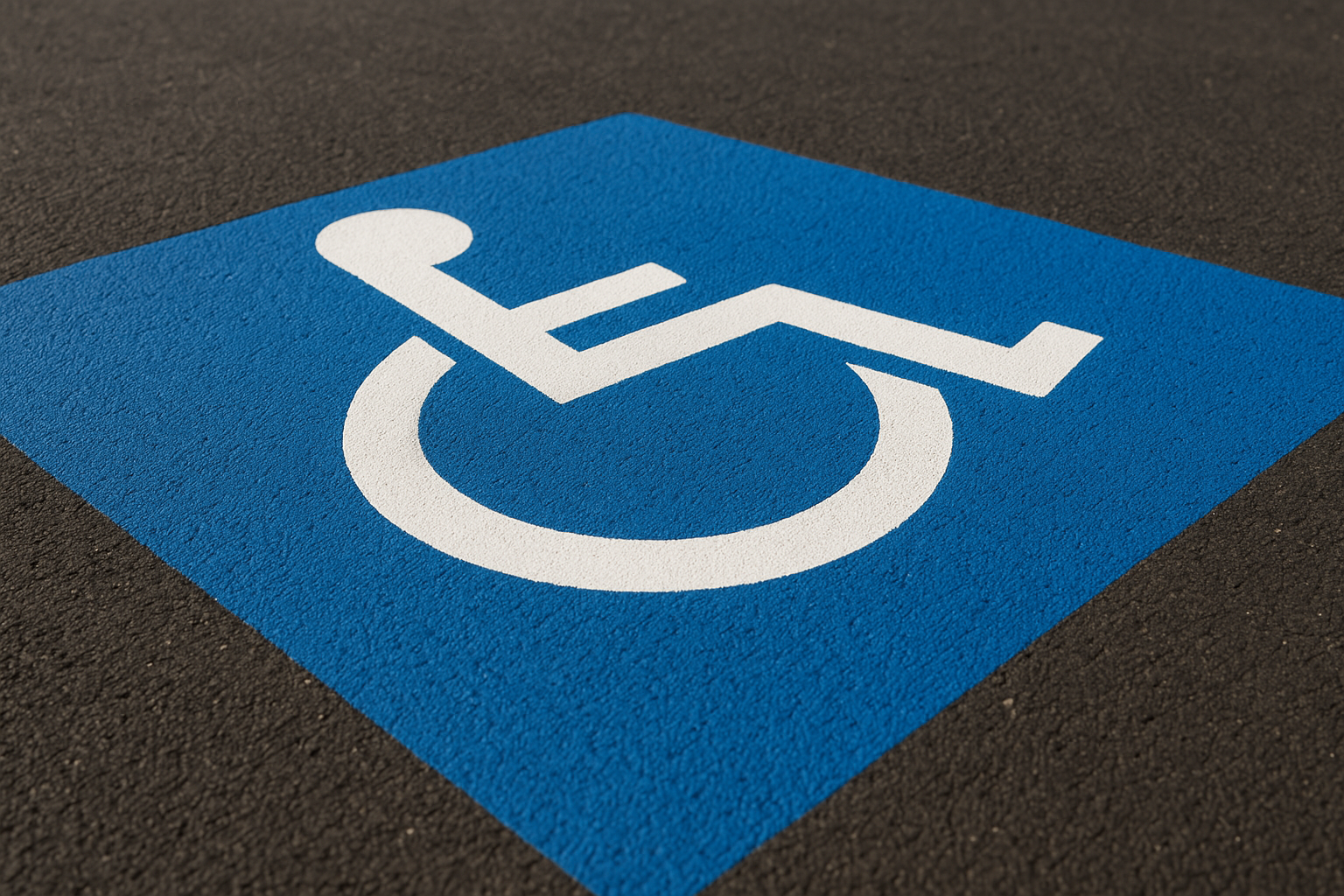
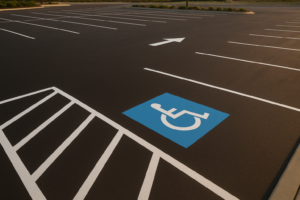
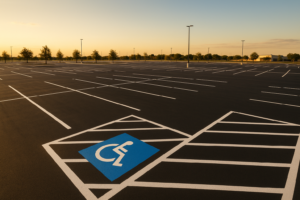
Precise ADA-compliant accessible stall markings — including the International Symbol of Access and access aisle — are a critical component of professional parking lot striping.
What Types of Paint Are Used for Parking Lot Striping?
Paint selection is one of the most important — and frequently overlooked — decisions in a parking lot striping project. The wrong paint type can lead to premature fading, poor adhesion, or environmental issues. Professional contractors choose paint based on surface type, traffic volume, climate, and project budget.
Water-Based Traffic Paint (Latex)
Water-based latex paint is the most widely used option for commercial parking lot striping. It dries quickly — typically within 30 minutes under normal conditions — is low in volatile organic compounds (VOCs), and is relatively affordable. However, it has a shorter lifespan than solvent-based alternatives, especially in high-traffic areas or under intense UV exposure.
Solvent-Based Alkyd Paint
Solvent-based alkyd paint offers superior adhesion and durability, making it well-suited for high-traffic commercial lots. It holds up better against Texas heat and heavy vehicle use. The trade-off is a longer drying time and higher VOC content, which may require additional ventilation precautions during application.
Thermoplastic Markings
Thermoplastic is a heat-applied material that bonds deeply into the pavement surface. It is significantly more durable than painted lines — lasting 3 to 7 years in many cases — and is commonly used for high-wear zones like stop bars, crosswalks, and ADA symbols. While the upfront cost is higher, the extended service life often makes thermoplastic the most economical long-term choice for busy commercial properties.
Epoxy Paint
Epoxy-based paint is typically used in parking garages and interior concrete surfaces. It provides exceptional abrasion resistance and can withstand the constant wear from tires that painted concrete floors experience. It is less common on open asphalt lots due to cost but is the gold standard for garage floors and covered structures.
Quick Paint Comparison at a Glance
- Water-based latex: Fast dry, eco-friendly, 1–2 year lifespan — best for routine restriping
- Solvent-based alkyd: Durable, strong adhesion, 2–3 year lifespan — best for high-traffic lots
- Thermoplastic: Heat-fused, longest-lasting, 3–7 years — best for crosswalks and high-wear areas
- Epoxy: Superior abrasion resistance — best for parking garages and concrete interiors
How to Get Parking Lot Striping Done Right: Step-by-Step Process
Getting your lot professionally striped is a straightforward process when you work with an experienced contractor. Therefore, following these steps ensures a smooth project from initial assessment through final inspection.
- Assess your lot’s current condition. Walk the property and note faded lines, missing ADA markings, unclear fire lanes, and areas where traffic flow seems confused or inefficient. Document with photos for reference when speaking with contractors.
- Request a free quote. Contact a professional striping company — such as stripespls.com — and provide your lot’s dimensions, stall count, surface type, and any specific compliance requirements you’re aware of.
- Review the proposed layout plan. Work with the contractor to examine a layout that maximizes stall capacity, satisfies ADA requirements, and complies with local fire and safety codes. Ask the contractor to explain any changes from the existing layout.
- Select the right paint type. Based on your surface, traffic volume, and budget, choose between water-based latex, solvent-based alkyd, or thermoplastic markings. Your contractor should help match the product to your specific conditions.
- Schedule the work strategically. Coordinate a date and time that minimizes disruption to your business or tenants — ideally early morning or off-peak hours. Confirm that the forecast shows no rain for at least 24 hours after the scheduled work.
- Prepare the surface properly. Ensure the asphalt or concrete is clean, dry, and free of oil stains, loose debris, or standing water. Surface preparation directly affects how long the paint adheres and how crisp the finished lines appear.
- Allow adequate cure time. Keep vehicles off freshly painted areas for at least one hour — or as directed by your contractor — to prevent smearing. Thermoplastic markings typically cool and harden within minutes but should be confirmed by the crew before reopening.
- Conduct a post-project walkthrough. Inspect completed markings against the agreed layout plan. Verify that all ADA spaces, fire lanes, and directional arrows are present, properly dimensioned, and clearly visible before signing off on the project.
New Layout vs. Restriping: Which Does Your Lot Need?
Restriping means repainting over existing faded markings, following the original layout. It is the more common and cost-effective option for lots that are structurally sound and simply worn from weather and use. Specifically, restriping is appropriate when the existing layout is efficient, ADA-compliant, and meets current code requirements.
New layout striping, in contrast, starts from scratch. This is the right choice for a newly paved surface, when the current layout wastes capacity, or when ADA reconfiguration is required. A contractor will measure the lot, design an optimized layout, and snap chalk lines before any paint is applied.
If your markings are simply faded, explore the restriping services at stripespls.com for a quick, affordable refresh.
ADA Compliance Rules Every Property Owner Must Know
ADA compliance in parking lot striping is not optional — it is a federal legal requirement under the Americans with Disabilities Act. Non-compliant properties face civil lawsuits, federal fines, and the reputational cost of being seen as inaccessible. Understanding the specific requirements protects your property and ensures every visitor can access your facility with dignity.
Required Number of Accessible Spaces by Lot Size
The ADA prescribes a minimum number of accessible spaces based on total lot capacity. Here is the federal scale:
- 1–25 total spaces: 1 accessible space required
- 26–50 total spaces: 2 accessible spaces required
- 51–75 total spaces: 3 accessible spaces required
- 76–100 total spaces: 4 accessible spaces required
- 101–150 total spaces: 5 accessible spaces required
- 151–200 total spaces: 6 accessible spaces required
- 201–300 total spaces: 7 accessible spaces required
- Over 500 total spaces: 2% of total spaces must be accessible
Accessible Space Dimension Requirements
Each standard accessible stall must be at least 8 feet wide with a 5-foot-wide access aisle alongside it. Van-accessible spaces require an 8-foot-wide stall with an 8-foot-wide access aisle — or alternatively, an 11-foot-wide stall with a 5-foot aisle. At least one in every six accessible spaces must be van-accessible.
Texas Accessibility Standards (TAS)
Texas enforces the Texas Accessibility Standards (TAS), which largely mirror federal ADA requirements but include some state-specific provisions for signage height, surface slope, and facility type. Any contractor working in Texas should be fluent in both sets of standards to ensure full compliance.
Fire Lane Code Requirements in Frisco, TX
Fire lanes must be designated adjacent to building entrances and along required access routes per Frisco fire codes. Red curb paint, “No Parking Fire Lane” stenciling, and posted signs are all components that may be required depending on building type and occupancy. Failure to maintain compliant fire lane markings can result in municipal fines and dramatically increased liability during an emergency response.
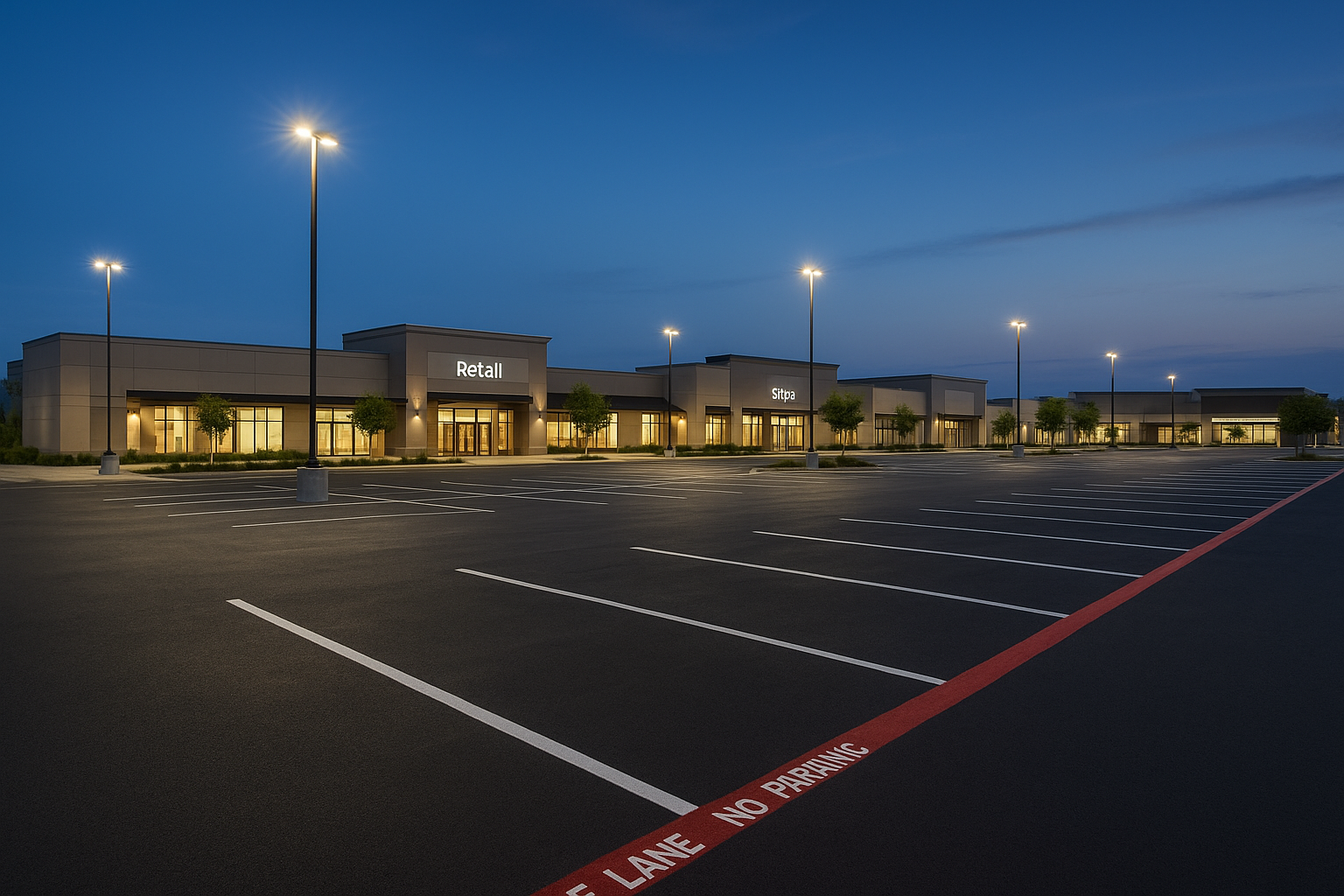
Red fire lane markings and bright stall lines are essential components of safe, code-compliant parking lot striping in commercial properties.
How Much Does Parking Lot Striping Cost?
Cost is one of the most common questions property managers have about parking lot striping — and one that competitors frequently dodge with vague answers. Here is a straightforward breakdown based on real-world project variables.
Factors That Affect Striping Costs
- Lot size and stall count: Larger lots with more stalls cost more in materials and labor. Most contractors price by stall or by square footage.
- Restripe vs. new layout: Restriping over existing lines is significantly less expensive than designing and painting a new layout from scratch.
- Paint type: Water-based latex is the most economical; thermoplastic markings cost more upfront but last longer, often reducing total cost over time.
- Number of specialty markings: ADA symbols, fire lane stencils, directional arrows, and crosswalks all add to the scope and cost.
- Surface condition: A lot that requires pressure washing or crack sealing before striping will cost more than one that is ready to paint.
- Accessibility and scheduling: Off-hour or phased work to avoid business disruption may carry a scheduling premium.
Typical Cost Ranges for Commercial Properties
For straightforward restriping of an existing layout, many commercial lots in the North Texas area fall in the range of $0.15 to $0.35 per linear foot for painted lines, or roughly $3 to $7 per stall including the line itself. A 100-space lot might cost between $400 and $900 for a basic restripe.
New layout projects, ADA compliance upgrades, or lots requiring thermoplastic markings will carry higher costs — sometimes ranging from $1,500 to $5,000 or more depending on scope and complexity. However, the best way to get accurate pricing is to request a free, no-obligation quote based on your specific lot.
The team at stripespls.com provides transparent, itemized quotes for every project — so you know exactly what you are paying for before any work begins.
How to Choose the Right Parking Lot Striping Contractor
Not all striping contractors are equal. Choosing the wrong one can mean faded lines within months, non-compliant ADA markings, or fire lane violations that cost far more to correct than they would have to do right the first time. Therefore, knowing what to look for helps you make a confident, informed decision.
Questions to Ask Before Hiring a Striping Company
- Do you carry liability insurance and workers’ compensation coverage?
- Are you familiar with both federal ADA requirements and Texas Accessibility Standards?
- What paint type and brand do you use, and why is it appropriate for my surface and climate?
- Do you provide a written layout plan before work begins, or do you work from the existing faded lines only?
- Can you provide references or photos from comparable commercial projects in the area?
- How do you handle weather delays, and what is your policy if paint quality falls short of expectations?
- Do you offer any warranty or guarantee on your work?
Red Flags to Watch Out For
- No written quote or itemized breakdown before work begins
- Unable to answer basic ADA dimension questions
- Offers prices dramatically below market rates — a sign of inferior materials or shortcuts
- No verifiable history of commercial projects in North Texas
- Requires full payment upfront before any work is done
How Often Should You Restripe a Parking Lot?
The correct restriping frequency depends on several factors: traffic volume, paint type, surface condition, and local climate. In general, most commercial parking lots need attention every 1 to 2 years. However, the Texas environment accelerates this timeline.
Signs Your Lot Needs Restriping Now
- Stall lines are faded to less than 50% of their original brightness
- Drivers are parking outside marked stalls or creating their own rows
- ADA symbols are no longer clearly visible or dimensionally legible
- Fire lane markings have faded or become partially obscured
- Directional arrows are no longer guiding traffic flow effectively
- You have received complaints from customers, tenants, or a code enforcement notice
Specifically for high-traffic retail lots and properties with heavy delivery truck activity, annual restriping is often the most practical schedule. Lower-use office or residential lots may realistically extend to 24 months between services.
Serving Frisco and the Greater North Texas Region
While Frisco is a primary service area, the team at stripespls.com covers a broad stretch of North Texas — including Plano, McKinney, Allen, Denton, and surrounding communities. That regional reach means property managers across the Dallas–Fort Worth Metroplex can access the same level of professional expertise and quality craftsmanship regardless of which city their property is in.
The team serves a wide range of clients — from retail shopping centers and healthcare facilities to schools, apartment complexes, warehouse distribution properties, and municipal organizations. Each project is tailored to the specific needs of the property, whether that means a simple restripe or a complete lot redesign with reconfigured ADA spaces and new fire lane designations.
For property managers in the Denton area specifically, the professional parking lot striping services in Denton, TX page provides localized information. Similarly, the contact page makes it easy to reach the team directly and request a free, no-obligation quote for any project size.
Frequently Asked Questions About Parking Lot Striping
What is parking lot striping and why is it important?
Parking lot striping is the professional application of painted lines, symbols, and markings to a parking surface to organize traffic, define stalls, and meet safety and accessibility requirements. It is important because clear markings reduce accidents, maximize capacity, ensure ADA compliance, and project a professional image to customers and visitors.
How often should a commercial parking lot be restriped?
Most commercial lots should be restriped every 1 to 2 years. High-traffic retail and commercial properties in Texas often need annual restriping due to intense UV exposure and heavy use. Lower-traffic lots may extend to 24 months between services.
What ADA requirements apply to parking lot striping?
The ADA requires a minimum number of accessible spaces based on total lot capacity, with specific stall and access aisle dimensions, the International Symbol of Access painted on each stall, and compliant vertical signage. Texas additionally enforces the Texas Accessibility Standards (TAS), which include state-specific provisions that must be met alongside federal requirements.
How much does parking lot striping cost?
Basic restriping typically costs $3 to $7 per stall or $0.15 to $0.35 per linear foot, depending on paint type and lot conditions. New layout projects, ADA upgrades, and thermoplastic markings increase costs — larger or more complex lots may range from $1,500 to $5,000 or more. A free quote from a local provider gives you the most accurate estimate.
What types of paint are used for parking lot striping?
The most common options are water-based latex paint (fast-drying, eco-friendly, 1–2 year lifespan), solvent-based alkyd paint (more durable, 2–3 years), thermoplastic (heat-applied, longest-lasting at 3–7 years), and epoxy (used primarily in parking garages). The right choice depends on surface type, traffic volume, and budget.
How long does parking lot paint take to dry?
Water-based latex paint typically dries within 30 to 60 minutes under normal Texas weather conditions. Solvent-based paints may take longer. It is best practice to keep vehicles off freshly painted areas for at least one full hour to avoid smearing and ensure a clean finish.
Can striping be applied to existing asphalt or concrete?
Yes. Striping can be applied to both existing asphalt and concrete surfaces. The surface must be clean, dry, and free of oil stains or loose debris so the paint bonds properly. A freshly sealed lot should cure for at least 30 days before striping is applied.
Is fire lane marking required for commercial properties in Texas?
Yes. Texas fire codes require clearly designated fire lanes for most commercial properties to ensure emergency vehicle access. Required markings typically include red curb paint, “No Parking Fire Lane” pavement stenciling, and posted signs. Missing or faded fire lane markings can result in code violations and significant liability exposure.
What is the difference between new layout striping and restriping?
Restriping repaints existing faded lines following the original layout — the most common and affordable option. New layout striping designs and paints a parking lot from scratch, which is appropriate for newly paved surfaces, inefficient existing layouts, or properties requiring ADA reconfiguration. New layouts require measurements and a design plan before any paint is applied.
Do I need a permit for parking lot striping in Frisco, TX?
Routine restriping typically does not require a permit in Frisco. However, projects that involve significant changes to traffic circulation patterns or new construction-related layouts may require city approval. A knowledgeable local striping contractor can advise you on whether your specific project triggers permit requirements.
How can professional striping maximize my parking lot’s capacity?
A professional contractor can evaluate your lot’s exact dimensions and design an optimized stall layout using ideal angles, aisle widths, and traffic flow patterns. In many cases, a redesigned layout adds 10% to 20% more usable stalls compared to an inefficient original configuration — directly increasing customer capacity without expanding the physical footprint.
What should I look for when choosing a parking lot striping contractor?
Look for a contractor with verifiable commercial experience, full liability and workers’ comp insurance, demonstrated knowledge of ADA and TAS requirements, transparent written quotes, and references or photos from comparable local projects. Avoid contractors who cannot answer basic compliance questions or who offer dramatically below-market pricing without a clear explanation.
Conclusion: Why Expert Parking Lot Striping Makes the Difference
Professional parking lot striping is one of the most impactful — and cost-effective — investments a commercial property owner or manager can make. From improving safety and traffic flow to maximizing stall capacity and maintaining full ADA and fire code compliance, quality line marking delivers measurable value for every type of property. Furthermore, in a competitive market like North Texas, a clean, well-organized parking lot signals professionalism and care long before a customer ever walks through your door.
Specifically, understanding your options — from paint types and restriping frequency to ADA space counts and fire lane requirements — puts you in a stronger position to get the job done right and avoid costly compliance mistakes. Therefore, partnering with an experienced, knowledgeable striping contractor is the most reliable path to a lot that performs as well as it looks.
The team at stripespls.com brings expertise, precision, and a commitment to quality to every parking lot striping project across the Frisco area and the broader North Texas region. Whether you need a straightforward restripe or a complete lot redesign, contact the team today to request your free quote and take the first step toward a safer, more organized, fully compliant parking facility.