Safety compliance parking lot striping is the process of measuring, painting, and maintaining ADA-compliant stalls, fire lanes, and directional markings so a commercial property meets current accessibility and fire-safety codes. For property owners, this single line of work touches everything from visitor safety and emergency access to municipal inspections and insurance liability. In this guide, you will learn exactly what compliant striping requires, how the dimension and color standards work, what the project typically costs, how often lines need refreshing, and how to choose a contractor who gets every measurement right the first time. See our pro lot striping guide for advanced contractor tips.
Quick Answer: Safety compliance parking lot striping combines ADA-required accessible stalls, correctly marked fire lanes, and clearly painted traffic lines that meet exact dimension and color standards. Most commercial lots need this refreshed every 18 to 24 months, and the required number of accessible stalls, fire lane width, and paint colors are all set by specific federal and local codes covered in detail below.
What Is Safety Compliance Parking Lot Striping?
Safety compliance parking lot striping refers to painted markings — stall lines, accessible parking symbols, fire lane borders, wheel stops, and directional arrows — that satisfy federal and local codes at the same time. Specifically, it includes ADA (Americans with Disabilities Act, the federal civil rights law requiring accessible facilities) accessible stalls, fire lane designations required by local fire marshals, and traffic-flow markings such as arrows and stop bars.
In addition, compliant striping must meet exact dimension and color standards, not just look tidy. For example, a stall that looks fine visually can still fail an inspection if it is two inches too narrow, uses the wrong blue, or is missing a required access aisle. Because of this, safety compliance parking lot striping is really a technical discipline, not a cosmetic one.
Why Parking Lot Striping Compliance Matters for Every Property Owner
However, compliance is not just a box to check. Poorly marked lots create real hazards: cars parked too close together, blocked fire lanes that delay emergency response, and confusing traffic patterns that lead to fender-benders or worse.
As a result, property owners who neglect striping face more than safety risks. Fines, lawsuits under the ADA, and failed municipal inspections are all common consequences of ignoring parking lot striping compliance. A well-maintained parking lot striping plan also improves how a property looks and functions for every visitor, employee, and delivery driver who uses it.
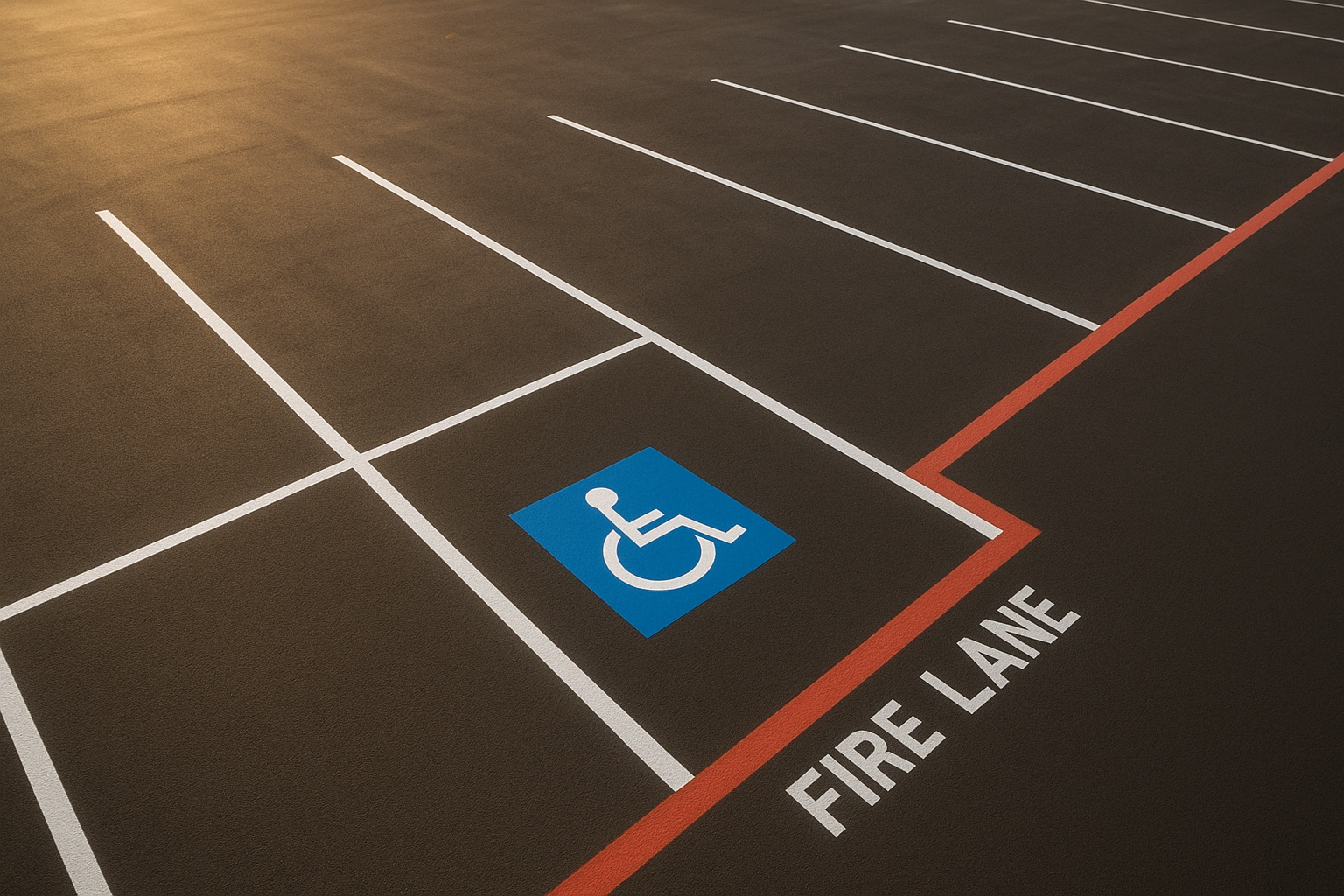
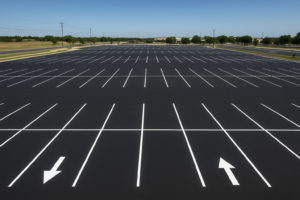
Clear, code-compliant striping keeps traffic flow organized and ensures safety compliance parking lot striping standards are met.
ADA Requirements for Compliant Parking Lot Striping
The ADA sets specific, non-negotiable rules for accessible parking, and these requirements scale directly with the total number of spaces in a lot. In particular, lots with 1 to 25 total spaces need at least one accessible stall, while larger lots require proportionally more, including van-accessible spaces with wider access aisles.
Accessible Stall Ratios by Lot Size
Because inspectors check this ratio first, it is worth memorizing. The table below summarizes the federal minimums that apply to most commercial lots.
| Total Parking Spaces | Minimum Accessible Stalls |
|---|---|
| 1–25 | 1 |
| 26–50 | 2 |
| 51–75 | 3 |
| 76–100 | 4 |
| 101–150 | 5 |
| 151–200 | 6 |
| 501–1000 | 2% of total |
At least one out of every six accessible spaces, and never fewer than one, must be van-accessible with a wider access aisle. Consequently, small lots cannot skip this requirement just because they only need a single accessible stall.
Van-Accessible Stalls and Access Aisle Widths
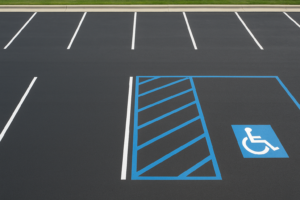
Furthermore, accessible stalls must be painted blue with the International Symbol of Accessibility and located on the shortest accessible route to the building entrance. Standard accessible aisles must be at least 60 inches wide, while van-accessible aisles need at least 96 inches, or 132 inches where a lot uses shared aisles between two stalls.
For a deeper breakdown of layout standards, our asphalt striping guide covers dimension specifics in detail. You can also review official guidance directly through ADA.gov for the latest federal standards, or the International Symbol of Access on Wikipedia for background on the accessibility symbol itself.
Fire Lane Striping and Local Fire Code Requirements
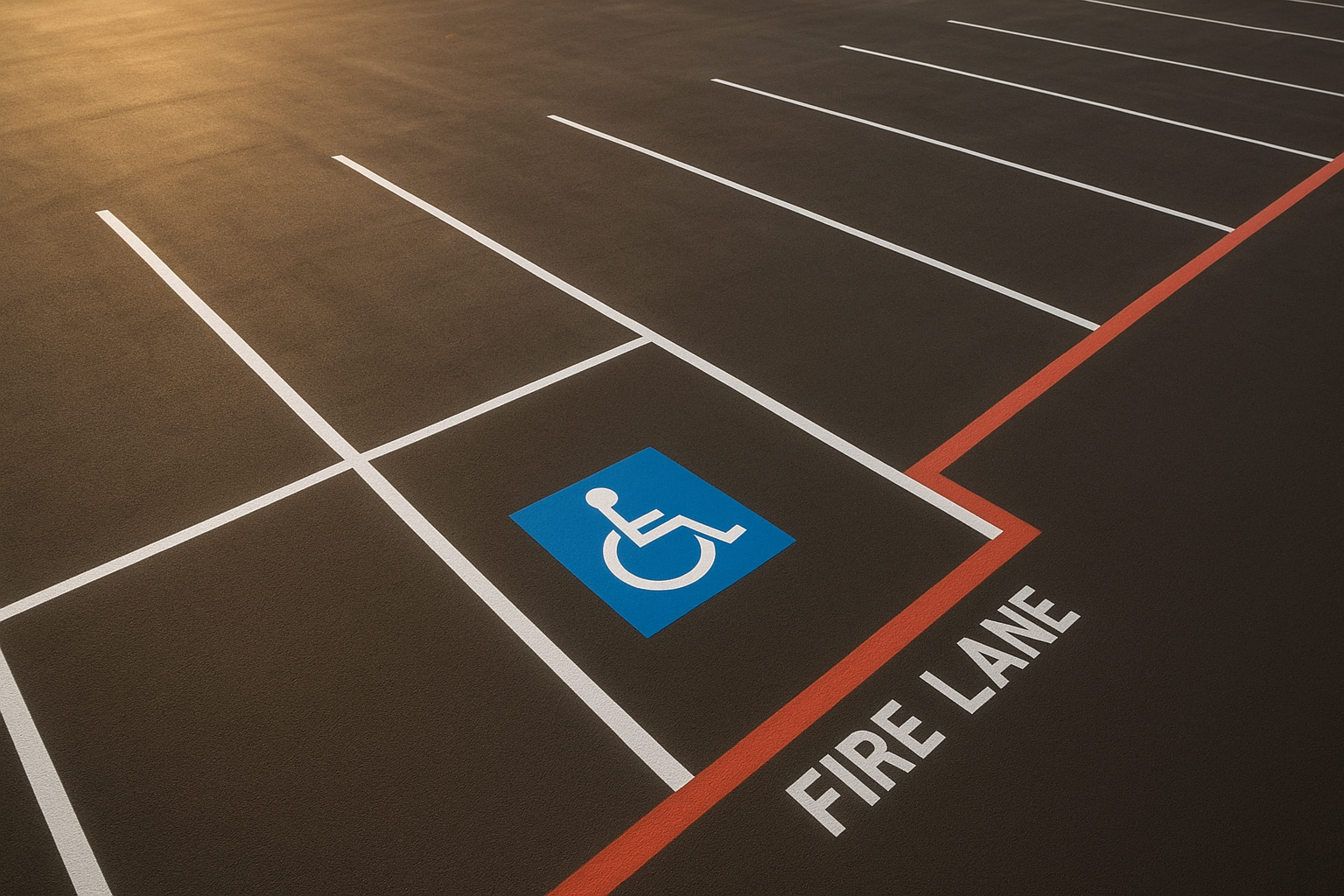
Fire lanes are typically painted red with white lettering that reads “Fire Lane — No Parking,” and most local fire codes require a minimum clear width of 20 feet. Consequently, blocked or faded fire lanes can delay emergency vehicle access, which is precisely why fire marshals routinely inspect commercial properties.
Local requirements vary, so it is worth checking with the municipality or referencing OSHA’s general safety guidance at OSHA.gov when planning a layout. Similarly, the federal Manual on Uniform Traffic Control Devices (MUTCD) outlines standard colors and layouts used nationwide, while the National Fire Protection Association (NFPA) publishes the fire lane and access standards most local codes are built on.
Above all, lettering height matters as much as color. Most jurisdictions require letters at least 3 inches tall spaced no more than 25 feet apart along the curb or pavement edge, so drivers see the warning well before they park.
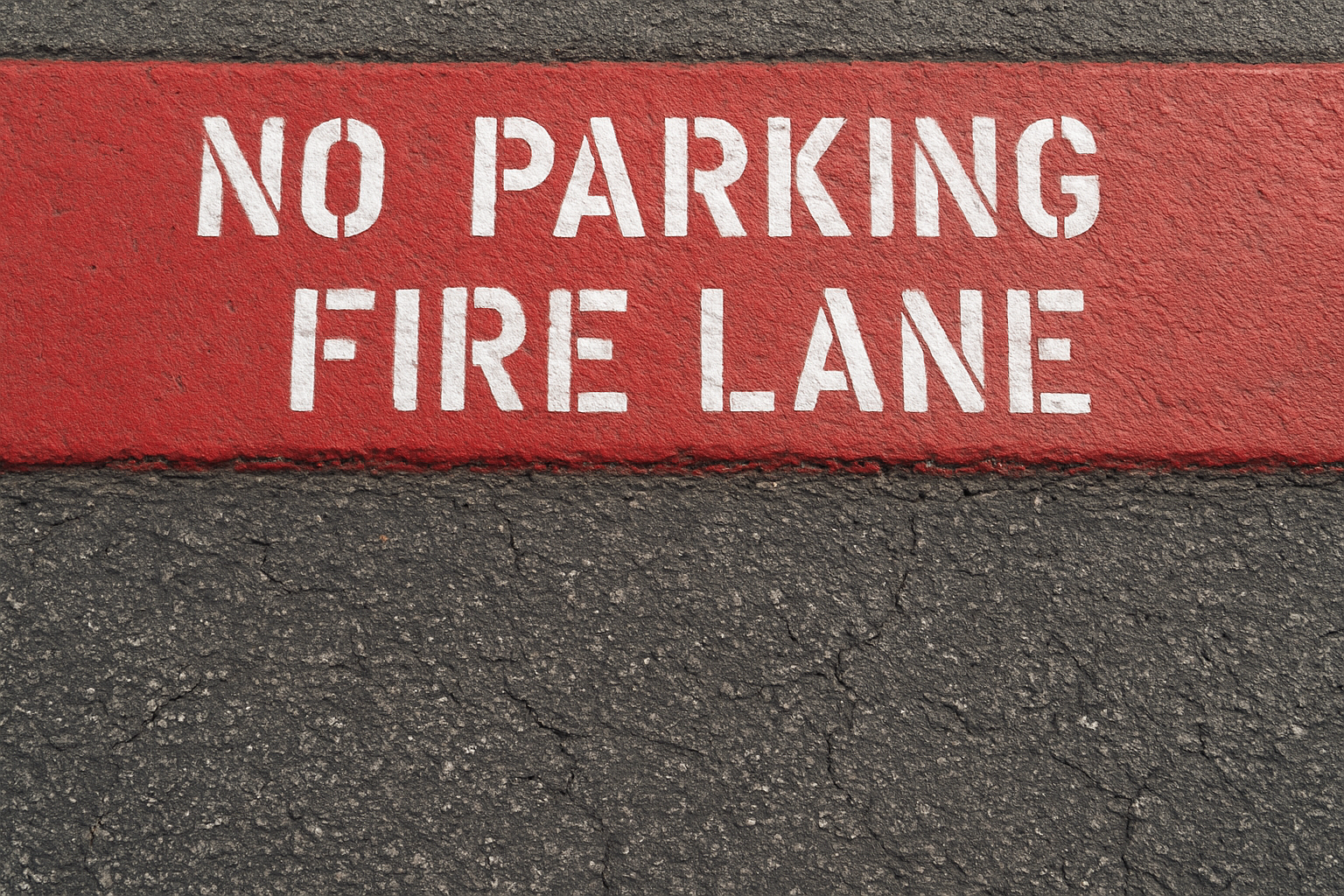
Properly marked fire lanes keep emergency access clear at all times.
Traffic Flow Markings: Arrows, Stop Bars, and Lane Lines
In particular, directional arrows, stop bars, crosswalks, and yield triangles guide vehicles and pedestrians safely through a lot. Without them, drivers guess at right-of-way, and guessing near a busy entrance is where most parking lot fender-benders happen.
Specifically, one-way arrows should be repeated every 100 feet in long drive aisles, stop bars belong 4 feet before any stop sign or crosswalk, and pedestrian crosswalks near building entrances should use high-visibility ladder-style striping rather than two plain parallel lines. Similarly, speed bumps and speed humps should always be paired with painted warning triangles or hatching so drivers see them at night.
Paint, Thermoplastic, and Equipment Used in Compliant Striping
Materials matter almost as much as layout. When choosing materials for safety compliance parking lot striping, prioritize durability and lifecycle to stay compliant between inspections. Standard waterborne traffic paint is the most common choice because it is affordable and dries quickly, but it typically lasts only 12 to 18 months under heavy traffic.
In contrast, thermoplastic pavement marking — a heat-applied material that bonds directly into the asphalt surface — can last 5 to 8 years and holds up far better against snowplows, sun, and constant tire wear. Consequently, many high-traffic properties choose thermoplastic for fire lanes and accessible stall symbols even though the upfront cost is higher, because the long-term durability protects compliance between inspections.
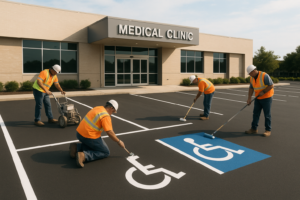
Professional crews also rely on specific equipment to guarantee accuracy: layout chalk lines and lasers for measurement, airless striping machines for clean paint edges, and stencils for accessibility symbols, arrows, and fire lane lettering. Therefore, a contractor’s equipment list is a fair predictor of how precise the finished markings will be.
Parking Lot Striping Layout Standards and Stall Dimensions
Beyond ADA and fire lane rules, standard stall dimensions still need to meet local zoning and code minimums. The table below shows the dimensions most municipalities expect for standard, compact, and accessible stalls.
| Stall Type | Typical Width | Typical Length |
|---|---|---|
| Standard stall | 9 feet | 18 feet |
| Compact stall | 8 feet | 16 feet |
| Accessible stall | 8 feet + 5 or 8 ft aisle | 18 feet |
| Van-accessible stall | 8 feet + 8 ft aisle | 18 feet |
These figures are typical minimums; some municipalities require slightly wider stalls or additional drive-aisle clearance, so it is worth double-checking with a local building department before finalizing a layout.
How to Achieve Safety Compliance Parking Lot Striping: Step-by-Step
Bringing a lot into compliance is straightforward once it is broken into clear steps. Below is the process professional crews follow from initial assessment to final inspection. For layout planning details, see our parking lot layout guide.
- Assess current markings. Walk the property with a compliance checklist, measuring existing stall widths, fire lane clearances, and ADA stall counts against current codes and noting any faded or missing lines.
- Calculate accessible space requirements. Determine the exact number of ADA and van-accessible stalls required based on the lot’s total parking capacity, using the federal ratio table as a baseline.
- Design the layout on paper first. Map stall dimensions, drive-aisle widths, fire lane routes, and accessible paths before any paint touches the asphalt, so mistakes get caught on a drawing instead of on the pavement.
- Select durable materials. Choose high-grade traffic paint or thermoplastic rated for the correct colors, including blue for accessible stalls, red for fire lanes, and yellow or white for standard traffic lines.
- Apply markings to code. Follow MUTCD standards for stall dimensions, access aisle widths, fire lane lettering height and spacing, and directional arrow placement throughout the lot.
- Schedule follow-up inspections. Set a recurring restriping schedule every 12 to 24 months so markings stay visible, legible, and fully inspection-ready year-round.
Above all, consistency matters more than perfection on the first pass. Therefore, many property owners partner with a specialist rather than tackling this in-house — our restriping services page outlines what that process looks like from start to finish.
Cost of Safety Compliance Parking Lot Striping
Pricing varies by lot size, layout complexity, and material choice, but most commercial striping projects run from a few hundred to several thousand dollars. In general, per-stall pricing gives a useful ballpark for budgeting.
| Project Element | Typical Cost Range |
|---|---|
| Standard stall line (paint) | $2 – $7 per stall |
| ADA accessible stall with symbol | $75 – $150 per stall |
| Fire lane striping and lettering | $1.50 – $3 per linear foot |
| Full lot restriping (mid-size lot) | $800 – $3,500 |
Because every lot is different, getting a free quote is still the most accurate way to estimate cost. To understand the full impact of timing on cost and appearance, see why fresh striping matters for your property.
Common Mistakes That Break Parking Lot Striping Compliance
Even well-intentioned property managers make avoidable errors. In particular, too few accessible stalls, missing access aisles, and faded fire lane paint are the most frequent violations found during inspections.
- Incorrect stall widths that fail local zoning minimums
- Access aisles painted too narrow for van-accessible stalls
- Faded or peeling fire lane lettering that is no longer legible from a vehicle
- Confusing or missing directional arrows near entrances and exits
- Accessible stalls placed too far from the building’s accessible entrance
Regular audits, ideally paired with a professional walk-through, catch these problems before an inspector does.
How Often Should Compliant Striping Be Refreshed?
Most commercial lots need restriping every 18 to 24 months, though high-traffic retail centers or schools may need it annually. Sun, heat, and general wear all accelerate fading faster than many owners expect. Learn more about maintaining markings at maintaining parking lot striping.
In fact, one industry estimate suggests that pavement markings can lose up to 50% of their reflectivity within the first year of heavy traffic exposure. That is why routine visual checks matter as much as the calendar.
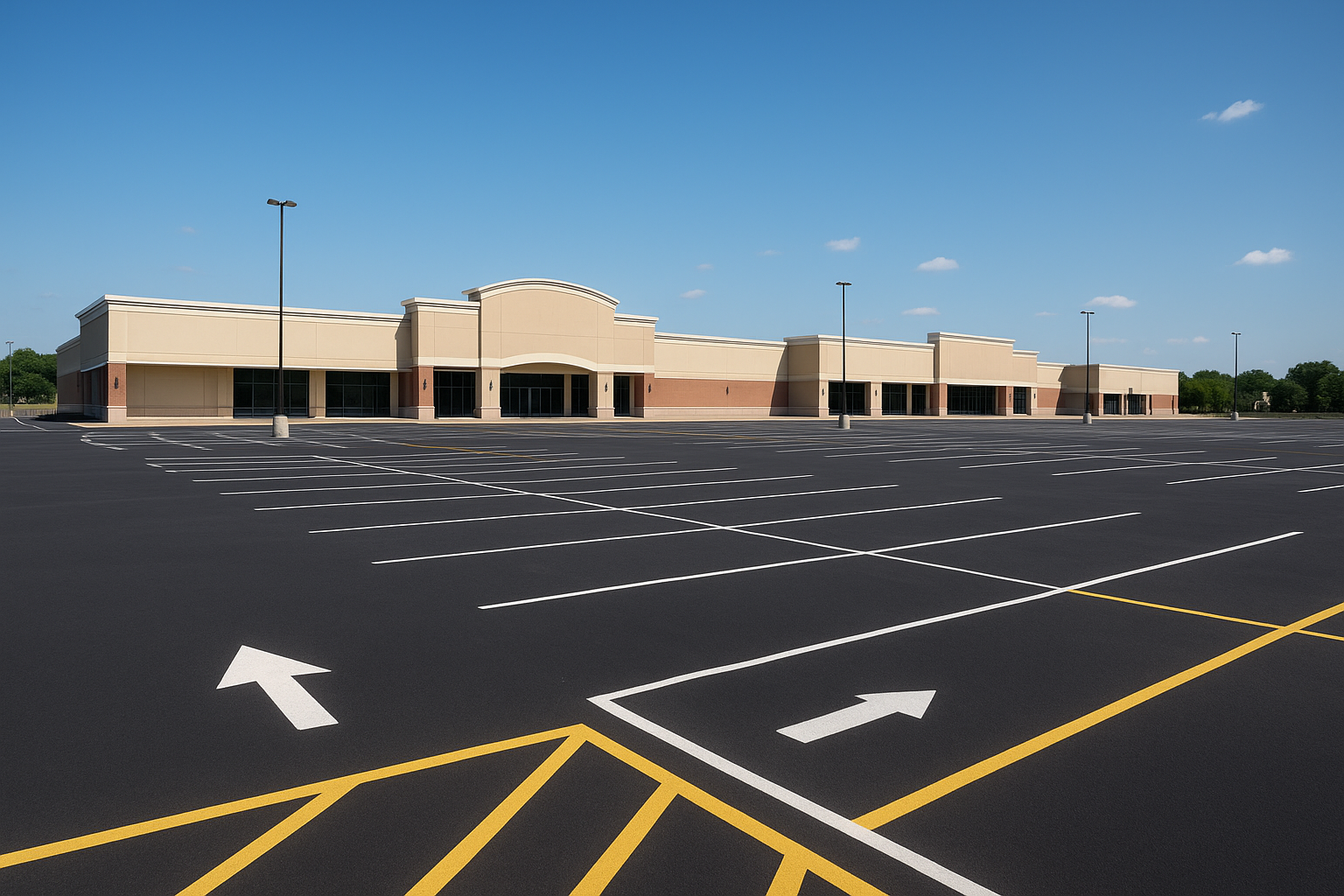
Fresh, well-maintained lines support both safety compliance parking lot striping goals and smoother traffic flow.
DIY Striping vs Hiring a Professional Contractor
Small lots can technically be striped with rented equipment and store-bought paint. However, most commercial properties need professional-grade layout accuracy to meet code, and a single miscalculated aisle width can trigger a failed inspection.
In contrast, a licensed contractor carries liability insurance, understands current ADA and fire code ratios, and uses commercial-grade paint or thermoplastic rated for heavy traffic. Consequently, the labor savings of a DIY project rarely offset the risk of a compliance failure, a re-do, or a liability claim down the road.
State and Local Code Variations Property Owners Should Know
While the ADA sets a federal floor, states and municipalities can add stricter requirements on top of it. For example, some cities require wider fire lanes than the federal 20-foot minimum, additional signage at accessible stalls, or specific paint reflectivity ratings for night visibility.
Therefore, it is never safe to assume that meeting the federal minimum automatically satisfies a local fire marshal or building inspector. Similarly, some counties require a licensed contractor’s stamped layout plan before a certificate of occupancy is issued, so checking with the local permitting office early saves time and rework later.
Choosing a Professional Striping Contractor in Denton and Plano
Because compliance details are precise, hiring an experienced local crew reduces risk significantly. A contractor familiar with North Texas municipal codes, like the team at stripespls.com, understands both ADA rules and local fire marshal expectations.
Property managers, retail centers, schools, and healthcare facilities across Denton and Plano rely on professional crews for consistent results. For a broader look at how proper markings affect vehicle and pedestrian movement, review this guide on how line striping improves traffic flow.
Frequently Asked Questions About Safety Compliance Parking Lot Striping
What is safety compliance parking lot striping?
It is the practice of painting stall lines, ADA accessible spaces, fire lanes, and directional arrows so a property meets federal and local accessibility and fire codes. It protects visitors and reduces the property owner’s legal liability.
How often should a parking lot be restriped for compliance? Learn more in our parking lot striping Texas guide. Most commercial lots need restriping every 18 to 24 months, though high-traffic properties may need it annually. Faded lines are a common cause of compliance failure during inspections.
What are the ADA requirements for parking lot striping?
ADA rules require a minimum number of accessible stalls based on total spaces, van-accessible spaces with wider access aisles, and blue paint with the International Symbol of Accessibility. The exact ratio scales with lot size.
How wide should a fire lane be marked?
Fire lanes are typically marked with red paint and lettering, and most local fire codes require a minimum clear width of 20 feet. Local fire marshals can require additional width for specific building types.
What color paint is required for handicap parking spaces?
Blue paint is the standard color for ADA accessible stalls and the accessibility symbol, while access aisles are usually striped in blue or white diagonal lines.
How much does compliant parking lot striping cost?
Pricing varies by lot size and layout complexity, but most commercial striping projects run from a few hundred to several thousand dollars. Getting a free quote is the most accurate way to estimate cost.
How long does new striping take to dry?
Standard traffic paint typically dries to the touch within 30 minutes but should not be driven on for at least an hour. Full cure time can take up to 24 hours.
What happens if a parking lot is not ADA compliant?
Non-compliant lots can face fines, lawsuits, and failed inspections, along with real safety risks for disabled visitors. Property managers are ultimately responsible for correcting violations promptly.
Can I stripe my own parking lot instead of hiring a professional?
Small lots can technically be striped with rented equipment, but most commercial properties need professional-grade layout accuracy to meet code. A licensed contractor also carries liability coverage that DIY work does not.
What is the difference between restriping and a new layout?
Restriping repaints existing lines in their current positions, while a new layout redesigns the lot for better traffic flow or updated code requirements.
What are common mistakes that cause compliance failures?
Common mistakes include too few accessible stalls, missing access aisles, faded fire lane paint, and incorrect stall widths. Regular audits catch these issues before an inspector does.
How many ADA spaces does my parking lot need?
The required number scales with total parking spaces, starting at one accessible stall for lots with 1 to 25 spaces. Larger lots need proportionally more, including van-accessible stalls.
Does weather affect the durability of parking lot striping?
Yes, extreme heat, heavy rain, and UV exposure all accelerate paint fading. Choosing high-quality, durable paint or thermoplastic extends the life of the markings.
Who enforces parking lot safety compliance codes?
Local fire marshals enforce fire lane codes, while ADA compliance can be enforced through federal civil rights complaints and local building inspections. Municipalities often conduct routine property inspections.
Is safety compliance parking lot striping required by law?
Yes, accessible stall requirements come from the federally mandated ADA, and fire lane markings are typically required under state and local fire codes. Together, these make safety compliance parking lot striping a legal obligation, not an optional upgrade.
What is the MUTCD and how does it apply to parking lot striping?
The Manual on Uniform Traffic Control Devices is the federal standard for pavement marking colors, shapes, and placement. Many local codes for arrows, stop bars, and lane lines are based directly on MUTCD specifications.
Can faded striping affect insurance claims after an accident?
Yes, faded or missing markings can be used as evidence of property owner negligence in an accident claim. Maintaining clear, compliant lines helps limit liability exposure if an incident occurs on the property.
Final Thoughts on Staying Compliant
In summary, safety compliance parking lot striping is not a one-time task — it is an ongoing responsibility that protects visitors, keeps emergency access clear, and shields property owners from fines and liability. From ADA-accessible stalls to fire lane paint, traffic arrows, and precise stall dimensions, every detail plays a role in a property’s overall safety.
Therefore, regular inspections paired with a reliable restriping schedule remain the simplest way to stay ahead of code changes and everyday wear. Whether you manage a retail center, school, or healthcare facility in Denton or Plano, working with an experienced local team makes safety compliance parking lot striping far easier to maintain over the long run. You can request a free quote anytime through stripespls.com to get started. Last updated: 2026-08-11.