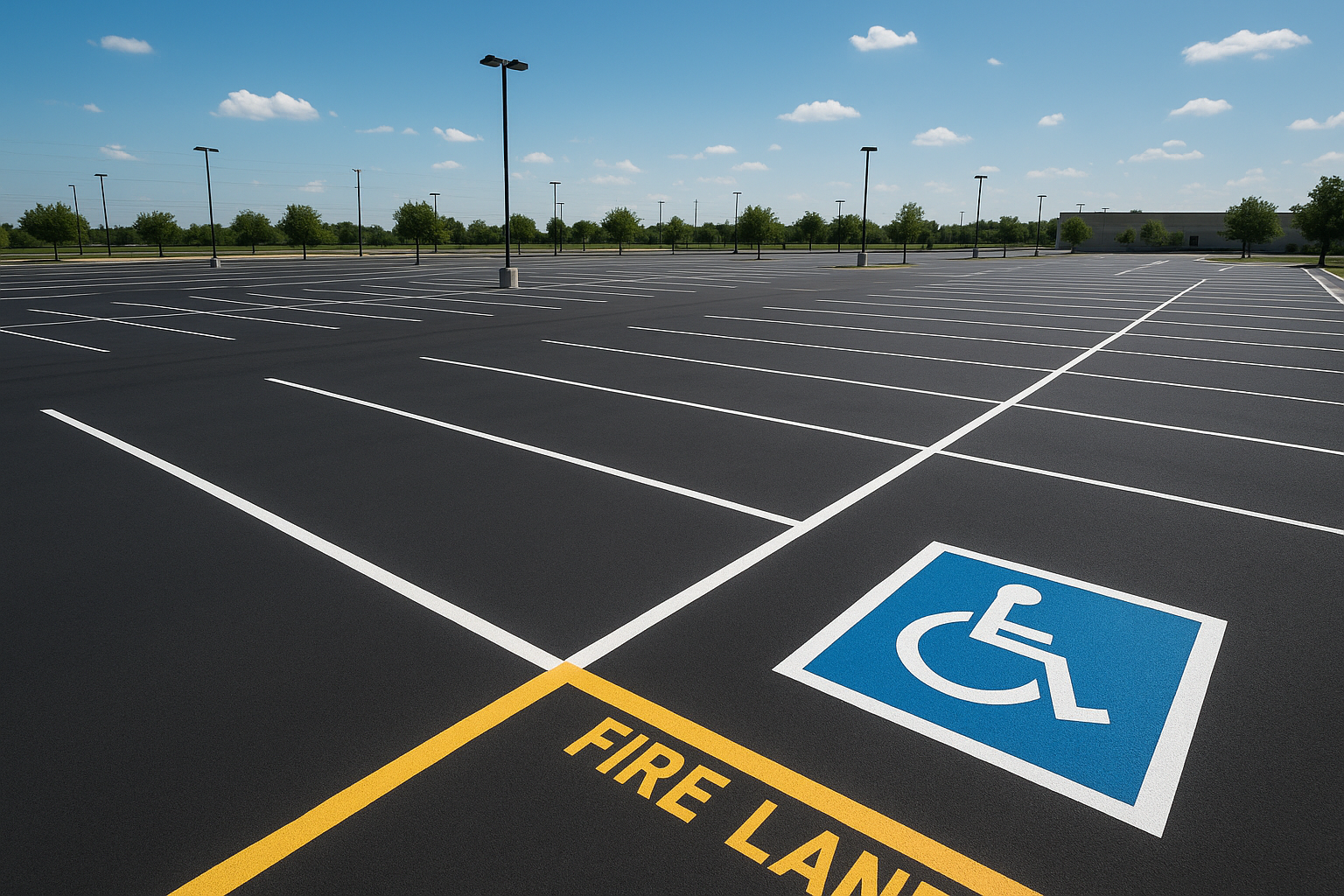
A professional line marking service is one of the most impactful investments a Texas property owner can make. Clear, durable pavement markings improve traffic flow, maximize usable parking stalls, and keep your facility compliant with safety codes and federal accessibility standards. Whether you manage a retail center, school, medical office, or apartment complex in the Denton or Plano, TX area, knowing what a quality line marking service involves helps you protect your property, your tenants, and your bottom line.
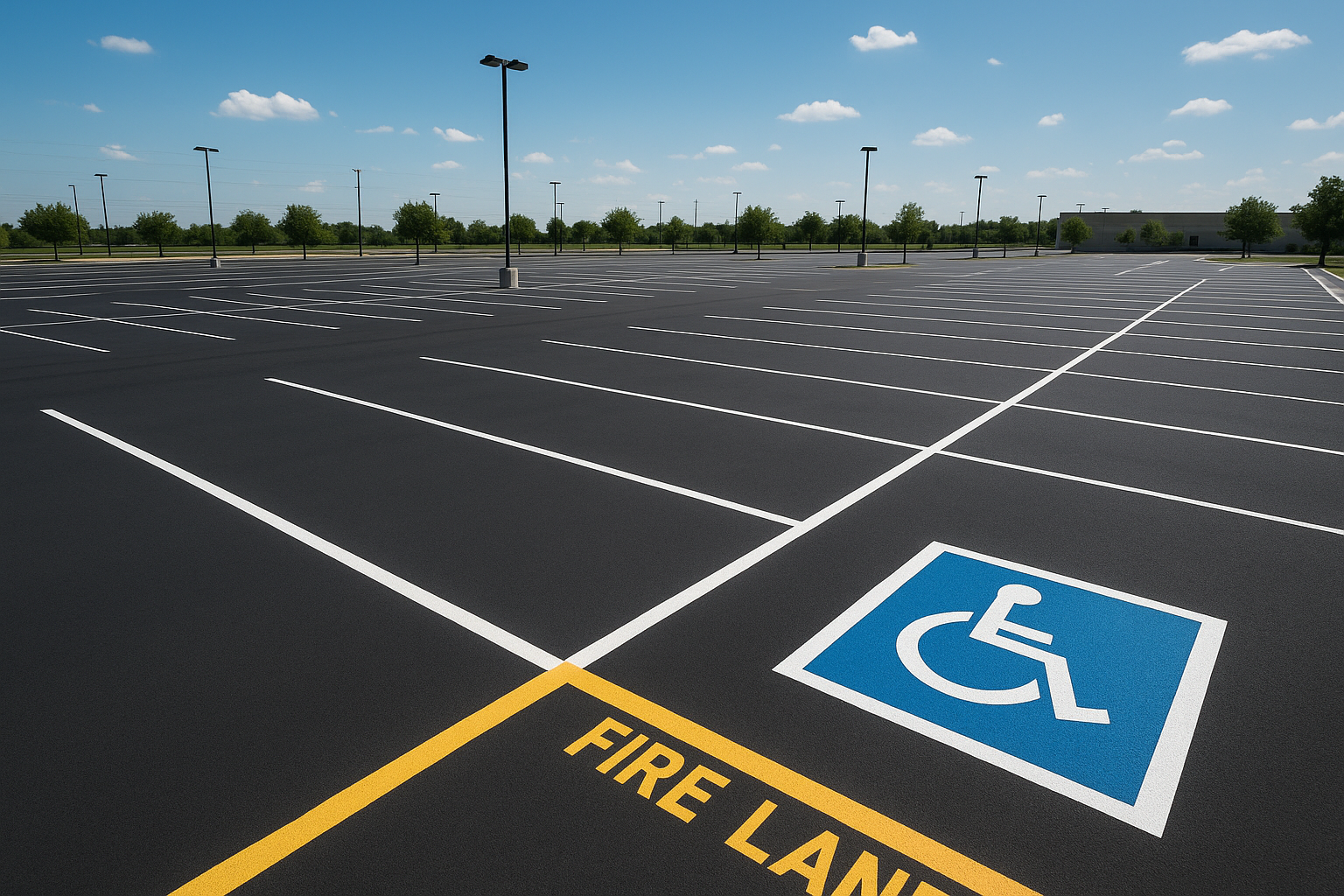
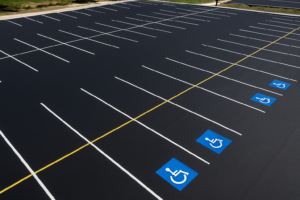
A freshly completed line marking service transforms a commercial parking lot, improving safety and organization across the entire property.
What Is a Line Marking Service?
A line marking service is a professional pavement marking solution that applies paint or thermoplastic material to paved surfaces. It defines parking stalls, traffic lanes, fire lanes, crosswalks, and safety zones. Specifically, it covers everything from the initial layout of a brand-new lot to the restriping of faded lines on an existing surface.
According to the Federal Highway Administration, pavement markings are a critical element of roadway and parking lot safety. They provide drivers with visual guidance that reduces confusion and prevents accidents. The same principle applies directly to private commercial lots.
Furthermore, clearly marked lots increase usable parking capacity by up to 20% compared to unmarked or faded lots — simply by organizing vehicles into defined stalls. That translates directly into better customer experience and fewer liability risks for property owners.
Who Needs a Professional Line Marking Service?
Almost every commercial property with a paved parking area needs professional line marking. In particular, the following property types depend on consistent, accurate markings to operate safely and legally:
- Retail shopping centers and strip malls
- Schools, colleges, and university campuses
- Hospitals, medical clinics, and healthcare facilities
- Apartment complexes and HOA communities
- Warehouses, distribution centers, and industrial facilities
- Municipal lots, parks, and government buildings
- Churches, event venues, and places of public assembly
Types of Parking Lot Markings in a Full Line Marking Service
A complete line marking service covers far more than simple parking stall lines. Each marking type serves a distinct purpose. Together, they create a safe, efficient, and code-compliant parking environment from curb to curb.
Standard Parking Stall Lines
Standard stall lines define individual parking spaces and form the foundation of any lot layout. They are typically painted in white or yellow and must conform to local dimensional standards — usually a minimum of 8.5 feet wide by 18 feet deep per stall. Proper spacing ensures drivers can enter and exit stalls safely. As a result, door-ding incidents and minor fender benders are significantly reduced.
ADA-Compliant Handicap Stall Markings
ADA compliance is not optional. Under the Americans with Disabilities Act, commercial properties must provide a minimum number of accessible parking stalls based on total lot size. These stalls require specific dimensions, access aisles, and the International Symbol of Accessibility painted on the pavement. Working with a contractor who understands ADA compliance markings is essential to avoiding fines and legal exposure in Denton and Plano.
Fire Lane Designations
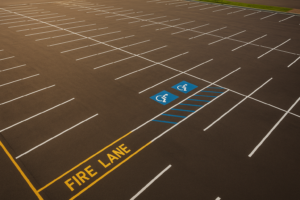
Fire lanes must remain clear at all times so emergency vehicles can reach buildings without delay. Most Texas municipalities require fire lanes to be marked with red curb paint and “NO PARKING — FIRE LANE” lettering on the pavement. A qualified fire lane marking contractor ensures your property meets local fire code requirements precisely and avoids costly citations.
Directional Arrows and Traffic Flow Markings
Directional arrows, stop bars, and one-way lane designations guide drivers through a lot in an orderly manner. Consequently, they reduce conflict points between vehicles and pedestrians. These markings are especially important in busy retail or healthcare facility lots where traffic volumes are high and pedestrian crossings are frequent.
Crosswalk and Pedestrian Zone Markings
Crosswalks protect pedestrians by clearly designating safe walking paths across vehicle travel lanes. In addition, pedestrian zone markings near entrances and storefronts alert drivers to foot traffic areas. Many property owners overlook these markings until an incident occurs — by which point the liability exposure is already significant.
Curb Painting and No-Parking Zones
Curb painting communicates restrictions without signage. Yellow curb paint typically indicates a loading or no-parking zone. Red curb paint designates fire lanes. White curb paint can mark short-term or passenger loading areas. These color-coded systems are universally understood and help enforce parking rules even when no attendant is present.
Reserved and Special-Use Space Markings
Beyond standard and ADA stalls, many lots require reserved spaces for management, electric vehicle charging stations, expectant mothers, or curbside pickup zones. A skilled line marking contractor can design and apply custom stencils for these designations, keeping the overall lot layout clean and professional.
Paint vs. Thermoplastic: Which Line Marking Material Is Right for You?
Choosing between paint and thermoplastic is one of the most important decisions in any line marking project. Both materials have distinct advantages. The right choice depends on your budget, traffic volume, climate exposure, and long-term maintenance goals.
Water-Based Traffic Paint
Water-based traffic paint is the most common and cost-effective option for parking lot striping. It dries quickly — typically within 30 minutes — and suits most standard commercial applications. However, in high-traffic lots exposed to Texas heat and intense UV radiation, paint lines can begin to fade within 12 to 18 months. For lower-traffic lots on a tighter budget, paint remains a practical and widely used choice.
Thermoplastic Striping
Thermoplastic striping is a heated plastic compound that bonds directly to the asphalt surface. It is significantly more durable and can last three to five years under heavy use. Consequently, it is the preferred choice for high-traffic driveways, school zones, and municipal lots where restriping every year is not practical. You can explore this option through thermoplastic striping and decals services available throughout North Texas.
Paint vs. Thermoplastic — Quick Comparison
- Cost: Paint is lower upfront; thermoplastic costs more initially but saves money over time.
- Durability: Paint lasts 1–2 years; thermoplastic lasts 3–5 years.
- Dry time: Paint dries in 30 minutes; thermoplastic cures in under 10 minutes.
- Best for: Paint suits low-traffic lots; thermoplastic is ideal for schools, hospitals, and busy commercial lots.
- Reflectivity: Thermoplastic can incorporate glass beads for enhanced nighttime visibility.

Thermoplastic material offers superior durability compared to standard paint, making it the preferred choice for high-traffic line marking applications.
ADA Compliance and Your Line Marking Service: What Texas Law Requires
ADA compliance is one of the most misunderstood aspects of parking lot line marking. Many property owners assume their lot is compliant simply because it has handicap stalls. However, compliance involves much more than that — and the penalties for non-compliance are serious.
Minimum ADA Stall Count Requirements
According to U.S. Access Board ADA guidelines, the required number of accessible stalls scales with total lot capacity. For example, lots with 1 to 25 total spaces must provide at least 1 accessible stall. Lots with 26 to 50 spaces require 2. At 51 to 75 spaces, you need 3. Larger lots follow a continuing ratio. Furthermore, at least one in every six accessible stalls must be van-accessible, with a minimum 8-foot access aisle.
What ADA Pavement Markings Must Include
Each ADA-compliant stall must be clearly marked with the International Symbol of Accessibility (the wheelchair symbol) painted on the pavement — not just on a sign. In addition, each stall must include a properly sized access aisle (either 5 feet for standard accessible stalls or 8 feet for van-accessible stalls). These aisles must be marked with diagonal hatching to prevent other vehicles from blocking them.
Penalties for Non-Compliance in Texas
Non-compliance with ADA parking requirements can result in civil complaints, federal investigations, and fines starting at $75,000 for a first violation. Repeat violations carry penalties up to $150,000. Therefore, ensuring your line marking contractor fully understands ADA requirements before work begins is not just smart — it is essential.
How to Prepare Your Parking Lot for a Line Marking Service
Proper preparation ensures the best possible results from any line marking project. Specifically, following these steps before the crew arrives helps markings bond correctly and last longer — saving you money on premature restriping.
- Clear the parking lot entirely. Remove all vehicles, shopping carts, equipment, and debris. The crew needs unobstructed access to every stall and lane area to lay straight, precise lines.
- Clean the pavement surface thoroughly. Sweep or blow off loose dirt, gravel, leaves, and organic debris. Paint and thermoplastic adhere best to a clean, dry surface that is free of oil, dust, and other contaminants that weaken the bond.
- Repair surface damage in advance. Cracks, potholes, or significantly deteriorated asphalt should be patched before striping begins. Applying markings over damaged pavement shortens their lifespan and can void contractor workmanship guarantees.
- Review your layout requirements with the contractor. Discuss your desired stall configuration, ADA stall count, fire lane locations, and directional markings before work begins. Changes after application are costly and time-consuming to correct.
- Allow adequate cure time after completion. Keep vehicles off the freshly marked surface for at least 30 to 60 minutes for paint, or until the contractor confirms the thermoplastic has fully cured. Rushing this step can smear or damage the new markings.
Signs Your Parking Lot Needs Restriping Now
Many property owners wait too long before scheduling a professional line marking service. In fact, faded or invisible markings create real safety and liability risks that compound over time. Here are the most common and urgent signs it is time to call a professional:
- Lines are visibly faded or barely visible in daylight
- Drivers are parking inconsistently or outside designated stalls
- ADA symbols or access aisles are no longer clearly visible
- Fire lane markings are faded, cracked, or partially missing
- You have recently had the lot resurfaced, seal coated, or repaved
- Your property has received a code violation or ADA compliance notice
- Pedestrians are crossing vehicle lanes in unsafe or unmarked locations
- Your lot has not been restriped in more than two years
According to the National Safety Council, parking lots are the site of roughly 50,000 crashes per year in the United States. Therefore, well-maintained pavement markings are not just a cosmetic concern — they are a genuine and measurable safety measure.
How Often Should You Schedule a Line Marking Service?
As a general rule, most commercial lots with standard paint markings should be restriped every one to two years. High-traffic lots — such as hospital campuses, large retail centers, or school parking areas — may require annual restriping due to accelerated wear. Thermoplastic-marked lots, by contrast, typically only need attention every three to five years. In addition, any lot that has just been seal coated needs immediate restriping because seal coating covers existing lines entirely.
What Does a Line Marking Service Cost in Texas?
Pricing for a line marking service varies based on several factors. Understanding these variables helps property owners budget accurately and avoid surprise costs after the job is done.
Key Factors That Affect Line Marking Pricing
- Lot size and stall count: Larger lots with more stalls cost more, but the per-stall rate often decreases at higher volumes.
- Material type: Thermoplastic markings cost more upfront than water-based paint but last significantly longer.
- Scope of work: A simple restripe of existing lines costs less than a complete new layout with redesigned traffic flow.
- Number of specialty markings: ADA symbols, fire lane stencils, directional arrows, and custom text add to the overall cost.
- Surface condition: Lots that require crack sealing or pressure washing before striping will have additional preparation costs.
- Location and access: Properties in areas with high traffic or limited access windows (such as 24-hour facilities) may require after-hours scheduling, which can affect pricing.
For most commercial restripes in North Texas, property owners can expect to pay between $300 and $700 for a small lot (under 30 stalls) and $700 to $2,500 or more for larger properties. However, the best way to get an accurate figure is to request a free on-site quote. Explore the full range of parking lot marking services from Stripes PLS to understand what each project type involves before requesting your estimate.
New Lot Layout vs. Restriping: Understanding the Difference
Not all line marking projects are the same. Two of the most common service types are new lot layout and restriping — and each requires a different approach from your contractor.
New Lot Layout
A new lot layout starts from scratch. The contractor measures and plans the entire lot to maximize stall count, optimize traffic flow, designate ADA and fire lane areas, and ensure compliance with local codes. Specifically, this type of project is common after new construction, major repaving, or when a property’s parking needs have fundamentally changed.
Restriping an Existing Lot
Restriping follows the existing layout and simply refreshes faded or worn lines. It is faster, less expensive, and can typically be completed with minimal disruption to daily operations. However, a restripe is also an opportunity to correct previous layout mistakes, add missing ADA markings, or upgrade to thermoplastic for better longevity.
Choosing a Line Marking Contractor in Denton and Plano, TX
Not all striping companies deliver the same level of quality. When evaluating contractors, look for experience with both new lot layouts and restriping projects, demonstrated knowledge of ADA requirements, and professional-grade equipment that delivers precise, straight lines every time.
What to Look for in a Line Marking Service Provider
- Verified ADA knowledge: Your contractor should be able to confirm the correct stall count, access aisle dimensions, and symbol requirements for your specific lot size.
- Local code familiarity: Fire lane and pavement marking requirements vary by municipality. A local contractor knows Denton and Plano regulations in detail.
- Professional equipment: Quality striping machines produce consistent line widths and straight edges. Avoid contractors using consumer-grade spray equipment.
- Written quote and scope of work: Always get a written proposal that specifies materials, stall count, marking types, and warranty before signing anything.
- Portfolio of completed projects: Ask for photos of similar commercial lots they have completed in the North Texas area.
Stripes PLS is a full-service parking lot marking company serving commercial and residential properties throughout the Denton and Plano areas. The company specializes in professional striping, ADA compliance solutions, fire lane marking, and thermoplastic applications. From a simple restripe to a complete new lot layout, their team delivers precise, durable results tailored to each property’s specific needs.
Furthermore, working with a locally operated business means faster response times, familiarity with North Texas municipal codes, and a team that stands behind its work long after the job is complete. Visit Stripes PLS to request a free quote and explore the complete range of services available for your property.
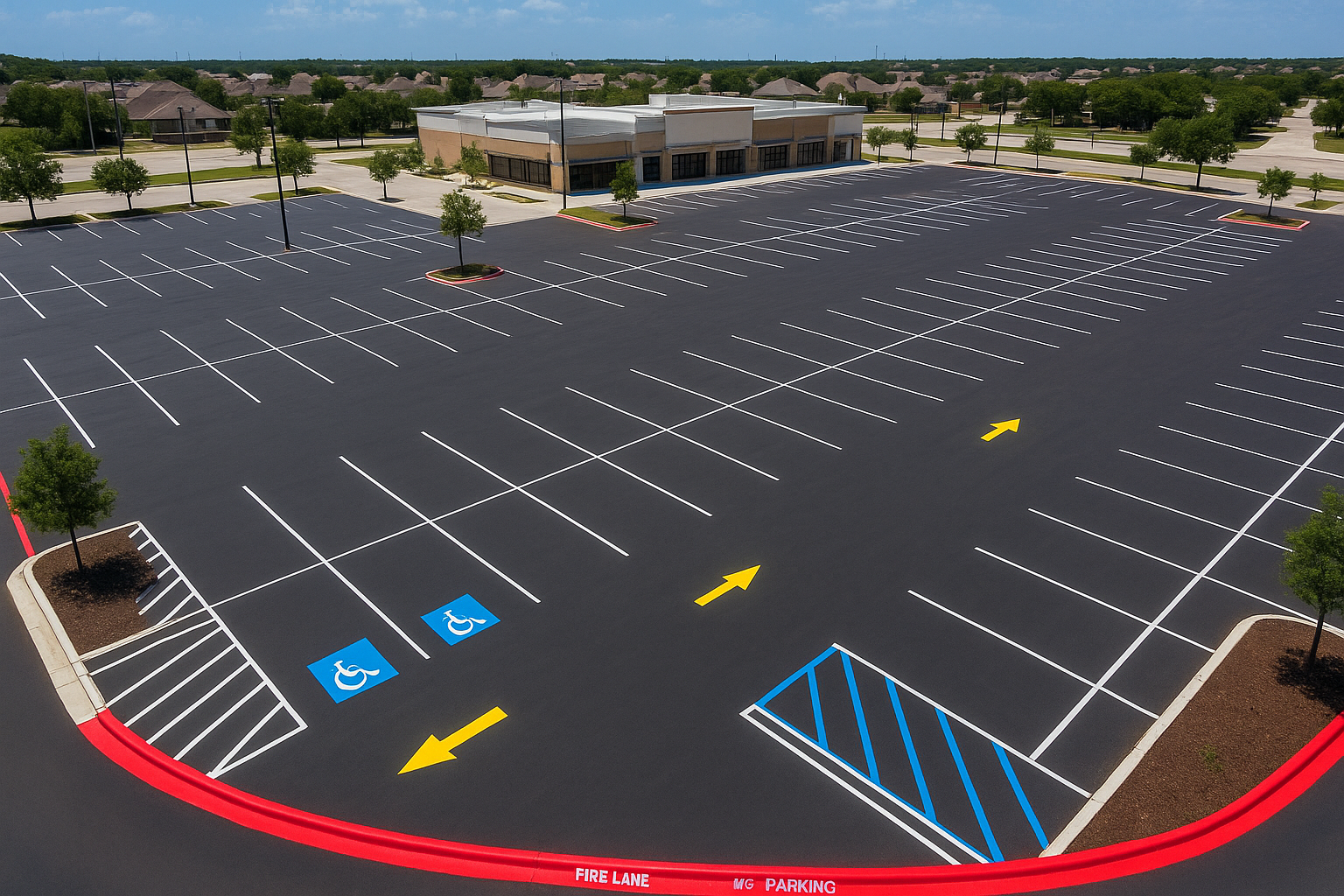
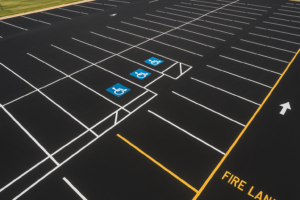
An aerial view of a completed line marking service reveals how comprehensive pavement markings organize an entire commercial parking lot — from stall lines to fire lanes.
Frequently Asked Questions About Line Marking Service
What is a line marking service?
A line marking service is a professional pavement marking solution that applies paint or thermoplastic material to parking lots, roadways, and paved surfaces. It defines stalls, lanes, fire lanes, crosswalks, and safety zones to improve traffic organization, meet code requirements, and enhance overall property safety.
How often should parking lot lines be repainted?
Most parking lot lines should be repainted every one to two years, depending on traffic volume and weather exposure. High-traffic lots in Texas may need restriping more frequently due to intense UV fading and heavy daily use. Thermoplastic markings can extend that interval to three to five years.
Does a line marking service include ADA-compliant handicap stalls?
Yes. A professional line marking service includes ADA-compliant handicap stall markings, correctly sized access aisles, diagonal hatching, and the International Symbol of Accessibility painted on the pavement. Compliance with the Americans with Disabilities Act is required for most commercial properties.
What is the difference between paint and thermoplastic line marking?
Paint is a cost-effective option for standard parking lot striping and dries within about 30 minutes. Thermoplastic is a heated plastic compound that bonds more durably to pavement and typically lasts three to five years. Thermoplastic is ideal for high-traffic areas where longevity and reduced maintenance frequency are priorities.
How long does a parking lot line marking service take?
A typical parking lot line marking project takes anywhere from a few hours to a full day, depending on lot size and scope of work. Most lots can be reopened to traffic within 30 to 60 minutes after paint application, or sooner with thermoplastic. Scheduling during low-traffic hours minimizes disruption.
Is fire lane marking required by law in Texas?
Yes. Fire lane markings are required by local fire codes in most Texas municipalities. Properly marked fire lanes ensure emergency vehicles can access buildings quickly and safely. Failure to maintain visible fire lane markings can result in citations and fines from local fire marshals.
How much does a line marking service cost in Texas?
The cost depends on lot size, number of stalls, material type, and scope of work. Small commercial lots under 30 stalls typically range from $300 to $700. Larger properties may cost $700 to $2,500 or more. Requesting a free on-site quote from a local provider like Stripes PLS is the most accurate way to get pricing.
Can line marking be done on existing asphalt without resurfacing?
Yes. Line marking can be applied directly to existing asphalt as long as the surface is structurally sound and clean. Severely cracked or deteriorated pavement may need patching before striping to ensure proper adhesion and a longer-lasting result.
What types of properties need professional line marking?
Commercial parking lots, retail centers, schools, healthcare facilities, warehouses, apartment complexes, churches, and municipal properties all benefit from professional line marking. Any paved surface used for parking or vehicle circulation typically requires clear, durable, code-compliant markings.
What common mistakes should property owners avoid with parking lot striping?
Common mistakes include delaying restriping until lines are nearly invisible, failing to meet ADA stall count requirements, using low-quality paint that fades within months, and not restriping after seal coating. Working with an experienced line marking contractor from the start helps avoid costly compliance issues and repeat applications.
Do line marking services include directional arrows and symbols?
Yes. Most professional line marking services include directional arrows, stop bars, crosswalk striping, handicap symbols, fire lane stencils, and other pavement markings. These elements work together to guide drivers and pedestrians safely and efficiently through a property.
How do I know if my parking lot needs restriping?
If lines are faded, difficult to see in daylight, or drivers are parking inconsistently, your lot likely needs restriping. Additional warning signs include missing ADA symbols, faded fire lane markings, and drivers using unmarked pedestrian crossings. A professional site assessment can confirm whether a full restripe or targeted touch-ups are the right solution.
Conclusion: Why a Quality Line Marking Service Is Worth Every Dollar
In summary, a professional line marking service does far more than apply paint to pavement. It organizes your property, protects you from ADA and fire code violations, reduces accident risk, and creates a better, safer experience for every driver and pedestrian who visits your lot. For property owners across the Denton and Plano, TX region, investing in quality pavement markings is one of the most cost-effective ways to maintain a compliant, well-organized facility. Whether you need a complete new layout, a restripe of faded markings, specialized ADA designations, or durable thermoplastic applications, working with an experienced local contractor ensures the job is done correctly the first time. Reach out to Stripes PLS today to request your free quote and take the first step toward a cleaner, safer, and more organized parking lot.