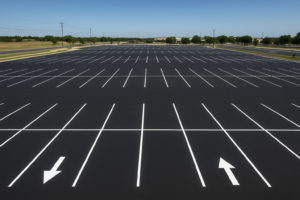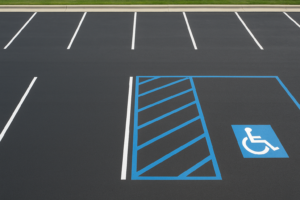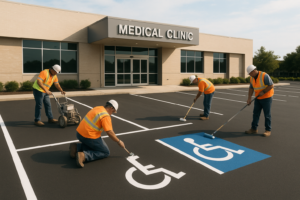

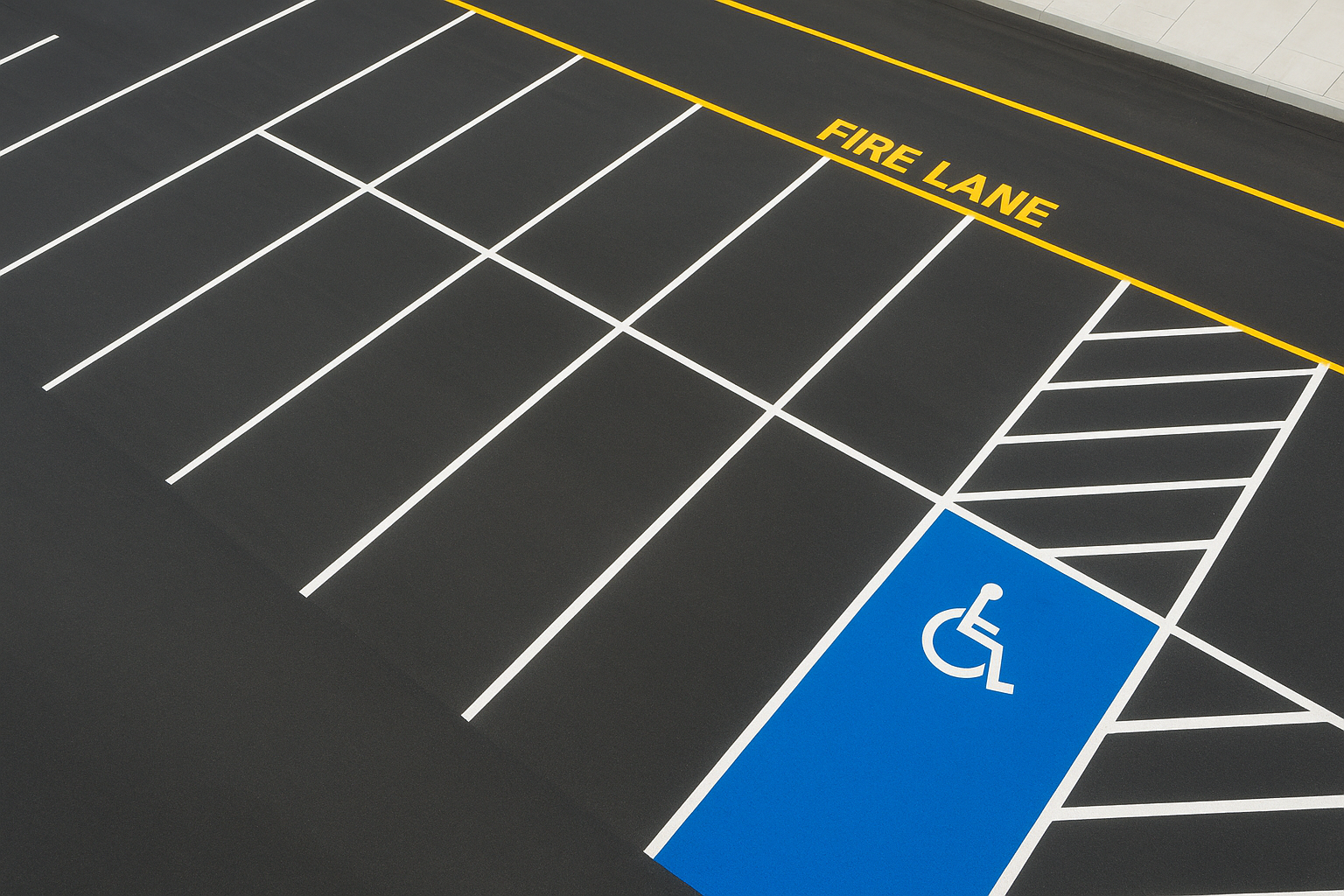
A complete parking lot marking project covers standard stalls, ADA-compliant spaces, fire lane designations, and directional markings in a single professional service visit. For a deeper walkthrough, see our parking lot issues.
What Is Parking Lot Marking and Why Does It Matter?
Parking lot marking refers to the full system of painted lines, symbols, and text applied to a parking surface to guide drivers, establish legal compliance, and protect pedestrians. It goes far beyond white stall lines. A thorough marking system includes ADA-accessible space designations, fire lane paint and stenciling, directional arrows, stop bars, crosswalks, curb paint, and numbered space stencils when required.
In practical terms, poorly marked lots cause driver confusion, pedestrian hazards, and compliance violations that can trigger fines or lawsuits. Conversely, a well-marked facility reduces accidents, improves traffic flow, and signals to tenants and customers that the property is professionally maintained.
Federal law also plays a role. The ADA Standards for Accessible Design legally mandate accessible parking space counts, dimensions, and signage for any commercial property open to the public. Therefore, parking lot marking is not optional — it is a legal requirement with real consequences for non-compliance. For a deeper walkthrough, see our Parking Lot Layout Design: Complete Planning Guide.
Every Type of Parking Lot Marking Explained
A complete parking lot marking project involves several distinct marking types. Each one has a specific function, and each one affects the safety and legality of your facility. Below, we cover all of them in detail. For a deeper walkthrough, see our Parking Bay Marking Services in Denton & Plano, TX.
Standard Parking Stall Lines
Standard stall lines define each individual parking space. They must be straight, evenly spaced, and consistent in width. Most commercial stalls measure 8.5 to 9 feet wide and 18 to 20 feet deep. In addition, drive aisle width — typically 22 to 24 feet for two-way traffic — is critical for safe vehicle movement. Incorrect stall dimensions waste usable space or, worse, create door-ding and fender-bender risks.
Paint color for standard stalls is almost always white in commercial lots, though yellow is used in some municipal and school settings. The key is uniformity — inconsistent line widths or spacing erode driver confidence and make lots feel poorly managed.
ADA Handicap Space Markings
ADA-compliant accessible parking is among the most regulated aspects of parking lot marking. Specifically, each accessible space must be at least 8 feet wide, with a 5-foot access aisle beside it. Van-accessible spaces require an 8-foot access aisle. The International Symbol of Accessibility — the wheelchair symbol — must be painted on the pavement surface. Corresponding signs must be mounted at a height of at least 60 inches from the ground, measured to the bottom of the sign.
The number of required accessible spaces scales with total lot size. For example, lots with 1 to 25 total spaces need at least 1 accessible space. Lots with 26 to 50 spaces need 2. The ratio continues to increase as lot capacity grows. Furthermore, at least one in every six accessible spaces must be van-accessible. Missing these requirements puts a property in direct violation of federal law, regardless of whether a complaint has been filed.
ADA Quick Reference: Required Accessible Parking Space Counts
- 1–25 total spaces → 1 accessible space minimum
- 26–50 spaces → 2 accessible spaces
- 51–75 spaces → 3 accessible spaces
- 76–100 spaces → 4 accessible spaces
- 101–150 spaces → 5 accessible spaces
- 151–200 spaces → 6 accessible spaces
- At least 1 in every 6 accessible spaces must be van-accessible.
Fire Lane Designations
Fire lane markings are required by local fire codes to ensure emergency vehicles have unobstructed access to buildings. Typically, fire lanes are marked with red curb paint, yellow pavement markings, and “NO PARKING — FIRE LANE” stenciling on the asphalt surface. Specific requirements — including curb color, stencil size, and proximity to building entrances — are set by the local fire marshal and may vary by municipality.
Faded or missing fire lane markings expose property owners to significant risk. Consequently, local fire departments can issue citations requiring immediate correction. More importantly, if an emergency vehicle is delayed because a fire lane was blocked and unmarked, the liability implications for the property owner can be severe.
Directional Arrows and Traffic Flow Markings
Directional arrows painted on the pavement guide drivers through the lot and prevent head-on conflicts in narrow aisles. Similarly, one-way traffic designations, entrance and exit markings, and “STOP” stenciling at intersections within the lot all contribute to a safer, more organized facility. These markings are especially critical in busy retail, healthcare, and school environments where vehicle and pedestrian traffic mix.
Crosswalk Stripes and Pedestrian Markings
Crosswalk stripes define safe pedestrian pathways through the parking area. They alert drivers to expect foot traffic and give pedestrians a clearly marked route. In high-traffic lots, crosswalk placement near building entrances and between aisles significantly reduces pedestrian-vehicle conflict. According to the Federal Highway Administration, clearly marked crosswalks with retroreflective paint improve driver awareness in both daytime and low-light conditions.
Curb Painting
Curb painting communicates parking restrictions at a glance. Red curbs signal no-parking zones (typically fire lanes). Yellow curbs indicate loading zones or time-limited stopping areas. Blue curbs designate accessible parking zones. Fresh, vibrant curb paint is one of the most visually effective ways to communicate rules without additional signage and is an important component of a thorough parking lot marking service.
Stenciling and Specialty Markings
Specialty stenciling includes space numbers, reserved designations, loading zone text, speed limit markings, and custom signage text painted directly on the pavement. These elements are particularly common in structured parking facilities, hospitals, universities, and any property with assigned or reserved parking. Additionally, speed bump markings — yellow stripes across the full width of the bump — are an important safety feature that warn drivers before they reach the obstacle.
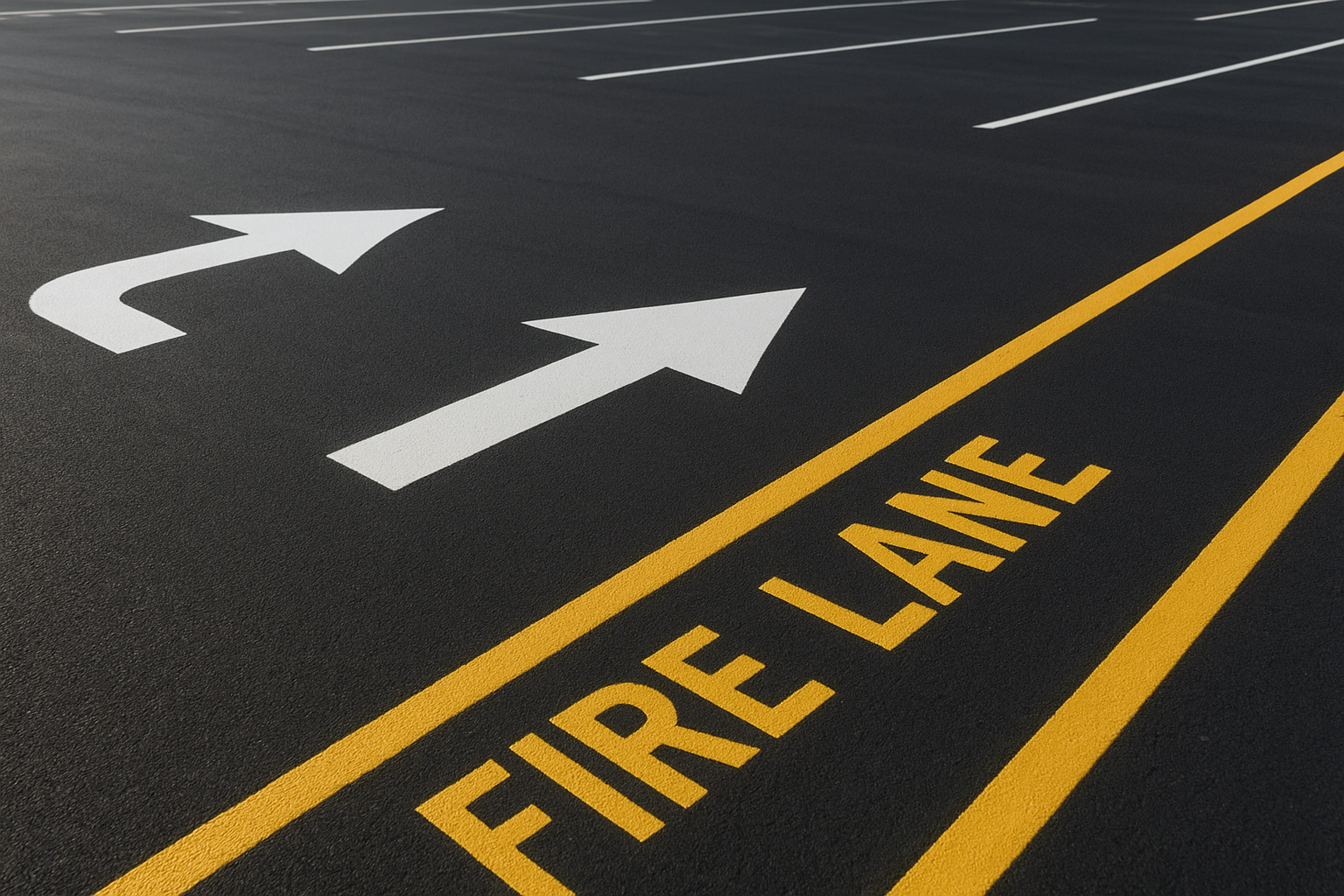
Directional arrows, fire lane curb paint, and stenciled text are essential elements of any complete parking lot marking service. For a deeper walkthrough, see our parking lot line painting.
Parking Lot Paint Types: Choosing the Right Material
Paint selection is one of the most consequential decisions in any parking lot marking project. The wrong choice shortens marking life dramatically, especially in climates with extreme sun exposure or freeze-thaw cycles. Here is a breakdown of the most common options. See our line painting guide for paint selection details.
Water-Based Latex Traffic Paint
Water-based latex is the most widely used parking lot marking paint in commercial applications. It dries in approximately 30 minutes and is ready for vehicle traffic within one hour under normal conditions. It is more environmentally friendly than solvent-based alternatives and easier to clean up. However, in very high-wear areas or extreme climates, it may fade faster than oil-based options.
Oil-Based Alkyd Paint
Oil-based alkyd paint offers superior durability in high-wear environments such as busy drive-through lanes, truck loading areas, and high-volume retail lots. It bonds more aggressively with asphalt surfaces and resists wear from heavy tire traffic. On the downside, alkyd paint takes longer to cure — sometimes several hours — and produces stronger fumes during application. Furthermore, it is more difficult to clean from equipment and has a higher VOC (volatile organic compound) content.
Thermoplastic Markings
Thermoplastic is a heat-applied marking material used primarily for high-traffic roadway and commercial applications where maximum longevity is required. It is significantly more durable than paint — lasting five to seven years in many applications — and is often used for crosswalks, stop bars, and heavily traveled drive lanes. However, thermoplastic is more expensive to apply and requires specialized equipment. It is therefore most cost-effective for markings in areas subject to the most wear.
Retroreflective Paint with Glass Beads
Retroreflective paint incorporates glass beads into the wet paint surface, creating markings that reflect headlight beams back to the driver at night. This dramatically improves visibility in low-light and wet conditions. The Federal Highway Administration’s research confirms that retroreflective pavement markings reduce nighttime accident risk. In North Texas, where summer nights remain busy and winter rain is frequent, specifying glass-bead traffic paint is a sound investment for any parking lot marking project.
Paint Type Comparison at a Glance
- Water-based latex: Fast-drying, eco-friendly, standard commercial choice — lasts 1–2 years
- Oil-based alkyd: High durability, slower cure, best for heavy-wear zones — lasts 2–3 years
- Thermoplastic: Maximum longevity, specialized application, premium cost — lasts 5–7 years
- Retroreflective (glass bead): Adds nighttime visibility to any paint type — recommended for all crosswalks and high-visibility zones
How to Plan a Parking Lot Marking Project: Step-by-Step
A well-planned parking lot marking project delivers better results and avoids costly surprises. Specifically, following a structured approach ensures every compliance requirement is met and the finished lot functions exactly as intended. For detailed application techniques, see our parking lot striping guide. Here is the process, step by step.
- Assess the current lot condition. Walk the entire parking surface and document every faded marking, cracked section, missing ADA space, and any fire lane area that needs attention. Take photographs for reference. Note areas where pavement repairs may be needed before new paint will adhere correctly.
- Identify all required marking types. Determine which markings your facility legally requires, including standard stalls, ADA-compliant handicap spaces, van-accessible spaces, fire lanes, directional arrows, stop bars, crosswalks, curb paint, and any custom stenciling required by local code.
- Verify ADA compliance requirements. Cross-reference your current accessible space count and configuration against the ADA Standards for Accessible Design. Identify any gaps in van-accessible space count, access aisle width, or signage height that must be corrected.
- Request a professional site measurement and quote. Contact a licensed parking lot striping contractor to measure your lot, confirm the full scope of work, and provide a detailed written estimate covering materials, labor, timeline, and any surface preparation required. Learn how to choose a reliable striping service before you hire.
- Schedule work during low-traffic hours. Coordinate with your striping crew to perform the parking lot marking work during off-peak hours — early mornings, evenings, or overnight — to minimize disruption for tenants and customers. For a deeper walkthrough, see our parking lot striping.
- Prepare the surface. Ensure the asphalt or concrete surface is thoroughly cleaned of dirt, debris, oil, and moisture before marking begins. Surface preparation is a key factor in how long new markings will last.
- Inspect the completed project. After the paint has fully cured, conduct a thorough walkthrough with your contractor. Verify that all lines are straight, ADA dimensions meet code, fire lane designations are clearly legible, and directional arrows are properly oriented.
Restriping vs. Full New Lot Layout: Which Option Do You Need?
This is one of the most common questions property owners ask before starting a parking lot marking project. The answer depends on several factors: the condition of existing markings, recent pavement work, and whether the current layout is meeting your space efficiency and compliance needs.
When Restriping Is the Right Choice
Restriping — applying fresh paint over the existing layout — is typically the right choice when the current configuration is functional, code-compliant, and the pavement surface is in good condition. It is faster and less expensive than a full redesign. Most commercial lots benefit from restriping every one to two years, depending on traffic volume, sun exposure, and paint type used.
When a New Layout Is Necessary
A new lot layout is necessary when the existing lines have been erased — typically after repaving — or when the property has changed in a way that makes the old layout inadequate. For example, if a property has expanded, if new tenants require additional parking, or if an ADA audit reveals that the current stall configuration does not meet federal standards, a redesign is required.
Research from the Institute of Transportation Engineers indicates that optimized parking lot design can increase usable capacity by 10 to 15 percent over older, less efficient layouts. In high-demand areas, that additional capacity has real economic value. Therefore, a full redesign is often worth the investment when the lot is already due for a major upgrade.

Professional-grade parking lot marking equipment ensures straight, consistent lines with uniform paint thickness that resists fading under heavy traffic. For a deeper walkthrough, see our parking lot striping.
How Much Does Parking Lot Marking Cost?
Cost is one of the first questions property owners ask — and for good reason. Parking lot marking costs vary based on several factors, including lot size, number of spaces, the complexity of required markings, surface condition, and local labor rates. For guidance on hiring and vetting contractors, see our line marking service checklist. Understanding these variables helps you budget accurately and evaluate quotes from contractors.
Typical Parking Lot Marking Cost Ranges
- Small commercial restripe (up to 50 spaces): $300 – $700
- Medium lot restripe (50–150 spaces): $700 – $2,000
- Large commercial lot (150+ spaces): $2,000 – $6,000+
- New full layout (after repaving): $1,500 – $5,000+ depending on lot size and marking complexity For a deeper walkthrough, see our Otto’s Parking Marking: Pro Lot Striping Guide.
- ADA compliance upgrade (add or correct accessible spaces): $200 – $800 per space depending on signage and surface work required
- Fire lane marking: $100 – $400 per linear section depending on length and stenciling required
- Thermoplastic crosswalk installation: $400 – $1,200 per crossing depending on width and traffic volume
These are general benchmarks. Consequently, the best way to get an accurate number is to request a free, itemized quote from a local parking lot marking professional who can assess your specific property in person. For a deeper walkthrough, see our How Can I Improve My Parking Lot Layout Design?.
What Drives the Cost Up?
- Poor surface condition requiring cleaning or crack filling before marking can begin
- High volume of specialty stenciling such as space numbers, logos, or custom text
- Old conflicting markings that need to be blacked out before fresh lines are applied
- Multiple marking colors (white, blue, red, yellow) requiring equipment cleaning between coats
- Remote location or difficult site access increasing contractor travel time
Surface Preparation: The Step Most Owners Overlook
Surface preparation is the single most overlooked factor in parking lot marking durability. Even the best traffic paint will peel or fade prematurely if it is applied to a dirty, damp, or deteriorated surface. For regional timing and climate guidance, see our parking lot striping in DFW recommendations. Therefore, proper prep work is not optional — it is what separates a marking job that lasts two years from one that starts flaking in six months.
Key Surface Preparation Steps
- Pressure washing or blowing: Remove all loose debris, sand, and dirt that would prevent paint adhesion
- Degreasing: Oil stains from vehicle leaks must be treated with a degreaser before painting — oil repels water-based paint
- Crack filling: Structural cracks should be filled and allowed to cure before new markings are applied
- Drying time: The surface must be completely dry — most contractors require at least 24 hours after rain before striping begins
- Blacking out old markings: Where layout changes are being made, old conflicting lines must be covered with black paint before new lines are applied, or ghost lines will confuse drivers
When evaluating contractors, ask specifically what surface preparation is included in the quote. A low bid that skips prep work will cost more in the long run when markings fade prematurely and require early reapplication.
How Long Do Parking Lot Markings Last?
The lifespan of parking lot markings depends on several interacting variables. Understanding them helps you set realistic maintenance schedules and avoid the cost and safety risk of severely faded lines. Read our durable striping tips to maximize longevity.
Factors That Affect Marking Longevity
- Traffic volume: High-traffic lots wear through paint faster — especially in drive lanes and at stop bars
- UV exposure: Intense sun bleaches and dries out paint. In North Texas, UV degradation is a primary cause of early fading
- Paint quality: Professional-grade traffic paint with UV-resistant additives lasts significantly longer than consumer-grade products
- Surface condition: Paint bonds better and lasts longer on sound, properly prepared asphalt than on cracked or porous surfaces
- Application thickness: A single thin coat fades faster than two applied coats with adequate wet film thickness
- Climate: Freeze-thaw cycles in northern climates and extreme heat in southern climates both accelerate wear
As a general guideline, most commercial parking lot markings using quality water-based paint last 12 to 24 months before restriping is recommended. High-quality oil-based paint can extend that to 24 to 36 months in moderate-traffic areas. Thermoplastic markings can last five to seven years. In North Texas specifically, annual inspections are recommended due to high UV exposure and summer heat.
Common Parking Lot Marking Mistakes Property Owners Make
Even attentive property managers fall into avoidable traps with parking lot marking. Recognizing these mistakes early can save significant money and liability exposure. For a deeper walkthrough, see our parking lot striping.
Waiting Too Long to Restripe
Faded lines create driver confusion and signal neglect to tenants and visitors. As a result, accident risk increases. More importantly, severely faded lines force contractors to rely on ghosting — the shadows of old paint — to guide new lines, which can introduce inaccuracies. Most professionals recommend inspecting markings annually and restriping every one to two years.
Underestimating ADA Requirements
Federal ADA requirements are updated periodically. Consequently, a lot that was compliant five years ago may no longer meet current standards. Common violations include insufficient van-accessible space count, access aisles that are too narrow, missing or incorrectly mounted signage, and faded International Symbol of Accessibility markings. Each of these carries potential legal exposure.
Ignoring Fire Lane Visibility
Fire lane markings are not maintenance items that can be deferred indefinitely. Local fire marshals conduct inspections and issue citations that require immediate remediation. More seriously, blocked fire lanes during emergencies create life-safety risks that carry profound liability for the property owner. Proactive maintenance is always less disruptive and less expensive than emergency corrections.
Choosing the Lowest-Bid Contractor Without Vetting Quality
Parking lot marking is not a commodity service where price alone should drive the decision. A contractor using inferior paint, skipping surface preparation, or applying lines with inadequate equipment will deliver results that fail within months. Before hiring, ask for references, confirm that the contractor uses professional-grade traffic paint, and verify that their scope of work includes proper surface prep.
Skipping the Post-Project Inspection
After any parking lot marking project, always walk the entire lot with the contractor before signing off. Verify line straightness, ADA dimension compliance, fire lane legibility, and that no old conflicting lines remain visible. Identifying issues immediately — before the crew leaves — is far easier than tracking down corrections later.
Parking Lot Marking Regulations: ADA, MUTCD, and Local Codes
Compliance is not a single standard — parking lot marking is governed by multiple overlapping regulatory frameworks. Understanding each one helps property owners stay fully compliant and avoid enforcement actions. For a deeper walkthrough, see our Non-Slip Parking Lot Markings: Guide for Property Owners.
Americans with Disabilities Act (ADA)
The ADA governs accessible parking space requirements for any place of public accommodation. Requirements cover space count, stall width, access aisle dimensions, surface slope, signage specifications, and the International Symbol of Accessibility. The 2010 ADA Standards for Accessible Design is the current controlling document. Violations can result in federal civil rights complaints and costly remediation orders.
Manual on Uniform Traffic Control Devices (MUTCD)
The MUTCD, published by the Federal Highway Administration, sets national standards for pavement markings, including color conventions, line widths, arrow designs, and crosswalk specifications. While it primarily governs public roadways, its standards are widely adopted by municipalities and are often referenced in local commercial property codes for parking facilities.
Local Fire and Building Codes
Local fire codes govern fire lane designation requirements — including minimum widths, curb color, pavement stenciling specifications, and proximity to building entrances. Building codes may additionally govern stall dimensions, drive aisle widths, and the number of spaces required relative to building square footage. Always verify local requirements with your municipality before finalizing a new lot layout.
Permits for Parking Lot Marking in Texas
Standard restriping of an existing layout generally does not require permits in Texas. However, new lot layouts or changes affecting ADA compliance, fire lane configuration, or traffic flow patterns may require approval from the local municipality or fire marshal’s office before work begins. When in doubt, consult with your contractor and local authorities before proceeding.
Best Conditions for Parking Lot Striping in North Texas
Timing and weather significantly affect the quality and longevity of any parking lot marking project. In North Texas specifically, the combination of intense summer UV, periodic winter freezes, and spring rain creates a challenging environment for traffic paint.
- Ideal temperature range: 50°F to 85°F — paint flows and bonds optimally in this range
- Humidity: Below 85% relative humidity — high humidity slows drying and reduces adhesion for water-based paint
- Best seasons in North Texas: Spring (March–May) and fall (September–November) offer the most consistently favorable conditions
- Avoid extreme summer heat: Asphalt surface temperatures above 120°F can cause water-based paint to dry too quickly, preventing proper bonding
- Post-rain waiting period: Wait at least 24 hours after rainfall before beginning any parking lot marking work For a deeper walkthrough, see our parking lot striping.
Serving Denton, Plano, and All of North Texas with Professional Parking Lot Marking
For property owners across the greater North Texas region, stripespls.com delivers complete parking lot marking solutions — every marking your facility needs, handled by professionals who understand local codes, climate conditions, and compliance requirements. The company offers a line marking service tailored to North Texas conditions. From Denton to Plano and across the surrounding region, the team serves commercial properties, retail centers, schools, healthcare campuses, and municipal organizations. For a deeper walkthrough, see our Parking Lot Restriping Denton & Plano, TX | Stripes PLS.
Whether you need a simple restripe, a complete new lot layout, ADA compliance upgrades, fire lane restoration, or specialty stenciling, the team brings precision and reliability to every project. You can browse completed work in the project gallery to see the quality firsthand. Learn more about the company’s approach and values on the about page. Article by Stripes Parking Lot Services. Last updated: 2026-07-12.
Requesting a free, no-obligation quote is simple. Visit the website, describe your property’s needs, and a professional will follow up with an accurate estimate tailored to your specific lot and marking requirements.
Frequently Asked Questions About Parking Lot Marking
What is included in a complete parking lot marking service?
A complete parking lot marking service includes standard stall lines, ADA-accessible space markings with access aisles and signage, fire lane paint and stenciling, directional arrows, stop bars, crosswalk stripes, curb painting, and any specialty stenciling such as space numbers or reserved designations. Comprehensive providers handle all marking types in a single coordinated visit.
How often should parking lot marking be refreshed?
Most commercial parking lots require restriping every one to two years, depending on traffic volume, UV exposure, paint type, and surface condition. High-traffic lots or properties in intense sun climates like North Texas may need annual inspection and more frequent restriping to keep all markings clearly visible and compliant.
What are the ADA requirements for parking lot marking?
The ADA requires a minimum number of accessible parking spaces based on total lot capacity, with at least one van-accessible space per accessible cluster. Each accessible space must be at least 8 feet wide with a 5-foot access aisle (8 feet for van-accessible), properly mounted signage, and the International Symbol of Accessibility painted on the surface. The 2010 ADA Standards for Accessible Design is the governing document.
How much does parking lot marking cost for a medium commercial lot?
A medium commercial lot with 50 to 150 spaces typically costs between $700 and $2,000 for a standard restripe. Costs vary based on the number of specialty markings required, surface condition, paint type, and local labor rates. Requesting a free itemized quote from a local professional gives the most accurate estimate for your specific property.
What is the best type of paint for parking lot marking?
Water-based latex traffic paint is the standard choice for most commercial parking lot marking projects — it dries quickly, is environmentally friendly, and performs well in most climates. Oil-based alkyd paint offers greater durability for high-wear zones. Thermoplastic is the longest-lasting option for crosswalks and high-traffic areas but requires specialized application equipment and higher upfront cost.
How long does parking lot paint take to dry?
Water-based traffic paint is typically dry to the touch within 30 minutes and ready for vehicle traffic within one hour under normal temperature and humidity conditions. Oil-based alkyd paint may take two to four hours or longer. Thermoplastic materials cool and harden within minutes of application. Extreme heat, cold, or humidity can lengthen drying times for all paint types.
Can parking lot marking be applied to existing asphalt without repaving?
Yes. Parking lot marking can be applied directly to existing asphalt as long as the surface is clean, dry, structurally sound, and free of oil contamination. Severely cracked or deteriorated pavement should be repaired before new markings are applied — otherwise new paint will not bond properly and will fade or peel quickly.
What regulations govern parking lot marking?
Parking lot marking is governed by multiple frameworks: the ADA (accessible space requirements), the MUTCD (pavement marking standards), local fire codes (fire lane specifications), and local building codes (stall dimensions and aisle widths). Each applies simultaneously, so full compliance requires attention to all of them, not just one.
What is thermoplastic parking lot marking and when is it used?
Thermoplastic is a heat-applied marking material that offers five to seven years of durability — significantly longer than paint. It is most cost-effective for high-wear areas such as crosswalks, stop bars, and frequently traveled drive lanes. While the upfront cost is higher than paint, the extended service life makes it economical for locations where markings are subject to constant wear.
Do I need a permit for parking lot marking in Texas?
Standard restriping of an existing configuration generally does not require a permit in Texas. However, new lot layouts or changes that affect ADA compliance, fire lane placement, or traffic flow patterns may require approval from the local municipality or fire marshal’s office. Confirm requirements with your local authority before beginning any new-layout project.
What is the best time of year for parking lot marking in North Texas?
Spring (March–May) and fall (September–November) offer the most favorable conditions for parking lot marking in North Texas — moderate temperatures, manageable humidity, and low risk of rain delays. Extreme summer heat can cause asphalt surface temperatures to exceed 120°F, which prevents proper paint bonding. Winter temperatures below 50°F can similarly affect adhesion and cure time.
What is the difference between restriping and a new parking lot layout?
Restriping applies fresh paint over an existing parking lot layout to refresh faded lines. A new layout involves designing and applying an entirely new parking configuration — typically required after repaving, property expansion, or when the existing design is no longer efficient or compliant. New layouts allow for optimization of space count and compliance with current ADA and fire code requirements. For a deeper walkthrough, see our Best Practices for Parking Lot Layout Design: A Complete Planning Guide.
Conclusion: Make Parking Lot Marking a Priority, Not an Afterthought
A well-executed parking lot marking project does far more than make a facility look clean — it protects drivers and pedestrians, satisfies federal ADA requirements, meets local fire codes, and reduces the property owner’s legal exposure. Furthermore, fresh, professional markings communicate to every visitor that the property is managed with care and attention to detail. Whether you are managing a retail strip center in Plano, a healthcare campus in Denton, or any commercial property across North Texas, investing in comprehensive parking lot marking pays dividends in safety, compliance, and curb appeal. For a free, no-obligation estimate tailored to your specific property, visit stripespls.com and take the first step toward a safer, more organized, and fully compliant parking facility.