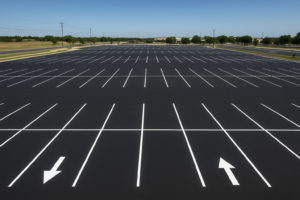

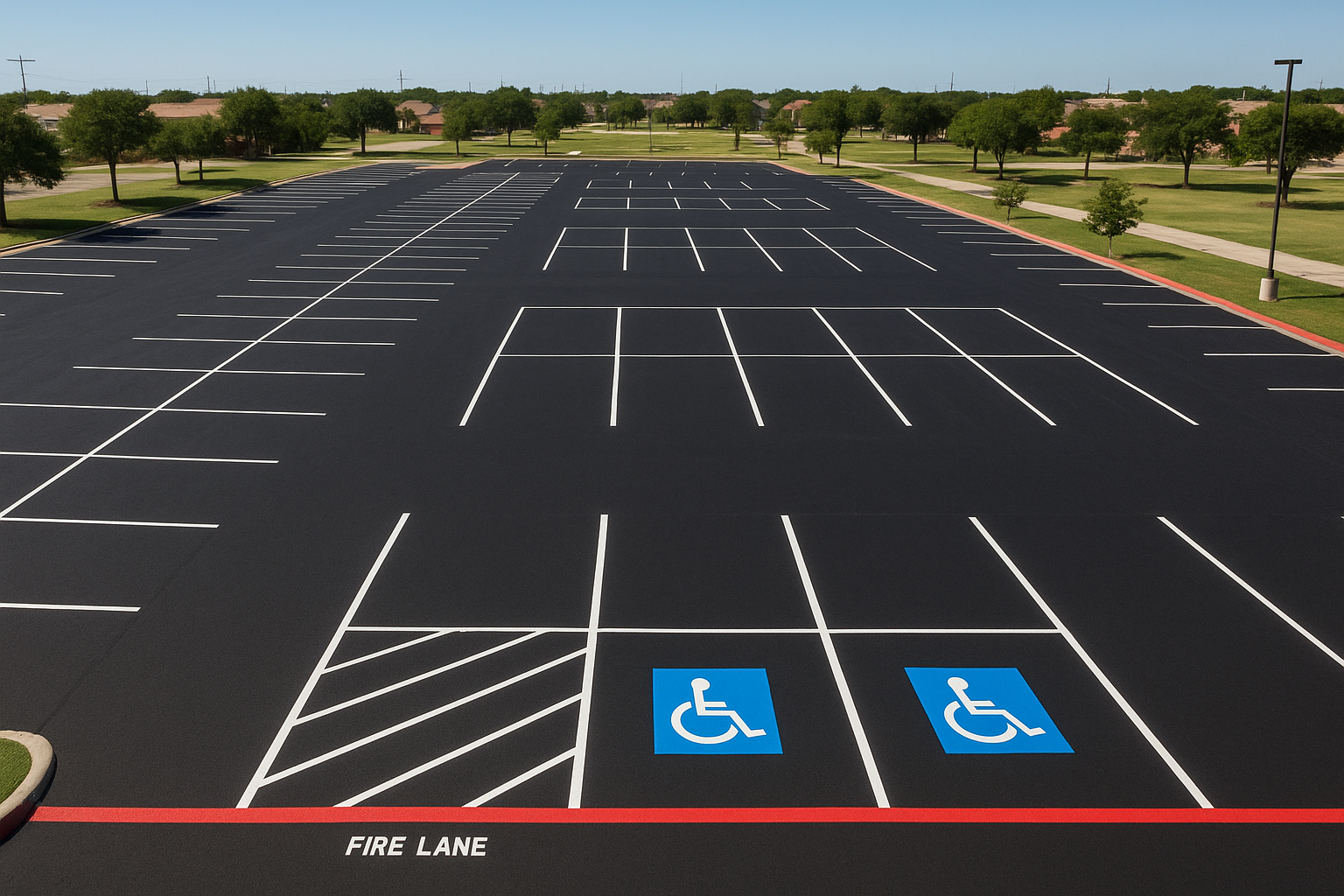
Professional parking lot striping delivered by ADA striping experts delivers code-compliant markings that organize traffic, protect property owners, and maximize usable space.
What Is Parking Lot Striping — and Why Does It Matter?
Parking lot striping is the professional application of painted lines, symbols, and stenciled markings on paved surfaces. For an in-depth reference, see the pro lot striping guide. These markings define individual parking spaces, guide vehicle traffic through drive aisles, designate fire lanes, and communicate critical safety rules. Specifically, a complete striping project covers standard white stall lines, ADA-compliant handicap spaces, van-accessible stalls, access aisles, directional arrows, crosswalks, curb painting, and specialty stencils like “STOP” text and speed bump indicators.
Furthermore, professionally designed striping layouts maximize the number of usable spaces within a given footprint. According to parking design guidelines published by the U.S. Department of Transportation, a well-executed layout can fit 10–15% more vehicles than a poorly planned one. For retail businesses, that directly translates to more customers. For property managers, it means fewer headaches and higher tenant satisfaction.
In addition, clear lot markings reduce the risk of low-speed collisions, pedestrian-vehicle conflicts near building entrances, and unauthorized parking in fire lanes or accessible stalls. The result is a safer, more organized property — and a stronger legal position if an incident ever occurs.
The Real Cost of Faded or Missing Parking Lot Markings
Faded markings do far more damage than most property owners realize. When lines are barely visible, drivers park haphazardly, traffic conflicts increase, and your lot begins to look neglected — which reflects directly on your business or tenants. However, the financial risks go well beyond aesthetics.
ADA Violations and Federal Penalties
Businesses with unclear or missing ADA markings risk civil complaints under Title III of the Americans with Disabilities Act. Specifically, first-time violations can carry penalties of up to $75,000, and subsequent violations can reach $150,000, per ADA.gov enforcement guidelines. Missing access aisles, incorrect stall widths, and absent International Symbol of Accessibility (ISA) markings are among the most commonly cited violations.
Liability from Accidents and Traffic Conflicts
When stall lines, pedestrian crossings, and traffic flow indicators are missing, accidents become more likely. As a result, property owners may face liability claims from drivers or pedestrians injured in avoidable incidents. Consequently, the cost of a routine restriping service is a fraction of what you might spend resolving a single liability claim — making proactive maintenance the smarter financial choice by far.
Fire Code Citations
Fire lane markings are not optional. Local fire departments and fire marshals inspect commercial properties for properly maintained fire lane designations. If fire lane curb paint has faded or stenciling is illegible, your property may be cited. Therefore, maintaining visible fire lane markings is essential for both compliance and emergency response readiness.
How Often Does a Parking Lot Need Restriping?
Most commercial parking lots need restriping every one to two years. However, several factors determine where your property falls in that range. UV radiation breaks down the binders in traffic paint, causing lines to fade faster in sun-heavy climates. Heavy seasonal rainfall and freeze-thaw cycles further accelerate surface wear. High-traffic lots — such as those at grocery stores, hospitals, or distribution centers — wear out faster than lower-traffic office parks. See Parking Lot Striping Frisco TX for a nearby service example.
In addition, lots that have been seal-coated recently will need restriping immediately after the sealant cures, since sealcoating covers existing markings entirely. Similarly, any lot undergoing repaving or surface repairs will need a fresh striping job as part of the restoration process.
A simple rule of thumb: if you can no longer read your lot’s stall lines clearly from a standing height in bright daylight, it’s time to schedule a parking lot restriping service. Proactive restriping is always more affordable than reactive repairs, compliance fines, or accident liability.
ADA-Compliant Parking Lot Striping: What Every Property Owner Must Know
ADA compliance is federal law — not a suggestion. For ADA installation specifics, see ADA-compliant striping. The ADA Standards for Accessible Design specify minimum requirements for accessible parking spaces based on total lot capacity. Understanding these standards is essential for every commercial property owner.
Required Number of Accessible Spaces
The table below summarizes the minimum accessible space requirements under federal ADA guidelines:
| Total Lot Spaces | Minimum Accessible Spaces | Van-Accessible Required |
|---|---|---|
| 1 – 25 | 1 | 1 |
| 26 – 50 | 2 | 1 |
| 51 – 75 | 3 | 1 |
| 76 – 100 | 4 | 1 |
| 101 – 150 | 5 | 1 |
Dimensional Requirements for Accessible Stalls
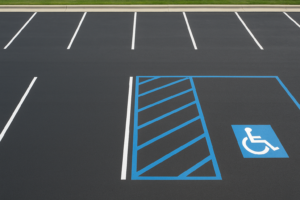
Each accessible stall must meet precise dimensional standards. A standard accessible space must be at least 8 feet wide with a 5-foot access aisle alongside it. Van-accessible spaces require a wider 8-foot access aisle. Additionally, every accessible stall must display a correctly sized and positioned International Symbol of Accessibility (ISA) and include appropriate vertical signage.
Moreover, accessible spaces must be located on the shortest accessible route to the building’s accessible entrance. This means placement matters — not just dimensions and symbols. A professional striping team will assess your entire lot layout to ensure placement, dimensions, and markings all meet current federal requirements.
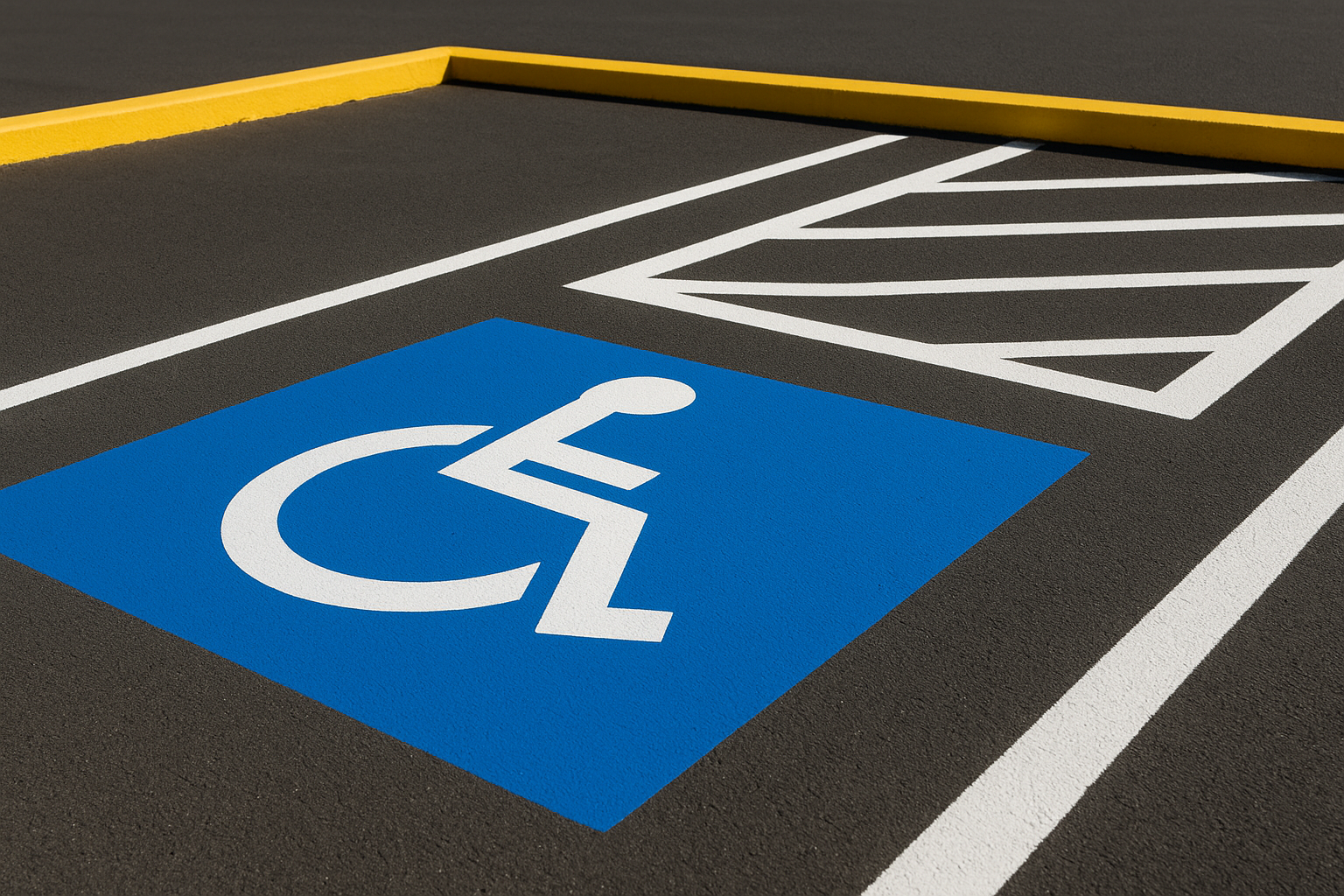
ADA-compliant handicap stalls require precise dimensions, correct symbols, proper access aisle placement, and appropriate signage to meet federal standards.
Complete Parking Lot Striping Services: What Is Typically Included
A full-service parking lot striping project covers several interconnected services. Understanding each one helps you plan your budget and communicate clearly with your contractor before the job begins.
Standard Stall Lines and Lot Layout Design
Standard stall lines form the backbone of every parking lot. Professional stripers use precision line striping machines to ensure consistent 4-inch line widths, proper stall dimensions (typically 8.5 to 9 feet wide by 18 to 20 feet deep), and straight, parallel rows. A well-designed layout also accounts for drive aisle widths — typically 24 feet for two-way traffic and 18 to 20 feet for one-way aisles. Learn more about parking lot striping services in our complete guide.
Furthermore, an experienced crew will evaluate your lot’s geometry to maximize space count without sacrificing safety. In some cases, angling stalls at 60 or 90 degrees — depending on aisle orientation — can meaningfully increase capacity.
ADA Handicap Stalls and Access Aisle Markings
ADA markings are among the most critical and closely scrutinized elements of any parking lot striping project. These include the ISA symbol painted in the stall, access aisle hash marks, and “VAN ACCESSIBLE” stenciling where required. Additionally, the color of the ISA symbol — typically blue with white contrast — must be legible and properly sized for compliance.
Fire Lane Marking and Red Curb Painting
Fire lane markings are required by the International Fire Code and enforced by local fire marshals. These markings typically include red-painted curbs and stenciled “FIRE LANE – NO PARKING” text along designated emergency access zones. Specifically, fire lane widths, clearances, and placement relative to building access points are all governed by code. Maintaining these markings ensures emergency vehicles can always reach your building quickly — and keeps your property free of fire code citations.
Directional Arrows, Crosswalks, and Specialty Stencils
Directional arrows, “STOP” text, pedestrian crosswalk stripes, speed bump markings, reserved space designations, and numbered stall markers all contribute to a safe, well-organized lot. These elements are especially important in larger lots where visitors may be unfamiliar with the layout. Moreover, clear pedestrian crosswalk markings near building entrances significantly reduce the risk of pedestrian-vehicle conflicts — a key liability concern for retail and healthcare properties.
New Lot Layouts vs. Restriping Existing Lots
New parking lot striping — applied to freshly paved or bare asphalt — requires careful planning and measurement to establish the layout from scratch. In contrast, restriping refreshes faded or worn markings on an existing lot. Both require professional equipment and expertise, but new layout jobs additionally involve a design phase where the contractor maps out stall placement, aisle widths, ADA stall locations, and traffic flow patterns before a single line is painted.
For a detailed look at everything included, visit the parking lot striping services page at stripespls.com. For a deeper walkthrough, see our Who Provides the Best Parking Lot Striping in Denton? A Complete Guide.
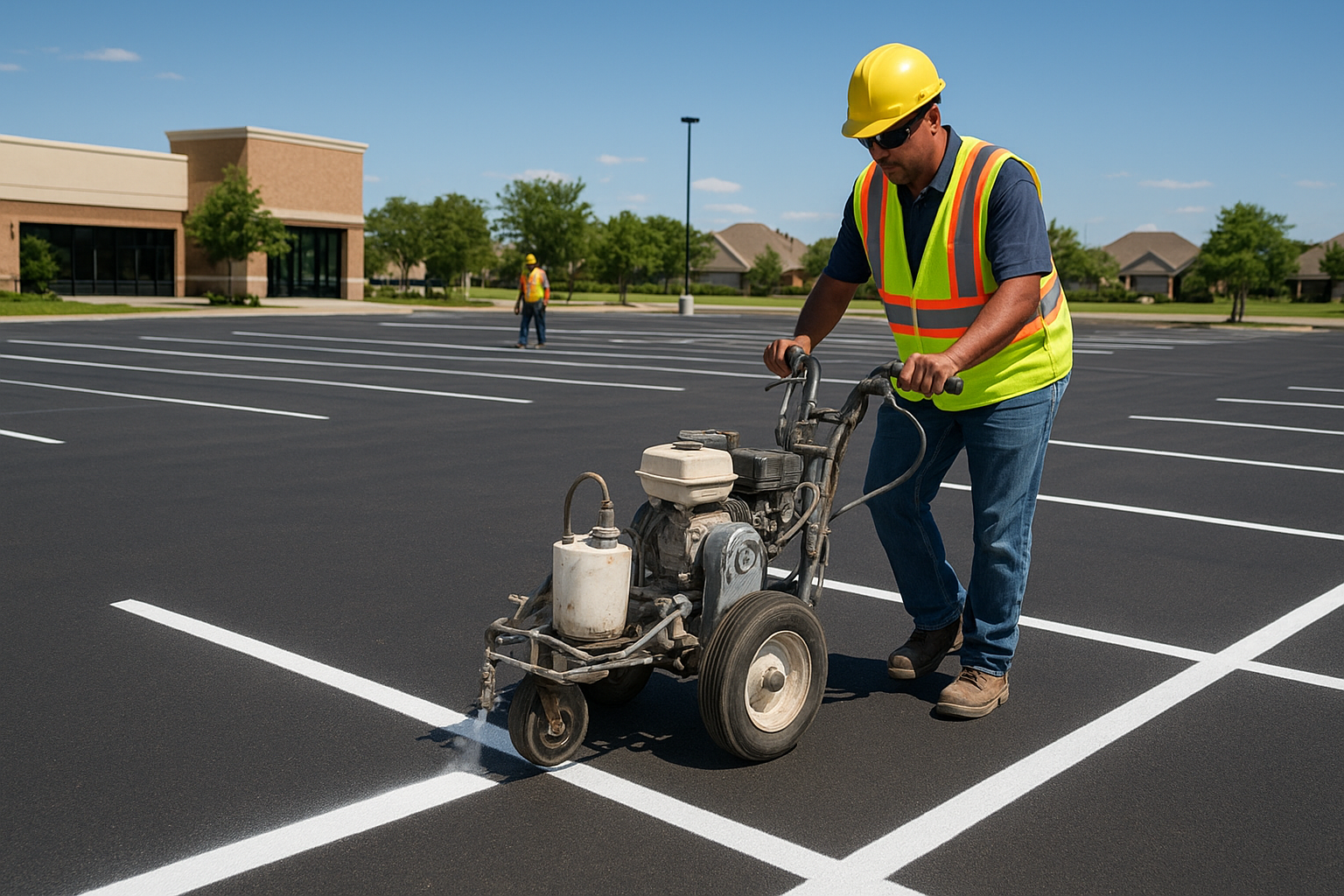
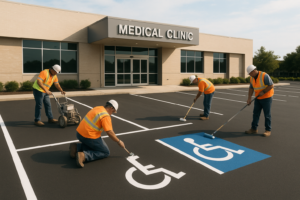
A professional striping crew uses precision equipment to deliver straight, durable, code-compliant lines on commercial and municipal parking surfaces; see PLS parking lot striping for examples of our equipment and crew in action.
Types of Paint Used for Parking Lot Striping
Not all parking lot paint is the same. The two most common types are water-based latex traffic paint and oil-based alkyd paint, and each has distinct trade-offs worth understanding before your project begins.
- Water-based latex traffic paint — dries in as little as 15 to 30 minutes, is lower in VOCs (volatile organic compounds — airborne chemicals released during drying), and is easier to apply in varying temperatures. It is the most common choice for standard commercial restriping projects.
- Oil-based alkyd paint — dries more slowly (typically 1 to 2 hours) but offers superior durability in high-traffic, high-wear environments. It is often used on busy drive lanes or lots exposed to heavy vehicle turning loads.
- Epoxy or thermoplastic coatings — premium options used in specialty applications such as parking garages, airport aprons, or lots requiring extremely long service life. These are more expensive but can last 5 to 7 years under ideal conditions.
Your striping contractor should recommend the right paint type based on your lot’s traffic volume, surface condition, climate, and budget. In particular, lots in regions with intense UV exposure or heavy rainfall may benefit from premium paint formulations that resist fading and moisture penetration more effectively.
How to Get Your Parking Lot Striped: A Step-by-Step Guide
Getting professional line marking service is straightforward when you follow a clear process; read about the long-term benefits in professional striping benefits. Here is a step-by-step guide to arranging parking lot striping for your commercial property:
- Assess your lot’s current condition. Walk the entire surface and note faded stall lines, missing ADA symbols, worn fire lane markings, and any areas where traffic flow is unclear. Take photos for reference — these will help your contractor assess scope and price the job accurately.
- Request a free, itemized quote. Contact a professional striping company with your lot dimensions, approximate number of spaces, and any specific needs — such as ADA compliance updates, fire lane work, or a complete new layout. Reach out to stripespls.com for a no-obligation estimate tailored to your property.
- Review the proposed layout plan. Before any paint is applied, work with the crew to confirm stall dimensions, traffic flow direction, ADA stall placement, fire lane zones, and any curb or signage requirements. A good contractor provides a written layout plan — insist on seeing it in advance.
- Prepare the surface and schedule the work. Coordinate a time when the lot can be fully or partially closed. Ensure the surface is clean, dry, and free of debris — dust, oil stains, and moisture prevent proper paint adhesion. If the lot has recently been seal-coated, confirm the sealant has fully cured before striping begins.
- Inspect the completed work before reopening. After the paint cures, walk the lot with the crew to verify all lines are straight and correctly spaced, ADA symbols and access aisles are properly placed, fire lanes are clearly designated, and no touch-ups are needed. Document the completed work with photos for your records.
Following this process reduces the chance of costly rework. Additionally, documented proof of professional striping work is valuable if you ever face an ADA audit, fire code inspection, or insurance claim.
How Much Does Parking Lot Striping Cost?
Parking lot striping costs vary based on lot size, number of spaces, services required, and local labor rates. However, the following general ranges give a useful starting point for budgeting purposes:
- Basic restripe (small lot, 20–50 spaces): $200 – $500
- Mid-size commercial lot (50–150 spaces) with ADA markings: $500 – $1,500
- Large commercial property with ADA, fire lanes, and directional work: $1,500 – $4,000+
- New lot layout from scratch (including design and measurement): Priced per project scope — request a custom quote
- Individual ADA stall additions or fire lane stenciling: $50 – $200 per stall or zone
These figures are general estimates only. The most accurate pricing always comes from an on-site or photo-based assessment. Moreover, the cost of professional striping is almost always lower than the cost of a single ADA violation fine — making it one of the best-value preventive maintenance investments available to property owners. Request a free custom quote from stripespls.com to get exact pricing for your property.
How to Choose the Right Parking Lot Striping Company
Not all striping contractors deliver the same quality. Choosing the wrong crew can mean uneven lines, incorrect ADA dimensions, or paint that fades within months. Therefore, vetting your contractor carefully before signing anything is essential.
Key Questions to Ask Before Hiring a Striping Contractor
- Do you carry general liability insurance and workers’ compensation coverage?
- What type and brand of traffic paint do you use, and how long does it last in this climate?
- Will you provide a written layout plan before work begins?
- Are you familiar with current ADA Standards for Accessible Design and local fire code requirements?
- Do you offer a satisfaction guarantee or warranty on your work?
- Can you provide references from similar commercial projects in this area?
What Sets a Professional Striping Company Apart
A professional operation uses commercial-grade line striping machines — not handheld rollers or spray cans; see our ADA compliant striping guide for compliance details and stencil standards.
Stripespls.com is a locally operated, full-service parking lot marking company based in Texas, serving property owners across the region. The company brings expertise in ADA compliance, fire lane designation, new lot layouts, and restriping — all backed by a reputation for reliability and attention to detail. Property managers, retail centers, schools, healthcare facilities, and municipal organizations trust the team for precise, durable results. Visit the stripespls.com blog for additional tips on parking lot maintenance and compliance. See our Dallas line marking guide for regional examples.
Common Parking Lot Striping Mistakes — and How to Avoid Them
Even experienced property owners make avoidable mistakes when it comes to parking lot markings. Specifically, the following errors are the most common — and the most costly:
- Waiting until lines are completely invisible — Striping is far easier and more accurate over faded but visible lines. When markings are gone entirely, the crew must re-measure from scratch, which takes longer and costs more.
- Failing to update ADA markings after code changes — ADA standards are updated periodically. A lot striped to 2010 standards may not meet current requirements. A professional contractor will ensure your markings reflect the current version of the ADA Standards for Accessible Design.
- Using the wrong paint type for the surface or climate — Applying water-based paint over an oily or poorly prepared surface leads to premature peeling. Similarly, using interior-grade paint outdoors causes rapid fading.
- Striping over a wet or recently sealed surface — Paint applied to a surface that is damp or not fully cured will not bond correctly, leading to bubbling, peeling, and rapid wear.
- Hiring the lowest bidder without vetting credentials — Unlicensed or underinsured contractors may cut corners on materials, line accuracy, or ADA compliance — costing you far more in the long run.
- Skipping the post-project inspection — Always walk the completed lot with the crew before they leave. Errors are much easier and cheaper to fix immediately than after the contractor has packed up and left the site.
Parking Lot Striping for Different Property Types
Parking lot striping requirements vary significantly depending on the type of property. Each use type has specific needs — from ADA ratios to fire lane configurations to traffic flow priorities. Understanding these differences helps property managers ask the right questions and set the right expectations.
Retail and Shopping Center Parking Lots
Retail lots prioritize maximum space count, clear pedestrian crosswalk markings, fire lane compliance near storefronts, and prominent cart return area designations. High turnover means these lots experience significant paint wear. As a result, restriping every 12 to 18 months is often appropriate for busy shopping centers. For local options, see parking lot striping Denton.
Medical and Healthcare Facilities
Healthcare properties typically require a higher ratio of accessible spaces than standard commercial lots, given the patient population they serve. In addition, patient drop-off zones, ambulance access areas, and clearly marked emergency vehicle lanes must all be factored into the striping plan. Compliance is especially critical at facilities serving patients with mobility limitations. We also serve nearby regions — learn about parking lot striping Fort Worth.
Schools, Universities, and Municipal Properties
Educational and government-owned properties often require clearly marked bus lanes, parent pick-up and drop-off zones, visitor spaces, and accessible parking areas — all while meeting the same federal ADA requirements as private commercial properties. Furthermore, these lots often serve large volumes of pedestrian traffic, making crosswalk visibility a top priority.
Office Parks and Multi-Tenant Commercial Properties
Office park striping often involves numbered stalls, reserved executive spaces, visitor zones, and EV charging area designations — an increasingly common request as electric vehicle adoption grows. Specifically, EV charging spaces must be positioned to allow charger cable reach without creating trip hazards across driving lanes.
Frequently Asked Questions About Parking Lot Striping
What is parking lot striping and what does it include?
Parking lot striping is the professional application of painted lines, symbols, and stencils on paved surfaces to define stalls, guide traffic, and ensure ADA and fire lane compliance. A complete project typically includes stall lines, ADA handicap markings, fire lane designations, directional arrows, crosswalks, and specialty stencils.
How often should a parking lot be restriped?
Most commercial parking lots need restriping every 1 to 2 years. High-traffic lots or those in regions with intense sun and weather exposure may need annual attention. After sealcoating, restriping is always required since sealant covers existing markings completely.
What ADA requirements apply to parking lot striping?
The ADA requires a specific number of accessible spaces based on total lot capacity, along with minimum stall widths of 8 feet, 5-foot access aisles (8 feet for van-accessible stalls), International Symbol of Accessibility placement, and proper signage. Non-compliance can result in fines up to $75,000 for a first violation.
How much does parking lot striping cost?
Costs depend on lot size, number of spaces, and services required. A basic restripe for a small lot may start around $200 to $500. Larger commercial lots with ADA markings, fire lanes, and directional work can range from $1,500 to $4,000 or more. Contact stripespls.com for a free custom quote.
How long does parking lot striping take to dry?
Water-based traffic paint typically dries in 15 to 30 minutes under normal conditions. However, most professionals recommend keeping vehicles off freshly painted lines for at least 1 hour to ensure full adhesion and a clean, durable finish.
What types of paint are used for parking lot striping?
The two most common options are water-based latex traffic paint (fast-drying, lower VOCs, ideal for most restripe projects) and oil-based alkyd paint (slower-drying but more durable in high-wear areas). Epoxy and thermoplastic coatings are premium options used in specialty applications like parking garages.
Do I need a permit for parking lot striping?
Routine restriping of existing markings typically does not require a permit. However, new lot layouts or significant changes to traffic patterns may require local municipality approval. A professional striping contractor can advise you on requirements specific to your area.
What is the difference between new striping and restriping?
New striping refers to applying markings on a freshly paved or bare surface for the first time, which requires full layout planning and measurement. Restriping means refreshing faded or worn markings on an existing lot to restore visibility, compliance, and organization.
Can parking lot striping improve traffic flow and safety?
Yes — significantly. Well-planned parking lot striping improves traffic flow by clearly defining drive aisles, entry and exit points, turning areas, and pedestrian crossings. Directional arrows and clear stall markings reduce confusion, lower the risk of low-speed collisions, and improve the overall experience for drivers and pedestrians alike.
What are fire lane markings and why are they required?
Fire lane markings are painted curbs and stenciled zones that designate areas where parking is prohibited to ensure emergency vehicle access. They are mandated by the International Fire Code and enforced by local fire marshals. Failing to maintain them can result in citations and, more critically, delayed emergency response.
What are the most common parking lot striping mistakes property owners make?
The most common mistakes include delaying restriping until lines are completely invisible, failing to update ADA markings after code revisions, using the wrong paint type for the climate or surface, striping over a wet or uncured sealcoated surface, and hiring unvetted contractors who cut corners on materials or compliance. A professional striping company eliminates all of these risks.
Conclusion: Why Professional Parking Lot Striping Is Worth Every Dollar
Parking lot striping is far more than a cosmetic upgrade — it is a practical, legally required investment in safety, compliance, and the professional image of your property. Fresh, precise markings protect you from ADA liability and fire code citations, improve traffic flow, reduce accident risk, and demonstrate that your property is well-managed and safe for every visitor. Furthermore, proactive restriping is always more affordable than addressing violations, accidents, or enforcement actions after the fact.
Whether you need a complete new layout, an ADA compliance update, fire lane marking, or a simple refresh of faded lines, working with an experienced professional ensures the job is done right — with the right materials, accurate dimensions, and full code compliance. According to the National Fire Protection Association, maintaining clear fire access markings is among the most important ongoing responsibilities for commercial property owners.
Take the first step today. Visit stripespls.com to learn more about available services, or request your free quote and give your parking lot the professional finish it deserves — and that your customers, tenants, and visitors expect.