ADA parking lot compliance Texas is a legal obligation that applies to virtually every commercial, retail, and public parking facility in the state. Failing to meet it exposes property owners to federal lawsuits, TDLR enforcement actions, and expensive retrofits. This guide covers every requirement — from space counts and dimensions to signage, slope, and maintenance — so you can protect your business and serve every customer safely.
The Americans with Disabilities Act (ADA) — signed into federal law in 1990 — sets nationwide minimum standards for accessible parking. However, Texas also enforces the Texas Accessibility Standards (TAS) through the Texas Department of Licensing and Regulation (TDLR). In some cases, TAS goes further than federal requirements. Together, these two frameworks define what a fully compliant parking lot must look like in the Lone Star State.
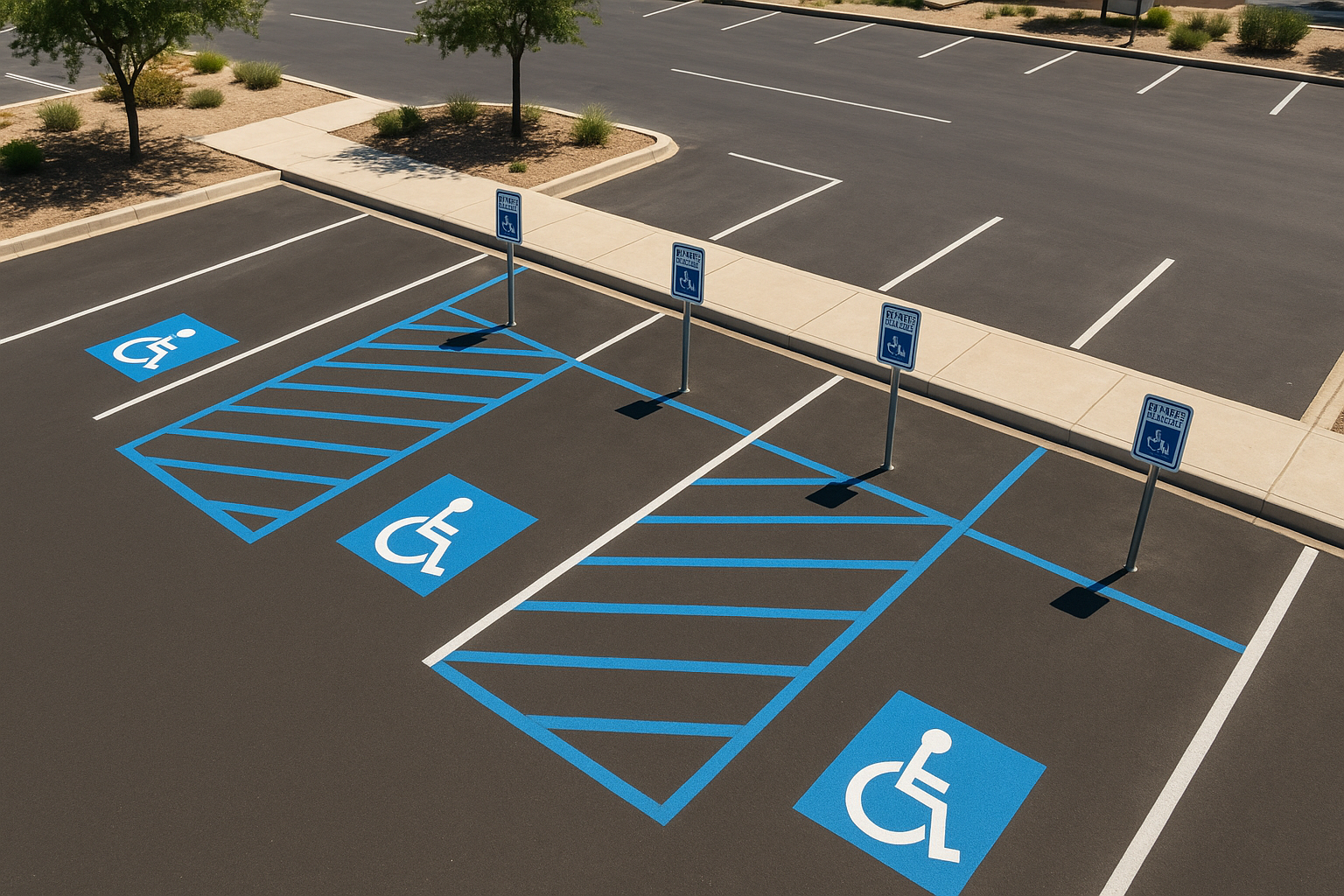
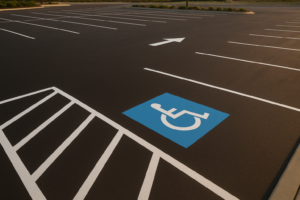
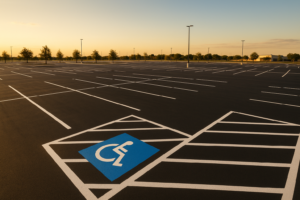
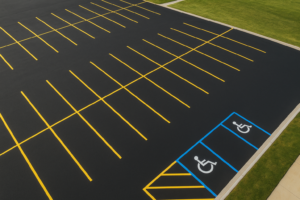
A properly striped Texas parking lot with ADA-compliant accessible spaces, access aisles, and van-accessible signage. For a deeper walkthrough, see our ADA compliant parking lot.
What Is ADA Parking Lot Compliance in Texas?
ADA parking lot compliance in Texas means satisfying both the federal ADA Standards for Accessible Design and the state’s Texas Accessibility Standards. In practice, this covers six core areas: the number of accessible spaces, their dimensions, surface slope, access aisles, signage, and proximity to building entrances.
Both sets of rules apply to new construction and to alterations. Furthermore, Title III of the ADA requires existing facilities to remove barriers when doing so is “readily achievable” — meaning businesses cannot claim an older lot is exempt simply because it predates the law. As a result, even properties built decades ago carry ongoing compliance obligations.
Who Must Comply?
Title III of the ADA applies to places of public accommodation — retail stores, restaurants, medical offices, hotels, shopping centers, and most other commercial facilities open to the public. State and local government facilities fall under Title II and face equally strict — sometimes stricter — requirements. In Texas, TAS enforcement covers most new construction and renovation projects regardless of ownership type.
Religious organizations are largely exempt from Title III. However, private nonprofits without a religious affiliation must still comply. Additionally, Texas state building codes and TAS may apply to construction and renovation work regardless of federal exemption status.
How Many Accessible Spaces Does Your Texas Lot Require?
The required number of accessible spaces scales directly with the total size of the parking facility. The table below reflects the minimums established by the ADA Standards for Accessible Design — which are also incorporated into TAS:
For lots exceeding 1,000 spaces, 20 accessible spaces are required plus 1 for each additional 100 over 1,000. At least 1 in every 6 accessible spaces must be van-accessible — regardless of total lot size.
Special-Use Facilities: Higher Ratios May Apply
Standard ratios apply to most parking lots, but certain facility types require more accessible spaces. Specifically, outpatient medical facilities must provide 10% of total spaces as accessible. Facilities that primarily serve people with mobility disabilities — such as rehabilitation centers — must make 20% of spaces accessible. Therefore, if your facility has a medical or specialized use, confirm which ratio applies before finalizing your layout.
Dimensions, Access Aisles, and Surface Slope Requirements
Getting the dimensions exactly right is non-negotiable for ADA parking lot compliance in Texas. Standard accessible spaces must be at least 8 feet wide with a 5-foot access aisle on one side. Van-accessible spaces require either an 11-foot-wide space with a 5-foot aisle, or an 8-foot space with a wider 8-foot aisle. Both configurations provide enough room for a side-deploying wheelchair lift or ramp to operate safely.
Access Aisle Rules
Access aisles must be marked with bold diagonal striping so that drivers cannot mistake them for parking spaces. Furthermore, they must connect directly to an accessible pedestrian route leading to the building entrance — not a route that forces wheelchair users into traffic lanes. Two adjacent accessible spaces may share one access aisle, which allows lot designers to maximize overall space efficiency.
Access aisles must be kept clear at all times. Shopping cart corrals, utility equipment, landscaping planters, and temporary signage placed inside an aisle all create an immediate compliance failure — even if the parking space itself is correctly marked.
Surface Slope: The Most Overlooked Requirement
Surface slope is a critical and frequently overlooked detail. Both the parking space itself and its access aisle must have a slope no greater than 1:48 in any direction — approximately 2%. Even a slightly steeper grade can cause a wheelchair to roll unexpectedly, creating a serious safety hazard and an immediate violation.
In practice, many Texas lots require regrading before they can achieve full compliance. Parking areas that appear flat to the eye can still exceed 2% when measured accurately with a digital level or slope meter. Consequently, professional measurement — not visual estimation — is always recommended before certifying slope compliance.
Overhead Clearance for Van-Accessible Spaces
Van-accessible spaces — and the vehicle route leading to them — must provide at least 98 inches (approximately 8 feet, 2 inches) of overhead clearance. This is particularly relevant in covered parking structures and garages where low-hanging beams, pipes, or signage can obstruct high-roof wheelchair-equipped vans. Many Texas garages that appear compliant fail this requirement at the entry gate or approach ramp.
Required Signage for Accessible Parking in Texas
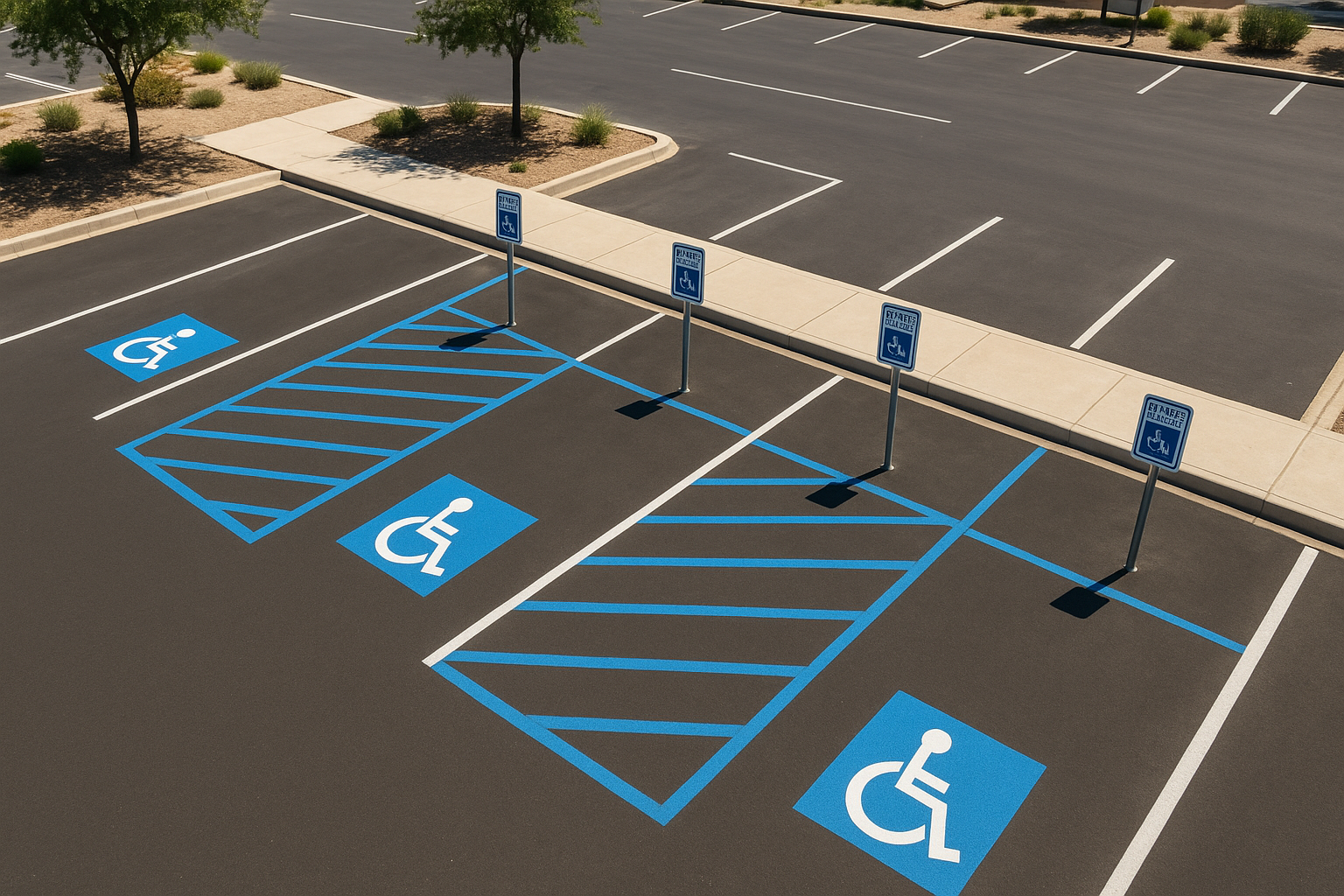
Proper signage is a distinct component of ADA parking lot compliance in Texas — and it is one of the easiest areas for inspectors to cite violations. Every accessible space must display the International Symbol of Accessibility (ISA) on a sign mounted at least 60 inches above the ground, measured from the bottom of the sign to the finished grade. This height keeps the sign visible even when a large pickup truck or SUV occupies an adjacent space.
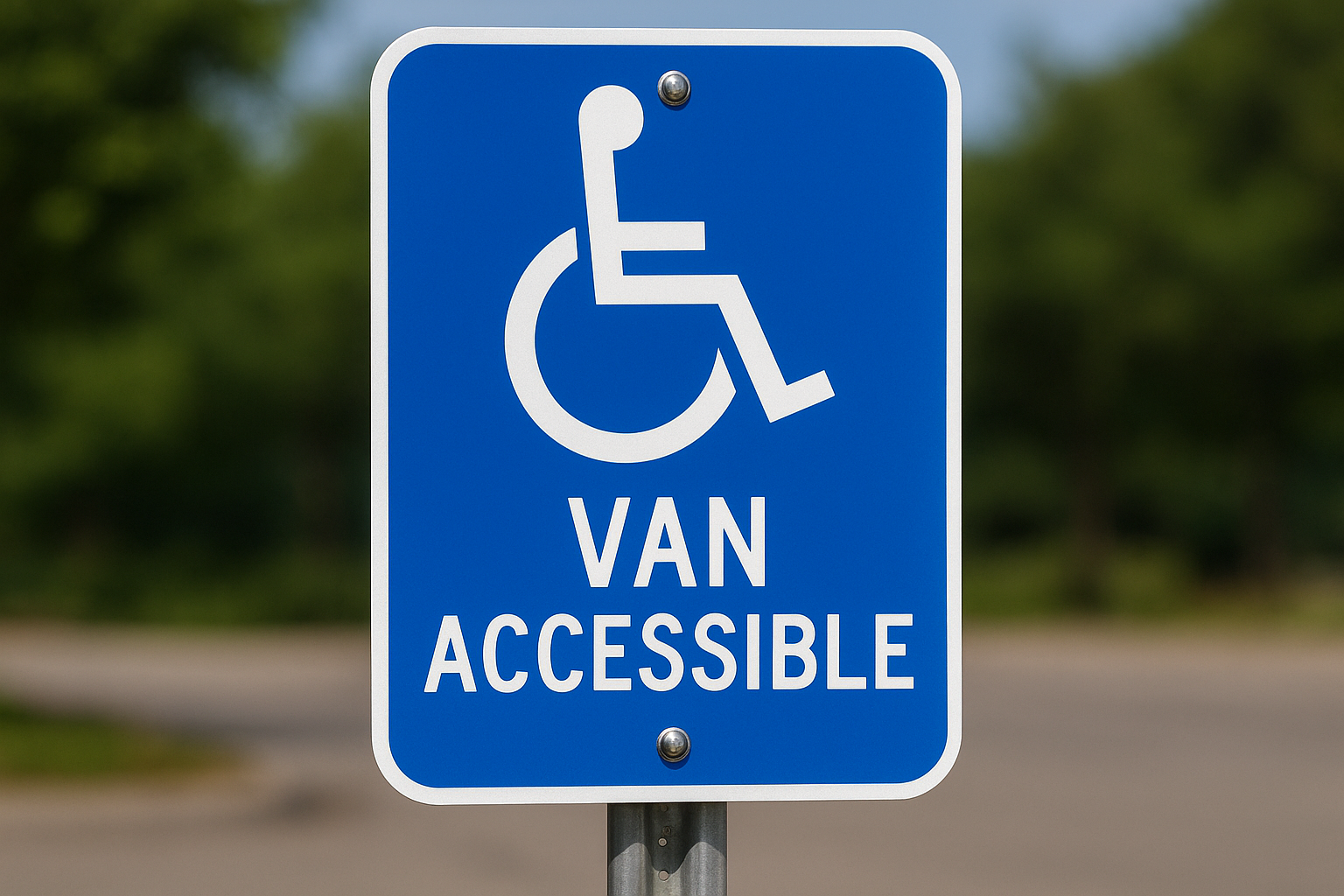
Correct van-accessible ADA signage mounted at the required 60-inch minimum height with the International Symbol of Accessibility.
Van-Accessible Signage Requirements
Van-accessible spaces need an additional sign reading “Van Accessible” mounted directly below the main ISA sign. This separate placard — not simply text added to the existing sign — is required by both federal ADA standards and TAS.
Texas Fine-Amount Notice Requirement
Texas state law adds an extra signage obligation that goes beyond federal requirements. Signs near accessible spaces must display the fine amount for illegal parking — currently ranging from $500 to $1,250 for a first offense under Texas Transportation Code §681.011. Many property owners overlook this state-specific rule entirely, which creates a separate, citable violation independent of the federal ADA sign requirements.
Pavement Symbol Marking
In addition to vertical signs, the International Symbol of Accessibility should be painted on the pavement surface of each accessible space. While the ADA primarily mandates vertical signage, TAS and most Texas local jurisdictions also require or strongly recommend the pavement ISA symbol. Painting it in white or blue on the asphalt provides a redundant visual cue and demonstrates a good-faith commitment to compliance.
Location Requirements: Where Must Accessible Spaces Be Placed?
Having the correct number of accessible spaces means nothing if they are placed incorrectly. Both the ADA and TAS require accessible parking spaces to be located on the shortest accessible route to the building entrance or facility they serve. This route must be accessible — meaning it must connect via a curb ramp, level walkway, or other compliant path rather than forcing users to cross traffic lanes.
Multiple Entrances and Dispersed Spaces
When a facility has multiple accessible entrances, accessible parking spaces must be dispersed among those entrances. You cannot cluster all accessible spaces near one entrance when other entrances are also accessible and regularly used. Similarly, if a parking structure serves multiple buildings, accessible spaces must be distributed to serve each building proportionally.
Passenger Loading Zones
When a facility provides a passenger loading zone — a designated drop-off area — at least one must be ADA-compliant. Compliant loading zones require an access aisle at least 60 inches wide and 20 feet long adjacent to the vehicle pull-up space. Furthermore, the vehicle pull-up area must have at least 114 inches of vertical clearance to accommodate high-roof vans. Many Texas facilities overlook loading zone requirements entirely, even when they carefully comply with parking space rules.
Texas Accessibility Standards (TAS) vs. Federal ADA: Key Differences
Texas enforces its own Texas Accessibility Standards through the TDLR for most new construction and renovation projects. While TAS closely mirrors the federal ADA Standards for Accessible Design, several important differences affect how Texas property owners must approach compliance.
- Plan Review Requirement: Under TAS, projects meeting certain cost thresholds must have plans reviewed and approved by a registered accessibility specialist before construction begins. The federal ADA does not impose a pre-construction review mandate.
- Inspection Requirement: TAS also requires post-construction inspection by a TDLR-registered accessibility specialist to confirm that the built project matches the approved plans. Federal ADA enforcement is complaint-driven and reactive; TAS enforcement is proactive.
- Cost Thresholds: Projects with a construction cost exceeding $50,000 generally trigger TAS plan review and inspection requirements. Smaller projects may be exempt, but it is the owner’s responsibility to determine applicability.
- TDLR Registration: Accessibility specialists who perform TAS reviews in Texas must be registered with the TDLR. Engaging an unregistered consultant does not satisfy the TAS requirement — even if that consultant is technically knowledgeable.
In contrast, existing lots not undergoing renovation are primarily governed by the federal barrier removal obligation under Title III. However, because TAS enforcement is active and serial ADA litigation is common in Texas, proactive compliance is always the safer and more cost-effective path.
For more detail on TAS requirements, the TDLR Architectural Barriers Program publishes current forms, fee schedules, and registered specialist directories on its official website.
Accessible Route from Parking to Building Entrance
Accessible parking spaces are only one part of the picture. The path from those spaces to your building entrance must itself be fully accessible. Specifically, the accessible route must:
- Be at least 36 inches wide (60 inches preferred at turn areas)
- Have a running slope no greater than 1:20 (5%) and a cross slope no greater than 1:48 (2%)
- Include curb ramps wherever the route crosses a curb — with detectable warning surfaces (truncated dome tiles) at transitions
- Have a stable, firm, and slip-resistant surface free of gaps, cracks, or level changes greater than ½ inch
- Not pass through a space used for parking or vehicle maneuvering
Many Texas properties correctly stripe their accessible spaces but then route wheelchair users across uneven concrete, through a landscaped area, or around a vehicle travel lane — all of which constitute separate ADA violations. Therefore, the accessible route must be evaluated alongside the parking spaces as one integrated system.
6 Steps to Bring Your Texas Parking Lot Into Full Compliance
Achieving full ADA parking lot compliance in Texas is entirely manageable when approached in a systematic order. Follow these six steps to address the most common deficiencies efficiently: For a deeper walkthrough, see our ADA Compliance Markings – Stripes Parking Lot Servies, Inc..
- Count your total spaces and calculate the required number of accessible spaces. Use the ADA ratio table above to determine the minimum count. Confirm whether your facility type — such as a medical office — triggers a higher ratio. Document the calculation for your records.
- Select and verify compliant locations. Position accessible spaces on the shortest accessible route to the building entrance, prioritizing spots that avoid routes crossing active traffic lanes. For facilities with multiple accessible entrances, distribute spaces proportionally among them.
- Measure dimensions and surface slope precisely. Use a tape measure to confirm each space and aisle meets minimum width requirements. Use a digital slope meter or level to verify the surface grade does not exceed 2% in any direction — including diagonal measurements. Do not rely on visual estimation alone.
- Evaluate and clear the accessible route. Walk the full path from each accessible space to the building entrance. Look for curb ramp presence and condition, surface gaps or cracks, cross-slope issues, and any obstructions. Address deficiencies before restriping — otherwise you risk creating a compliant space attached to a non-compliant route.
- Apply professional parking lot striping. Engage a qualified parking lot striping contractor — such as Stripes PLS — to paint accessible space markings, access aisle diagonal hash lines, and the ISA pavement symbol using durable, high-visibility paint that meets Texas heat and UV conditions. For a deeper walkthrough, see our Asphalt Striping: Guide to Parking Lot Line Marking.
- Install and verify all required signage. Mount the ISA sign at a minimum of 60 inches above grade. Add a “Van Accessible” placard below the ISA sign on qualifying spaces. Confirm that fine-amount notices required by Texas law are posted. Photograph all installed signs as documentation of compliance.
Common ADA Compliance Mistakes Texas Property Owners Make
Even well-intentioned property owners repeatedly fall into the same compliance traps. Knowing the most common mistakes in advance makes them far easier to avoid.
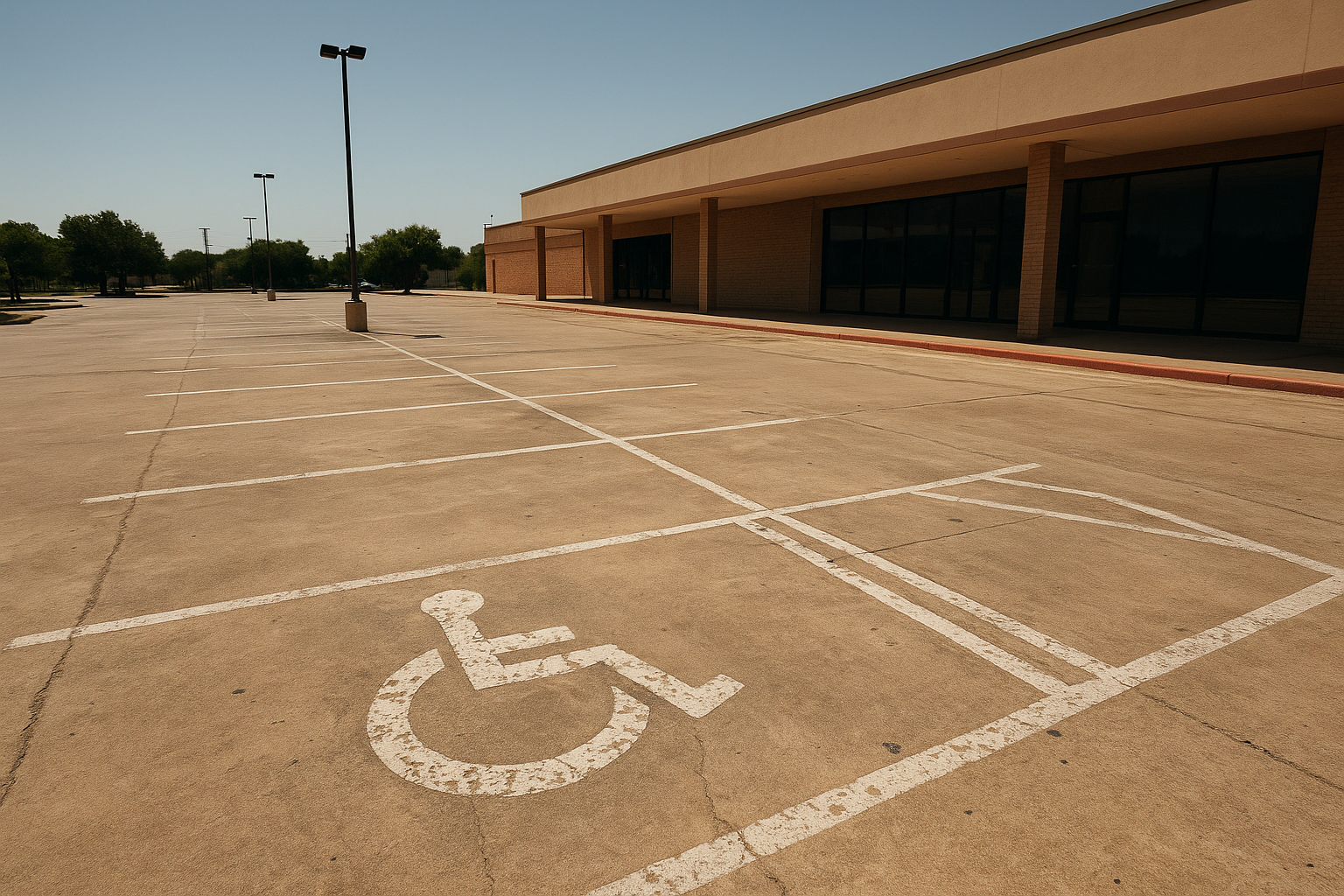
Faded pavement markings are among the most frequently cited ADA compliance deficiencies in Texas parking lots. For a deeper walkthrough, see our Accessible Parking Marking: ADA Compliance Guide for Lots.
- Incorrect space placement: Many lots have the correct number of accessible spaces but position them far from the entrance — a direct violation of proximity requirements. The accessible space closest to the entrance must always be designated accessible, not the one that is simply most convenient to stripe.
- Faded striping: Texas sun and UV exposure degrade paint quickly. Faded access aisle hash lines and ISA symbols are among the most cited deficiencies during inspections. Repainting every one to two years is a practical necessity, not optional maintenance.
- Missing or incorrect van-accessible spaces: Many lots lack a proper van-accessible space entirely. Others have one that doesn’t meet the 98-inch overhead clearance requirement on the vehicle approach route — a particularly common problem in covered parking structures.
- Blocked access aisles: Shopping cart corrals, seasonal displays, delivery pallets, landscaping planters, and utility equipment placed in access aisles create an immediate compliance failure — even when the parking space itself is correctly marked and dimensioned.
- Missing Texas fine-amount signage: Omitting the state-required fine-amount notice is a distinct, separately citable violation under Texas Transportation Code — one that federal ADA rules alone do not address.
- Non-compliant accessible routes: Correct parking space striping is meaningless if the route to the entrance crosses traffic, lacks a curb ramp, or has surface defects. Inspectors and ADA plaintiffs evaluate the entire accessible path — not just the painted spaces. For a deeper walkthrough, see our Curb Painting – Stripes Parking Lot Servies, Inc..
Addressing these issues proactively — with a professional striping service that understands both federal and TAS requirements — is far less expensive than defending an ADA lawsuit. In Texas, demand letters from serial ADA plaintiffs often arrive without prior warning, making preventive compliance the only reliable protection.
Enforcement, Penalties, and Litigation Risk in Texas
Understanding who enforces ADA parking lot compliance in Texas — and what the consequences are — is essential for every property owner and manager. For a deeper walkthrough, see our customized parking solutions.
Federal Enforcement: DOJ and Private Lawsuits
The U.S. Department of Justice enforces federal ADA requirements and can bring civil actions against non-compliant businesses. More commonly, however, enforcement comes from private lawsuits filed under Title III. Private plaintiffs can seek injunctive relief (a court order to fix the violations) and attorney’s fees. Because plaintiffs can recover legal costs, ADA litigation is financially attractive for plaintiff’s attorneys — particularly in Texas, which has a well-documented pattern of serial ADA filings.
TDLR Enforcement of TAS
The TDLR enforces TAS for new construction and renovation projects through its Architectural Barriers Program. Violations discovered during or after plan review can result in required design changes, construction delays, and administrative penalties. Additionally, the TDLR can receive and investigate complaints from members of the public about existing barriers — making ongoing compliance equally important after construction.
Parking Violation Fines for Unauthorized Parking
Local law enforcement handles citations for unauthorized parking in accessible spaces. Under Texas Transportation Code §681.011, first-offense fines range from $500 to $1,250. Subsequent violations carry higher penalties. Property owners are not fined for unauthorized drivers parking in their accessible spaces — but they are responsible for ensuring those spaces are correctly marked and signed to support citation and enforcement.
Why Ongoing Maintenance Is Part of ADA Compliance
Compliance is not a one-time event. In Texas, the combination of intense UV radiation, extreme heat, freeze-thaw cycles in northern regions, and heavy vehicle traffic degrades pavement markings faster than in most other states. A parking lot that passes inspection today can develop citable deficiencies within 18 months without proper maintenance.
A practical maintenance schedule should include:
- Annual visual inspection of all accessible space markings, access aisle striping, ISA pavement symbols, and signage condition For a deeper walkthrough, see our asphalt striping services.
- Repainting every 1 to 2 years in high-UV Texas environments, or sooner if markings become faded or unclear
- Slope re-verification after any pavement resurfacing or patching that could alter surface grade
- Sign replacement whenever panels are damaged, faded, or obscured by vegetation growth
- Accessible route inspection to identify new surface cracks, settlement, or obstructions that may have developed since the last review
Working with a professional parking lot striping company — such as Stripes PLS — that understands both federal ADA requirements and Texas-specific TAS rules ensures your markings meet current standards every time. Proactive maintenance is consistently cheaper than reactive litigation. For a deeper walkthrough, see our commercial parking lot maintenance.
ADA Compliance for Parking Lots: New Construction vs. Existing Facilities
The compliance obligations differ somewhat depending on whether your facility is newly constructed, undergoing renovation, or simply an existing property with no current construction activity.
New Construction
New construction must be fully compliant with both federal ADA standards and TAS from the outset. There is no “phase-in” period and no cost-based exception. Full plan review and inspection by a TDLR-registered specialist is required for projects above the applicable cost threshold.
Alterations and Renovations
When a parking lot is altered — including resurfacing, restriping, or reconfiguring spaces — the altered areas must be brought into full compliance. Furthermore, the ADA’s “path of travel” obligation means that alterations to the lot may also trigger a requirement to upgrade the accessible route to the building entrance, even if you are not directly touching that route. As a result, renovation budgets should always include an accessible route evaluation component.
Existing Facilities Without Current Renovation
Existing facilities that are not currently under construction must still remove accessibility barriers when doing so is “readily achievable” — that is, when removal can be accomplished without much difficulty or expense. The ADA provides no blanket exemption for older lots. Specifically, restriping faded markings, installing a missing curb ramp, or correcting signage height are all generally considered readily achievable — and therefore required.
Conclusion: ADA Parking Lot Compliance in Texas Is an Ongoing Responsibility
ADA parking lot compliance Texas requires sustained attention to space count, dimensions, slope, access aisles, accessible routes, signage, and regular maintenance. The stakes for getting it wrong are significant — federal lawsuits, TDLR enforcement actions, construction delays, and reputational damage are all real risks for non-compliant facilities. However, full compliance is entirely achievable with the right knowledge, a systematic approach, and a qualified striping contractor who understands both federal ADA standards and the Texas-specific TAS requirements that apply to your property.
Start with a thorough audit of your current lot, address deficiencies in the order outlined above, and schedule annual maintenance to keep your accessible parking spaces safe, visible, and legally sound for every visitor. Proactive compliance is always less expensive than reactive litigation — and it demonstrates a genuine commitment to making your facility welcoming for everyone.
Frequently Asked Questions About ADA Parking Lot Compliance Texas
What is ADA parking lot compliance in Texas?
ADA parking lot compliance in Texas means satisfying both the federal ADA Standards for Accessible Design and the state’s Texas Accessibility Standards for accessible spaces, signage, surface slopes, access aisles, and accessible routes. Both frameworks apply to most commercial and public parking facilities in the state, with TAS adding plan review and inspection requirements for qualifying construction projects.
How many accessible parking spaces are required in a Texas lot?
The required number scales with lot size. A lot with 1 to 25 spaces needs at least 1 accessible space; 26 to 50 spaces requires 2; and the ratio continues upward. At least 1 in every 6 accessible spaces must be van-accessible. Outpatient medical facilities must designate 10% of total spaces as accessible.
What is the minimum width for an ADA parking space in Texas?
Standard accessible spaces must be at least 8 feet wide with a 5-foot access aisle. Van-accessible spaces need either an 11-foot space with a 5-foot aisle, or an 8-foot space with an 8-foot aisle to accommodate wheelchair lift deployment.
Are van-accessible spaces required in every Texas parking lot?
Yes. At least one in every six accessible spaces must be van-accessible and must provide at least 98 inches of overhead clearance on the vehicle route leading to the space. This requirement applies to surface lots, structured garages, and covered parking facilities alike.
What slope is allowed for accessible parking spaces in Texas?
The maximum allowable slope is 1:48 — approximately 2% — in any direction for both the parking space and its access aisle. Steeper slopes create safety hazards for wheelchair users and constitute a compliance violation that must be corrected through regrading.
What signage is required for accessible parking spaces in Texas?
Each space must have a sign bearing the International Symbol of Accessibility mounted at least 60 inches above grade. Van-accessible spaces require an additional “Van Accessible” sign below the ISA sign. Texas law also requires fine-amount notices ($500 to $1,250 for a first offense) to be posted near accessible spaces — a state-specific requirement beyond federal ADA rules.
What fines apply for illegal parking in accessible spaces in Texas?
Under Texas Transportation Code §681.011, drivers who illegally park in an accessible space face fines from $500 to $1,250 for a first offense, with higher penalties for subsequent violations. Business owners with non-compliant lots separately risk federal civil lawsuits and injunctive relief under Title III of the ADA.
Does Texas have its own accessibility standards beyond the federal ADA?
Yes. The Texas Accessibility Standards, enforced by the TDLR, apply to most new construction and renovations. TAS mirrors federal ADA standards but adds mandatory pre-construction plan review and post-construction inspection by a TDLR-registered accessibility specialist for projects above certain cost thresholds.
How often should accessible parking striping be repainted in Texas?
There is no fixed legal interval, but best practice in Texas is to repaint every one to two years given intense UV exposure and heat. Faded access aisle hash lines and ISA pavement symbols are among the most frequently cited compliance deficiencies during inspections and in ADA demand letters.
Can a Texas business be sued for non-compliant accessible parking?
Yes. Under Title III of the ADA, individuals can file federal lawsuits seeking injunctive relief and attorney’s fees. Texas has a well-documented pattern of serial ADA litigation targeting parking lot deficiencies. Demand letters often arrive without warning, making proactive compliance the most reliable protection.
What is an access aisle and why is it required for ADA compliance?
An access aisle is a marked, level zone beside an accessible parking space that allows wheelchair users to safely exit and enter their vehicle without being blocked by adjacent parked cars. Without a correctly sized and clearly marked access aisle — free of obstructions — the parking space does not meet ADA or TAS compliance standards.
Who enforces ADA parking lot compliance in Texas?
The U.S. Department of Justice enforces federal ADA requirements and can bring civil actions against violators. The TDLR enforces TAS through its Architectural Barriers Program for new construction and renovations. Local law enforcement handles accessible parking violation citations under Texas Transportation Code.
Do churches and nonprofits need ADA-compliant parking in Texas?
Religious organizations are largely exempt from Title III of the ADA. However, private nonprofits without a religious affiliation must comply. Additionally, Texas state building codes and TAS may still apply to construction and renovation work at religious facilities regardless of federal exemption status.
Does restriping a parking lot trigger ADA compliance requirements in Texas?
Yes. Restriping — even without structural changes — is considered an alteration under ADA and TAS rules. Therefore, the restriped areas must be brought into full compliance. Additionally, the “path of travel” obligation may require upgrading the accessible route to the building entrance as part of the same project.