Parking lot striping is one of the most cost-effective investments a commercial property owner can make. Clear, professional pavement markings improve safety, maximize usable space, and create the kind of organized first impression that builds trust before a customer ever steps inside. Whether you manage a shopping center, office complex, warehouse, or medical facility, the condition of your parking lot speaks volumes about your property.
In this complete guide, we cover everything you need to know — from how parking lot striping works and when to schedule it, to layout planning, paint types, ADA compliance requirements, and how to choose the right professional striping contractor.
Quick Navigation: Use the headings below to jump to the section most relevant to your property. This guide covers the full scope of commercial parking lot striping — from basics to compliance.
What Is Parking Lot Striping and Why Does It Matter?
Parking lot striping refers to the process of applying painted lines, symbols, and markings to a paved surface to organize vehicle flow, define parking spaces, and communicate safety rules. Furthermore, it encompasses everything from standard stall lines and directional arrows to fire lane markings, ADA-compliant accessible spaces, and pedestrian crosswalks.
Most people overlook pavement markings until they fade. However, faded lines lead directly to driver confusion, inefficient use of space, liability exposure, and code violations. In contrast, a freshly striped lot communicates professionalism, reduces accidents, and helps your property operate at peak efficiency every single day.
The Business Case for Professional Striping
Specifically, well-executed parking lot striping delivers measurable benefits for commercial properties of every size:
- Improved curb appeal — clean lines signal a well-maintained, professional property
- Safer traffic flow — directional arrows and designated lanes reduce conflicts between vehicles and pedestrians
- Maximum space efficiency — a properly designed layout captures every usable stall
- ADA compliance — correctly marked accessible spaces protect you from fines and lawsuits
- Fire code adherence — visible fire lanes keep emergency access open and your property code-compliant
- Liability reduction — clear markings help establish reasonable standards of care if an accident occurs
According to the National Safety Council, parking lot accidents account for thousands of injuries each year in the United States. Therefore, clear and consistent pavement markings are not a cosmetic luxury — they are a fundamental safety measure.
Types of Parking Lot Striping and Pavement Markings
Not all parking lot markings serve the same purpose. In addition, different marking types carry specific regulatory requirements depending on your property type and local codes. Here is a breakdown of the most common categories:
Standard Parking Stall Lines
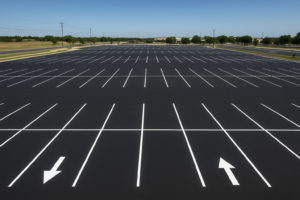
Standard stall lines define individual parking spaces. Typically, a standard parking space measures 8.5 to 9 feet wide and 18 to 20 feet deep, though dimensions vary by local code. Angled stalls (45° or 60°) are common in one-way traffic aisles, while 90° perpendicular stalls work best in two-way traffic layouts. Proper stall sizing prevents door-ding damage and keeps traffic moving efficiently.
ADA Accessible Parking Space Markings
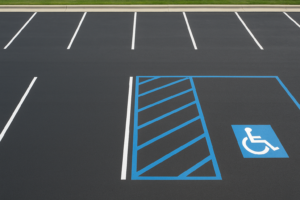
ADA-compliant accessible spaces require specific dimensions, signage, and access aisles as defined by the Americans with Disabilities Act (ADA) Design Standards. Specifically, a standard accessible space must be at least 8 feet wide with a 5-foot adjacent access aisle. Van-accessible spaces require an 8-foot access aisle. Furthermore, the number of required accessible spaces is proportional to the total number of stalls in your lot. Non-compliance can result in significant fines from federal or local enforcement agencies.
Fire Lane Markings
Fire lanes must remain clear at all times for emergency vehicle access. As a result, they are typically painted red with “FIRE LANE – NO PARKING” text stenciled along the curb or pavement surface. Most municipalities require fire lane striping to meet specific width and placement requirements. Faded fire lane markings are a common code violation that property owners often discover during fire marshal inspections.
Directional Arrows and Traffic Flow Markings
Directional arrows guide drivers through your lot safely, particularly in one-way traffic aisles or complex multi-entrance layouts. In addition, “STOP” stencils, yield markings, and speed bump notifications all contribute to a well-organized traffic flow pattern that reduces accidents and improve traffic flow.
Pedestrian Crosswalks and Safety Zones
Crosswalk striping clearly delineates safe paths for pedestrians moving between their vehicles and building entrances. Consequently, well-marked crosswalks significantly reduce the risk of pedestrian-vehicle conflicts. Safety hatching (diagonal lines within restricted zones) and curb markings further reinforce boundaries that keep both drivers and pedestrians safe.
Loading Zones, Reserved Spaces, and Specialty Markings
Loading docks, delivery zones, reserved employee spaces, visitor parking, EV charging station bays, and no-parking curb markings are all specialty striping categories. Similarly, stenciled text like “RESERVED,” “COMPACT,” “NO PARKING,” or tenant names help manage lot usage and reduce unauthorized parking disputes.
Parking Lot Striping Paint: Which Type Is Right for Your Lot?
The paint or coating material used for parking lot striping has a direct impact on durability, visibility, and long-term cost. There are three primary options used in commercial applications; see our pro lot striping guide for detailed comparison.
Water-Based Latex Paint
Water-based latex is the most widely used parking lot striping paint in the United States. It dries quickly (typically within 30 minutes), produces low VOC (volatile organic compound) emissions, and is easy to apply with standard line-striping equipment. However, it has a shorter lifespan than other options — usually 1 to 2 years under heavy traffic conditions. It is best suited for moderate-traffic lots or properties that restripe on a regular schedule.
Oil-Based Alkyd Paint
Oil-based alkyd paint offers greater durability and a richer color saturation than latex alternatives. As a result, it is commonly used for high-traffic commercial and industrial lots. The trade-off is longer dry time and higher VOC content, which means it may be restricted or require permits in certain jurisdictions. In addition, it typically costs more per gallon than water-based products.
Thermoplastic Pavement Markings
Thermoplastic is a hot-applied material that melts onto the pavement surface and bonds much more permanently than paint. Consequently, it is the most durable option available — lasting 5 to 7 years or longer even under heavy traffic. Furthermore, thermoplastic can incorporate glass beads for retroreflectivity (enhanced nighttime visibility). It is the preferred choice for crosswalks, fire lane markings, and high-wear areas. The upfront cost is higher, but the long lifespan often makes it more economical over time.
Pro Tip: In high-heat climates like Texas, water-based latex paint can degrade faster due to UV exposure and extreme surface temperatures. Ask your striping contractor about paint formulations specifically rated for hot-climate performance.
When to Schedule Parking Lot Striping or Restriping
Knowing when to restripe is just as important as knowing how it is done. Several conditions signal that your parking lot markings need attention:
- Lines are faded, cracked, or barely visible from a standing position
- Directional arrows and stenciled text have worn away
- You have recently had the lot seal coated or repaved
- Your ADA-accessible space count or layout no longer meets current code requirements
- You are reconfiguring the lot layout to add spaces or improve traffic flow
- Fire lane markings are faded and have triggered inspection concerns
- You have received complaints from tenants, customers, or delivery drivers about confusion in the lot
How Often Should a Parking Lot Be Restriped?
For most commercial lots with standard latex paint, parking lot restriping every 1 to 2 years is a reasonable maintenance cycle. High-traffic lots — such as grocery store parking lots, shopping malls, or busy office complexes — may need restriping annually or even more frequently. In contrast, thermoplastic markings can last 5 to 7 years before requiring replacement. Therefore, matching the paint type to your traffic volume is critical for long-term cost efficiency.
In Texas specifically, the intense summer heat and UV radiation accelerate paint degradation. As a result, many Texas commercial property owners find that annual restriping keeps their lots looking sharp and code-compliant year-round.
Parking Lot Layout Design and Space Planning
Effective parking lot striping starts with thoughtful layout design. A poorly designed layout wastes usable space, creates traffic bottlenecks, and frustrates visitors. Conversely, a well-planned layout maximizes every square foot and makes navigation intuitive.
Key Layout Factors to Consider
- Stall angle: 90° stalls maximize density; 45° and 60° angled stalls improve flow in one-way aisles
- Aisle width: Standard two-way aisles should be 24 feet wide; one-way aisles typically require 12 to 18 feet
- Entry and exit placement: Entrances and exits should align with natural traffic patterns to minimize conflicts
- Pedestrian pathways: Safe walking routes from parking to building entry should be clearly marked and unobstructed
- ADA space placement: Accessible spaces must be located on the shortest accessible route to building entrances
- Reserved and specialty zones: Loading docks, EV charging stations, and reserved areas should be positioned to minimize interference with general parking
In many cases, a professional parking lot striping contractor will assess your lot dimensions and help you develop a parking lot layout design that adds stalls, improves flow, and meets all applicable codes — all before a single line is painted.
ADA Compliance and Parking Lot Striping: What You Must Know
ADA compliance is not optional. The Americans with Disabilities Act establishes legally binding requirements for accessible parking spaces at any commercial facility open to the public. Failing to meet these requirements can expose your property to federal complaints, lawsuits, and mandatory remediation costs.
ADA Accessible Space Requirements at a Glance
- 1 to 25 total spaces: 1 accessible space required
- 26 to 50 total spaces: 2 accessible spaces required
- 51 to 75 total spaces: 3 accessible spaces required
- 76 to 100 total spaces: 4 accessible spaces required
- 101 to 150 total spaces: 5 accessible spaces required
- For every 6 accessible spaces required, at least 1 must be van-accessible
Additionally, accessible spaces must be marked with the International Symbol of Accessibility (ISA) — the familiar blue wheelchair symbol — both on the pavement surface and on a vertical sign posted at the front of the space. The access aisle must be marked with diagonal striping and labeled “NO PARKING.” These requirements are non-negotiable and are enforced independently of local building codes.
The Parking Lot Striping Process: Step by Step
Understanding the striping process helps you plan effectively and set realistic expectations. Professional parking lot striping typically follows a clear sequence of steps:
- Site Assessment and Measurement — The contractor walks the entire lot, measures dimensions, identifies existing markings, notes code requirements, and discusses layout goals with the property owner or manager.
- Layout Planning and Design — A scaled layout is developed showing stall placement, aisle widths, ADA space locations, traffic flow arrows, and specialty zones. This step ensures the final striping maximizes space and meets all applicable codes.
- Surface Cleaning and Preparation — The pavement surface is cleaned thoroughly using blowers and/or pressure washing to remove debris, dirt, and loose material. Clean surfaces are essential for paint adhesion and line sharpness.
- Layout Transfer and Chalk Lines — Key reference points are measured and marked on the pavement with chalk lines or paint dots to guide the striping machine precisely. This step prevents crooked or misaligned lines.
- Line Striping Application — A professional line striping machine applies paint in clean, consistent passes. Standard stall lines are typically applied at a 4-inch width. The operator follows the layout plan closely to maintain alignment and spacing throughout the lot.
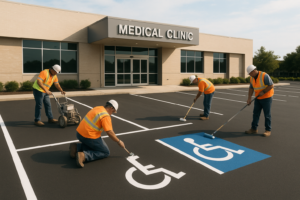
- Stenciling and Specialty Markings — Directional arrows, ADA symbols, “FIRE LANE,” “STOP,” “RESERVED,” and other stenciled markings are applied by hand using pre-made stencil templates after the main line work is complete.
- Drying and Final Inspection — Water-based latex paint typically dries within 20 to 30 minutes under normal conditions. The crew then performs a final walk-through to check alignment, coverage, and completeness before opening the lot to traffic.
Note on Timing: Most parking lot striping projects can be completed during off-peak hours or overnight to minimize disruption to your business operations. Coordinate with your contractor in advance to arrange a schedule that works for your tenants and customers.
How Much Does Parking Lot Striping Cost?
Cost is one of the most common questions property managers have about parking lot striping. Pricing varies based on several factors, but here is a general framework to help you plan your budget:
Factors That Affect Striping Cost
- Lot size and number of stalls: Larger lots with more stalls naturally cost more. Most contractors price by the linear foot or per stall.
- Paint type: Thermoplastic costs more upfront than water-based latex but lasts significantly longer.
- Scope of work: Simple restriping over existing lines costs less than a full new layout with fresh measurements and layout design.
- Number of specialty markings: ADA symbols, fire lane stenciling, directional arrows, and custom text add to total labor time and cost.
- Surface condition: Heavily degraded pavement may require crack filling or surface prep before striping can begin.
- Scheduling and access: Overnight or weekend work may carry a premium depending on the contractor.
Typical Parking Lot Striping Price Ranges
As a general reference, here are ballpark ranges commonly cited in the industry:
- Per stall (restripe): $2 to $5 per stall with standard latex paint
- New layout per stall: $5 to $10 per stall including layout measurement
- ADA space with symbol: $75 to $200 per accessible space including symbol and aisle striping
- Fire lane striping (per linear foot): $1 to $3 per linear foot
- Full lot restripe (small-medium lot): $500 to $2,000+ depending on size and complexity
Always request a detailed written quote from your contractor before work begins. Specifically, ensure the quote breaks out labor, materials, stall count, and any specialty markings separately so you can compare bids accurately.
New Lot Striping vs. Restriping: What Is the Difference?
Property owners often ask whether their project counts as new striping or restriping. Understanding the difference helps set accurate expectations for scope, cost, and timeline.
New striping applies to freshly paved or seal-coated lots with no existing lines, or to lots being reconfigured with a completely new layout. It requires full measurement, layout design, and careful planning. Therefore, it is the more complex and time-intensive option.
Restriping follows existing line locations on a lot where the layout is staying the same. The contractor simply paints over faded lines to restore visibility. As a result, restriping is faster, simpler, and less expensive than a full new layout — provided the original layout was well-designed and code-compliant.
If your original layout had flaws — awkward angles, insufficient ADA spaces, or inefficient aisle widths — restriping over old lines simply preserves those problems. In that case, a full layout redesign may be the smarter long-term investment.
Choosing the Right Parking Lot Striping Contractor
Not all striping contractors deliver the same quality. Furthermore, a poor striping job can create compliance issues, safety hazards, and an unprofessional appearance that reflects badly on your property. Here is what to look for when evaluating candidates:
What to Look for in a Striping Contractor
- Experience with commercial properties: Look for contractors who specialize in commercial parking lots, not just residential driveways.
- Knowledge of ADA and local code requirements: Your contractor should be able to confirm ADA space counts and dimensions without you having to look them up.
- Professional equipment: High-quality striping machines produce cleaner, more consistent lines than low-end sprayers. Ask about the equipment they use.
- Proof of insurance: General liability and workers’ compensation coverage are non-negotiable for any contractor working on your property.
- Portfolio of completed projects: Ask to see before-and-after photos of similar commercial properties they have striped.
- Clear written estimates: A professional contractor provides a detailed written quote, not a verbal ballpark figure.
- References: Ask for references from property managers or commercial clients they have worked with previously.
In addition, confirm that the contractor will handle all required permits if your municipality requires them for pavement marking work. Some jurisdictions require traffic control plans or permit applications for work in publicly accessible lots.
Parking Lot Striping for Different Property Types
Different commercial property types have distinct striping needs. Consequently, a one-size-fits-all approach rarely works. Here is a look at how requirements vary by property type:
Retail Shopping Centers
Retail lots handle high vehicle turnover throughout the day. Therefore, they benefit from wide aisles, clearly marked crosswalks near store entrances, designated fire lanes, and a generous allocation of accessible spaces near anchor tenants. Cart return zones and loading areas also require clear delineation.
Office Complexes and Corporate Campuses
Office parking lots often have reserved spaces for management, visitors, or specific tenants. Furthermore, structured layouts with clear directional flow support the predictable morning and evening traffic peaks typical at office properties. EV charging station markings are increasingly common at corporate campuses.
Industrial and Warehouse Facilities
Industrial sites require durable markings that can withstand heavy truck traffic, forklift movement, and harsh conditions. In addition, loading dock delineation, truck apron markings, and clearly defined pedestrian safety corridors are essential for worker safety and operational efficiency at warehouses and distribution centers.
Healthcare Facilities and Medical Offices
Medical facilities typically require a higher ratio of ADA-accessible spaces than many other property types due to their patient demographics. Similarly, patient drop-off zones, ambulance access lanes, and emergency vehicle routes all require precise, well-maintained striping. Clarity is especially important here because visitors are often stressed and unfamiliar with the facility.
Frequently Asked Questions About Parking Lot Striping
How long does parking lot striping take to dry?
Water-based latex paint used for most parking lot striping dries to the touch within 20 to 30 minutes under normal temperature and humidity conditions. However, in cooler weather or high humidity, drying can take longer. Thermoplastic markings cool and harden within minutes of application. Your contractor will advise on when the lot can safely reopen to traffic.
Can parking lot striping be done in the rain?
No — paint will not adhere properly to a wet pavement surface. Specifically, water-based latex requires a dry surface and ideally temperatures above 50°F for proper adhesion and curing. Most professional contractors monitor weather forecasts closely and reschedule if rain is expected. Similarly, striping should not be applied to a freshly seal-coated surface until it has fully cured (typically 24 to 48 hours minimum).
What is the standard width of parking lot striping lines?
Standard parking stall lines are typically 4 inches wide. However, some municipalities or property types require 6-inch lines for enhanced visibility. Fire lane lines and curb markings are often wider — sometimes 6 to 8 inches — to ensure they stand out clearly. Your contractor will confirm the correct width specifications for your location and lot type.
Do I need a permit for parking lot striping?
In most cases, restriping a private commercial parking lot does not require a permit. However, when changing the layout significantly — such as adding or removing spaces — or when the lot is adjacent to a public right-of-way, a permit may be required. Additionally, ADA modifications may trigger a plan review requirement in some jurisdictions. Always verify with your local building or zoning department before beginning work.
What color paint is used for parking lot striping?
White is the standard color for most parking stall lines, directional arrows, and pedestrian markings. Yellow is commonly used for fire lane curbs, no-parking zones, and safety warnings. Blue is reserved exclusively for ADA-accessible spaces and their access aisles. Red is used for fire lane pavement markings where required by local code. These color conventions are widely recognized and help drivers quickly interpret lot markings.
How do I maintain my parking lot stripes between restriping cycles?
Regular sweeping and debris removal extend the life of parking lot striping by preventing abrasion from grit and gravel. In addition, applying a quality sealcoat to the pavement every 2 to 3 years before lines become severely faded can protect both the asphalt and the markings. When sealcoating is done, plan for immediate restriping afterward since sealcoat covers all existing lines.
Professional Parking Lot Striping Services for Commercial Properties
At Stripes Parking Lot Services, Inc., we specialize in professional parking lot striping in Denton for commercial properties across Texas. Our team handles everything from fresh layouts on newly paved lots to routine restriping cycles, ADA compliance updates, fire lane markings, and specialty stenciling — all with the precision and durability your property deserves.
We serve retail centers, office complexes, industrial facilities, healthcare campuses, and multi-family residential properties. Furthermore, we coordinate scheduling to minimize disruption to your operations — including after-hours and weekend availability. Every project includes a thorough site assessment, a detailed written quote, and a final inspection to make sure the work meets your expectations.
Learn more about our complete pavement marking services or explore our asphalt striping guide to understand how regular striping fits into a comprehensive lot care program. You can also contact our team to schedule a free on-site estimate for your property.
Conclusion: Get the Most From Your Parking Lot Striping Investment
Parking lot striping is far more than a cosmetic touch-up. It is a critical component of property safety, ADA compliance, efficient space utilization, and professional appearance. Specifically, well-executed striping reduces accidents, satisfies legal requirements, maximizes your available stalls, and tells every visitor that your property is managed with care and attention to detail.
Whether you need a complete new layout, a routine restripe, or targeted compliance updates, understanding the process — paint types, layout principles, ADA requirements, contractor selection, and cost factors — puts you in the best position to make smart decisions for your property. Above all, regular, professional parking lot striping is one of the highest-return maintenance investments available to commercial property owners. Do not wait until your lines disappear entirely — schedule your striping service before your lot starts working against you.