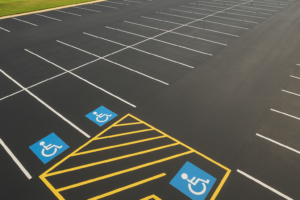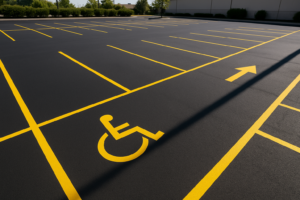

Parking lot striping is one of the smartest maintenance investments a commercial property owner in the Dallas-Fort Worth area can make — yet it is frequently deferred until lines vanish, fender-benders multiply, or an ADA audit triggers expensive penalties. Across the DFW metroplex, professionally striped parking lots do far more than look tidy. They channel traffic safely, protect businesses from liability, maximize available stall count, and guarantee that every visitor — including those with disabilities — can park legally and without confusion.
In this complete guide, you will find everything you need about parking lot striping in North Texas: what the process involves, how ADA compliance works, how much it costs, when to restripe versus start fresh, which paint types perform best in the Texas heat, and exactly how to choose the right local contractor. Whether you manage a retail center in Plano, a medical campus in Irving, or a school in Denton, this resource covers every angle.
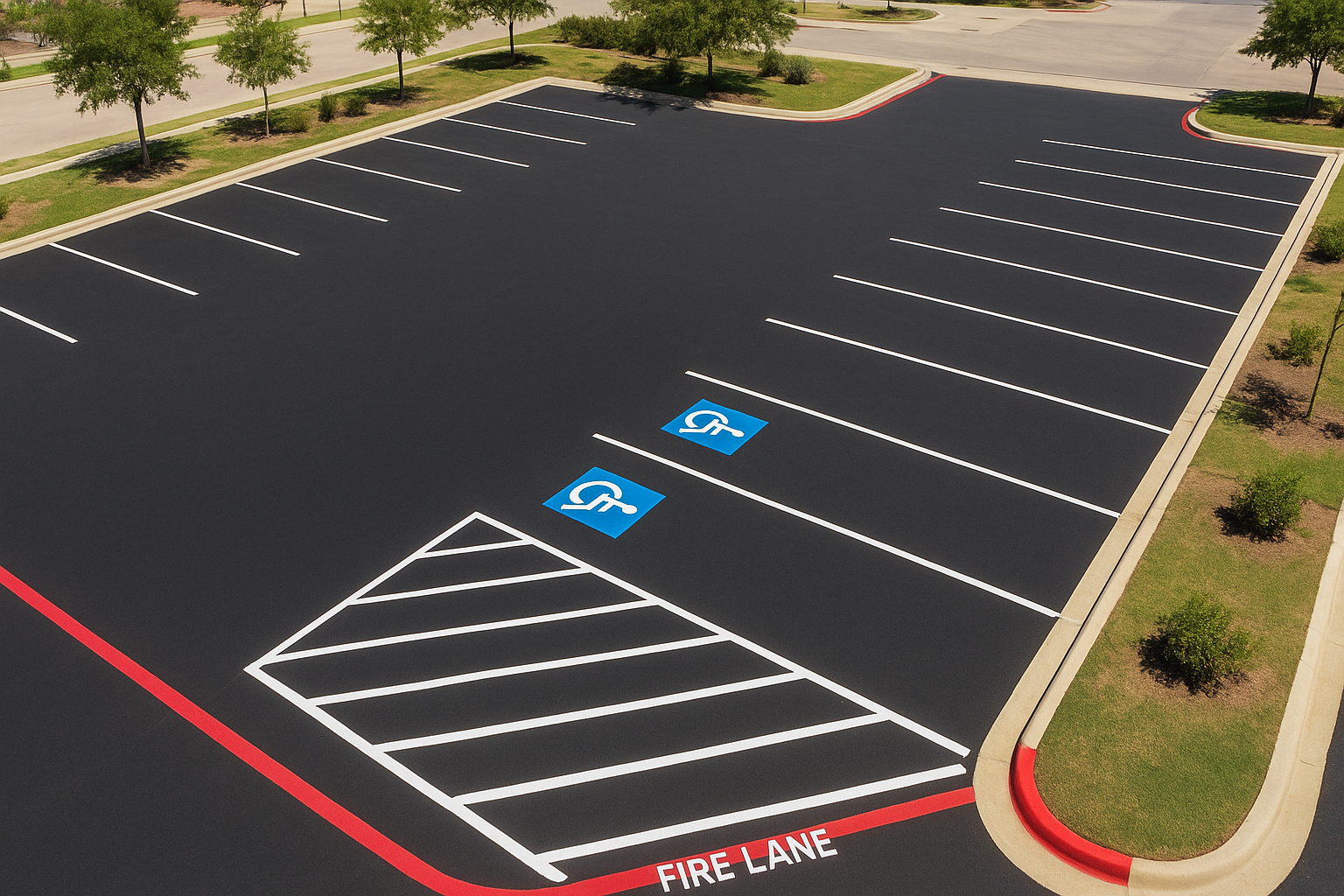
A freshly striped commercial parking lot in the DFW area — complete stall lines, ADA accessible markings, fire lane designations, and directional arrows in one professional layout. For a deeper walkthrough, see our Parking Lot Striping Services: Complete Guide 2025.
What Is Parking Lot Striping — and Why Does It Matter in DFW?
Parking lot striping is the professional application of painted lines, symbols, stenciled letters, and directional markings on paved parking surfaces. In the DFW context, this work spans everything from standard white stall lines and yellow curb paint to ADA-compliant handicap symbols, van-accessible access aisles, fire lane designations, crosswalk markings, stop bars, and speed bump indicators.
According to the ADA National Network, accessible parking requirements apply to virtually every public-facing facility in the United States — making correct striping a legal necessity, not a cosmetic option. Furthermore, the Texas Department of Licensing and Regulation (TDLR) enforces state-level accessibility standards that sometimes exceed federal ADA minimums. As a result, North Texas property owners must satisfy both frameworks simultaneously.
The DFW metroplex is also one of the fastest-growing regions in the country. According to U.S. Census data, DFW added more residents than any other metro area between 2020 and 2023. More residents means more vehicles, more commercial development, and — consequently — a greater demand for organized, clearly marked parking facilities at every type of property.
Key Benefits of Professional Parking Lot Markings
- Improved traffic flow — Directional arrows and clearly defined lanes eliminate confusion, reduce accidents, and keep vehicles moving efficiently through your lot.
- ADA and TDLR compliance — Correctly sized accessible stalls, van-accessible spaces, and proper access aisles protect against federal and Texas state penalties.
- Fire safety and emergency access — Visible fire lane markings ensure emergency vehicles can reach your building without obstruction at any time.
- Maximized stall capacity — A professionally planned layout can increase usable stall count by 10 to 15 percent over an unplanned arrangement, according to estimates from the National Parking Association.
- Professional curb appeal — Fresh, crisp lines signal a well-maintained, welcoming property to every customer and tenant who pulls in.
- Reduced liability exposure — Clear markings reduce the risk of parking-related accidents, slip-and-fall incidents near lane edges, and ADA-related lawsuits.
Why Texas Heat Makes Regular Parking Lot Striping Essential
The North Texas climate is uniquely harsh on parking lot paint. Intense UV radiation, summer surface temperatures that regularly exceed 150°F on asphalt, and seasonal freeze-thaw cycles during winter cause stall lines to fade significantly faster than in cooler regions. In most DFW parking lots, standard water-based traffic paint begins losing visibility within 18 to 24 months — and high-traffic areas deteriorate even faster.
Consequently, parking lot striping in DFW is not a one-time project. It is a routine maintenance task — as predictable as asphalt sealcoating or HVAC servicing. Property managers who build restriping into their annual or biennial maintenance schedules avoid the reactive scramble of emergency repainting after a complaint, an accident, or a compliance inspection.
In addition, asphalt surfaces in DFW are often resurfaced or sealcoated on a rolling cycle. Every sealcoating event covers existing lines completely, requiring a full fresh stripe afterward. Coordinating striping with your sealcoat schedule saves money and keeps the lot looking its best throughout the year.
Restriping vs. New Striping: Which Does Your Lot Need?
One of the first decisions every property owner faces is whether to refresh existing markings or redesign the layout entirely. The right choice depends on the condition of your current lines and whether the underlying layout still serves your property efficiently.
When Restriping Is the Right Choice
Restriping — also called overstriping — is ideal when your existing layout is functionally sound, ADA-compliant, and simply faded from traffic and sun exposure. A professional crew follows the ghost lines left by the original markings, applying fresh paint directly over them. This process is significantly faster and more affordable than a complete redesign.
Specifically, restriping is the right call when lines have become difficult to see in bright Texas sunlight, when drivers are parking inconsistently, or when your last striping job was completed 18 to 24 months ago. If your layout was well-planned from the start and nothing structural has changed, a professional restripe is typically all you need.
When New Striping Is Necessary
New striping is required in four primary scenarios: the lot is being paved or sealcoated for the first time; the existing layout is non-compliant with current ADA requirements; you need to reconfigure the lot for better capacity or traffic flow; or ghost lines from previous markings have become too irregular to follow reliably.
New striping projects involve careful on-site measurement, stall layout planning, ADA stall count calculations, and typically a review of local fire lane code requirements. Therefore, these projects take longer and cost more — but the investment yields a properly optimized layout that serves the property for years.
Signs Your Parking Lot Needs Immediate Striping Attention
- Stall lines are faded or nearly invisible in bright sunlight.
- Drivers are parking haphazardly, blocking traffic lanes or other vehicles.
- ADA handicap symbols are cracked, peeling, or missing entirely.
- Fire lane markings are worn away, unclear, or partially missing.
- You have recently sealcoated the lot, covering all existing lines.
- Customers or tenants have complained about parking confusion or safety concerns.
- You have received a notice of violation from a code inspector or fire marshal.
How the Parking Lot Striping Process Works — Step by Step
Understanding the full process helps property owners plan projects effectively, coordinate with tenants, and set realistic expectations. Here is exactly how professional parking lot striping projects unfold in the DFW area.
- Assess Your Lot’s Current Condition — Walk the full lot and document all faded lines, missing ADA markings, unclear fire lanes, damaged curb paint, and traffic flow bottlenecks. Take photographs from multiple angles. This documentation helps your contractor produce an accurate quote and catches compliance issues before work begins.
- Request an On-Site Quote from a Local DFW Striping Contractor — Contact a qualified local striping company and schedule an on-site evaluation. Ask specifically about ADA stall count requirements, fire lane paint specifications, your surface type (asphalt vs. concrete), and which paint material they recommend for DFW’s climate conditions.
- Review the Proposed Layout Plan and Confirm ADA Compliance — Before approving any work, review the full stall layout plan carefully. Confirm the correct number of accessible spaces, van-accessible stalls, and access aisle widths per both federal ADA guidelines and Texas TDLR requirements. Request written confirmation that the layout is code-compliant.
- Schedule Work During Low-Traffic Hours — Coordinate with your contractor to stripe during off-peak hours — evenings, early mornings, or weekends — to minimize disruption to customers and tenants. Ensure the surface is thoroughly clean, dry, and free of debris or standing water before work begins. Paint adhesion depends heavily on surface preparation.
- Allow Proper Paint Cure Time and Inspect All Work — Keep all vehicles off freshly striped areas for at least one hour after water-based paint application. Then walk the entire lot and inspect every marking against the agreed layout plan. Check fire lane continuity, ADA symbol clarity, directional arrow placement, and stall line straightness before signing off.
For properties across Denton, Plano, and the broader North Texas area, professional parking lot striping services from a locally experienced team make this process substantially faster and more reliable than hiring a general contractor unfamiliar with North Texas fire codes and ADA regulations.
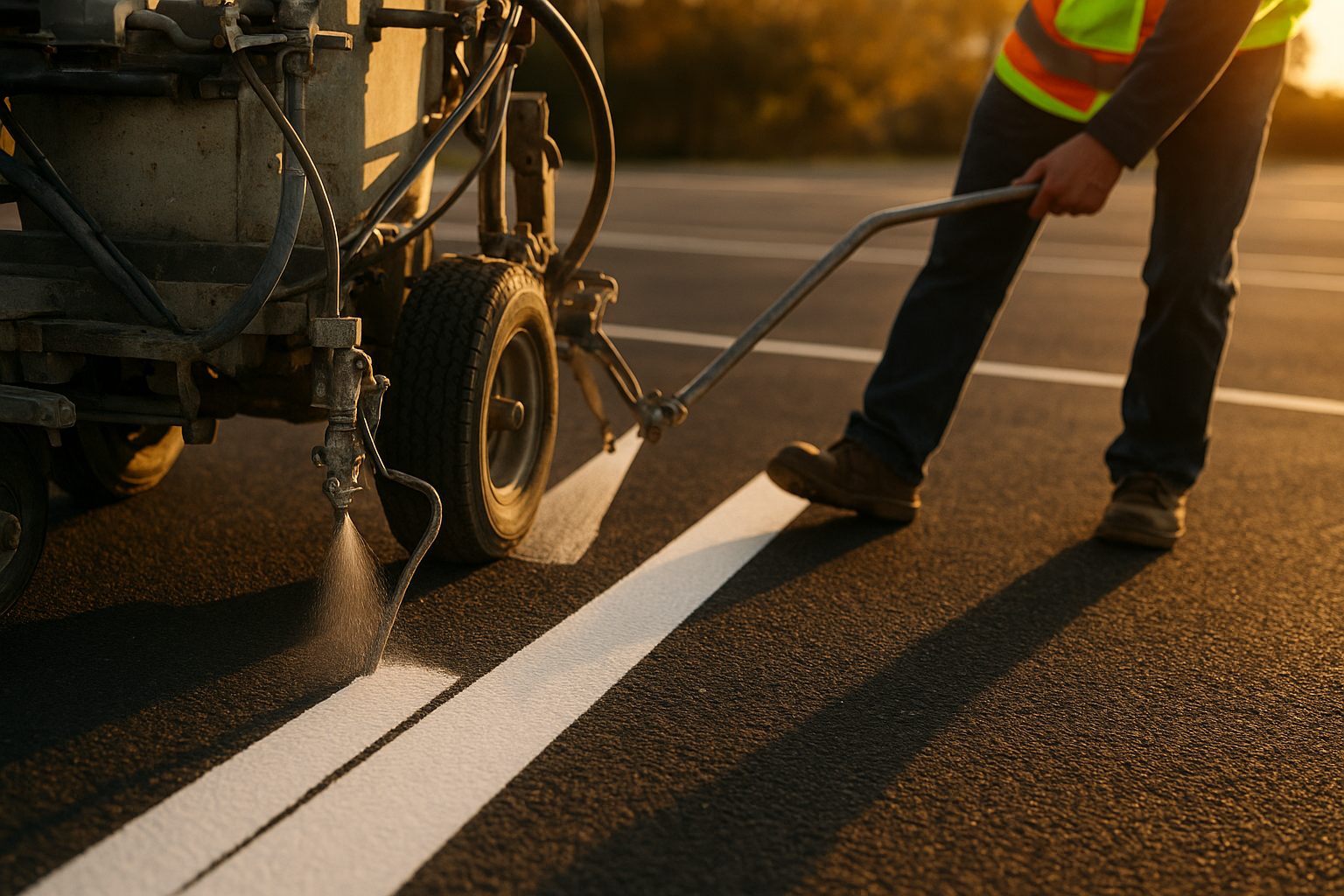
A professional striping machine applies precise, durable markings to a commercial asphalt surface during a North Texas parking lot striping project. For a deeper walkthrough, see our School Parking Lot Striping: Complete Safety Guide for TX.
ADA Compliance in Parking Lot Striping: What Every DFW Property Owner Must Know
ADA compliance is the single most critical — and most frequently misunderstood — aspect of any parking lot striping project. Under the Americans with Disabilities Act of 1990, any parking facility serving the public must provide a minimum number of accessible stalls based on total lot capacity. Specifically:
- 1–25 total spaces: 1 accessible stall required
- 26–50 total spaces: 2 accessible stalls required
- 51–75 total spaces: 3 accessible stalls required
- 76–100 total spaces: 4 accessible stalls required
- 101–150 total spaces: 5 accessible stalls required
- 151–200 total spaces: 6 accessible stalls required
- 201–300 total spaces: 7 accessible stalls required
- Over 500 total spaces: 2% of total spaces must be accessible
Moreover, at least one in every six accessible stalls must be van-accessible, featuring an 8-foot-wide access aisle (or a 5-foot aisle on the passenger side where a 16-foot-wide space is provided). Standard accessible stalls require a 5-foot access aisle. These dimensions are non-negotiable and must be clearly marked with the International Symbol of Accessibility (ISA) — the universally recognized blue wheelchair symbol.
Texas State Accessibility Standards (TDLR)
In addition to federal ADA requirements, Texas enforces its own accessibility standards through the TDLR under the Texas Accessibility Standards (TAS). TAS requirements sometimes exceed federal minimums — for example, in signage height specifications and surface slope tolerances. Non-compliance with TDLR standards can result in formal complaints, mandated inspections, and significant monetary penalties that dwarf the cost of correct striping in the first place.
Therefore, working with a DFW striping contractor who understands both federal ADA and Texas TAS requirements is not just advisable — it is essential. For properties in Denton specifically, expert parking lot striping services in Denton, TX ensure every accessible stall, van space, access aisle, and signage element meets current code requirements.
Fire Lane Striping Requirements in DFW
Fire lane markings are governed by local fire marshals in each DFW municipality — requirements vary between Dallas, Fort Worth, Denton, Plano, Frisco, and surrounding cities. In general, fire lanes must be marked with red paint on curbs, paired with “No Parking — Fire Lane” signage at intervals specified by the local fire code. Painted lettering on the asphalt surface is also typically required.
Because fire lane specifications differ by jurisdiction, hiring a contractor with demonstrated experience across the DFW area — and a working knowledge of each city’s fire code — prevents costly rework after an inspection. Thermoplastic materials are increasingly preferred for fire lane markings because they outlast standard paint by three to five times in high-traffic areas.
Paint Types Used in Parking Lot Striping: Water-Based vs. Thermoplastic
Choosing the right paint material is one of the most consequential decisions in any parking lot striping project — especially in the Texas climate. Two primary options are available to DFW property owners, and each has distinct strengths.
Water-Based Traffic Paint
Water-based acrylic traffic paint is the standard choice for most parking lot striping projects in DFW. It is cost-effective, dries quickly (typically within 30 minutes under normal conditions), and performs well on both asphalt and concrete surfaces. However, it has a shorter lifespan — particularly in high-traffic zones and areas exposed to constant UV radiation.
For standard stall lines in lots with moderate traffic, water-based paint is entirely appropriate and offers the best balance of cost and performance. Most residential and small commercial parking lot striping jobs in the DFW region use this material effectively.
Thermoplastic Striping
Thermoplastic is a heated, molten material that bonds directly to the pavement surface upon cooling. It is substantially more durable than water-based paint — lasting three to five times longer in comparable traffic conditions. As a result, thermoplastic is the preferred choice for high-traffic areas, fire lane markings, ADA symbols, and crosswalks where longevity and visibility are critical.
The upfront cost of thermoplastic is higher than water-based paint. However, when you factor in reduced restriping frequency, the total cost of ownership is often lower over a five-year period. For large commercial lots in busy DFW locations — retail centers, hospital campuses, airport parking facilities — thermoplastic frequently represents the better long-term investment.
Quick Comparison: Water-Based Paint vs. Thermoplastic
- Water-based paint: Lower upfront cost · Dries in 30 min · Lifespan 18–24 months · Best for standard stall lines
- Thermoplastic: Higher upfront cost · Bonds on cooling · Lifespan 5–7 years · Best for fire lanes, ADA symbols, crosswalks
Cost of Parking Lot Striping in the DFW Region
Pricing for parking lot striping in DFW varies based on lot size, stall count, types of markings required, surface condition, and the paint material selected. However, general benchmarks help property managers budget effectively before requesting a quote.
Typical Pricing Ranges by Project Type
- Standard water-based line striping: $0.15 to $0.30 per linear foot
- Small lot restripe (20–30 stalls): $300 to $600 typically
- Medium commercial lot (50–100 stalls with ADA + fire lanes): $700 to $1,800
- Large commercial lot (100+ stalls, full layout): $1,500 to $4,000+ depending on complexity
- ADA handicap stall symbol (each): $25 to $75 per stall
- Thermoplastic markings: 3 to 5× the cost of water-based paint, per linear foot
- Fire lane curb painting (per linear foot): $0.50 to $1.50
These figures are general estimates. Your actual cost depends on the specific conditions of your property. For a precise, obligation-free estimate tailored to your DFW lot, request a free quote from Stripes PLS — a locally operated North Texas striping specialist.
Factors That Affect Your Final Striping Cost
- Surface condition: Heavily deteriorated or freshly sealcoated surfaces may require additional preparation steps.
- Layout complexity: Lots with unusual angles, islands, or multiple traffic flow patterns cost more to plan and execute.
- Number of specialty markings: Each ADA symbol, directional arrow, stop bar, crosswalk, and speed bump indicator adds to the total.
- Scheduling: After-hours or weekend work may carry a modest premium but prevents revenue-disrupting daytime closures.
- Material choice: Thermoplastic significantly increases upfront cost but reduces long-term maintenance frequency.
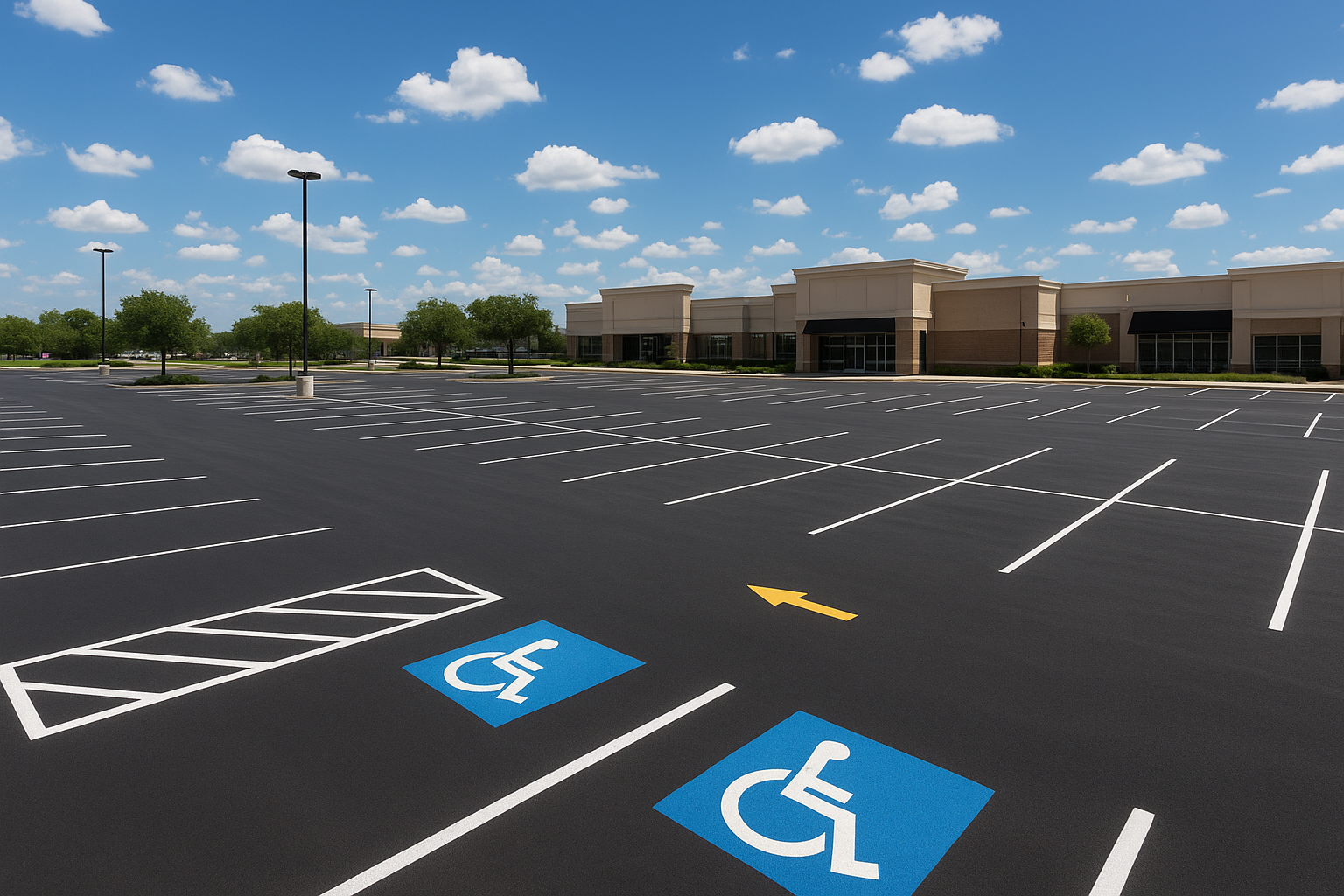
A well-organized DFW commercial lot featuring ADA-compliant symbols, directional arrows, defined stall lines, and fire lane markings — all delivered in a single professional striping project.
Types of Parking Lot Markings and What Each One Does
A complete parking lot striping project involves far more than simply painting white stall lines. Each marking type serves a specific functional or legal purpose. Understanding what goes into a full layout helps property owners communicate clearly with contractors and verify that nothing is missed.
- Standard stall lines: White or yellow lines defining individual parking spaces. Width and length specifications vary by code, but 9-foot-wide by 18-foot-deep stalls are standard in Texas.
- ADA handicap symbols: The blue International Symbol of Accessibility painted on the stall surface, required for every designated accessible space.
- Van-accessible markings: Additional width markings and text identifying stalls with the required 8-foot access aisle for wheelchair van deployment.
- Access aisles: Diagonal-hatched no-park zones adjacent to accessible stalls, providing boarding and alighting space for wheelchair users.
- Fire lane markings: Red curb paint and asphalt lettering (“Fire Lane — No Parking”) required by local fire codes for emergency access routes.
- Directional arrows: One-way and two-way traffic flow arrows that guide drivers through the lot safely and efficiently.
- Stop bars: Thick white lines at intersections and lot exits indicating where drivers must stop before proceeding.
- Crosswalks: Bold white striping creating safe pedestrian crossing zones between parking areas and building entrances.
- Speed bump indicators: Yellow markings on speed bumps and rumble strips that warn approaching drivers of surface changes.
- Reserved space markings: Text markings such as “Reserved,” “Visitor,” “Employee of the Month,” or “Electric Vehicle Charging” for designated specialty stalls.
- Curb painting: Yellow or red curb paint marking no-parking zones, loading zones, and fire lanes along curb edges.
Choosing the Right Parking Lot Striping Company in North Texas
Not all striping contractors deliver the same quality or compliance expertise. When evaluating providers for your DFW commercial property, focus on these essential criteria.
What to Look for in a DFW Striping Contractor
- Proven experience with commercial lots — Ask for a portfolio of completed projects similar in size and complexity to your property.
- Demonstrated ADA and TDLR knowledge — The contractor should be able to calculate your required accessible stall count and cite the specific code sections that apply.
- Familiarity with local fire codes — Fire lane requirements vary by DFW municipality. Your contractor must know the specific rules for your city.
- High-quality materials and equipment — Commercial-grade striping machines produce straight, consistent lines. Ask about paint brand, formulation, and expected lifespan in the Texas climate.
- Flexible scheduling — The ability to stripe during evenings, weekends, or phased segments is essential for businesses that cannot fully close their lot.
- Written estimates and layout plans — Any reputable contractor should provide a detailed written proposal with stall counts, marking types, material specifications, and pricing before any work begins.
- Local reputation and verifiable references — A contractor with strong roots in the DFW market will have demonstrable client relationships and verifiable reviews from local property managers.
Stripes PLS is a full-service parking lot striping company serving commercial and residential properties throughout Denton, Plano, and the greater North Texas region. The team specializes in ADA-compliant handicap stall markings, fire lane designation, directional arrows, crosswalks, restriping, and complete layout redesigns — delivering precise, code-compliant results tailored to each property’s specific conditions. Property owners can explore the full range of parking lot striping services and request a free on-site quote directly at stripespls.com.
Common Parking Lot Striping Mistakes — and How to Avoid Them
Even well-intentioned property owners make predictable mistakes when planning or procuring striping services. Understanding these pitfalls in advance saves money, prevents compliance issues, and avoids operational headaches.
- Waiting too long to restripe: Faded lines are not just an aesthetic problem. They create ambiguity that leads to inconsistent parking, traffic conflicts, and increased accident risk. Proactive restriping every 18–24 months prevents all of these issues.
- Using the wrong paint type for the surface or traffic level: Applying standard water-based paint to a high-traffic entrance lane or a fire lane will result in rapid deterioration. Match the material to the location’s demands.
- Failing to correctly calculate ADA stall counts: Undercounting accessible stalls — even by one — creates legal exposure under federal ADA and Texas TAS rules. Always verify the required number before finalizing any layout plan.
- Ignoring ghost lines from previous layouts: Old faded lines that remain visible beneath fresh paint confuse drivers and undermine the appearance of the finished job. Some ghost lines require blotting or covering with a masking compound before new paint is applied.
- Striping on a dirty or damp surface: Paint adhesion fails rapidly on contaminated or wet pavement. Thorough cleaning and surface drying are non-negotiable prerequisites for a durable result.
- Overlooking post-sealcoat striping timing: Fresh sealcoat must cure fully — typically 24 to 48 hours — before striping paint can bond correctly. Striping too soon causes premature peeling and reduces paint longevity significantly.
Frequently Asked Questions About Parking Lot Striping
What is parking lot striping and why is it important?
Parking lot striping is the professional application of painted lines, symbols, and markings on paved parking surfaces. It is important because clear markings improve traffic flow, maximize stall capacity, ensure ADA compliance, and reduce liability risk for property owners. In DFW specifically, intense UV radiation and heat accelerate paint fading, making regular striping an essential part of property maintenance.
How often should a parking lot be restriped in North Texas?
Most parking lots in North Texas need restriping every 18 to 24 months. However, high-traffic locations or lots with significant UV exposure may need annual restriping. Additionally, any lot that has been sealcoated requires a fresh stripe immediately after the sealcoat cures — typically 24 to 48 hours after application.
How much does parking lot striping cost in DFW?
Standard water-based line striping typically runs $0.15 to $0.30 per linear foot. A small lot restripe (20–30 stalls) may cost $300 to $600, while a medium commercial lot with ADA markings and fire lanes ranges from $700 to $1,800. Large lots with 100 or more stalls can cost $1,500 to $4,000 or more. Thermoplastic markings cost significantly more per linear foot but last three to five times longer.
What paint is used for parking lot striping in Texas?
Most DFW contractors use water-based acrylic traffic paint for standard stall lines — it dries within 30 minutes and is cost-effective on both asphalt and concrete. For fire lane markings, ADA symbols, and crosswalks in high-traffic areas, thermoplastic is the preferred material due to its significantly longer lifespan under Texas heat and UV conditions.
Are ADA-compliant markings required for all parking lots in Texas?
Yes. Under the Americans with Disabilities Act and the Texas Accessibility Standards (TAS), any parking facility serving the public must include a minimum number of accessible stalls with correct markings, signage, and access aisles. The minimum is one accessible stall per 25 total spaces for lots up to 100 stalls, with a scaling formula for larger lots. Non-compliance can result in fines under both federal and state law.
How long does parking lot striping take to dry?
Water-based traffic paint dries to the touch within 30 minutes under typical DFW weather conditions. However, most professional striping contractors recommend keeping vehicles off freshly painted areas for at least one full hour to prevent tire marks or smearing. Thermoplastic markings cool and harden within minutes of application.
Can parking lot striping be done at night or on weekends?
Yes. Many DFW parking lot striping companies offer night and weekend scheduling to minimize disruption to tenants and customers. Night striping is especially common for retail centers, hospitals, office parks, and schools where daytime lot closures are impractical. Some contractors also offer phased striping, completing one section per session while the rest of the lot remains open.
What is the difference between new striping and restriping?
New striping involves designing and painting a fresh parking lot layout from scratch — including stall measurements, ADA stall planning, fire lane routing, and layout optimization. Restriping (also called overstriping) follows existing faded lines to refresh a lot without redesigning the layout. Restriping is faster and less expensive; new striping is necessary after paving, sealcoating, or when the current layout is non-compliant or inefficient.
Do fire lane markings require special materials?
Yes. Fire lane markings typically require red paint on curbs and asphalt lettering, both meeting the specifications set by the local fire marshal for your DFW municipality. Requirements vary between Dallas, Fort Worth, Plano, Denton, Frisco, and other cities. Thermoplastic is increasingly preferred for fire lane markings because it outlasts standard paint significantly in high-traffic conditions.
What are the most common mistakes in parking lot striping projects?
The most common mistakes include waiting too long to restripe faded lots, using the wrong paint type for high-traffic zones, incorrectly calculating ADA stall counts, striping on a dirty or damp surface, and failing to account for ghost lines from previous layouts. Hiring an experienced, locally knowledgeable DFW striping contractor prevents all of these costly errors.
How many ADA parking spaces are required per total parking spaces?
The ADA requires one accessible space for every 25 total spaces in lots up to 100 stalls. Larger lots follow a sliding scale — for example, lots with 101 to 150 total spaces require 5 accessible stalls. At least one in every six accessible stalls must be van-accessible with an 8-foot access aisle. Texas TAS requirements align with and in some cases exceed these federal minimums.
How do I get a quote for parking lot striping in DFW?
Most reputable DFW striping companies offer free on-site or photo-based quotes with no obligation. You can visit stripespls.com/contact to request a free estimate for your commercial or residential property in Denton, Plano, or anywhere across the North Texas region. On-site evaluations are available and recommended for larger or more complex lots.
Conclusion: Keep Your DFW Parking Lot Safe, Compliant, and Professionally Marked
Parking lot striping in DFW is far more than a cosmetic refresh — it is a fundamental element of responsible property management that directly affects safety, legal compliance, operational efficiency, and the first impression every visitor forms the moment they pull into your lot. From ADA-compliant accessible stalls and van-accessible spaces to fire lane designations, crosswalks, directional arrows, and specialty reserved markings, every line on your pavement serves a specific, meaningful purpose.
Given the rapid growth of the Dallas-Fort Worth region and the uniquely harsh Texas climate that accelerates paint deterioration, property owners in Denton, Plano, and throughout North Texas should prioritize regular restriping and proactive ADA compliance reviews on a consistent maintenance schedule. Specifically, partnering with a locally experienced parking lot striping company ensures your lot meets all current federal ADA and Texas TAS standards — while looking sharp and welcoming every day.
To explore professional services or read more about parking lot maintenance, visit the Stripes PLS blog for in-depth resources, or contact the Stripes PLS team directly to schedule a free on-site evaluation for your North Texas property.