School parking lot striping is the process of painting durable, code-compliant lines, symbols, and lettering across a campus lot to organize traffic, mark accessible parking, and protect fire lanes. For administrators in Denton, Plano, and across North Texas, this service directly shapes student safety, staff efficiency, and legal compliance every single school day. In addition, faded or missing pavement markings turn pickup and drop-off into a guessing game, right when dozens of vehicles, buses, and pedestrians converge on the same asphalt. This guide goes further than a typical overview — it breaks down ADA rules, fire lane codes, paint choices, real costs, and a full compliance checklist so campus leaders can plan with confidence. For related compliance details, see our lane markings guide.
Direct answer: School parking lot striping combines ADA-compliant accessible stalls, fire lane marking, bus queuing lanes, directional arrows, and crosswalks into one coordinated layout. Done correctly, it reduces congestion at arrival and dismissal, keeps emergency access open at all times, and helps a campus satisfy federal and Texas accessibility law.
What Is School Parking Lot Striping?
School parking lot striping refers to the painted lines, symbols, and text applied to a school’s pavement to define parking stalls, traffic lanes, crosswalks, and fire lanes. It is a specialized branch of general parking lot striping services, adapted for the traffic patterns unique to K-12 and university campuses.
Unlike a typical retail lot, school properties see concentrated bursts of activity twice a day. As a result, layouts must account for buses, parent vehicles, staff parking, and pedestrians moving through the same corridors within a narrow window — often 15 to 30 minutes at a time.
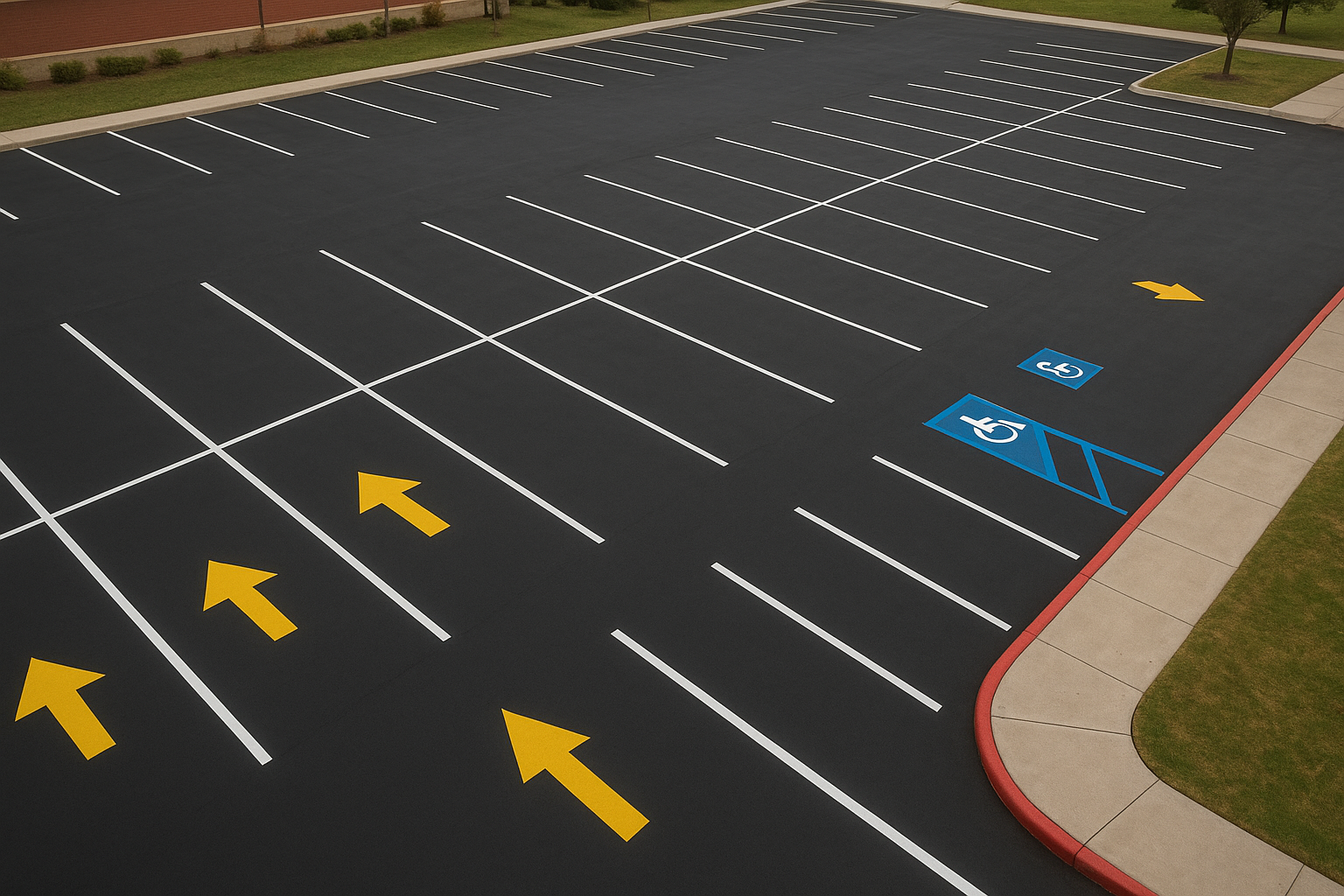
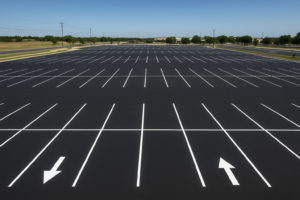
A well-planned school parking lot striping layout separates bus lanes, ADA stalls, and staff parking for safer daily traffic.
How School Lots Differ From Retail or Office Parking
In a retail lot, cars come and go throughout the day at a steady, predictable pace; see our retail parking striping guide for differences. On a school campus, however, hundreds of vehicles arrive or leave within minutes, which is why layout precision matters so much more. Consequently, a striping plan built for a shopping center rarely transfers well to a school without significant redesign.
Why Parking Lot Line Marking Matters for Student Safety
Clear parking lot line marking reduces the risk of accidents during the busiest moments of the school day. Specifically, well-defined lanes keep pedestrians separated from moving vehicles and give drivers a predictable path through the lot.
According to the National Highway Traffic Safety Administration, pedestrian fatalities in parking-related settings remain a persistent concern nationwide, which underscores why visible markings matter around schools. Furthermore, faded or absent lines force drivers to guess where to stop, turn, or yield, and that hesitation increases the chance of a collision near crosswalks.
Above all, a striped lot communicates expectations without requiring a staff member to direct every vehicle by hand. Consequently, crossing guards and staff can focus on watching pedestrians rather than managing basic traffic direction, which is a far better use of their attention during dismissal.
Bus Loading Zones and Pedestrian Walkways
Buses need their own dedicated lane, physically separated from parent drop-off, with clearly painted boundary lines and stop bars. In particular, a marked pedestrian walkway leading from the bus zone to the building entrance keeps students out of moving traffic entirely. Similarly, staggering bus and parent drop-off times combined with distinct striped zones reduces the single biggest cause of campus traffic backups.
ADA Compliance Requirements for School Parking Areas
Every school parking lot must include a minimum number of accessible stalls based on total parking capacity, along with at least one van-accessible space. For Texas-specific layout guidance, see our parking lot striping guide. These requirements come from the Americans with Disabilities Act (ADA), a federal civil rights law that sets minimum accessibility standards for public and commercial facilities.
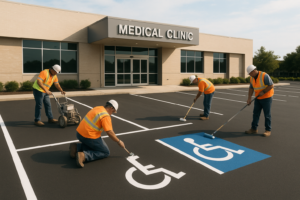
In practice, this means accessible stalls need proper width, a marked access aisle, and vertical signage in addition to painted symbols. Similarly, curb ramps and crosswalks near accessible spaces must connect to a clear, unobstructed path of travel that leads directly into the building.
| Total Parking Spaces | Minimum Accessible Stalls |
|---|---|
| 1 – 25 | 1 |
| 26 – 50 | 2 |
| 51 – 75 | 3 |
| 76 – 100 | 4 |
| 101 – 150 | 5 |
| 151 – 200 | 6 |
Ratios based on general ADA guidance; always confirm exact figures with the U.S. Access Board and local Texas code before finalizing a layout.
Because ADA guidelines can be technical, many property managers rely on a specialist familiar with local Denton and Plano code overlays. For a deeper breakdown of layout standards, the asphalt striping guide to parking lot line marking covers stall dimensions and spacing in more detail.
Fire Lane Marking and Traffic Flow at School Campuses
Fire lane marking keeps emergency vehicle routes open at all times, which is critical during an evacuation or medical emergency on campus. Local fire codes, often based on National Fire Protection Association (NFPA) standards, typically require red curb paint paired with white lettering that reads “Fire Lane, No Parking,” positioned at intervals set by the authority having jurisdiction.
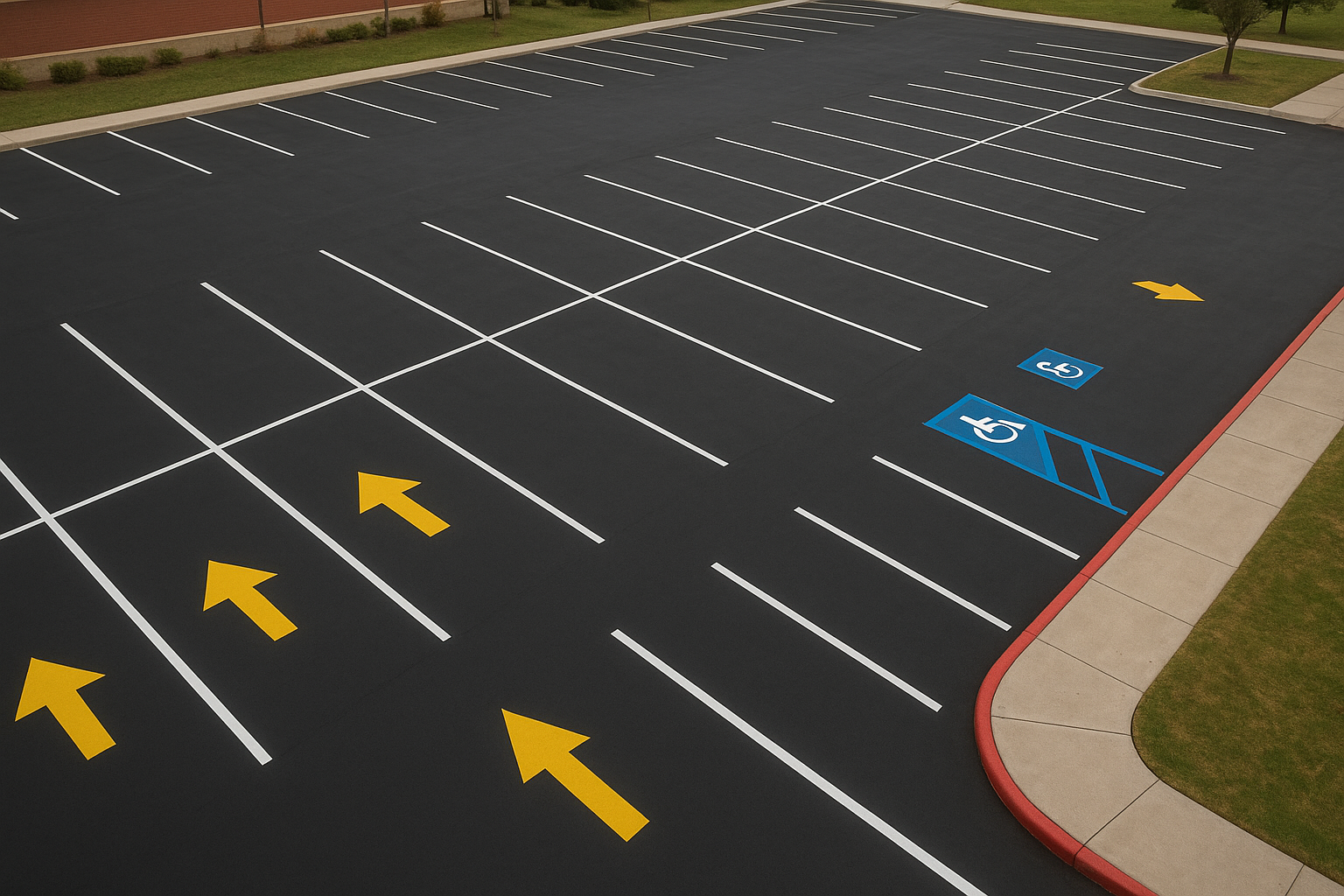
In addition to fire lanes, thoughtful directional arrows and stop bars help guide buses and parent vehicles through separate paths. This separation is one of the most effective ways line striping can improve traffic flow, since it removes the guesswork that leads to gridlock during dismissal.
For campuses experiencing regular backups at pickup time, reviewing how line striping can improve traffic flow in parking lots offers practical layout ideas beyond basic restriping.
Paint and Material Options for School Parking Lot Striping
Not all striping paint performs the same way under daily bus and vehicle traffic. Choosing the right material affects both durability and long-term cost, so it is worth comparing the common striping options before a project begins.
| Material | Typical Lifespan | Best Use |
|---|---|---|
| Water-based acrylic | 1–2 years | Standard stalls, arrows, crosswalks |
| Solvent-based paint | 2–3 years | Higher-traffic drive lanes |
| Thermoplastic | 4–7 years | Bus lanes, crosswalks, ADA symbols |
Thermoplastic vs. Painted Lines for High-Traffic Zones
Thermoplastic markings are melted onto the pavement rather than sprayed, which creates a thicker, more reflective surface. Because of this, thermoplastic holds up far longer under bus tires and heavy braking, making it the smarter long-term choice for bus lanes even though the upfront cost runs higher than standard paint.
How to Plan a School Parking Lot Striping Project
Planning ahead helps schools avoid rushed work and unnecessary disruption to daily operations. The following steps outline a practical, sequential approach that most North Texas campuses can follow from start to finish. See our commercial parking lot marking guide for layout examples.
- Assess the current lot. Walk the entire property to note faded lines, cracked pavement, missing ADA stalls, and any blocked or obstructed fire lane access before writing a scope of work.
- Review local code requirements. Confirm current ADA stall ratios and fire lane rules specific to Denton or Plano municipal code before finalizing any new layout or design change.
- Request a professional site evaluation. An experienced contractor can measure the lot precisely and recommend a layout that improves both pedestrian safety and daily vehicle flow.
- Schedule during low-traffic periods. Weekends, evenings, or school breaks allow paint to cure fully without interference from daily bus routes or parent traffic on campus.
- Inspect and maintain the markings. Plan for restriping every one to two years to keep lines visible, reflective, and fully code-compliant year-round.
Cost Factors for School Parking Lot Striping
Pricing for school parking lot striping depends on several variables, so no two campuses pay exactly the same rate. Understanding these factors in advance helps administrators budget more accurately.
- Lot size and stall count — larger lots require more paint and labor hours.
- Paint material — thermoplastic costs more upfront than water-based paint but lasts longer.
- Old paint removal — restriping projects with heavy grinding or blasting add labor time.
- Signage and ADA symbols — vertical signs and stenciled symbols add to the total scope.
- Scheduling window — night or weekend work can affect crew rates depending on the contractor.
In short, most school projects range from a few hundred dollars for a small restriping touch-up to several thousand dollars for a full campus redesign. Requesting a free, itemized quote remains the most accurate way to budget a specific project.
Signs a School Parking Lot Needs Restriping
Over time, sun exposure, weather, and constant vehicle traffic wear down even high-quality paint. Recognizing the warning signs early helps a school avoid safety gaps before they become a genuine liability.
Common indicators include chalky or barely visible stall lines, faded crosswalks near pedestrian entrances, and fire lane lettering that has worn away completely. Likewise, ADA symbols that have thinned or shifted out of alignment with the access aisle should be addressed right away, since misaligned markings can create a compliance violation even if the stall itself is still usable.

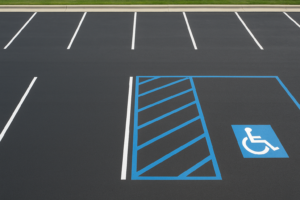
Comparing faded lines to fresh paint highlights why timely restriping keeps a lot safe and compliant.
Schools that catch these signs early can schedule a simple restriping project rather than a full lot redesign, which typically saves both time and budget.
School Parking Lot Striping Compliance Checklist
Use this quick checklist during a walkthrough to spot compliance gaps before an inspector or parent notices them first.
- ✅ Accessible stalls match the required ratio for total lot capacity
- ✅ At least one van-accessible space with a wide access aisle is marked
- ✅ Fire lane curbs are painted red with legible “Fire Lane, No Parking” lettering
- ✅ Crosswalks near entrances and bus zones remain highly visible
- ✅ Bus loading lanes are physically separated from parent drop-off
- ✅ Directional arrows and stop bars guide one-way traffic flow
- ✅ Restriping is scheduled at least every one to two years
Choosing a Contractor for School Parking Lot Striping in North Texas
Not every striping company understands the layout demands specific to school campuses, such as bus queuing lanes, staggered pickup zones, and strict ADA symbol placement. Therefore, it helps to work with a contractor that has direct experience serving educational properties in the region rather than one that primarily handles retail lots.
StripesPLS, based in Texas, provides Dallas parking lot striping, ADA compliance solutions, and fire lane marking for properties throughout the Denton and Plano areas. The team works with property managers, school districts, and healthcare facilities to deliver layouts tailored to each site’s traffic patterns rather than a one-size-fits-all template. For general background on how pavement markings function as a traffic control device, see this overview of road surface marking.
Property managers can request a free quote directly through stripespls.com to get project-specific pricing before committing to a scope of work.
Frequently Asked Questions About School Parking Lot Striping
What is school parking lot striping?
School parking lot striping is the process of painting traffic lines, ADA stalls, fire lanes, and directional markings on a campus lot. It organizes vehicle and pedestrian movement while keeping the property compliant with accessibility and fire codes.
How often should a school restripe its parking lot?
Most schools should restripe every 1 to 2 years, since heavy daily traffic from buses and parent pickup lines wears down paint faster than typical commercial lots. Faded lines should be repainted immediately once visibility drops.
Why is fire lane marking required at schools?
Fire lane marking is required so emergency vehicles have unobstructed access during evacuations or medical emergencies. Local fire codes typically mandate red curb paint and lettering that clearly states “Fire Lane, No Parking.”
What ADA requirements apply to school parking lots?
ADA rules require a minimum number of accessible stalls based on total parking count, van-accessible spaces with wider access aisles, and proper signage. The Americans with Disabilities Act sets the federal baseline, though some Texas municipalities add stricter local rules.
How much does school parking lot striping cost?
Costs vary by lot size, layout complexity, and paint type, but most school projects range from a few hundred to several thousand dollars. Requesting a free quote is the most accurate way to get a price specific to a campus.
What paint is best for school parking lot striping?
Water-based traffic paint and durable acrylic formulas are the most common choices because they dry quickly and resist fading. Thermoplastic markings last longer but cost more, making them better suited to high-traffic bus lanes.
How long does a school parking lot striping project take?
Most school lots are completed within one to two days, depending on size and the number of markings needed. Scheduling during weekends or school breaks helps avoid disrupting drop-off and pickup routines.
What is the difference between striping and restriping?
Striping refers to applying markings to a new or freshly paved lot, while restriping means repainting existing lines that have faded or shifted. Both require the same layout precision, but restriping often needs old paint removal first.
Can school parking lot striping improve traffic flow?
Yes, clearly marked lanes, arrows, and stop bars reduce confusion during high-volume pickup and drop-off periods. Well-planned striping separates bus lanes from parent vehicles, which lowers the risk of collisions and pedestrian incidents.
What common mistakes happen with school parking lot markings?
Common mistakes include undersized ADA stalls, missing van-accessible spaces, faded crosswalks near pedestrian zones, and fire lanes that are too narrow. Working with an experienced striping contractor helps avoid these compliance gaps.
Do schools need a permit for parking lot striping?
Permit requirements depend on the municipality and whether the project changes the existing traffic layout. Many restriping jobs that follow the original design do not require a new permit, but it is worth confirming with the local building department.
What is the best time of year for school parking lot striping?
Warmer, dry months allow paint to cure properly and reduce delays, making spring and summer breaks ideal in North Texas. Scheduling during a school holiday also minimizes disruption to daily campus operations.
What is the difference between thermoplastic and painted striping?
Thermoplastic markings are heat-applied and bond to the pavement surface, lasting four to seven years compared to one to two years for standard paint. Because of this durability, thermoplastic works best on bus lanes and crosswalks that see constant, heavy contact.
Who enforces fire lane and ADA compliance at schools?
Local fire marshals typically enforce fire lane compliance, while ADA accessibility falls under federal civil rights law with local building departments handling permitting. Schools should confirm both requirements with their municipality before a striping project begins.
Final Thoughts on School Parking Lot Striping
In summary, school parking lot striping is far more than a cosmetic upgrade. It plays a direct role in student safety, ADA compliance, fire code adherence, and smoother traffic flow during the busiest parts of the school day.
Ultimately, schools that stay proactive about restriping avoid the safety gaps that come with faded lines and unclear fire lanes. For campuses throughout Denton and Plano, TX, requesting a professional evaluation is a straightforward first step toward a safer, well-organized lot. As referenced throughout this guide, resources at stripespls.com can help property managers get started with a free, no-obligation quote for their next school parking lot striping project. Last updated: 2026-08-11. Author: StripesPLS Team.