Road marking services are the single most overlooked investment that keeps parking lots, private drives, and highway-adjacent properties safe, legal, and efficient. Whether you manage a retail center in Plano, a hospital campus in Denton, or a stretch of commercial frontage anywhere in North Texas, the quality of your pavement markings directly shapes driver behavior, pedestrian safety, and your liability exposure. In particular, this guide goes further than a typical highway striping overview: we cover material science, ADA law, fire lane code, highway-grade retroreflective markings, real cost ranges, and a complete preparation checklist so you know exactly what professional road marking services should deliver — for a parking lot or a public roadway.
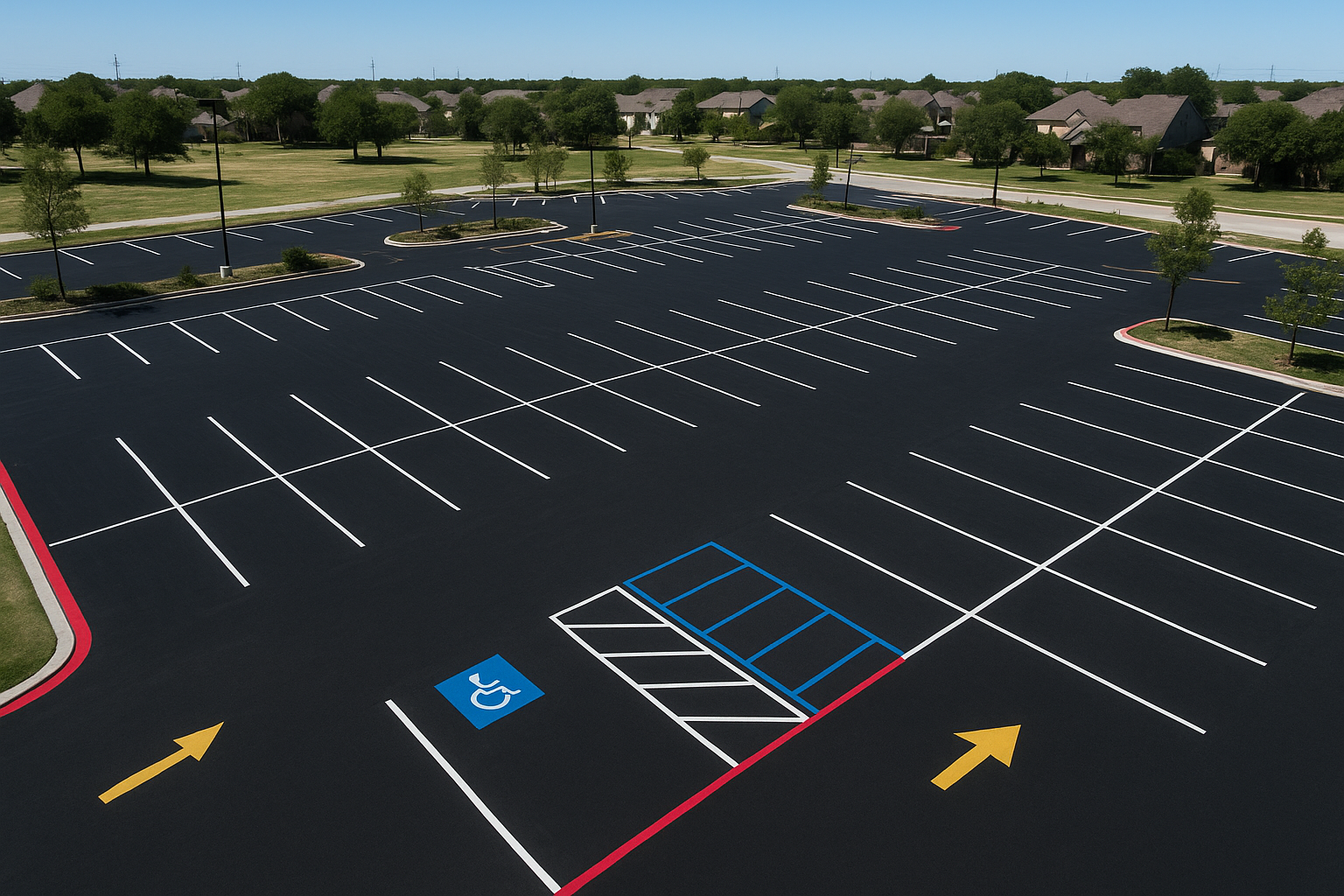
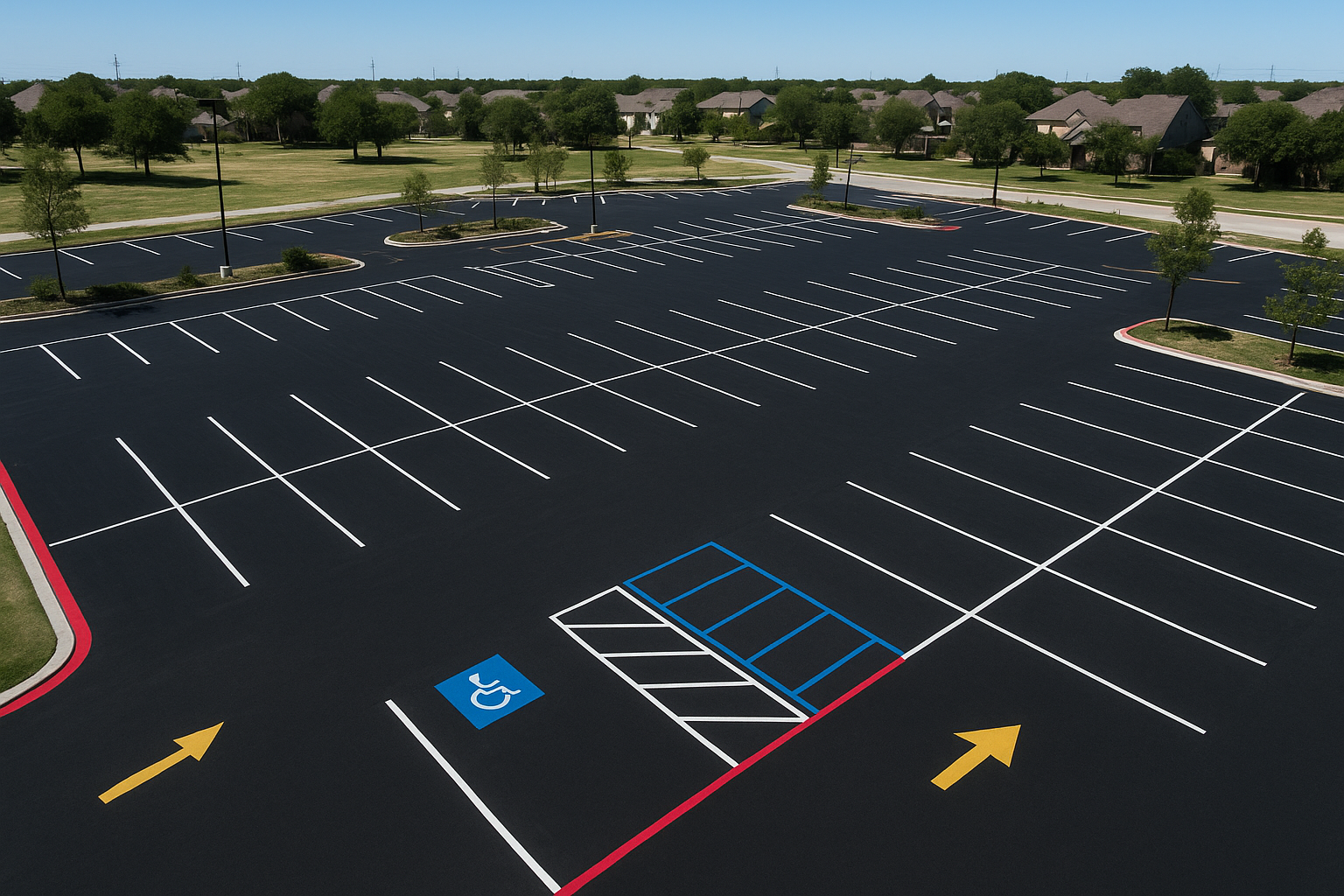
Professional road marking services produce crisp, durable lines that improve safety and maximize usable space on any paved surface.
What Do Professional Road Marking Services Include?
Road marking services cover any professionally applied pavement marking on a parking lot, private drive, or public roadway. In practice, this includes stall striping, ADA-compliant handicap designations, fire lane markings, directional arrows, stop bars, crosswalks, curb painting, and — for highway and roadway work — centerlines, edge lines, and lane-separation striping. Each element guides drivers, protects pedestrians, and keeps a property compliant with state and federal regulation.
According to the Federal Highway Administration, clearly visible pavement markings measurably reduce driver error and improve traffic safety in both public and private settings. Furthermore, the Texas Department of Transportation sets specific standards for marking materials, widths, and reflectivity on public roads — standards that heavily influence private lot and access-road expectations as well.
For commercial properties, professional striping is often the single most cost-effective improvement a manager can make. As a result, a well-planned layout can increase usable stall count by 10 to 15 percent compared with a faded or unplanned lot — capacity you already own but are not using.
Highway Striping vs. Parking Lot Marking: What’s the Difference?
Many property owners assume all pavement marking is the same. In reality, highway-grade road marking services follow a different rulebook than a retail parking lot, because roadway markings must meet the Manual on Uniform Traffic Control Devices (MUTCD), a federal standard governing line width, color, spacing, and reflectivity on every public road in the United States. Private lots have more flexibility, but the same principles of visibility and driver predictability still apply.
Longitudinal Markings: Centerlines, Lane Lines & Edge Lines
Longitudinal markings run parallel to the direction of travel. Specifically, yellow centerlines separate opposing traffic, white lane lines separate same-direction lanes, and white edge lines mark the outer boundary of the drivable surface. On highways, these lines typically measure 4 to 6 inches wide, while skip-line ratios (a painted segment followed by a gap) signal whether passing is permitted.
Transverse & Symbol Markings: Crosswalks, Arrows & Stop Bars
Transverse markings run perpendicular to traffic flow, and they include stop bars, crosswalks, and yield lines. Symbol markings, in contrast, use painted words and arrows — such as “ONLY,” “STOP,” or directional arrows — to reinforce a message drivers might otherwise miss. Together, these elements reduce hesitation at intersections and driveways, which is precisely where most low-speed collisions occur.
Raised Pavement Markers and Retroreflectivity Standards
Raised pavement markers (RPMs), sometimes called “cat’s eyes” or “Botts’ dots,” supplement painted lines on highways and high-speed roads. They reflect headlights back at the driver, which dramatically improves visibility during rain or fog. Most professional road marking services embed tiny glass beads directly into the paint or thermoplastic as well, since these beads are what create nighttime retroreflectivity — the property that makes a line glow under headlights rather than simply appear as a dull stripe. Without adequate bead density, even a freshly painted line can become nearly invisible after dark within a single season.
ADA Compliance: The Non-Negotiable Rule for Every Road Marking Project
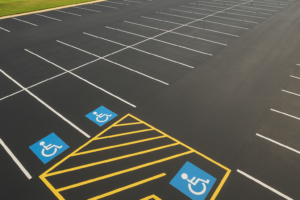
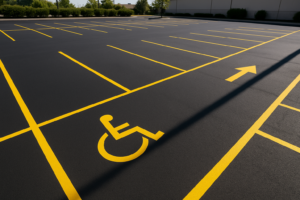
One of the most critical components of any professional road marking project is ADA compliance. The Americans with Disabilities Act mandates specific requirements for accessible parking, including minimum stall dimensions, access aisle widths of at least 60 inches, and van-accessible space ratios. Specifically, for every six accessible spaces, at least one must be van-accessible with an 8-foot-wide access aisle.
Non-compliance carries real consequences. Property owners who neglect ADA markings can face federal complaints, lawsuits, and expensive retrofits down the road. Therefore, working with a contractor who genuinely understands these standards is essential — not optional.
Stripespls.com, a full-service parking lot line marking company serving the Denton and Plano areas, builds ADA-compliant handicap stall markings into every project by default. Their crews verify stall counts, access aisle dimensions, and signage against current federal and local standards before calling a job complete.
How Many Accessible Spaces Does Your Lot Need?
The required number of accessible spaces scales with total lot capacity. For example, a lot with 1 to 25 total spaces needs at least 1 accessible space, while a lot with 26 to 50 spaces requires 2. Consequently, as your lot grows, your ADA obligations grow with it. A professional road marking contractor calculates this figure automatically during the quoting process, so you never have to guess.
Fire Lane Markings and Local Texas Safety Codes
Fire lane markings are another legally required component for most commercial properties in Texas. Local fire codes, enforced by city fire marshals, require that designated emergency access zones remain clearly marked and free of obstructions at all times. Typical fire lane markings include red-painted curbs and stenciled “No Parking Fire Lane” text applied at regular intervals.
Failure to maintain visible fire lane markings can result in citations from local inspectors and, more critically, delayed emergency response times. For this reason, fire lane repainting is usually bundled with routine lot restriping so everything gets refreshed in a single visit.
If you are unsure whether your property’s fire lane markings meet current Denton or Plano municipal code, reviewing the DFW parking lot striping and line marking services page is a useful starting point.
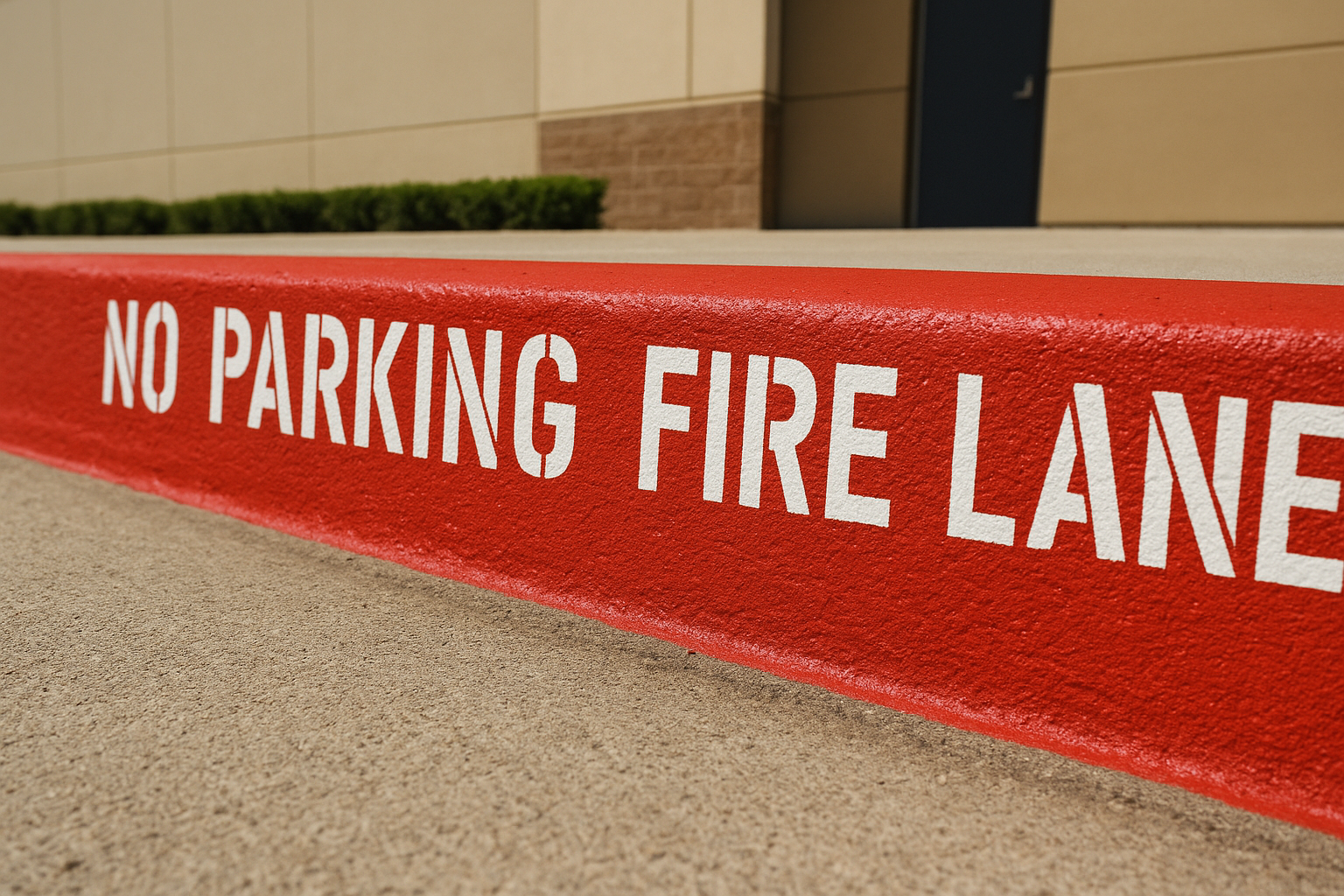
Fire lane curb markings are a required element of professional road marking services for commercial Texas properties.
Preparing Your Property for Professional Road Marking Services
Getting the most out of any project starts well before a crew arrives on site. Follow these six steps to ensure a smooth, long-lasting result:
- Assess the current condition of your lot or roadway. Walk the full surface and note faded lines, damaged pavement, missing ADA markings, and unclear fire lane designations, then photograph every problem area to share with your contractor.
- Confirm ADA, fire lane, and local code requirements. Check your city’s fire marshal rules and current ADA stall ratios before requesting a quote, so the scope of work matches what is legally required for your property.
- Request a detailed professional quote. Contact a licensed road marking services provider and share your lot dimensions, current layout, and compliance needs; a reputable company like Stripespls.com offers free on-site quotes across North Texas.
- Clean and repair the pavement surface. Sweep the area clear of debris, oil, and loose material, then fill and seal cracks or potholes before striping begins so paint adheres properly and lasts far longer.
- Coordinate access, scheduling, and traffic control. Work with your contractor to schedule the job during low-traffic hours, and arrange temporary signage or cones to redirect vehicles away from freshly painted areas while they cure.
- Inspect the finished markings for compliance. After the crew finishes, walk the site with your contractor to verify that ADA stalls, fire lanes, arrows, and dimensions all meet current Texas code requirements before signing off.
For more detail on vetting a provider, the reliable striping service checklist covers the key questions every property owner should ask before signing a contract.
Choosing the Right Materials: Paint, Thermoplastic, Epoxy & Tape
Texas heat and UV intensity are hard on pavement markings, so material selection matters enormously. Four materials dominate the market today, each with distinct strengths.
- Water-based traffic paint is cost-effective and dries quickly, typically within 30 minutes in warm Texas weather. However, it fades faster in high-traffic areas exposed to intense sunlight.
- Thermoplastic is a heat-applied material that bonds directly to the asphalt surface. As a result, it lasts three to five times longer than standard paint under comparable traffic and sun exposure.
- Epoxy coatings offer excellent chemical resistance and are often chosen for areas exposed to oil, fuel spills, or heavy tire abrasion, such as loading docks and drive-through lanes.
- Preformed tape markings are useful for temporary layouts, seasonal changes, or locations where quick installation without curing time is a priority.
For most commercial lots in the Denton and Plano areas, a professional contractor recommends thermoplastic for high-wear zones such as drive lanes and stop bars, while using quality traffic paint for standard stall markings. This hybrid approach balances durability against cost.
How Long Does Each Marking Material Last?
In general, water-based paint holds up for 1 to 2 years, thermoplastic lasts 3 to 5 years, and epoxy can hold color and texture for 4 to 6 years in moderate-traffic zones. Above all, actual lifespan depends heavily on traffic volume, sun exposure, and surface preparation, so treat these figures as a starting benchmark rather than a guarantee.
How Often Should You Restripe or Remark Your Property?
Most parking lots in Texas need restriping every one to two years. High-traffic retail and healthcare facilities may need touch-ups annually, while lower-traffic properties can often go two years between full restripes. A simple rule of thumb applies here: if lines are difficult to see from a standing vehicle, it is time to restripe.
For a comprehensive look at best practices, the Texas parking lot striping and line marking guide offers detailed recommendations based on lot type, traffic volume, and surface condition.
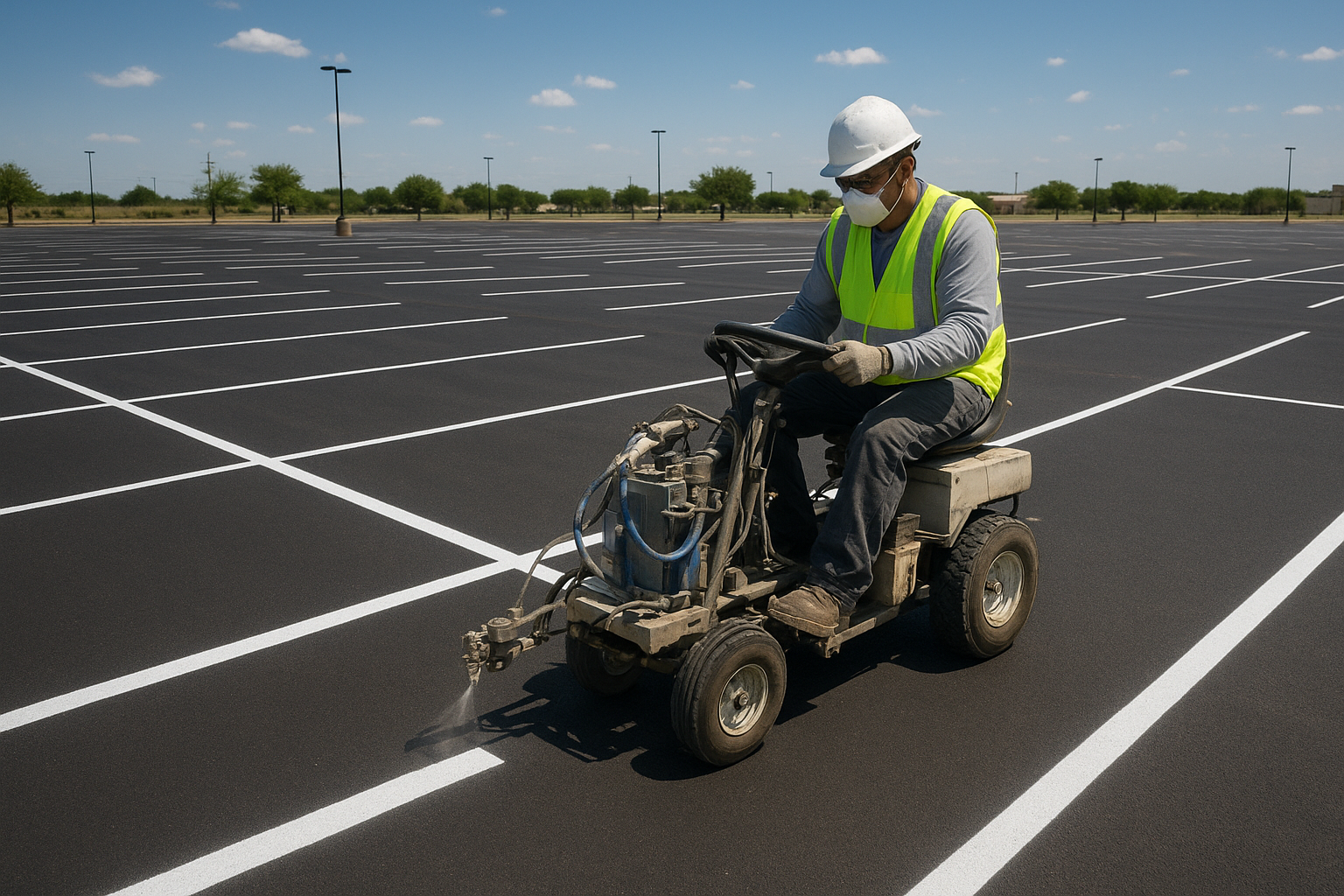
A skilled technician applies precise pavement markings using professional-grade equipment during a Texas striping project.
Who Relies on Professional Road Marking Services?
The need for professional pavement marking extends across nearly every property type. Retail centers, office parks, schools, hospitals, apartment complexes, and municipal facilities all depend on clearly marked surfaces to function safely. In addition, property managers overseeing multiple sites benefit from working with a single reliable contractor who understands compliance requirements across every location.
Stripespls.com serves a wide range of clients across greater North Texas, including property managers, business owners, healthcare facilities, and municipal organizations. Their team handles everything from complete new lot layouts to targeted restriping of faded markings, customized to each property’s specific needs. You can explore their full range of services at the complete parking lot marking guide.
What Do Road Marking Services Cost in Texas?
Costs vary based on lot size, number of stalls, and services required. Specifically, a basic restripe for a small commercial lot may start around $200 to $500, while larger projects that include ADA markings and fire lanes can run into the thousands. Highway-grade thermoplastic work, similarly, costs more per linear foot than standard paint because of the specialized equipment and heating process involved. Requesting a free, itemized quote is the best way to get an accurate estimate for your specific property.
Red Flags: How to Avoid a Bad Road Marking Contractor
Not every striping company operates to the same standard. Therefore, watch for these warning signs before signing a contract: no proof of insurance, no references from recent commercial jobs, vague pricing without an itemized breakdown, and unfamiliarity with ADA or local fire code requirements. In particular, a contractor who skips surface cleaning and crack sealing is setting your lot up for premature paint failure, regardless of how good the paint itself is.
Experience with ADA standards, proper equipment, quality materials, and transparent pricing are the hallmarks of a trustworthy road marking services provider — and they are worth asking about directly before any work begins.
Frequently Asked Questions About Road Marking Services
What are road marking services and what do they usually include?
Road marking services typically include parking lot striping, ADA-compliant handicap stall markings, fire lane designation, directional arrows, stop bars, crosswalks, and curb painting. On roadways, they also include centerlines, edge lines, and reflective markers.
How often should parking lot lines be restriped in Texas?
Most parking lots in Texas need restriping every one to two years due to UV exposure, heavy traffic, and weather. High-traffic commercial lots may require more frequent touch-ups to maintain visibility and compliance.
What ADA requirements apply to parking lot markings in Texas?
The ADA requires a specific number of accessible parking spaces based on total lot size, with at least one van-accessible space per six accessible spots. Each accessible space must include proper signage and a marked access aisle at least 60 inches wide.
How much do road marking services cost in Texas?
Costs vary based on lot size, number of stalls, and services required. A basic restripe for a small commercial lot may start around $200 to $500, while larger projects with ADA markings and fire lanes can run into the thousands.
What type of paint is used for parking lot and highway striping?
Most professional providers use water-based traffic paint, thermoplastic, or epoxy. Thermoplastic is more durable and ideal for high-traffic zones and highways, while water-based paint is cost-effective for standard lots.
How long does parking lot striping take to dry in Texas heat?
Water-based traffic paint typically dries within 30 minutes in warm Texas weather. Thermoplastic markings cool and harden almost immediately after application, which allows lots to reopen quickly.
Do I need a permit for parking lot striping in Texas?
In most cases, restriping an existing parking lot does not require a permit. However, new lot layouts or significant changes to traffic flow may require local municipal approval, so check with your contractor first.
What is the difference between restriping and a new lot layout?
Restriping refreshes existing faded markings along the same layout, while a new lot layout involves designing and painting an entirely new configuration to maximize stall count, improve traffic flow, or achieve ADA compliance.
How do fire lane markings work and why are they required?
Fire lane markings designate areas that must stay clear for emergency vehicle access. Local fire codes require them, and they typically include red curb paint plus “No Parking Fire Lane” stenciling. Failure to maintain them can result in fines.
Can road marking services improve traffic flow in a parking lot?
Yes. Well-placed directional arrows, lane dividers, stop bars, and clearly marked entry and exit points significantly reduce congestion and driver confusion, making professional striping one of the most cost-effective efficiency upgrades available.
What is the difference between highway striping and parking lot striping services?
Highway striping must follow MUTCD federal standards for width, color, spacing, and retroreflectivity, and it often uses raised pavement markers for nighttime visibility at high speed. Parking lot striping follows local code but allows more flexibility in layout design.
What are raised pavement markers and do I need them?
Raised pavement markers reflect headlights back at drivers, improving visibility in rain, fog, or darkness. They are commonly used on highways and higher-speed roads rather than standard retail parking lots.
What common mistakes should I avoid when hiring a striping company?
Avoid hiring companies that skip surface preparation, use low-quality paint, or lack experience with ADA compliance. Always ask for references, verify insurance, and confirm the contractor understands local code requirements before work begins.
Final Word: Why Professional Road Marking Services Are Worth It
Road marking services are not simply about aesthetics — they are about safety, compliance, and operational efficiency. From ADA-accessible stalls to fire lane designations, highway-grade retroreflective lines, and clear directional arrows, every element of a properly marked surface serves a specific purpose. Consequently, choosing an experienced local contractor who understands Texas codes, MUTCD standards, and regional weather conditions makes all the difference in the durability and accuracy of the finished result.
If your property is in the Denton or Plano area and your markings are faded, non-compliant, or simply due for a refresh, the team at Stripespls.com is ready to help. Their expertise in professional road marking services, ADA compliance, and fire lane designation ensures your property meets every standard — and looks great doing it. Request a free quote today and take the first step toward a safer, better-organized property.