Category: Uncategorized

  • PLS Parking Lot Striping: Expert Line Marking in TX

    PLS Parking Lot Striping: Expert Line Marking in TX

    PLS Parking Lot Striping: Expert Line Marking in TX

    PLS parking lot striping is a professional line marking service that applies precise, durable paint markings to parking surfaces — covering everything from stall lines and ADA handicap spaces to fire lanes and directional arrows. For property owners in Denton, Plano, and across North Texas, well-maintained parking lot markings are not optional. They directly affect safety, traffic flow, legal compliance, and the first impression your property makes on every visitor who pulls in.

    In fact, according to the U.S. Department of Justice, the Americans with Disabilities Act (ADA) requires a specific number of accessible parking spaces based on total lot capacity — and those spaces must meet strict dimensional and signage standards. Failing to comply can expose property owners to significant fines and legal liability.

    Furthermore, faded or missing markings contribute to traffic confusion, pedestrian hazards, and wasted parking capacity. Therefore, professional striping is one of the most cost-effective investments a property owner can make.

    What Is PLS Parking Lot Striping?

    PLS parking lot striping is the process of painting or re-painting clearly defined lines, symbols, and designations on a parking lot surface using professional-grade equipment and traffic-rated paint. The term “PLS” stands for the specialized, full-service approach that combines layout precision, code compliance knowledge, and durable materials into a single, streamlined service.

    Specifically, a complete striping project may include standard parking stall lines, ADA-compliant accessible spaces with the International Symbol of Access, fire lane designations, crosswalks, directional arrows, no-parking zones, curb painting, and custom stenciling. Each element serves a distinct safety or organizational purpose.

    According to Wikipedia’s overview of pavement marking, standardized line colors and widths help drivers navigate parking facilities predictably and safely. White lines typically define parking stalls, while yellow lines designate no-parking zones, fire lanes, and traffic flow boundaries.

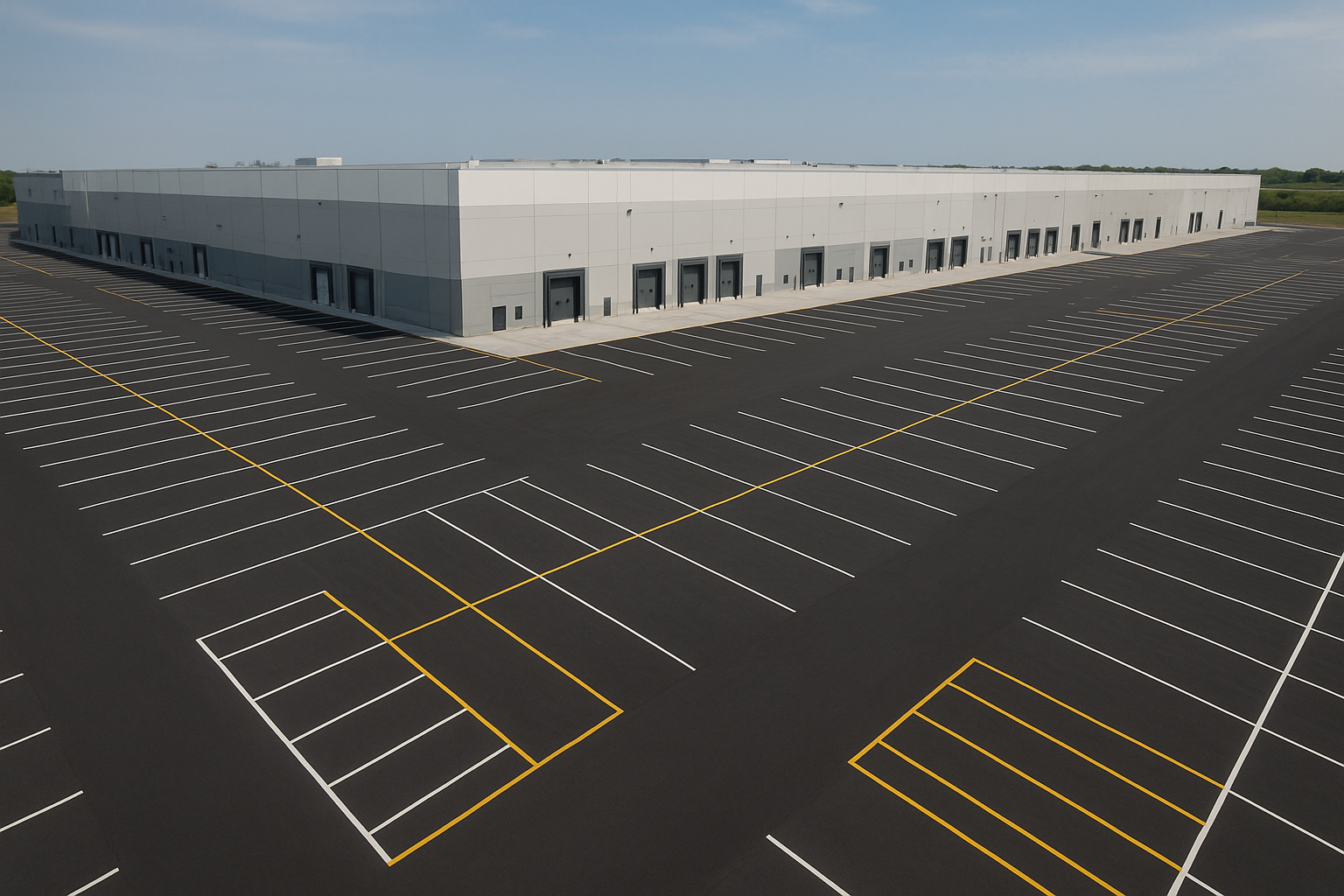
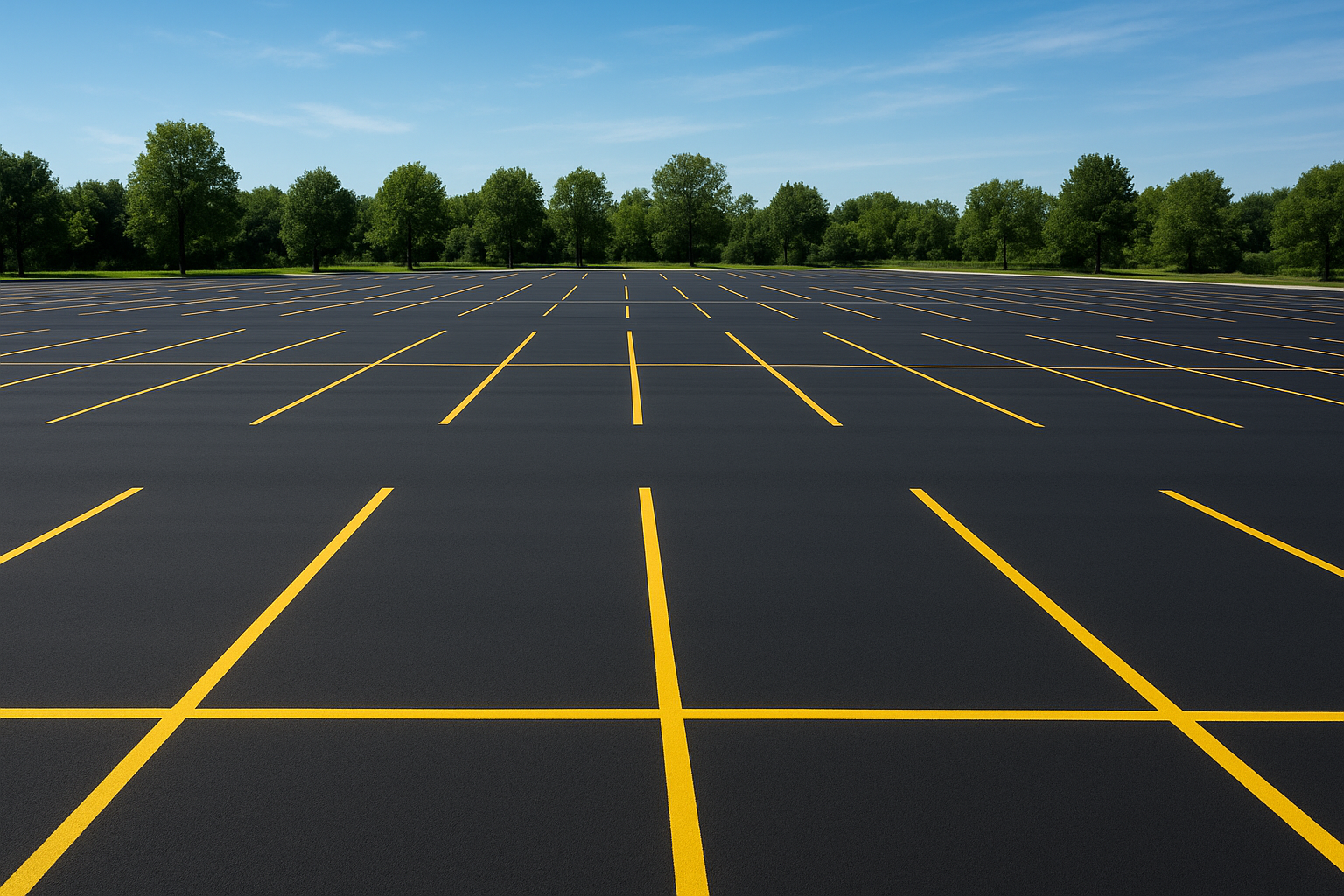
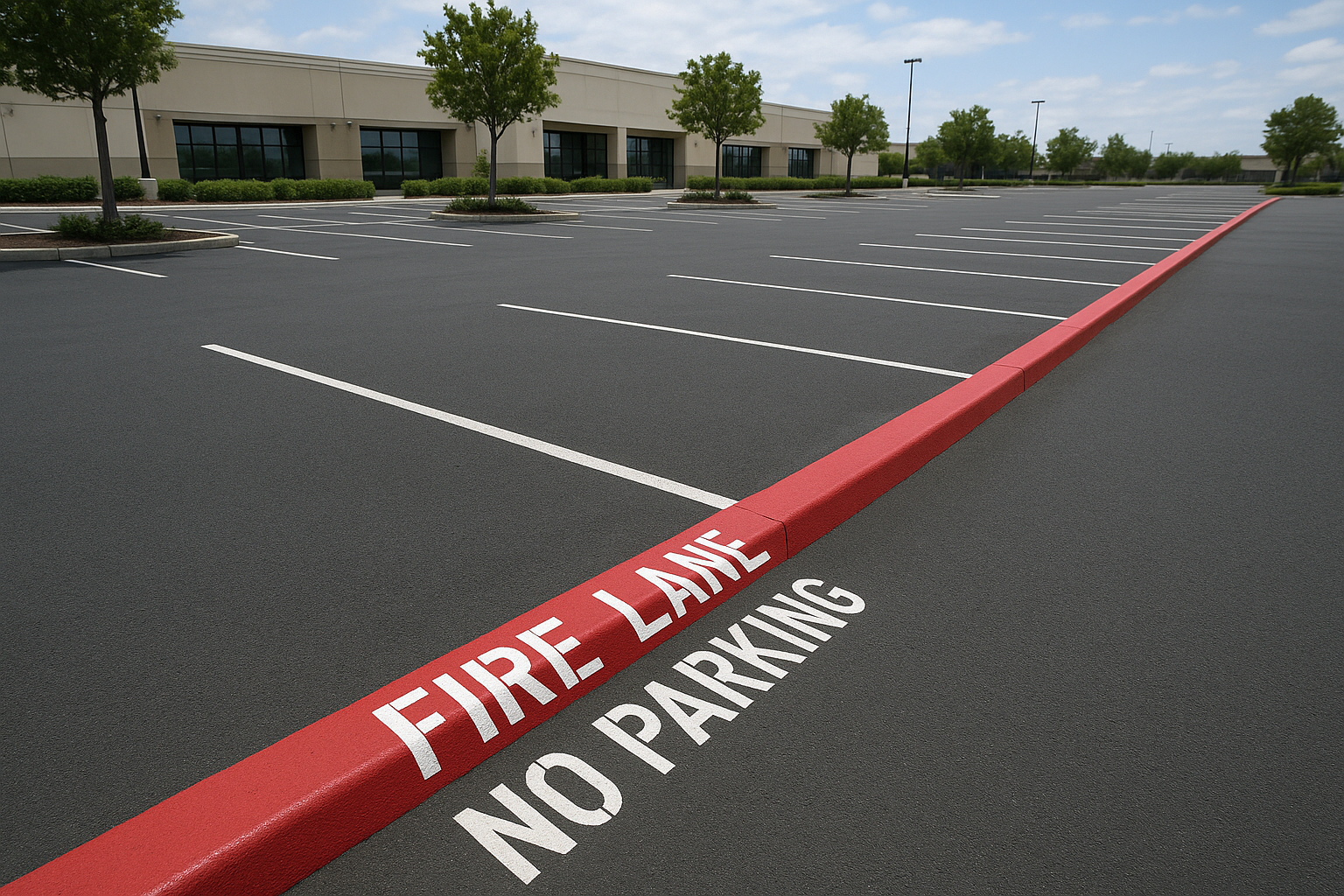
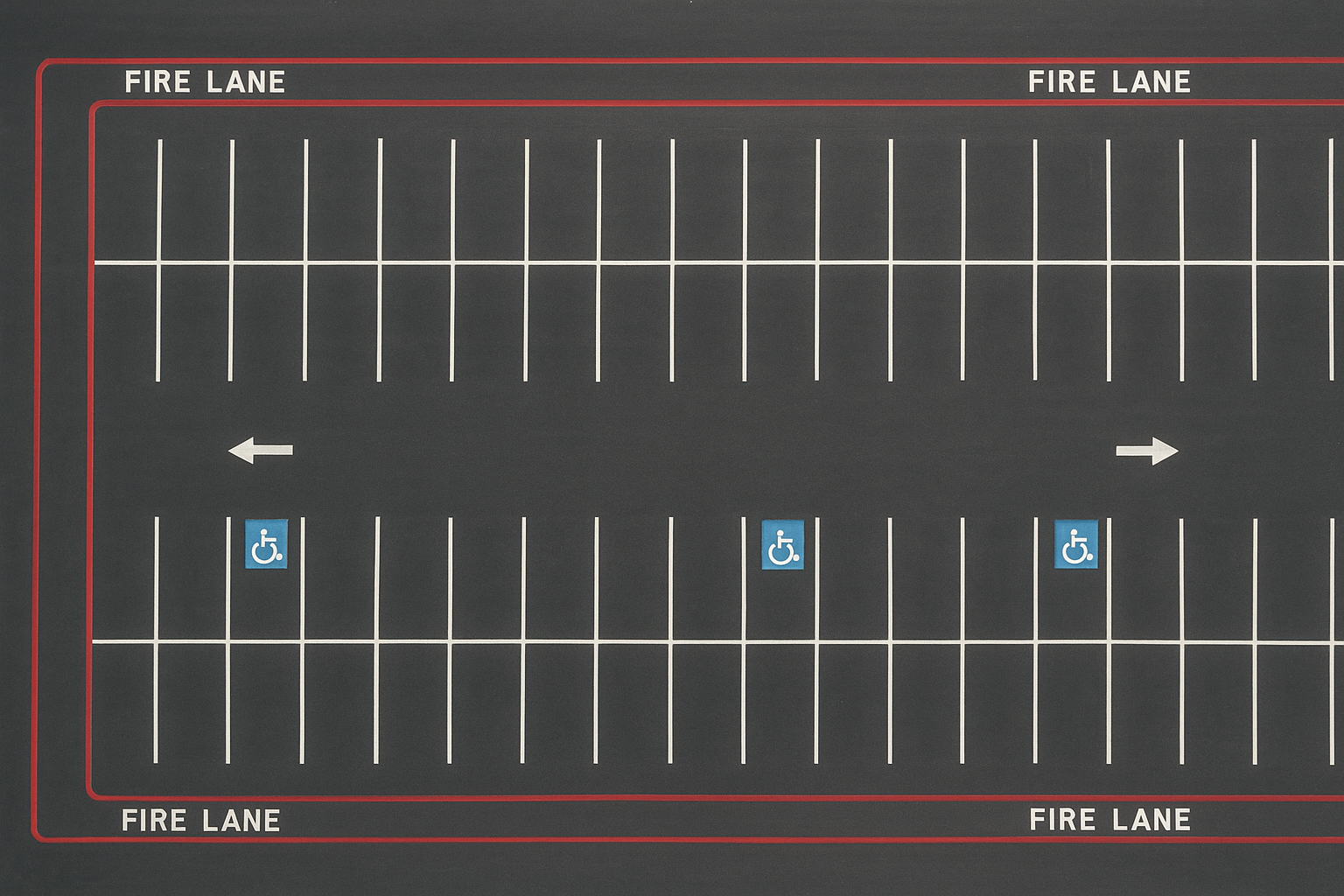
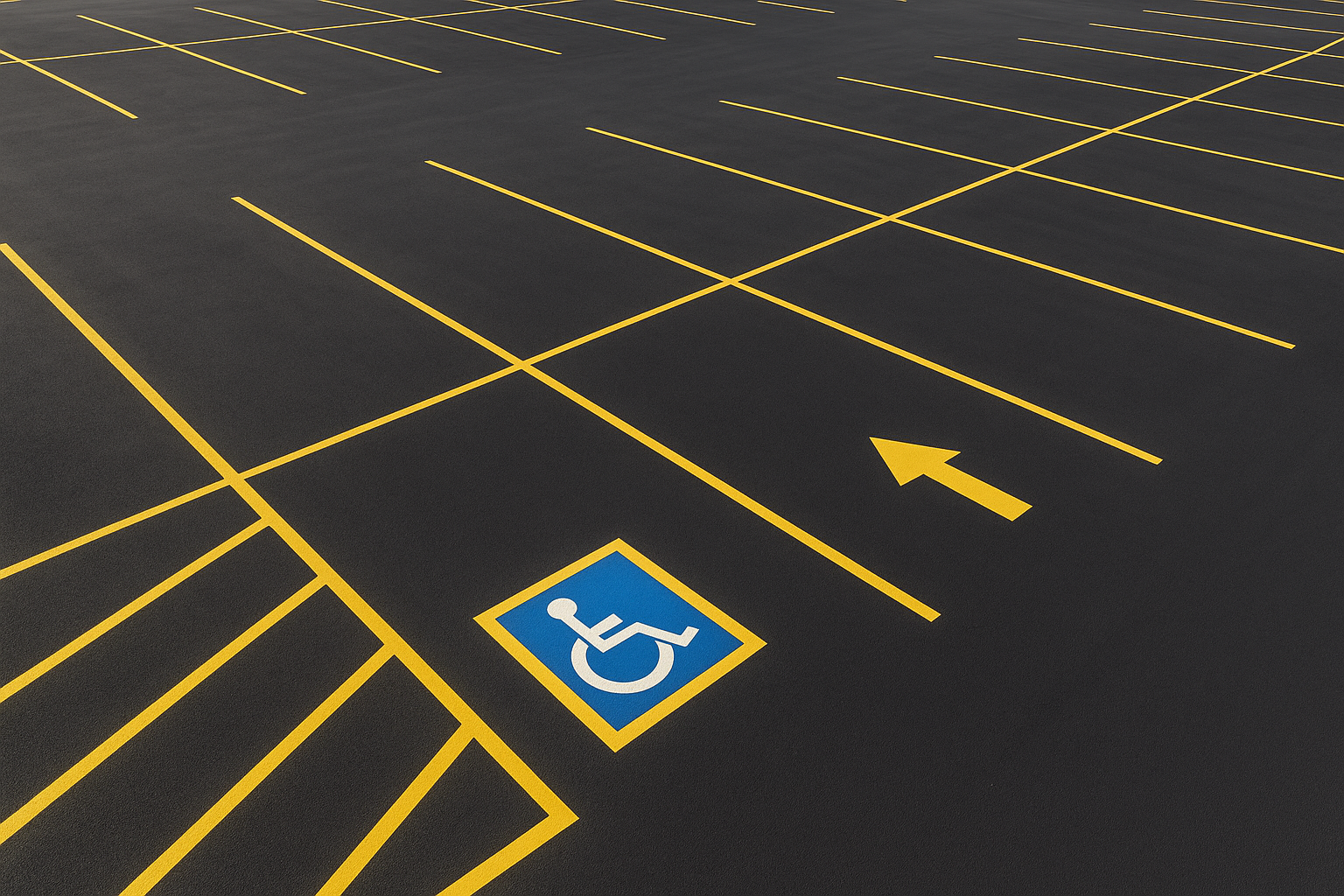
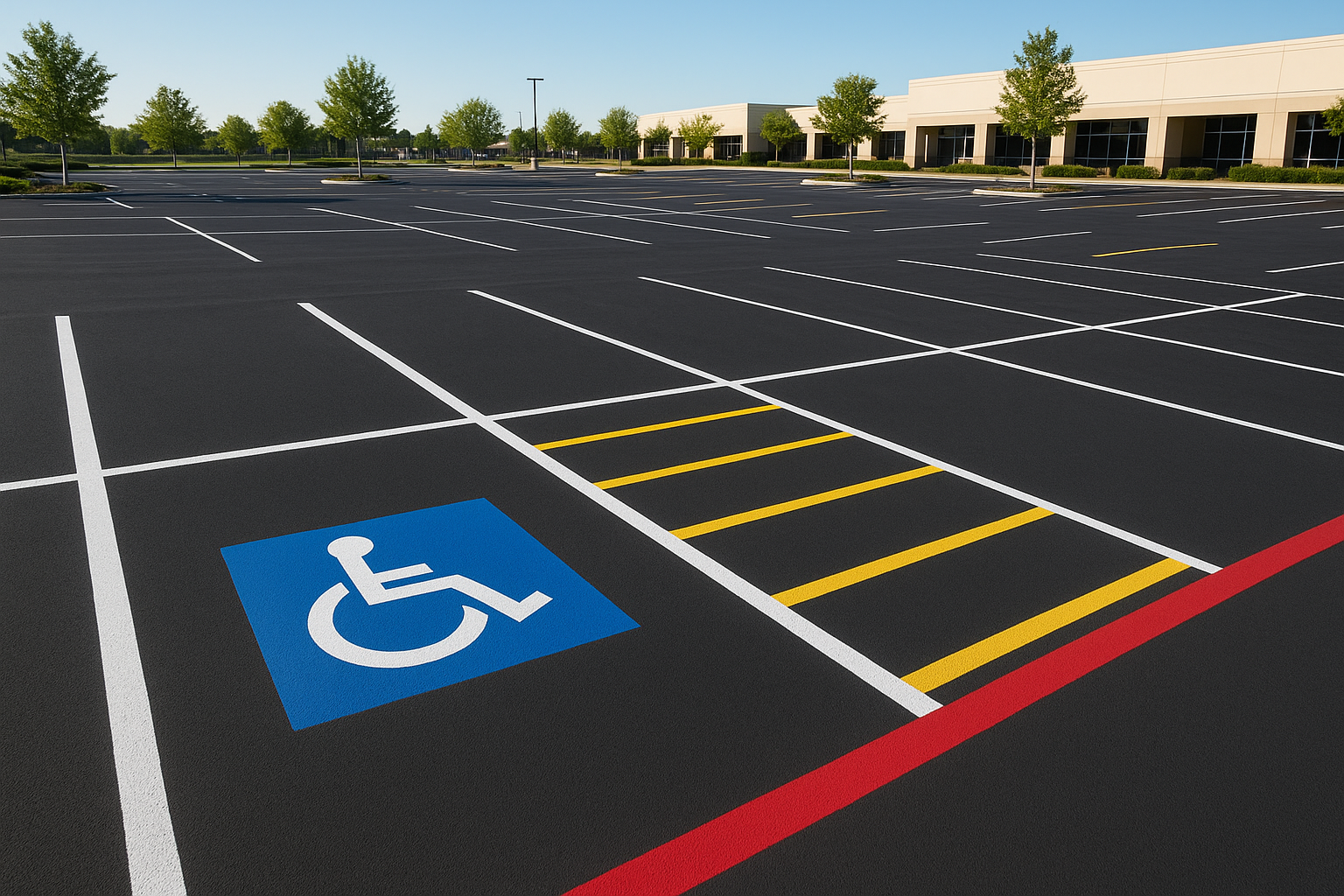
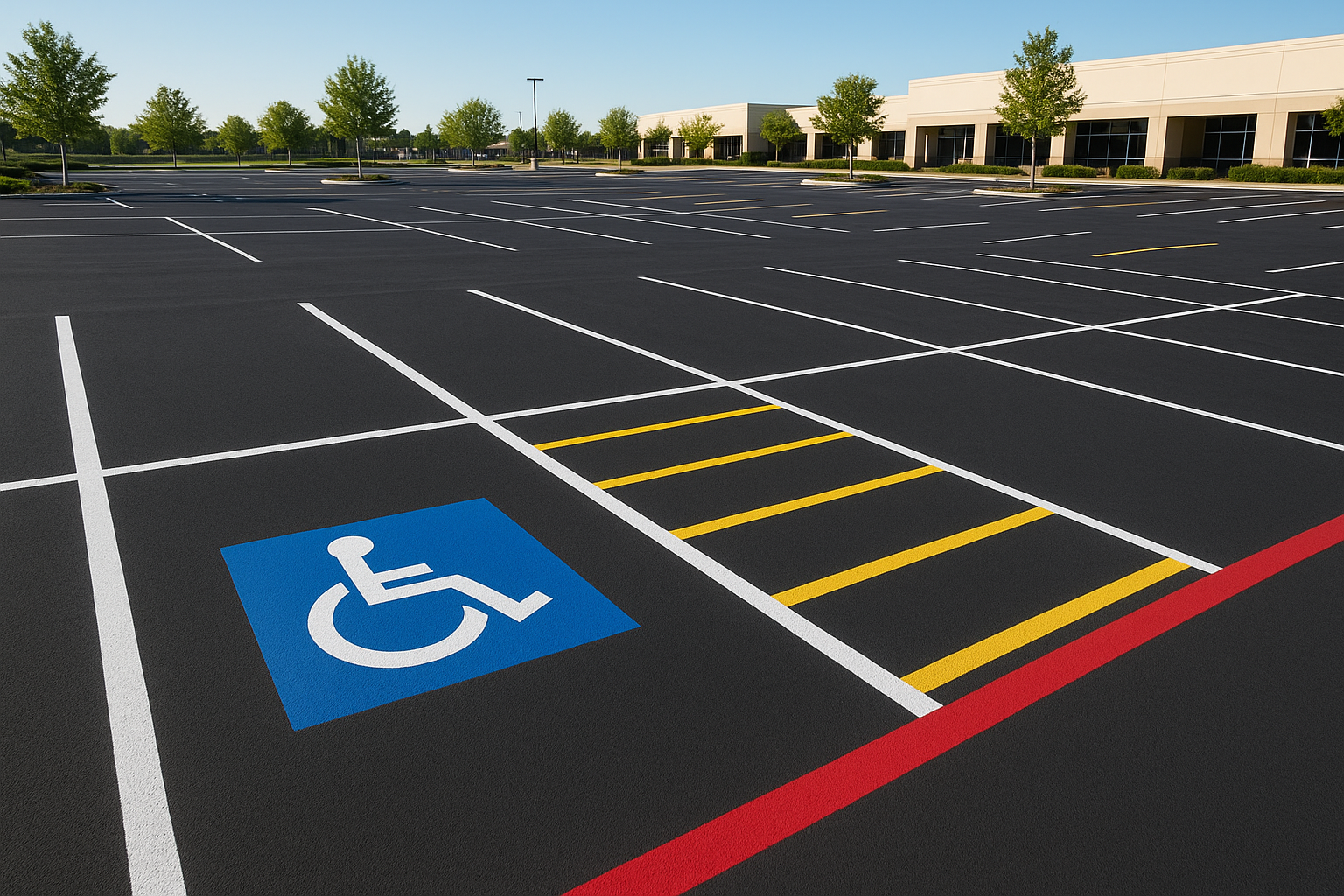
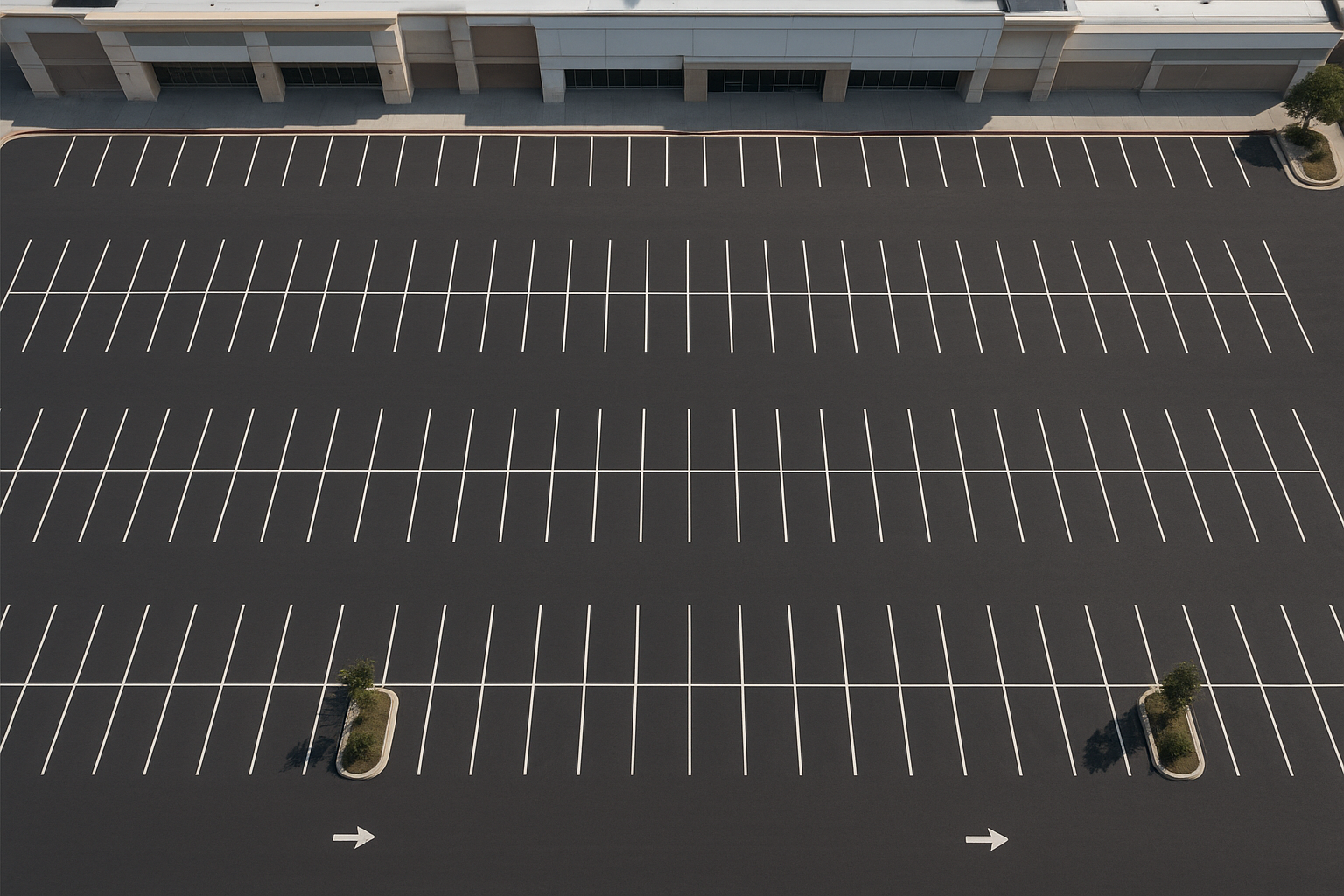
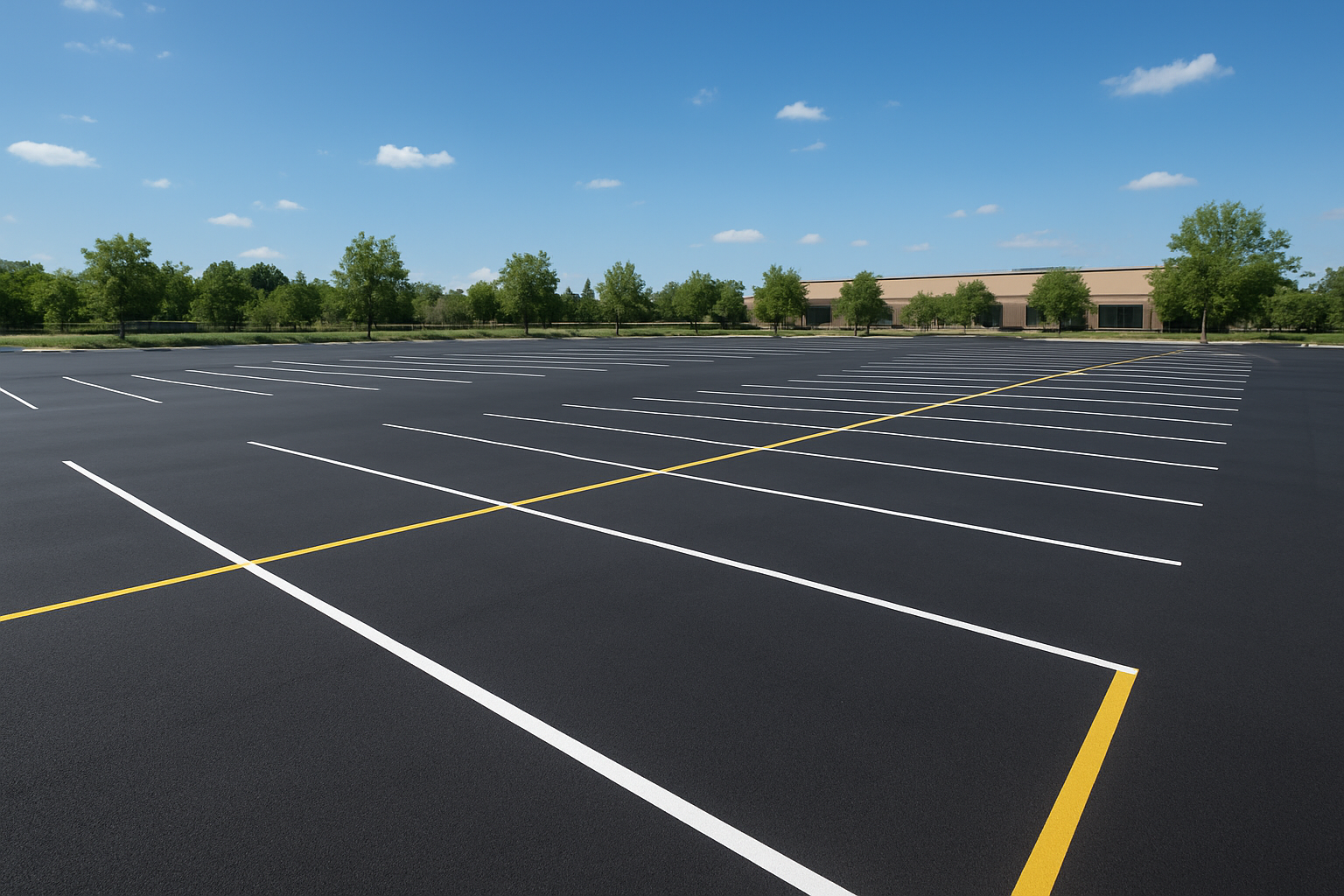
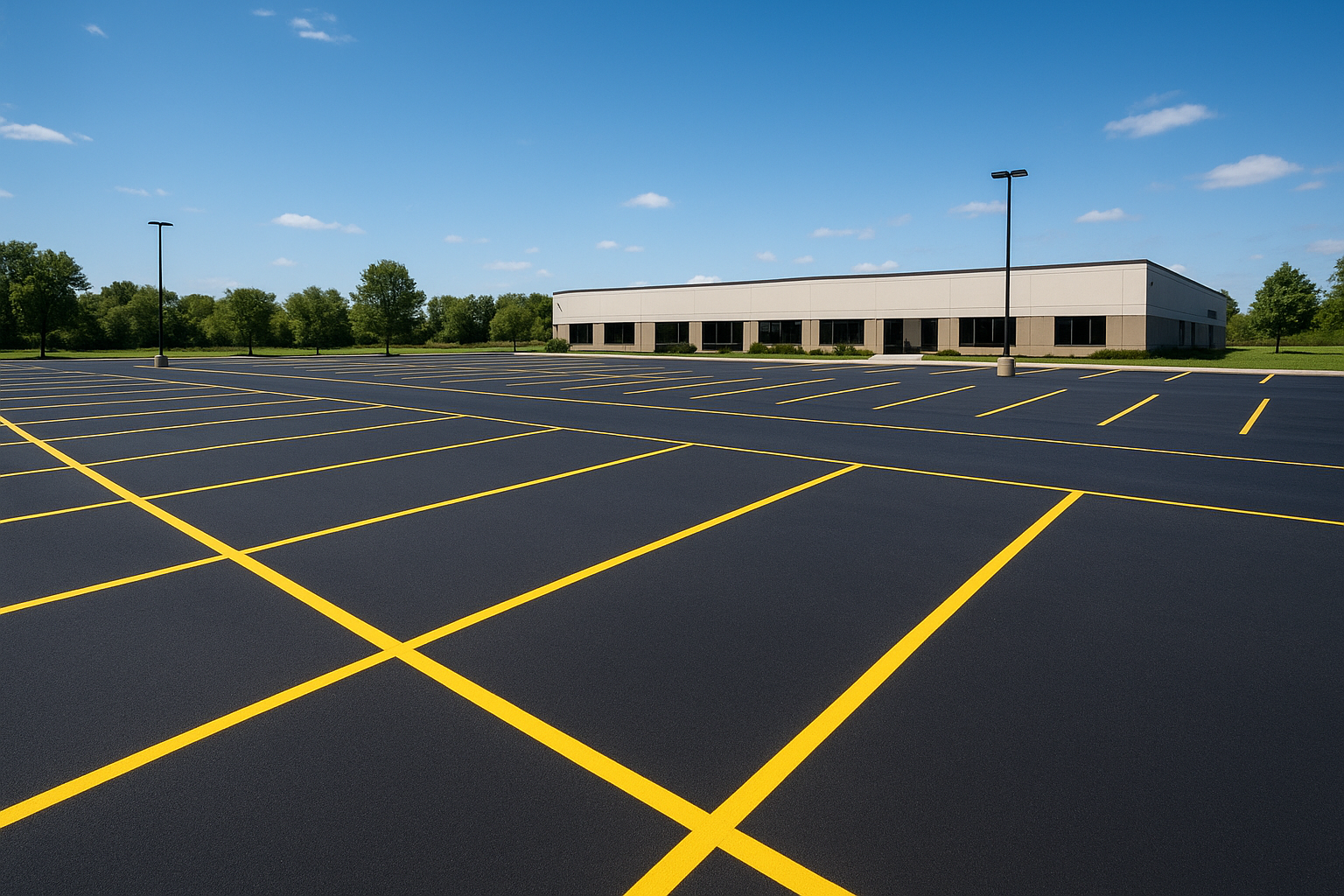
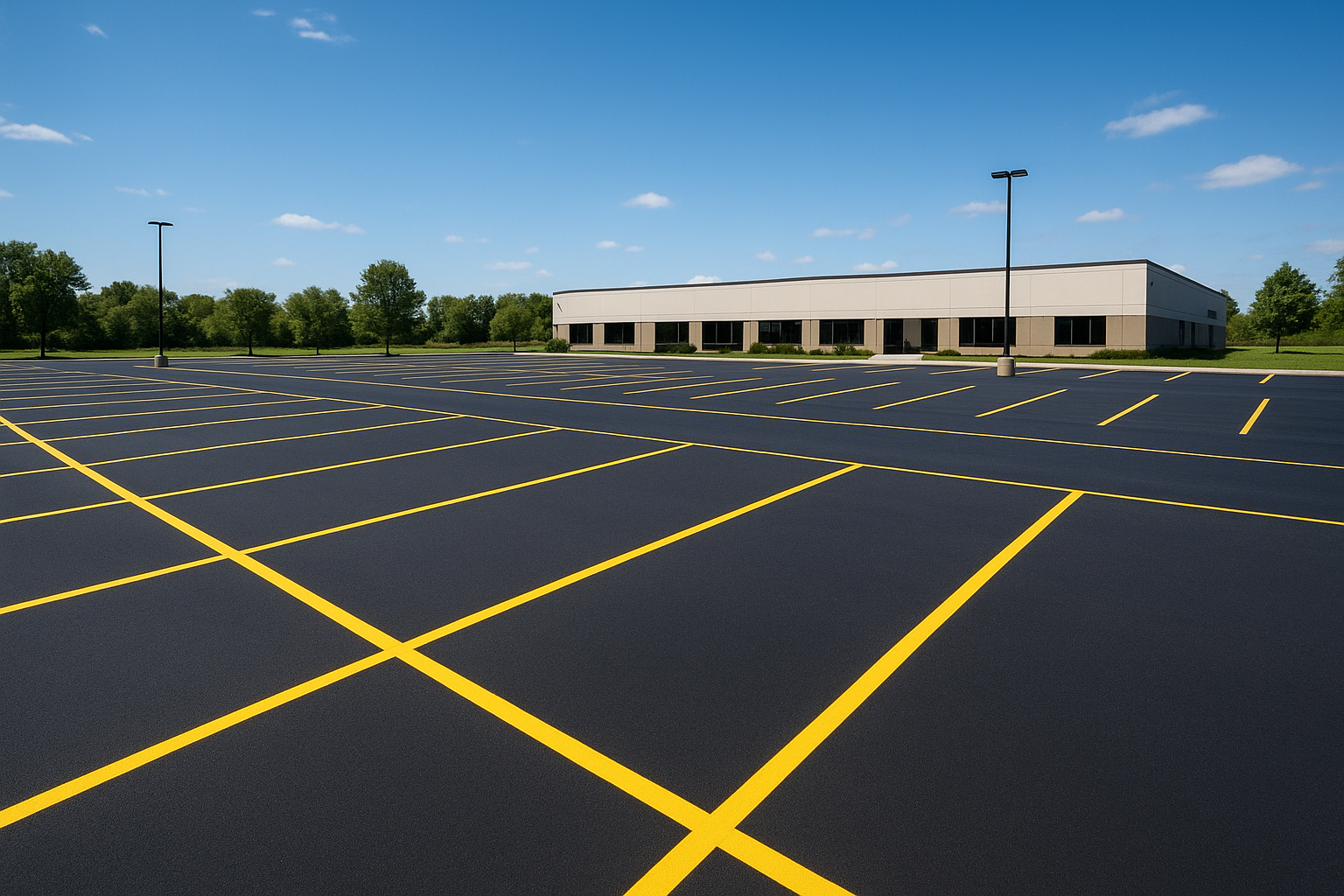
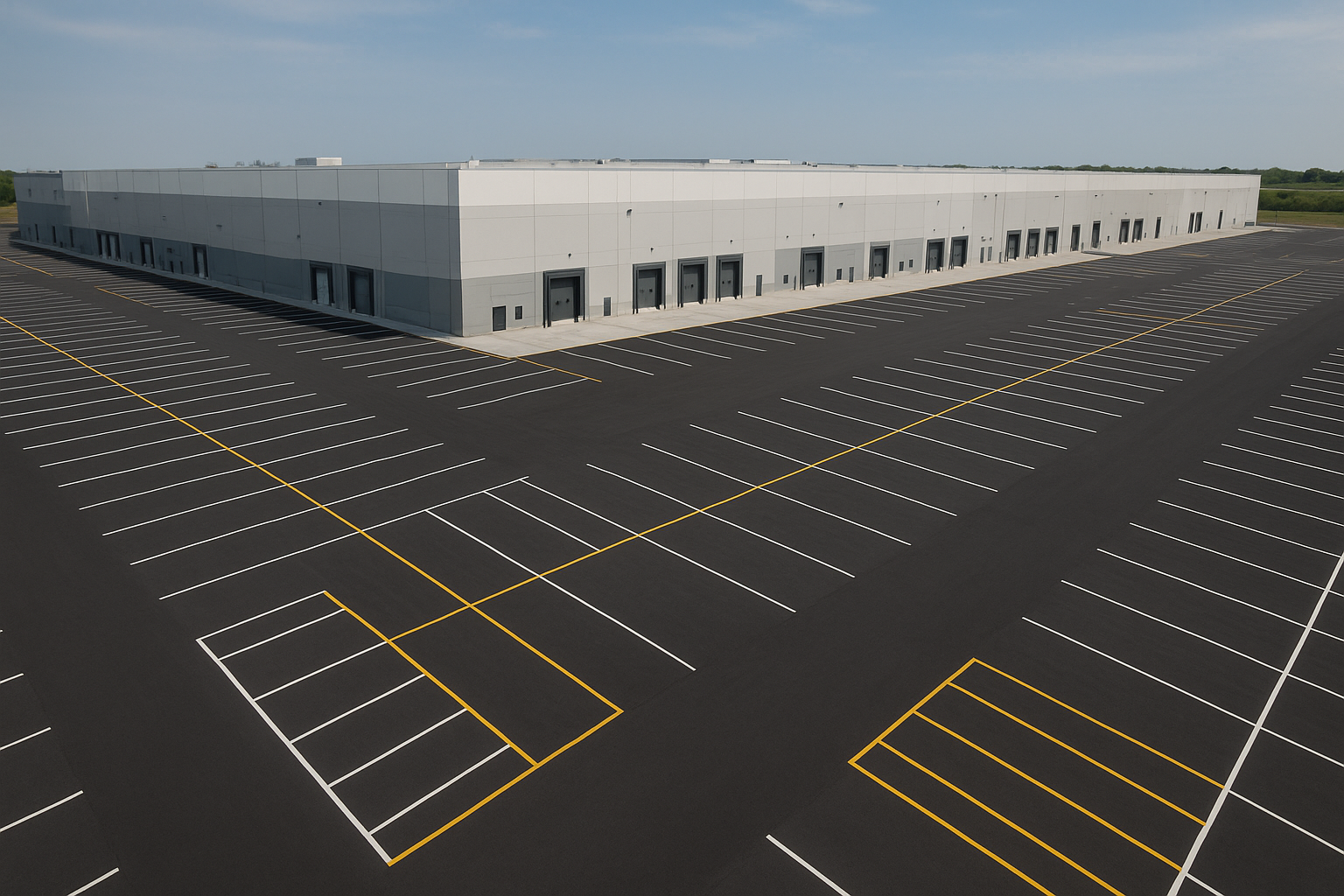
    Aerial view of a freshly completed PLS parking lot striping project with white stall lines, blue ADA spaces, and red fire lane markings on Texas asphalt

    A professionally completed PLS parking lot striping project shows crisp white stall lines, ADA-compliant blue handicap spaces, and clearly marked fire lanes — all essential for a safe, code-compliant Texas property.

    Why Professional Line Marking Matters for Texas Properties

    Texas commercial properties face intense sun exposure, heavy rainfall, and high traffic volumes — all of which accelerate the fading and deterioration of parking lot markings. Consequently, lines that looked sharp after initial application can become barely visible within 12 to 24 months without proper maintenance.

    Beyond aesthetics, faded markings create real operational problems. Drivers park inconsistently, blocking fire lanes or reducing the effective number of usable stalls. Additionally, unclear ADA spaces put property owners at risk of ADA accessibility violations, which can result in complaints, audits, and costly remediation.

    For property managers overseeing retail centers, healthcare facilities, schools, or municipal lots, maintaining sharp, visible markings is therefore both a legal obligation and a practical necessity. Professional striping companies bring the right equipment, materials, and code knowledge to handle each of these requirements efficiently.

    ADA Compliance: A Non-Negotiable Requirement

    The ADA mandates that parking lots provide a minimum number of accessible spaces based on total capacity. For example, a lot with 1 to 25 spaces must include at least one accessible stall. Lots with 26 to 50 spaces require two, and so on. Furthermore, at least one in every six accessible spaces must be van-accessible, with an 8-foot-wide access aisle.

    Striping these spaces correctly — with proper width, access aisle dimensions, and the International Symbol of Access — requires precision and up-to-date knowledge of current regulations. This is precisely why working with an experienced parking lot striping specialist is so important for any Texas commercial property.

    How to Get Professional Parking Lot Striping: A Step-by-Step Process

    Getting your parking lot professionally striped is straightforward when you follow a clear process. Here is how most projects unfold from start to finish:

    1. Assess your lot’s current condition. Walk the property and document faded lines, missing ADA markings, unclear fire lanes, and areas where traffic flow is confusing. Photos help your contractor understand the scope quickly.
    2. Request a free quote from a professional striping company. Provide your lot dimensions, condition photos, and specific requirements such as ADA compliance or fire lane marking. An itemized quote ensures you understand exactly what is included before work begins.
    3. Review the layout plan and confirm code compliance. Work with your contractor to verify that the proposed stall layout meets ADA requirements and that fire lane designations align with local fire code standards.
    4. Prepare the surface and schedule the work. Ensure the lot is clean, dry, and clear of vehicles on the scheduled date. Coordinating with tenants or employees in advance prevents delays and ensures crews can work efficiently.
    5. Inspect the finished work and allow proper cure time. After completion, review all lines and symbols against the agreed plan. Allow at least 30 minutes before reopening the lot, and avoid heavy vehicle use for the first 24 hours to ensure full paint adhesion.

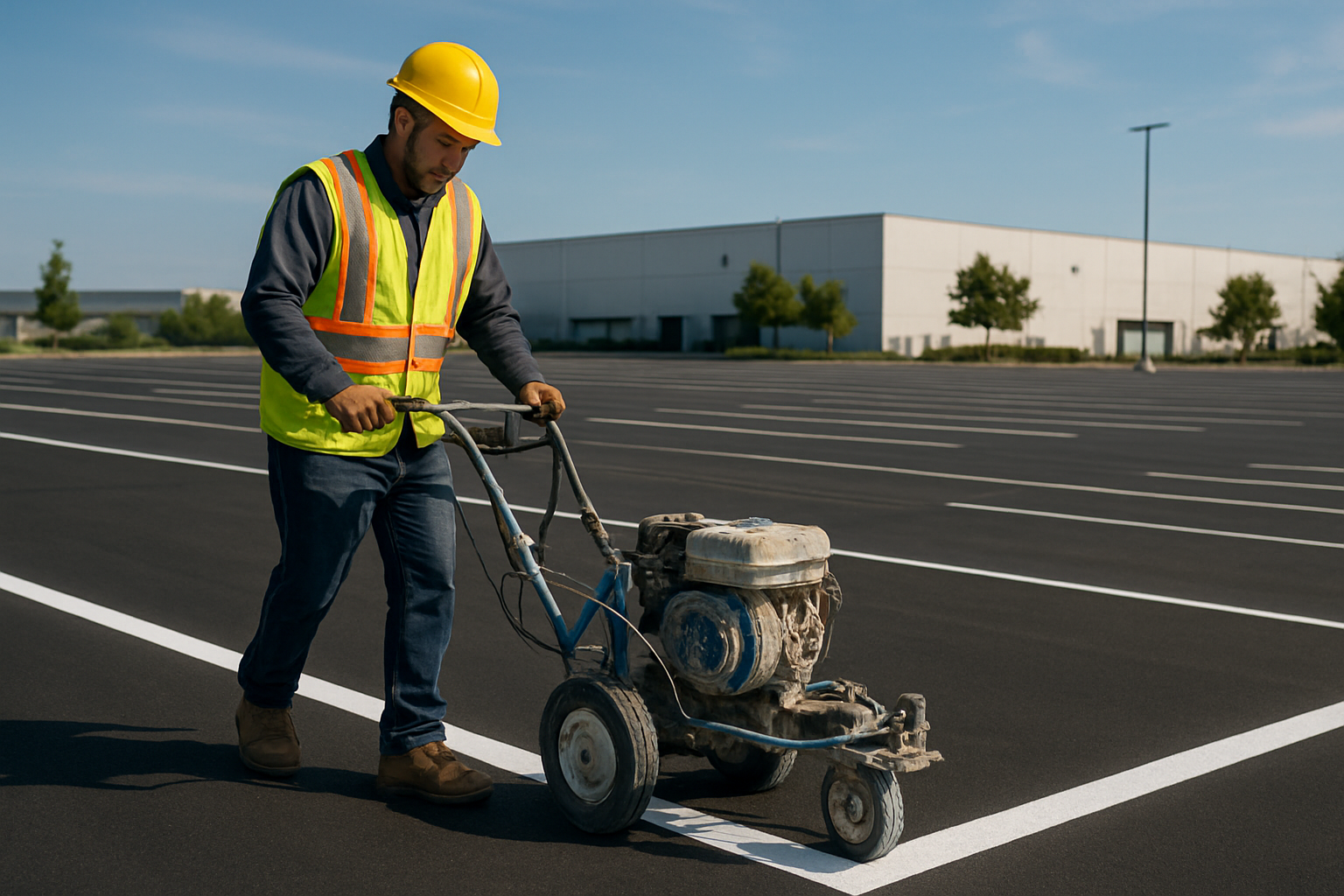
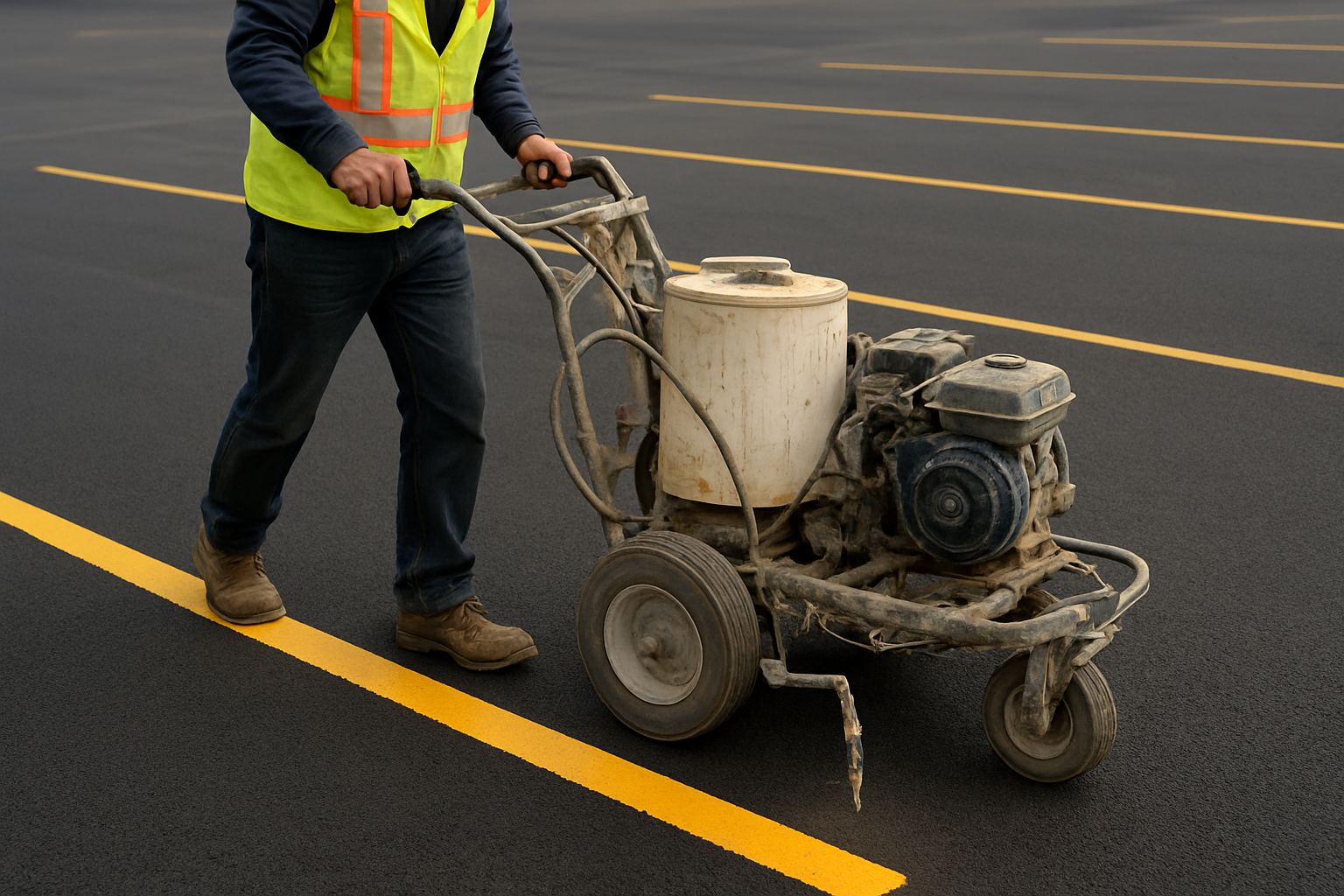
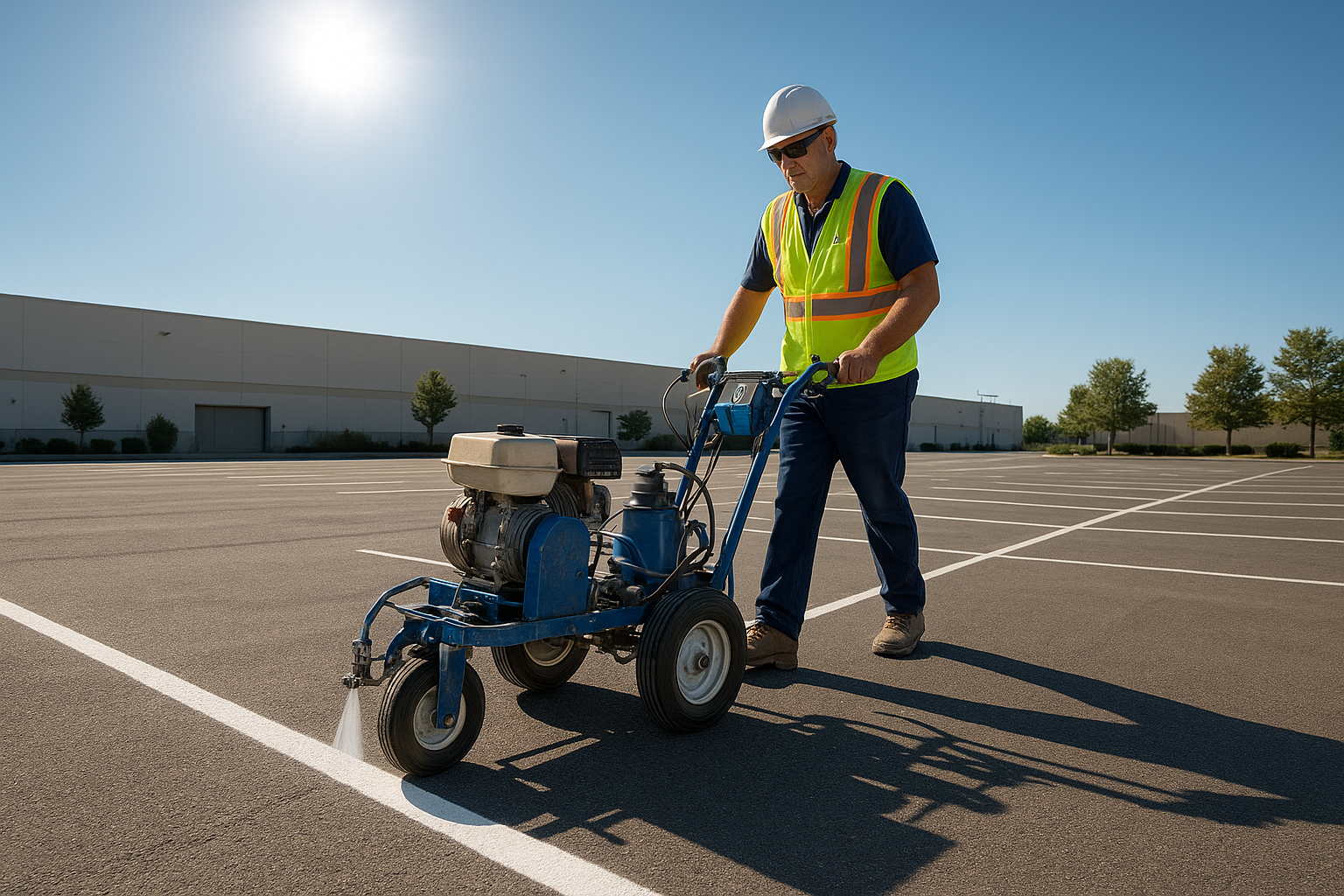
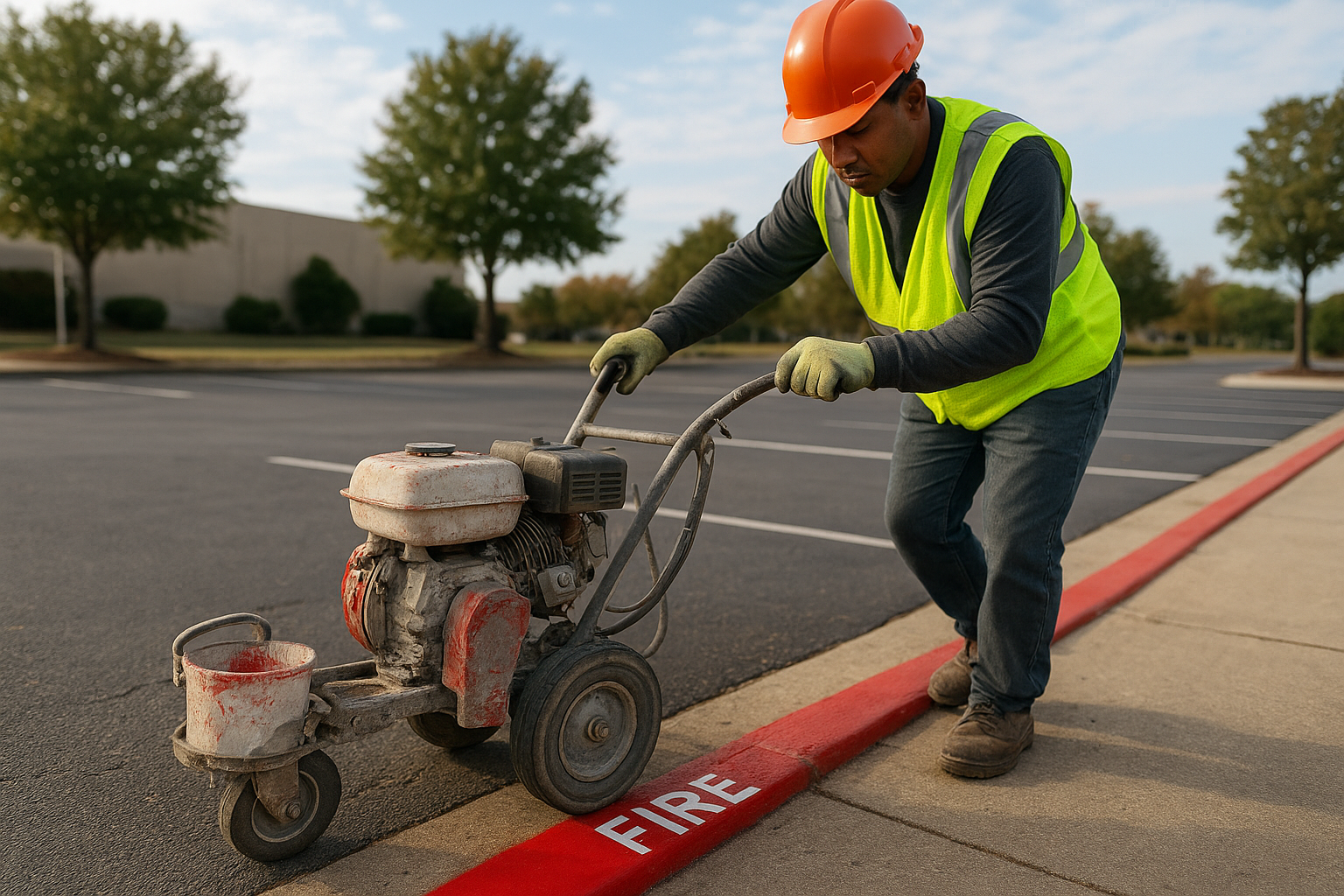
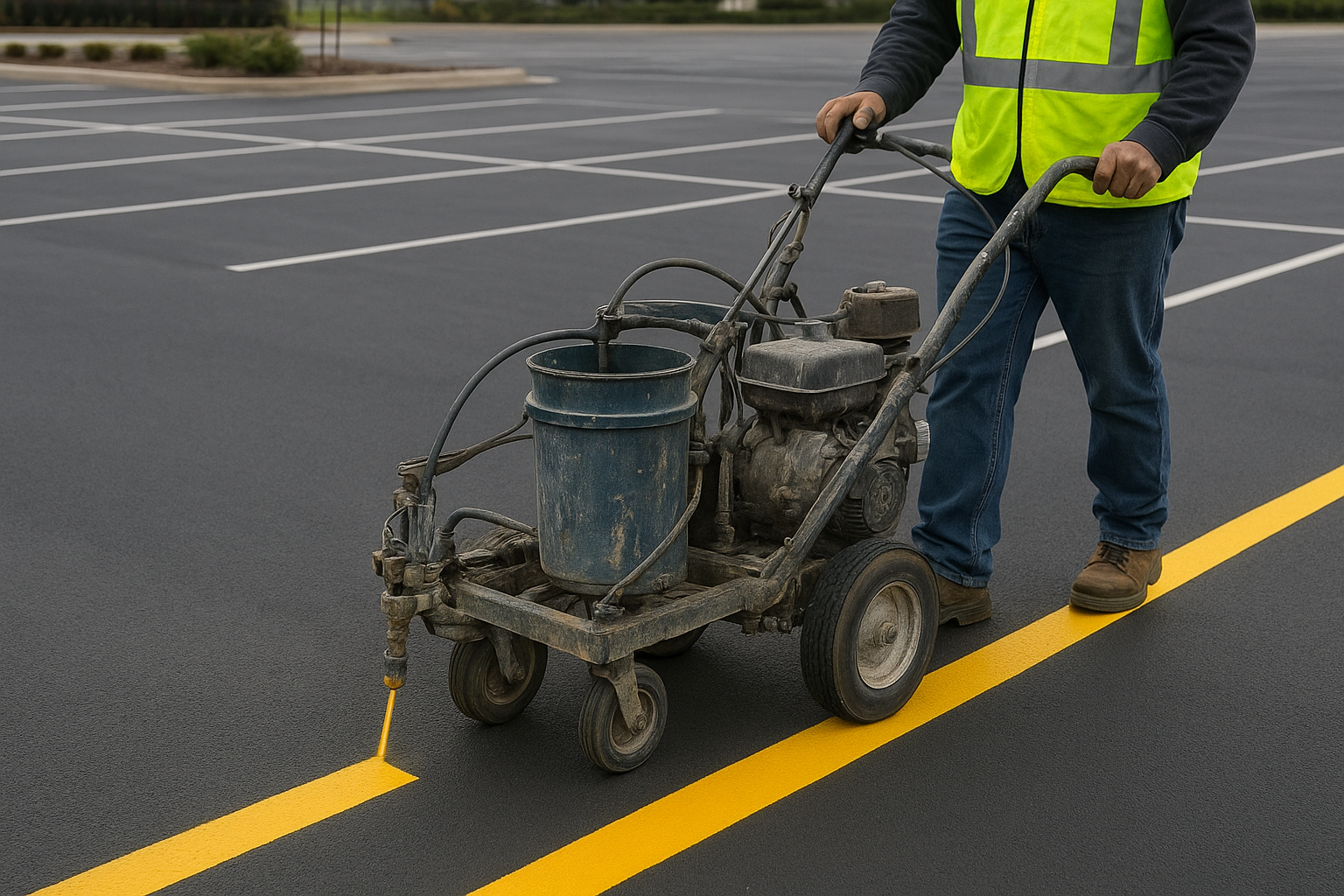
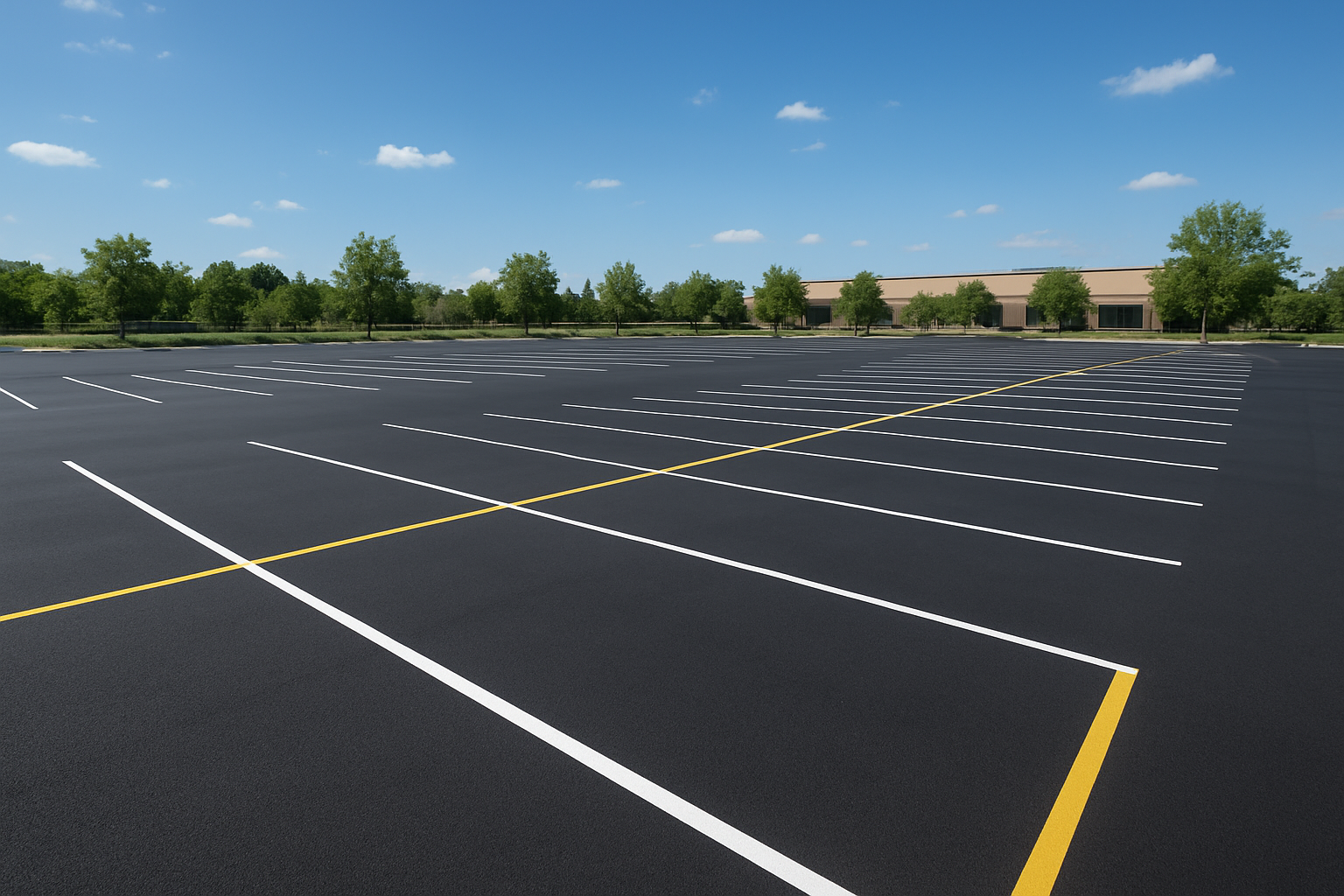
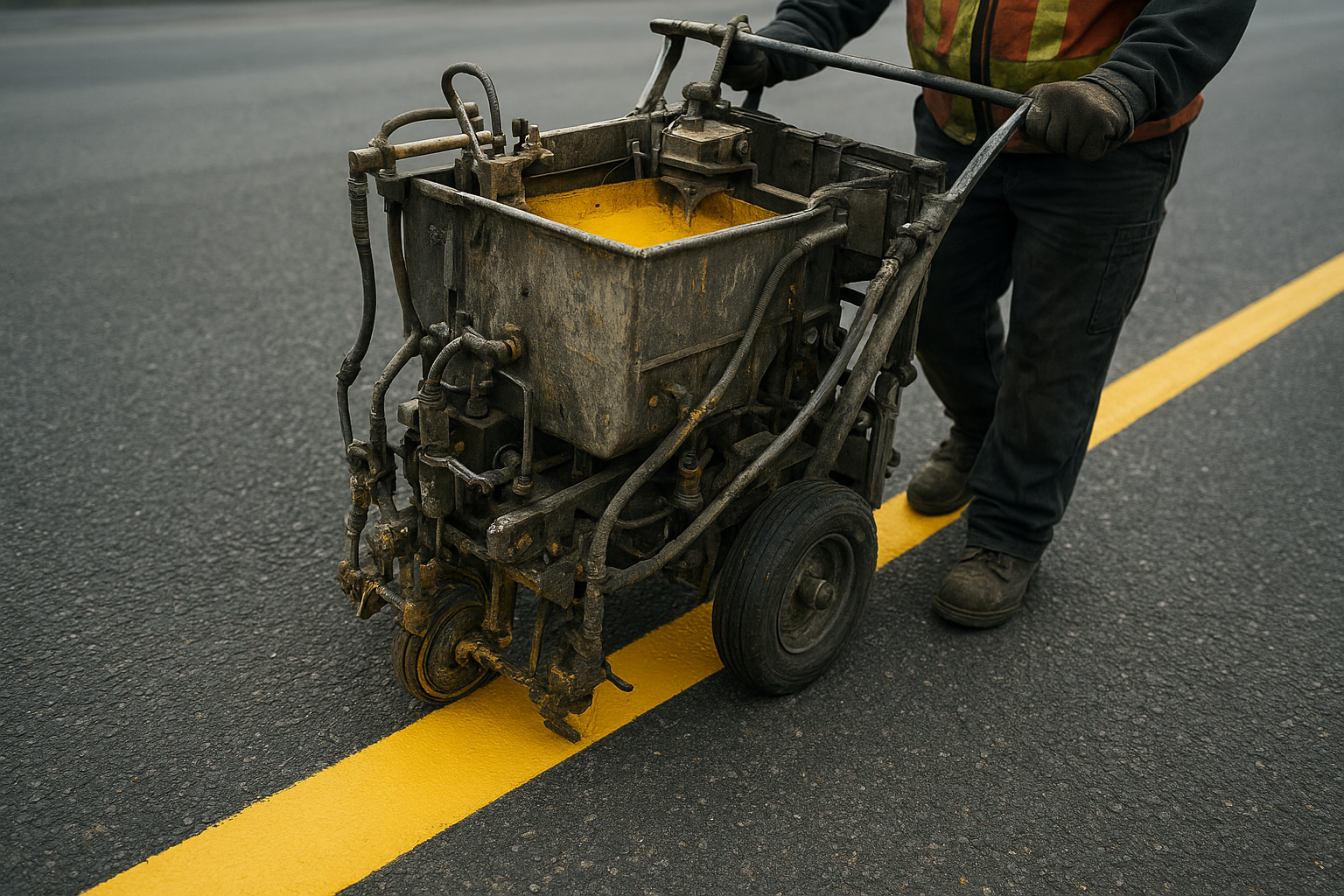
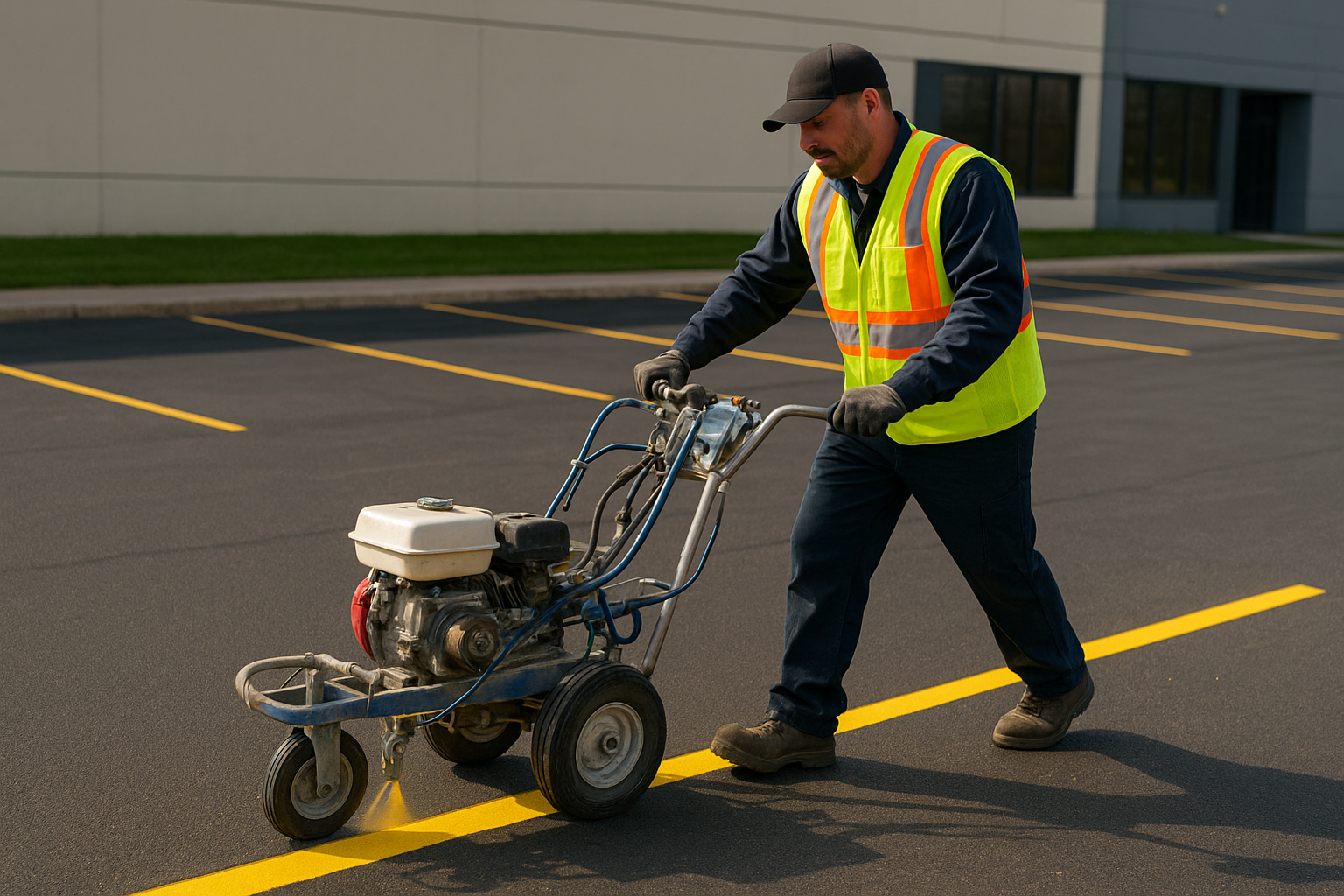
    Professional parking lot striping machine applying fresh white paint lines on Texas asphalt during a commercial lot marking project

    A professional-grade striping machine ensures straight, consistent lines — a key advantage of hiring an experienced parking lot marking crew over DIY methods.

    New Lot Layout vs. Restriping: Which Do You Need?

    Understanding the difference between a new lot layout and restriping helps you choose the right service for your property. In short, new lot layout striping involves designing and painting a complete parking configuration from scratch — typically after new asphalt has been poured or an existing lot has been fully resurfaced.

    Restriping, on the other hand, refreshes faded or worn markings on a lot that already has an established layout. This is the most common service for commercial properties, as it restores visibility without requiring a full redesign. However, restriping is also an excellent opportunity to correct outdated ADA configurations or adjust stall angles to improve capacity.

    For a deeper look at how line marking decisions affect your property, the asphalt striping guide to parking lot line marking covers material choices, layout strategies, and maintenance best practices in detail.

    Fire Lane Marking: A Critical Safety Requirement

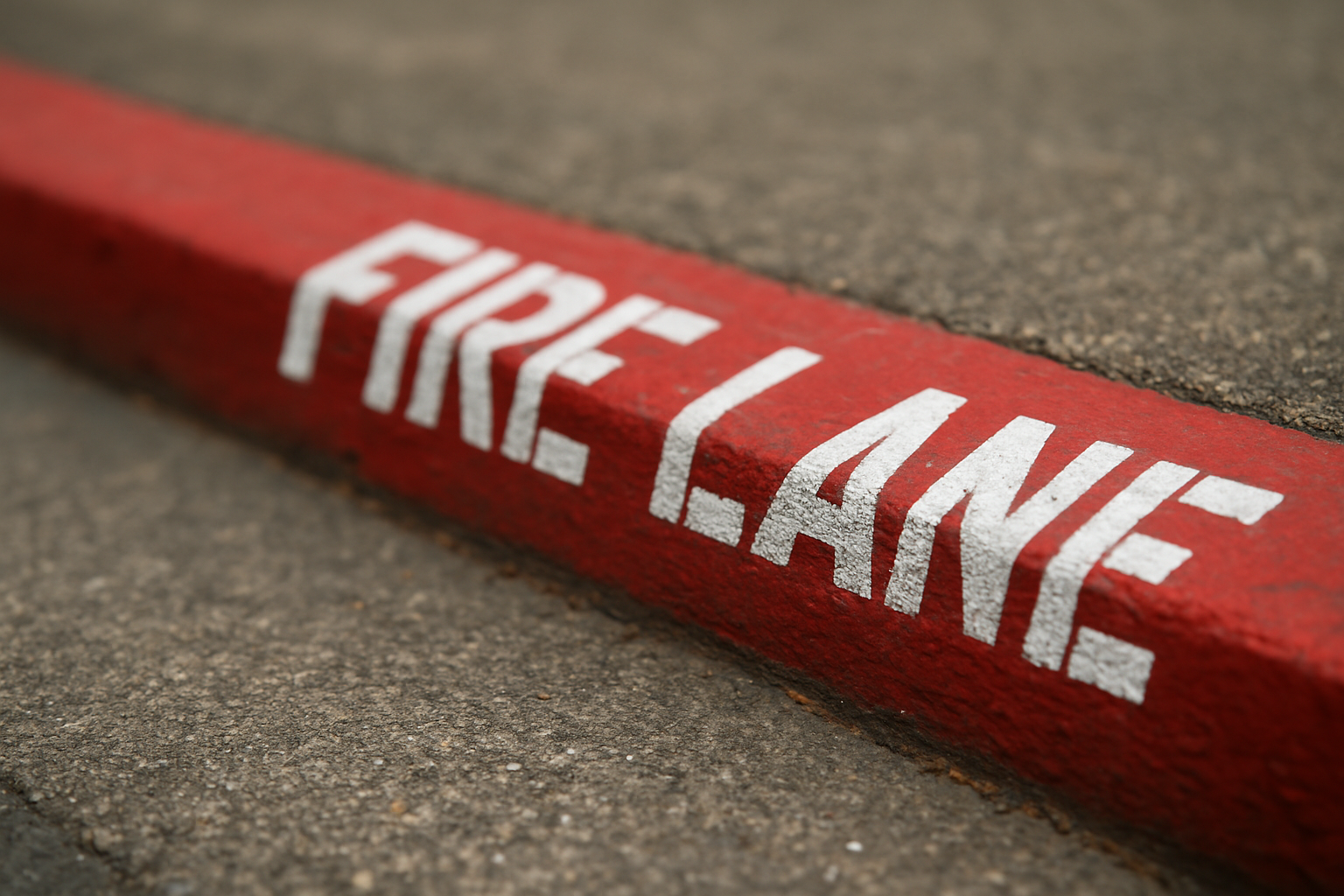
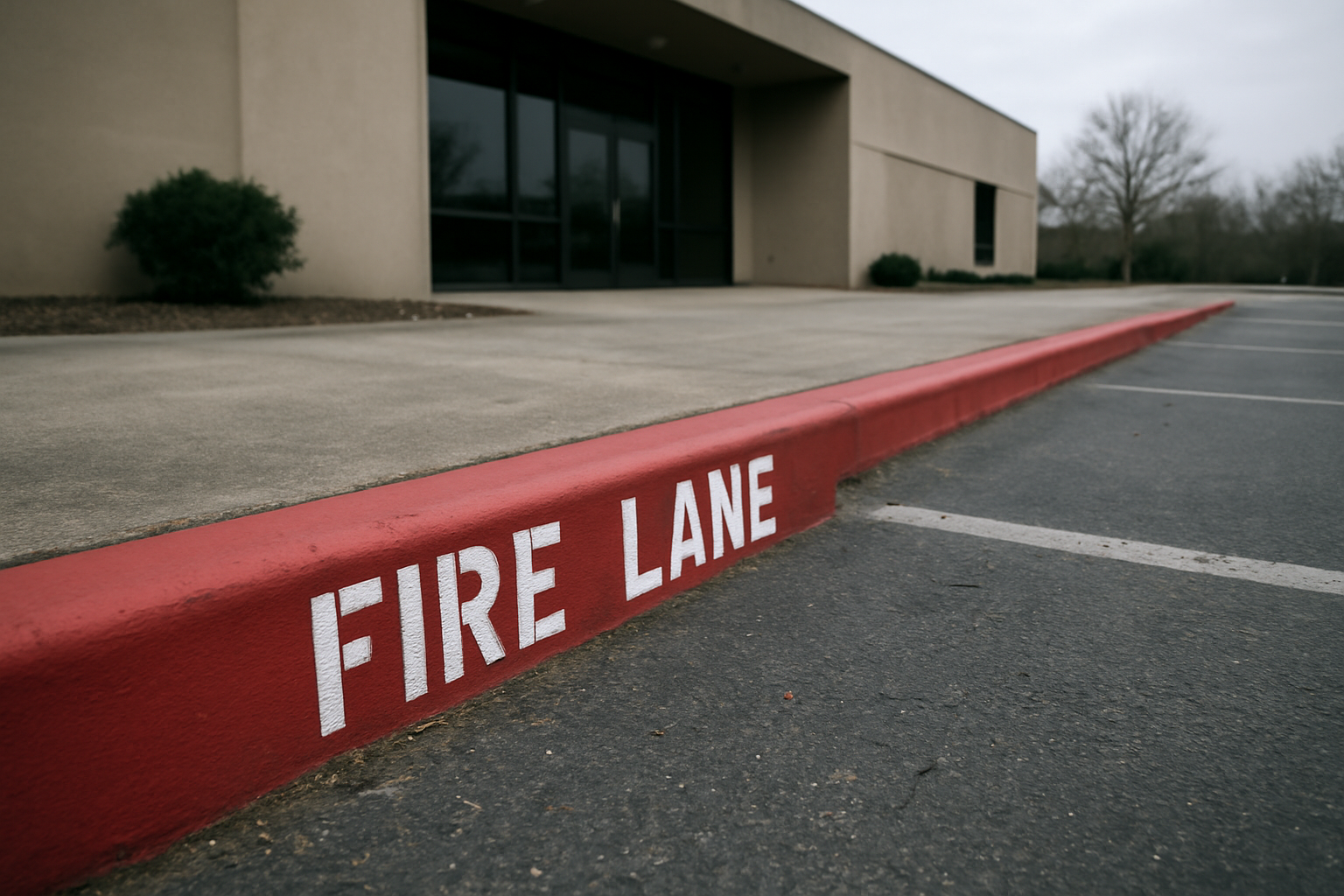
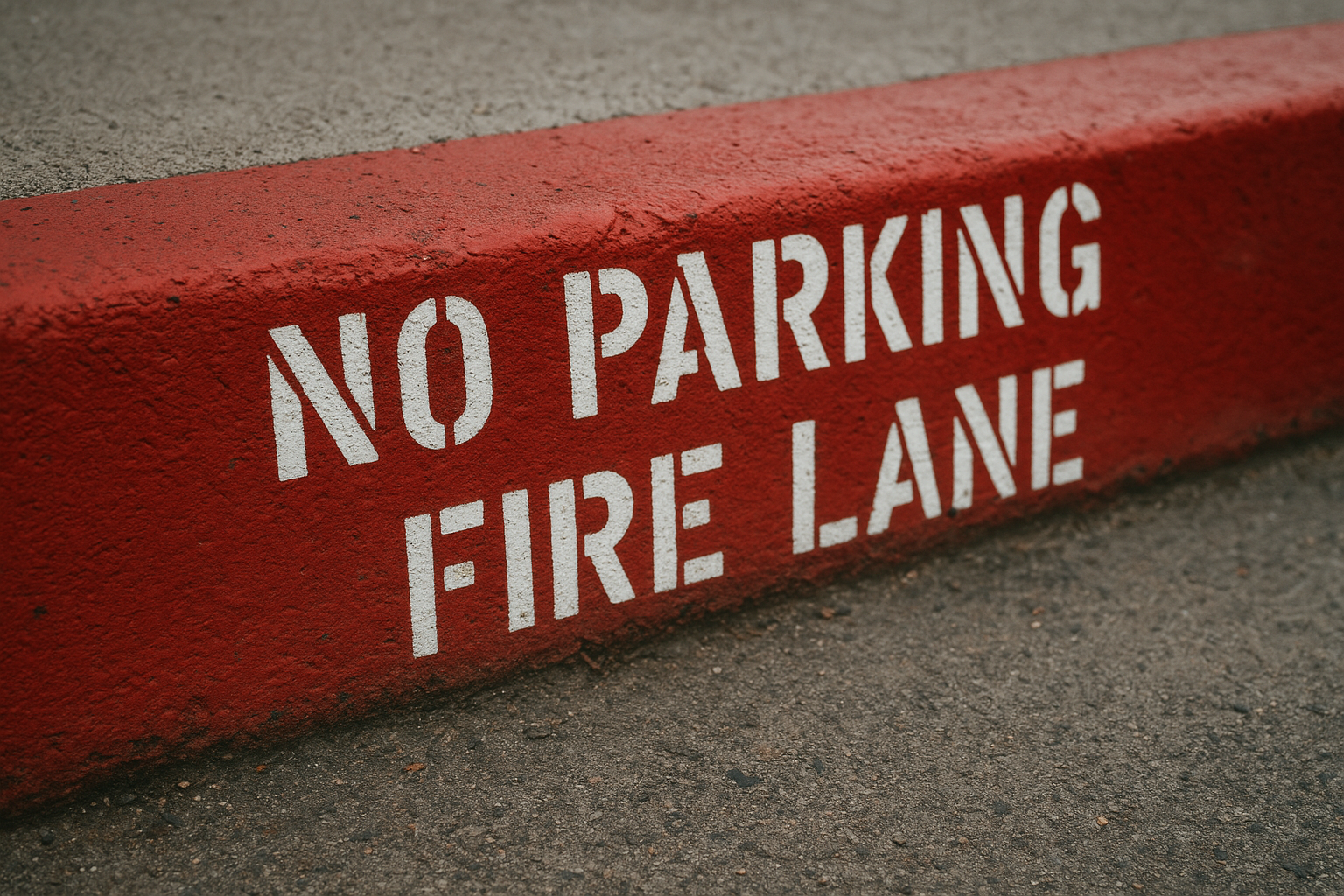
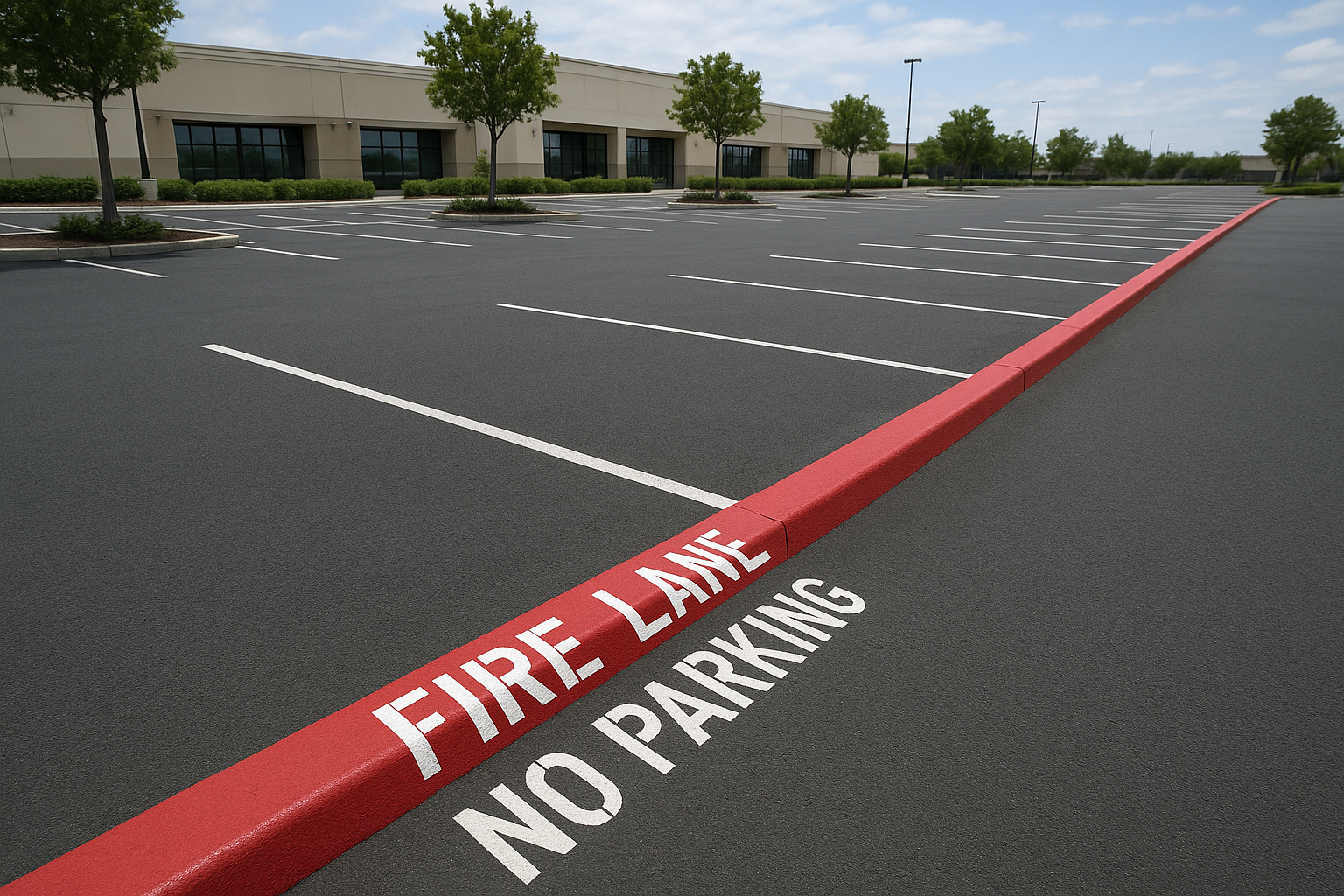
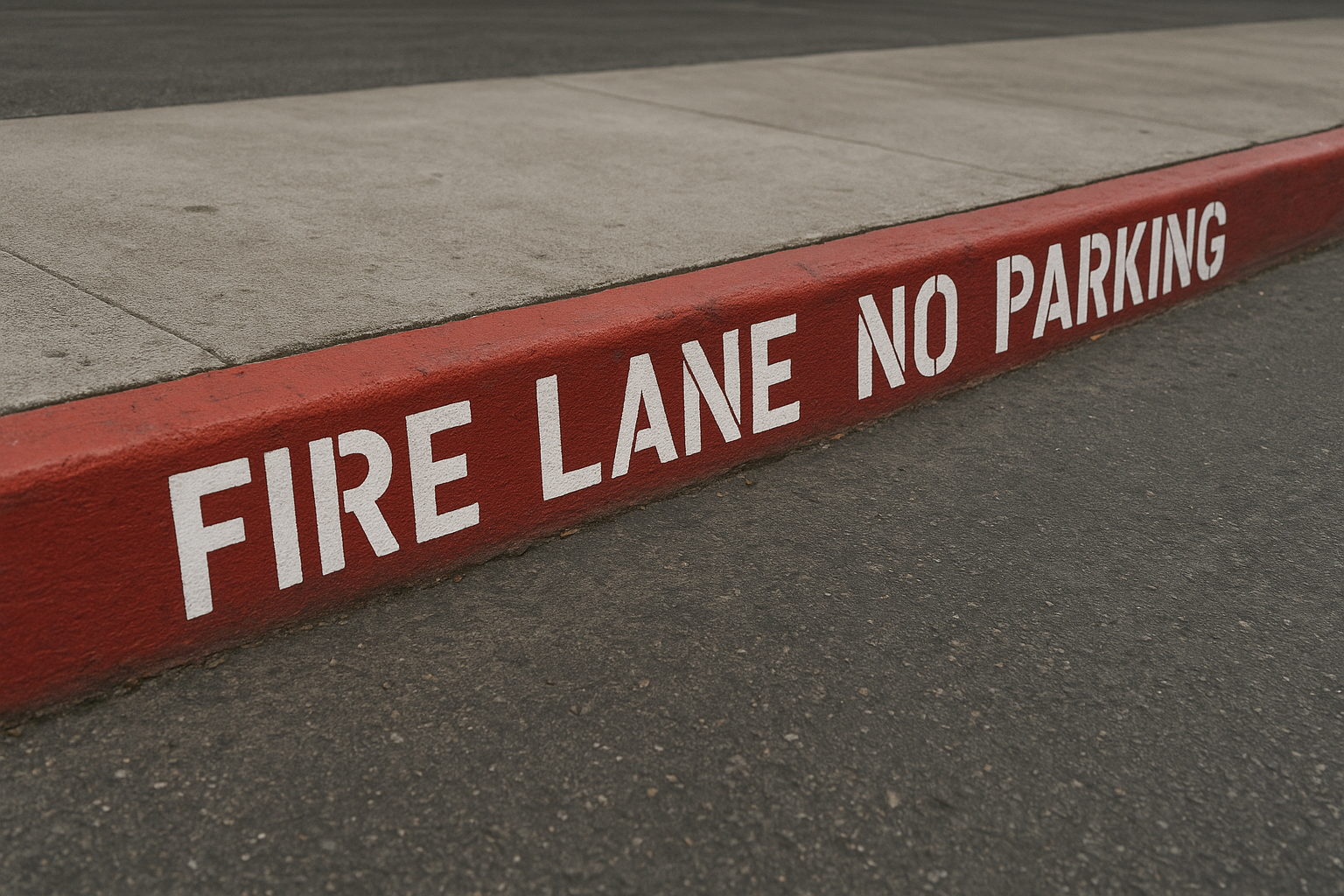
    Fire lane markings are among the most legally significant elements of any commercial parking lot. These red-painted curbs and stenciled designations must remain clearly visible at all times to ensure emergency vehicles can access the property without obstruction. Local fire codes in Texas specify exactly where fire lanes must be located and how they must be marked.

    Neglecting fire lane maintenance can result in citations from local fire marshals and, more critically, could delay emergency response during an actual incident. Therefore, including fire lane refresh in your regular striping maintenance schedule is not just a code requirement — it is a fundamental safety responsibility.

    Choosing the Right Striping Company in Denton and Plano, TX

    Not all striping contractors deliver the same level of quality and compliance knowledge. When evaluating providers, look for a company with demonstrated experience on commercial properties, familiarity with current ADA standards, and the professional equipment needed to produce straight, consistent lines at scale.

    Stripespls.com is a full-service parking lot marking company based in Texas, serving property managers, business owners, retail centers, schools, healthcare facilities, and municipal organizations across the greater North Texas region. The company specializes in professional striping, ADA compliance solutions, and fire lane marking for both commercial and residential properties throughout the Denton and Plano areas.

    From new lot layouts to restriping faded markings, the team brings precision and attention to detail to every project. Prospective clients can explore the full range of available services at the stripespls.com services page and request a free, no-obligation quote directly through the website.

    Additionally, referencing authoritative guidance from sources like the Federal Highway Administration’s pavement marking resources can help property owners understand best practices for long-lasting, high-visibility markings.

    Quick Reference: Key Parking Lot Striping Facts

    • Most lots need restriping every 1 to 2 years depending on traffic and weather exposure.
    • ADA requires at least 1 accessible space for every lot with 1 to 25 total stalls.
    • Water-based traffic paint typically dries in 30 minutes under normal conditions.
    • Fire lane markings are mandated by local fire codes and must be maintained continuously.
    • Van-accessible spaces require an 8-foot-wide access aisle adjacent to the stall.

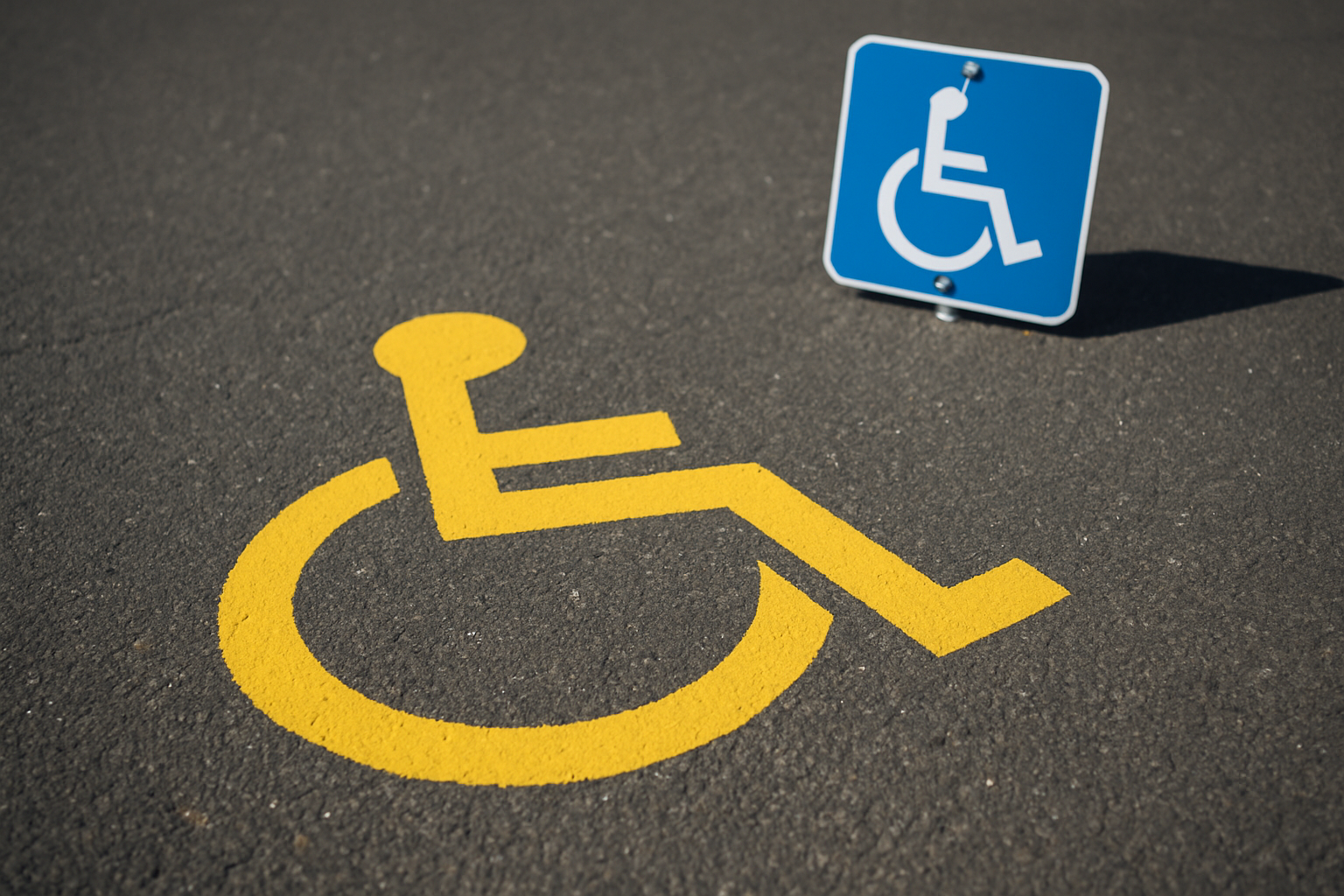
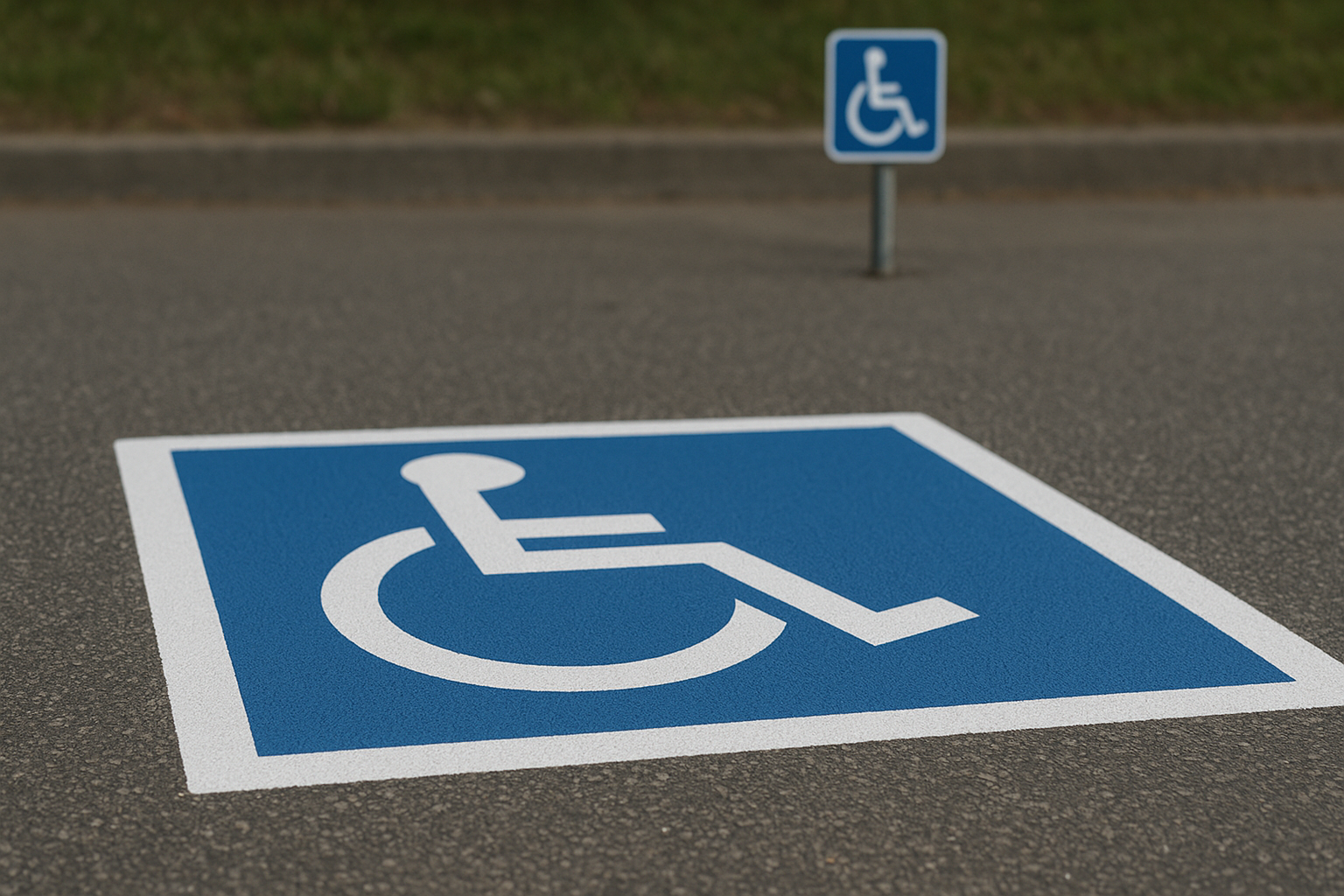
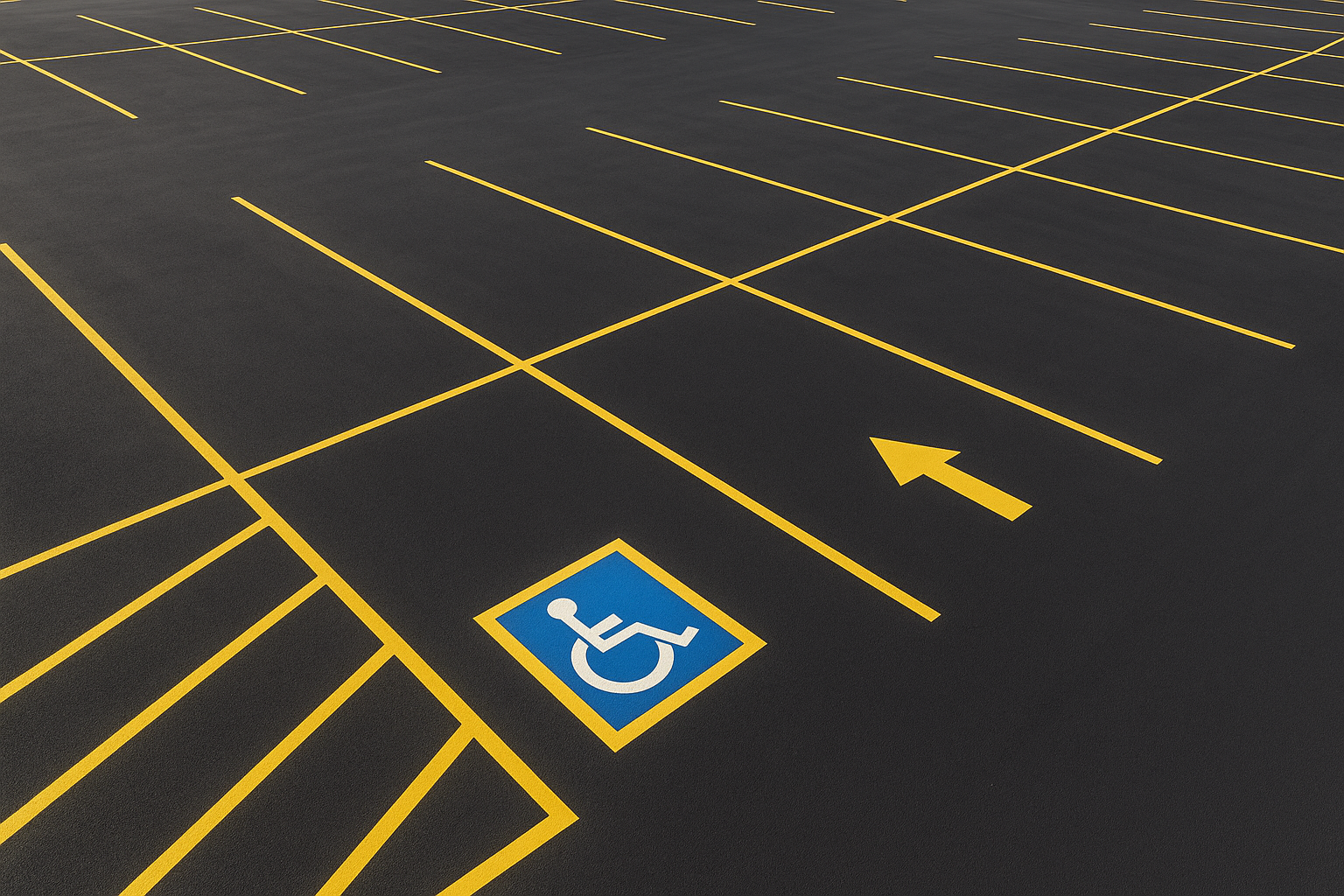
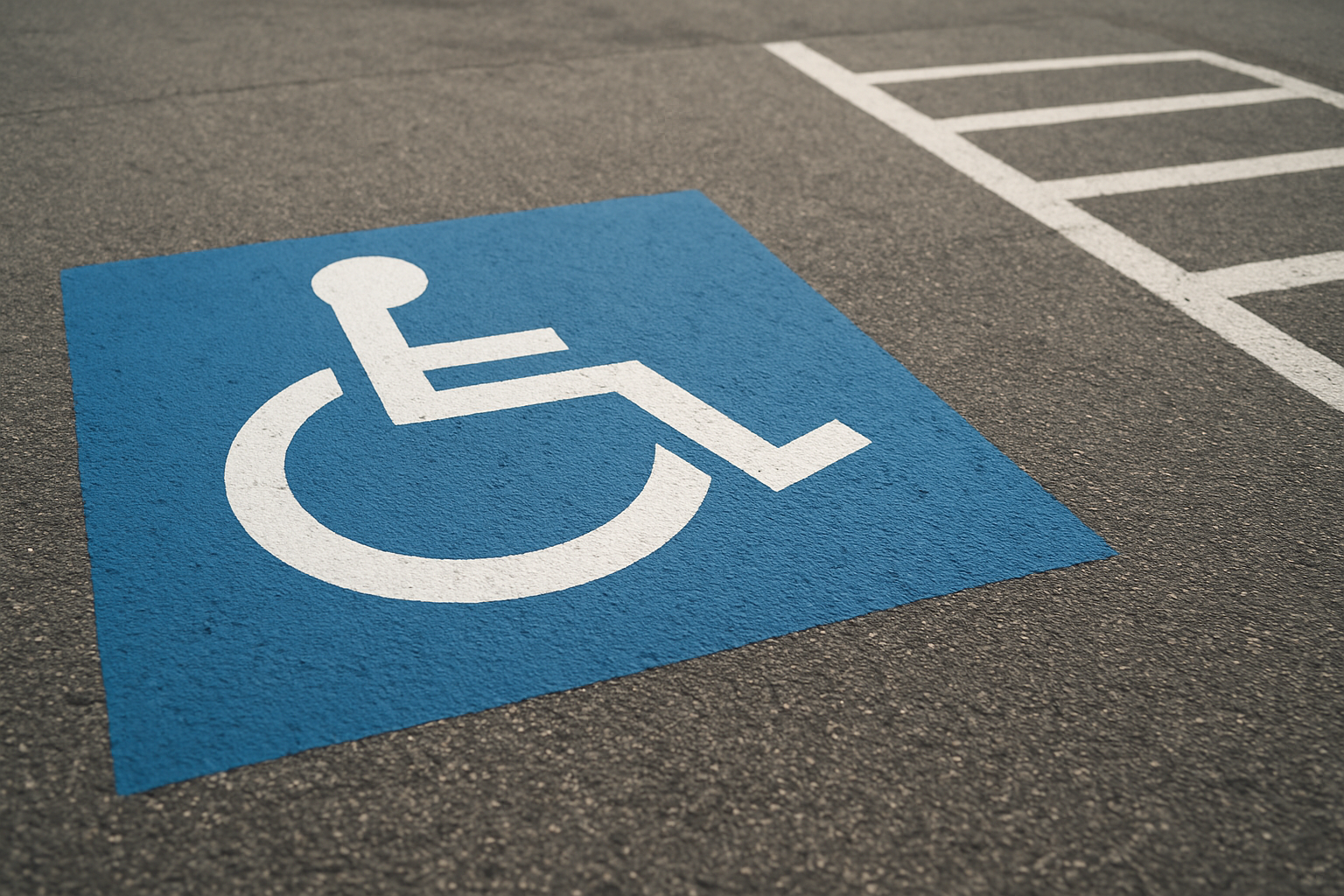
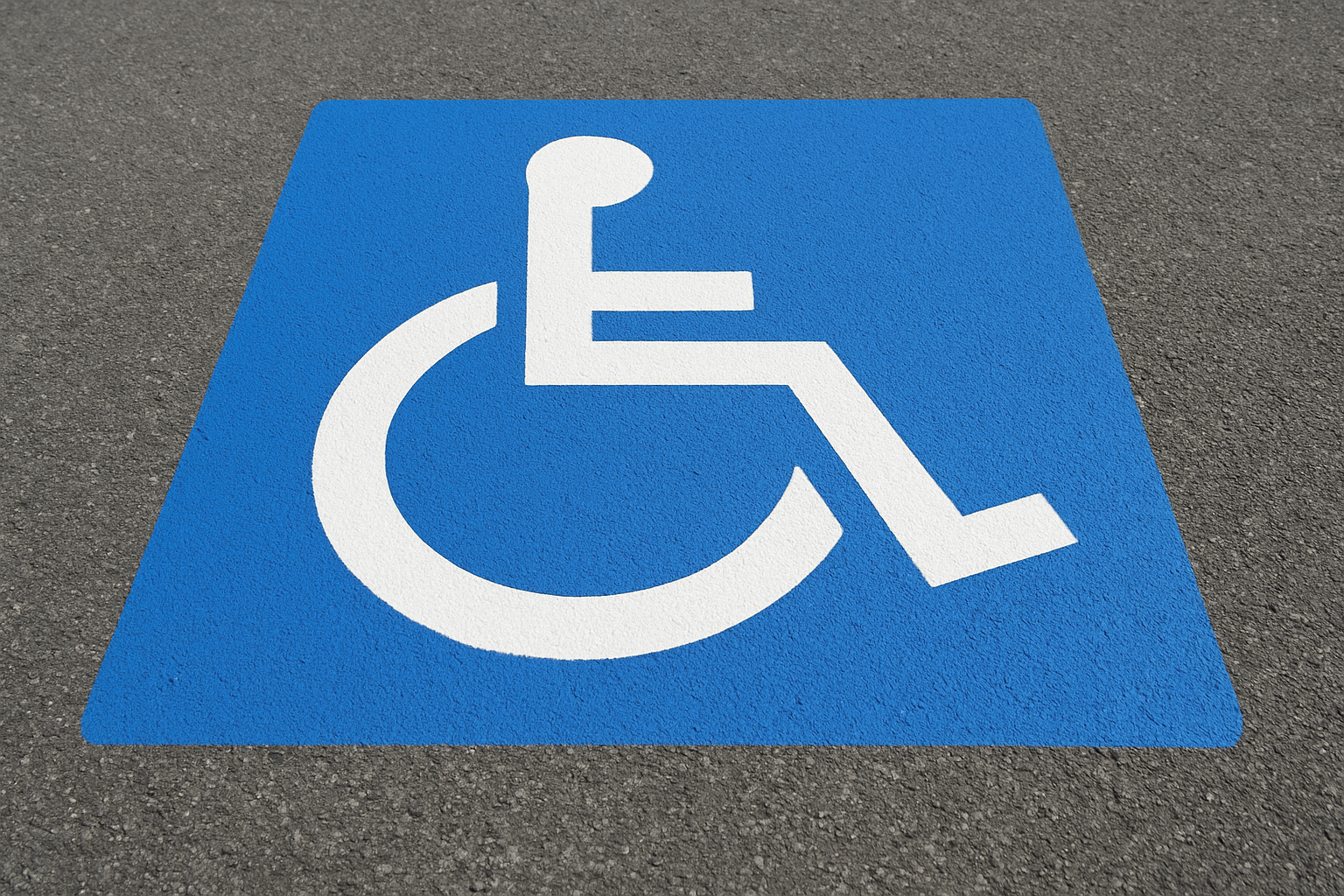
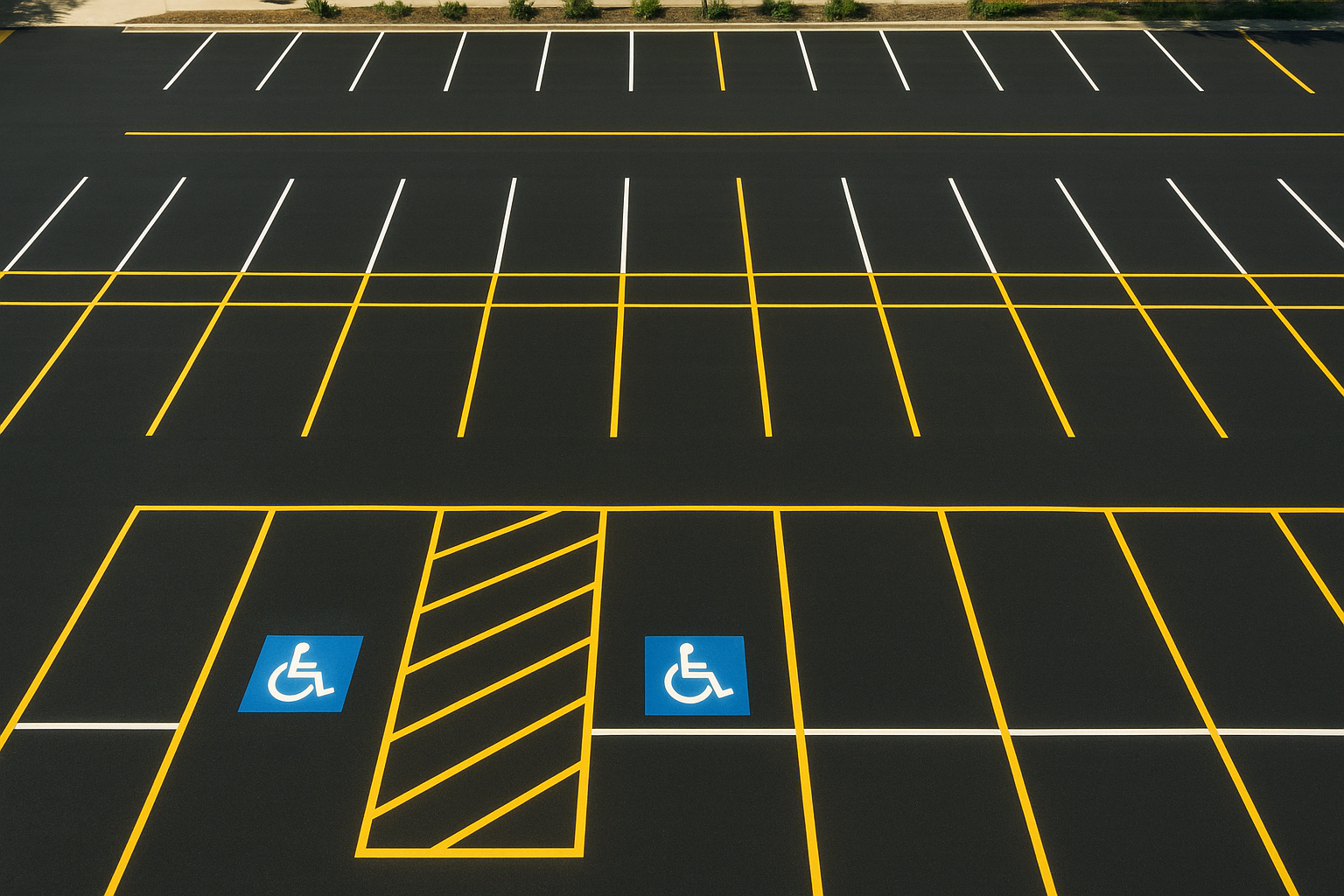
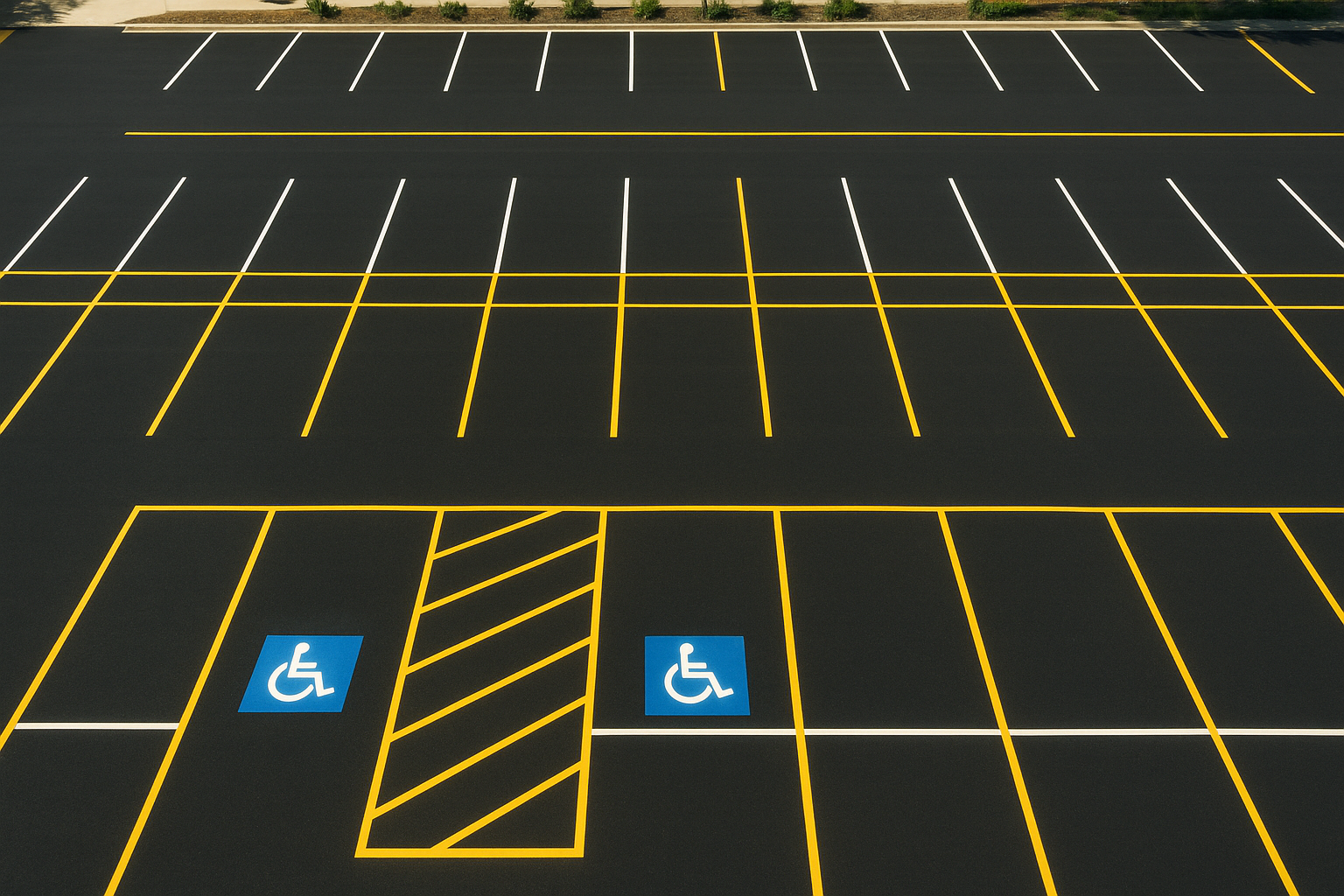
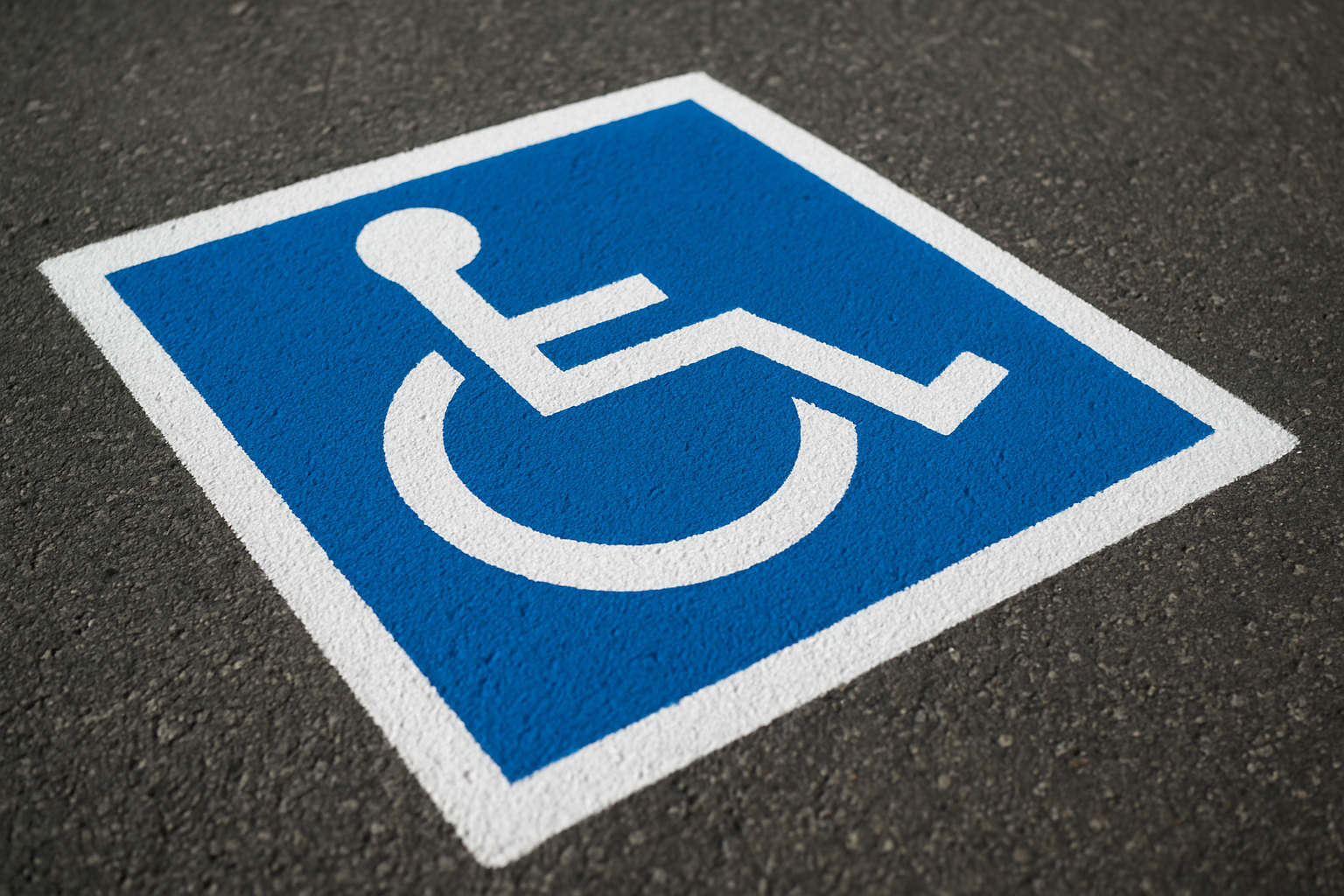
    Freshly painted ADA-compliant handicap parking space with International Symbol of Access stencil as part of a professional parking lot striping service

    ADA-compliant handicap stall markings must meet strict federal dimensional standards — a core component of any professional parking lot striping project.

    Frequently Asked Questions About PLS Parking Lot Striping

    What is PLS parking lot striping?

    PLS parking lot striping is a professional line marking service that applies precise, durable paint markings to parking surfaces. It covers stall lines, ADA handicap spaces, fire lanes, directional arrows, and more. The goal is to improve traffic flow, safety, and code compliance for commercial and residential properties.

    How often should a parking lot be restriped?

    Most parking lots need restriping every one to two years, depending on traffic volume, weather exposure, and surface condition. High-traffic commercial lots may require more frequent touch-ups to keep markings visible and compliant with ADA and fire code standards.

    Does parking lot striping have to meet ADA requirements?

    Yes. The Americans with Disabilities Act mandates specific dimensions, quantities, and signage for accessible parking stalls. Failure to comply can result in fines and legal liability for property owners, making ADA-compliant striping a non-negotiable aspect of any parking lot project.

    What type of paint is used for parking lot striping?

    Professionals typically use water-based traffic paint or oil-based alkyd paint for asphalt surfaces. Water-based paint dries faster and is more environmentally friendly, while alkyd paint offers greater durability in high-traffic conditions. The right choice depends on your lot’s specific usage and climate exposure.

    How long does parking lot striping take to dry?

    Water-based traffic paint typically dries within 30 minutes under normal Texas weather conditions. However, full cure time can take up to 24 hours, so limiting traffic on freshly painted areas is strongly recommended to ensure long-lasting adhesion.

    What is the cost of parking lot striping in Texas?

    Costs vary based on lot size, number of stalls, and services required. A basic restriping job for a small lot can start around $200 to $500, while larger commercial projects with ADA markings and fire lanes may run several thousand dollars. Requesting a free quote from a local provider like stripespls.com is the best way to get an accurate estimate.

    Can striping be done on both asphalt and concrete surfaces?

    Yes. Parking lot striping can be applied to both asphalt and concrete surfaces using appropriate paint formulations for each material. The surface should be clean and completely dry before application to ensure proper adhesion and longevity.

    What services are included in a full parking lot striping project?

    A full project typically includes stall line painting, ADA-compliant handicap space marking, fire lane designation, directional arrows, curb painting, and custom symbols or text. The exact scope depends on the property’s specific needs and applicable local code requirements.

    How do I know if my parking lot needs restriping?

    Faded, chipped, or barely visible lines are clear signs that restriping is overdue. Additionally, if your lot has recently been resurfaced, or if you have received complaints about traffic confusion or difficulty locating ADA spaces, fresh striping is strongly recommended.

    What are fire lane markings and why are they required?

    Fire lane markings are red-painted curbs or stenciled designations that keep emergency vehicle access routes clear at all times. They are required by local fire codes and must be maintained continuously to avoid citations and ensure emergency responders are never obstructed.

    Does stripespls.com serve areas outside Denton and Plano?

    Stripespls.com primarily serves the Denton and Plano areas and the broader North Texas region. Property owners in surrounding communities should contact the company directly to confirm service availability for their specific location.

    What is the difference between new lot layout striping and restriping?

    New lot layout striping involves designing and painting a complete parking configuration from scratch on a fresh or recently paved surface. Restriping, by contrast, refreshes existing faded markings on an already-configured lot. Both require professional equipment and expertise for accurate, code-compliant results.

    Conclusion: Keep Your Lot Safe, Compliant, and Professional

    In summary, pls parking lot striping is one of the most practical and impactful services a Texas property owner can invest in. Clear, durable markings improve safety, maximize usable parking capacity, satisfy ADA requirements, and project a professional image to every visitor who arrives at your property.

    Whether your lot needs a complete new layout or simply a fresh coat of paint over faded lines, working with a knowledgeable, experienced striping company makes all the difference. As a result, you avoid compliance risks, reduce driver confusion, and maintain a well-organized facility year-round.

    For property owners throughout Denton, Plano, and the greater North Texas area, stripespls.com offers free quotes, customized solutions, and the professional expertise to get your parking lot looking sharp and staying compliant. Contact the team today and take the first step toward a cleaner, safer, and fully code-compliant parking facility.

  • Texas Parking Lot Striping Company: Expert Line Marking

    Texas Parking Lot Striping Company: Expert Line Marking

    Texas Parking Lot Striping Company: Expert Line Marking

    A Texas parking lot striping company is a professional service provider that applies durable, code-compliant line markings to parking surfaces — helping property owners improve traffic flow, maximize stall capacity, and meet ADA and fire safety regulations. Whether you manage a retail center in Plano or a healthcare facility in Denton, choosing the right striping partner makes a measurable difference in safety and curb appeal.

    Aerial view of a Texas parking lot striping company's completed commercial lot with ADA and fire lane markings

    A professionally striped commercial parking lot reflects the quality and compliance standards that a top Texas parking lot striping company delivers on every project.

    What Is a Texas Parking Lot Striping Company?

    A Texas parking lot striping company is a licensed contractor that specializes in applying painted markings — including stall lines, directional arrows, ADA handicap symbols, fire lane designations, and curb markings — to paved parking areas. These businesses serve commercial and residential clients across the state, from small retail shops to large municipal facilities.

    In short, professional striping is not just about aesthetics. It is a critical component of property management that affects safety, legal compliance, and the overall customer experience. According to the U.S. Department of Justice ADA guidelines, parking lots must meet specific accessible space ratios and layout standards — and failure to comply can result in significant fines.

    Why Professional Line Marking Matters in Texas

    Texas weather is notoriously harsh on pavement markings. Intense UV exposure, scorching summer heat, and sudden heavy rainfall all accelerate paint fading. As a result, most parking lots in the state need restriping every one to two years to maintain clear, visible markings.

    Furthermore, faded or missing markings create real liability risks. Drivers may park incorrectly, block fire lanes, or occupy accessible spaces without authorization. Therefore, property owners who invest in regular professional striping protect both their tenants and themselves from preventable incidents.

    Research from the National Safety Council indicates that a significant percentage of vehicle accidents occur in parking lots each year. Consequently, well-organized and clearly marked parking areas directly reduce collision risks for drivers and pedestrians alike.

    Key Services Offered by Striping Professionals

    A full-service parking lot marking company typically provides the following:

    • New lot layout and striping — complete design and application for freshly paved surfaces
    • Restriping faded markings — refreshing existing lines without changing the layout
    • ADA-compliant handicap stall markings — correct symbols, access aisles, and signage
    • Fire lane designation — red curb painting and “No Parking” fire lane text
    • Directional arrows and crosswalks — guiding traffic safely through the lot
    • Curb painting and stenciling — numbered spaces, reserved zones, and loading areas

    How to Hire a Texas Parking Lot Striping Company

    Selecting the right contractor takes more than a quick internet search. Follow these steps to ensure you hire a qualified, reliable professional for your property.

    1. Assess your parking lot’s current condition. Walk the entire lot and document faded lines, missing ADA symbols, damaged markings, and fire lane areas that need attention before reaching out to any contractor.
    2. Research local Texas striping companies. Search for licensed and insured providers in your area, read customer reviews, and verify experience with commercial properties and ADA compliance standards. Resources like what to look for in a reliable striping service can guide your evaluation process.
    3. Request a detailed written quote. Contact at least two or three contractors and ask for itemized quotes covering scope of work, paint type, stall count, ADA markings, and estimated project timeline.
    4. Confirm ADA compliance requirements. Work with your chosen company to verify that your lot meets current ADA standards for accessible space ratios, access aisle widths, and required signage before any work begins.
    5. Schedule the project and prepare the lot. Coordinate a start date, notify tenants or customers of temporary parking restrictions, and ensure the surface is clean and free of debris so paint adheres correctly.

    For a deeper look at the planning process, the Texas expert line marking guide offers comprehensive advice on every phase of a striping project.

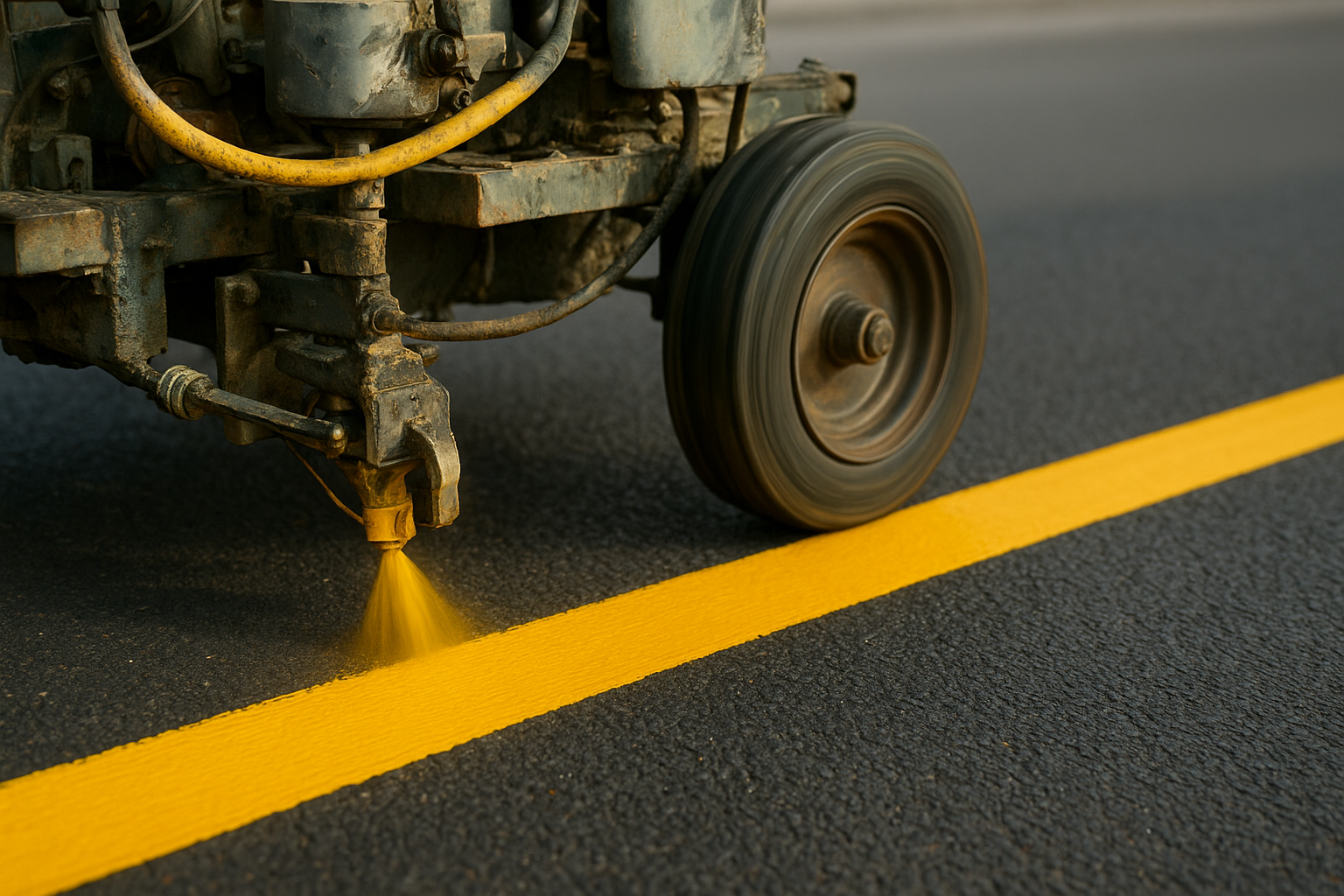
    Professional striping machine applying fresh yellow paint lines on a Texas commercial parking lot surface

    Modern striping equipment allows professional crews to apply precise, durable lines quickly — minimizing disruption to your property’s daily operations.

    ADA Compliance: A Critical Component of Parking Lot Marking

    The Americans with Disabilities Act (ADA) sets strict standards for accessible parking spaces. Specifically, the law requires a minimum number of accessible stalls based on total lot capacity, along with proper access aisles, van-accessible spaces, and compliant signage.

    For example, a lot with 1 to 25 total spaces must include at least one accessible space. Lots with 26 to 50 spaces require two, and the ratio continues to scale upward. Non-compliance exposes property owners to civil penalties and potential lawsuits — making ADA-accurate striping a non-negotiable investment.

    A qualified striping company will always audit your lot’s current accessible space count before beginning work. In addition, they will ensure that access aisles are at least 60 inches wide (or 96 inches for van-accessible spaces) and that international symbol of accessibility markings are correctly sized and positioned.

    Fire Lane Marking Requirements in Texas

    Fire lane markings are equally important. Texas fire codes require clearly designated fire access lanes at most commercial properties, typically marked with red curb paint and “Fire Lane — No Parking” text. These lanes must remain unobstructed at all times to allow emergency vehicle access.

    Consequently, property managers who neglect fire lane striping risk citations from local fire marshals and, more critically, delayed emergency response times. A professional striping crew ensures fire lane markings meet local municipal codes and remain highly visible throughout the year.

    Serving Denton and Plano: North Texas Striping Expertise

    The North Texas region — including Denton and Plano — is home to thousands of commercial properties that rely on professional parking lot maintenance. From bustling retail centers to school campuses and healthcare facilities, the demand for reliable, precise striping services continues to grow alongside the region’s rapid development.

    Stripespls.com is a locally operated, full-service parking lot marking company serving clients throughout the greater North Texas region. The company specializes in professional striping, ADA compliance solutions, and fire lane marking for both commercial and residential properties. Property managers, business owners, and municipal organizations across the Denton and Plano areas can request a free quote directly through the website.

    For clients in the DFW area specifically, the DFW expert line marking services page provides additional details on coverage areas and service options. Similarly, property owners in Denton can explore dedicated professional parking lot striping services in Denton, TX tailored to local needs.

    Quick Answer: A Texas parking lot striping company applies durable, code-compliant line markings to parking surfaces. Professional striping improves traffic safety, ensures ADA accessibility, designates fire lanes, and maximizes parking capacity — all while keeping properties visually clean and legally compliant.

    Freshly painted ADA handicap symbol on Texas parking lot asphalt by a professional striping company

    Accurate ADA handicap markings are a legal requirement — and a hallmark of quality work from a professional Texas parking lot striping company.

    What to Look for in a Quality Parking Lot Striping Contractor

    Not all striping contractors deliver the same level of quality. Therefore, it is important to evaluate any potential hire carefully before signing a contract. Consider the following factors:

    • Licensing and insurance — always verify the company carries general liability coverage
    • ADA knowledge — the contractor should demonstrate familiarity with current federal and state accessibility standards
    • Paint quality — professional-grade traffic paint lasts significantly longer than consumer-grade alternatives
    • Equipment — commercial striping machines produce straighter, more consistent lines than hand-rolled methods
    • References and reviews — a reputable company will have verifiable positive feedback from property managers and business owners
    • Written quote — any trustworthy contractor provides a detailed, itemized estimate before starting work

    Additionally, pavement marking standards vary by municipality in Texas, so a locally experienced contractor will be better equipped to navigate regional code requirements than an out-of-state provider.

    Frequently Asked Questions About Parking Lot Striping in Texas

    What does a Texas parking lot striping company do?

    A Texas parking lot striping company applies painted lines, symbols, and markings to parking surfaces to organize traffic flow, designate stalls, mark fire lanes, and ensure ADA compliance. Services typically include new lot layouts, restriping, handicap stall markings, directional arrows, and fire lane designation.

    How often should parking lot striping be redone in Texas?

    Most parking lots in Texas need restriping every one to two years due to intense sun, heat, and heavy rainfall accelerating paint fading. High-traffic lots may require more frequent touch-ups to maintain clear, visible markings.

    What are ADA requirements for parking lot striping?

    ADA requirements mandate a specific number of accessible parking spaces based on total lot size, with clearly marked access aisles, proper signage, and van-accessible spaces. Non-compliance can result in fines and legal liability for property owners.

    How much does parking lot striping cost in Texas?

    Parking lot striping costs in Texas typically range from $200 to $700 for small lots and can exceed $2,000 for large commercial properties, depending on lot size, number of spaces, and services required. Requesting a free quote from a local provider gives the most accurate estimate.

    How long does parking lot striping take to dry?

    Water-based traffic paint typically dries within 30 minutes under normal Texas weather conditions. However, crews usually recommend keeping traffic off freshly painted areas for at least one hour to ensure the paint cures properly.

    What type of paint is used for parking lot striping?

    Professional striping companies commonly use water-based acrylic traffic paint or oil-based alkyd paint. Water-based paints are faster-drying and more environmentally friendly, while oil-based options tend to offer greater durability in high-traffic areas.

    Do I need a permit for parking lot striping in Texas?

    Most standard restriping projects in Texas do not require a permit, but new lot layouts or significant modifications may need municipal approval. It is always advisable to check with your local city or county planning department before beginning a new striping project.

    What is the difference between restriping and new lot striping?

    Restriping involves painting over existing faded lines in the same layout, while new lot striping requires planning and laying out a completely fresh design on an unpainted surface. New lot striping is more complex and typically costs more due to the additional layout and measurement work involved.

    Can parking lot striping improve safety at my property?

    Yes, clearly marked parking lot striping significantly improves safety by guiding drivers and pedestrians, designating fire lanes, and reducing the risk of accidents. Well-organized markings also help emergency vehicles access the property quickly when needed.

    How do I choose a reliable parking lot striping company in Texas?

    Look for a company with experience in commercial striping, knowledge of ADA compliance standards, and a strong portfolio of completed projects. Reading reviews, verifying insurance, and requesting a detailed written quote are also important steps before hiring a striping contractor.

    Does stripespls.com serve both Denton and Plano, TX?

    Yes, stripespls.com serves commercial and residential clients throughout the greater North Texas region, including Denton and Plano, TX. The company offers a full range of parking lot striping services and provides free quotes through its website.

    Conclusion: Choosing the Right Striping Partner for Your Texas Property

    Ultimately, working with a qualified Texas parking lot striping company is one of the smartest investments a property owner or manager can make. Fresh, accurate markings improve safety, support ADA compliance, meet fire code requirements, and create a professional first impression for every visitor who pulls into your lot. Furthermore, regular maintenance prevents small issues — like fading paint — from becoming costly legal liabilities.

    For property owners throughout the Denton and Plano areas, stripespls.com offers customized, full-service parking lot striping solutions backed by local expertise and a commitment to quality craftsmanship. Whether you need a complete lot refresh or targeted ADA updates, the team is ready to help. Visit stripespls.com today to request your free quote and take the first step toward a cleaner, safer, and fully compliant parking facility.

  • Highway Striping Inc: What to Know Before You Hire

    Highway Striping Inc: What to Know Before You Hire

    Highway Striping Inc: What to Know Before You Hire

    When property owners search for highway striping inc services, they are looking for more than a company name — they want a reliable contractor who can deliver clean, durable, code-compliant markings for their parking lots, roadways, or commercial facilities. Highway striping inc is a term broadly used to describe professional pavement marking companies that handle everything from standard lot lines to complex ADA and fire lane layouts. Understanding what separates a quality striping contractor from a subpar one can save you time, money, and legal headaches.

    In this guide, you will learn exactly what professional striping services involve, how to evaluate contractors, what materials and methods matter most, and how to ensure your property stays compliant with current regulations. Whether you manage a retail center, a healthcare campus, or a school, this information applies directly to your situation.

    What Is Highway Striping Inc and What Do These Companies Do?

    Highway striping inc is a term that refers to professional pavement marking companies specializing in applying painted or thermoplastic lines, symbols, and designations to roadways and parking surfaces. These companies handle a wide range of work, including lane lines on public roads, stall markings in commercial lots, ADA-compliant handicap spaces, directional arrows, crosswalks, and fire lane designations.

    According to the Federal Highway Administration’s Manual on Uniform Traffic Control Devices (MUTCD), pavement markings serve a critical safety function by conveying regulations, warnings, and guidance to drivers. Professional striping companies follow these standards to ensure their work meets both federal and local requirements.

    Furthermore, the scope of work varies significantly depending on the property type. A small retail strip center may simply need faded lines refreshed. In contrast, a large healthcare campus may require a full layout redesign with new ADA stalls, van-accessible spaces, access aisles, and fire lane painting — all coordinated to meet strict code requirements.

    Aerial view of a freshly striped parking lot with highway striping inc style markings including ADA spaces and fire lanes

    A professionally striped commercial parking lot with ADA-compliant markings, fire lane designations, and clearly defined stalls — the hallmark of quality highway striping inc services.

    Why Pavement Marking Quality Matters More Than Price

    Many property owners make the mistake of choosing a striping contractor based solely on the lowest bid. However, the quality of materials and application technique directly affects how long the markings last and whether they hold up under heavy traffic and Texas weather conditions.

    Specifically, there are two primary material categories used in professional striping work:

    • Water-based latex paint: The most common option for parking lots. It dries quickly, is cost-effective, and typically lasts 12 to 24 months depending on traffic volume and UV exposure.
    • Thermoplastic markings: A heated plastic compound melted directly onto the pavement surface. Thermoplastic bonds more deeply, lasts 3 to 7 years, and offers superior retroreflectivity for nighttime visibility. Learn more about thermoplastic striping and decal options for your property.

    In addition, application technique matters enormously. Lines applied with poorly calibrated equipment produce uneven edges, inconsistent widths, and premature peeling. A skilled crew uses properly maintained line striping machines to deliver crisp, uniform results on every pass.

    How Faded Markings Create Real Liability

    Beyond aesthetics, faded or missing markings create genuine legal exposure. For example, worn ADA markings can place a commercial property out of compliance with the Americans with Disabilities Act, which mandates accessible parking spaces, access aisles, and proper signage for all commercial facilities open to the public. Non-compliance can result in complaints, fines, and costly litigation.

    Similarly, unclear traffic flow markings increase the risk of on-site vehicle accidents, which can expose property owners to premises liability claims. Therefore, maintaining clearly visible, properly placed markings is not simply a cosmetic concern — it is a risk management priority.

    How to Hire the Right Striping Contractor: A Step-by-Step Process

    Finding a qualified contractor does not have to be complicated. However, it does require asking the right questions and knowing what to look for. Follow this process to make a confident decision.

    1. Assess your current lot condition. Walk the property and note faded lines, missing ADA markings, worn fire lane designations, and any surface cracking or damage that may need repair before striping begins.
    2. Define the scope of work needed. Decide whether you need a full restripe, a new layout design, ADA upgrades, thermoplastic markings, or fire lane painting so you can communicate clearly with potential contractors.
    3. Research and shortlist local contractors. Search for licensed and insured striping companies in your area, check online reviews, and review their portfolio of completed projects to verify quality and experience. Browsing a company’s project gallery is a great starting point.
    4. Request written quotes from at least two contractors. Ask for itemized quotes that detail materials, labor, number of stalls, marking types, and estimated completion time.
    5. Confirm ADA and local code compliance knowledge. Ask each contractor to confirm familiarity with current ADA parking requirements and local fire code regulations so your finished lot meets all legal standards.
    6. Schedule the work and prepare the lot. Coordinate a date when the lot can be temporarily closed or sectioned off, and arrange for the surface to be clean and dry before the crew arrives.

    Professional striping machine applying yellow paint lines to asphalt during a commercial parking lot striping project

    Precision equipment and skilled operators are what distinguish professional pavement marking from amateur work.

    ADA Compliance: What Every Property Owner Must Understand

    ADA compliance is one of the most misunderstood aspects of parking lot management. Many property owners assume their lot is compliant simply because accessible spaces exist. In reality, compliance involves specific stall dimensions, access aisle widths, slope requirements, signage placement, and surface markings — all of which must meet the current ADA Standards for Accessible Design.

    For instance, a standard accessible space must be at least 8 feet wide with an adjacent 5-foot access aisle. Van-accessible spaces require an 8-foot aisle. Additionally, the number of required accessible spaces scales with total lot capacity — lots with 1 to 25 total spaces require a minimum of 1 accessible space, while larger lots require proportionally more.

    Consequently, working with a contractor who genuinely understands these requirements — rather than simply painting a blue symbol on the ground — is essential. A knowledgeable striping team will audit your existing layout, identify deficiencies, and propose corrections before a single line is painted.

    Fire Lane Markings: More Than Just Red Paint

    Fire lane designations are another area where precision matters. Local fire codes — which vary by municipality — specify exactly where fire lanes must be located, how wide they must be, and what signage must accompany the markings. In many Texas jurisdictions, fire lanes must be marked with red curbs, stenciled lettering, and no-parking signs at regular intervals.

    A professional striping company familiar with North Texas fire code requirements will ensure your fire lane markings satisfy local inspectors and keep your property in good standing. Visit the full services page to see the complete range of marking solutions available for commercial properties.

    Red fire lane curb markings and stenciled no-parking designations outside a commercial building, required for code compliance

    Fire lane markings must meet specific local code requirements — not just aesthetic standards — to keep properties compliant and emergency access clear.

    Choosing a Local Striping Partner in North Texas

    For property owners in the Denton and Plano areas, working with a locally based contractor offers clear advantages. A local team understands regional weather patterns, municipal code nuances, and the specific pavement conditions common across North Texas. They can respond quickly to scheduling requests and are accountable to the communities they serve.

    Stripes PLS is a full-service parking lot marking company based in Texas, serving commercial and residential clients throughout the greater North Texas region. The company specializes in professional striping, ADA compliance solutions, fire lane marking, directional arrows, and complete lot restriping. From new layout design to refreshing faded markings, the team brings precision and durability to every project.

    Property managers, retail center operators, school administrators, healthcare facilities, and municipal organizations across Denton and Plano can request a free quote directly through the Denton parking lot striping services page. The process is straightforward, and the team is known for reliability and quality craftsmanship on every project.

    According to industry data, a well-maintained parking lot can increase customer satisfaction and reduce on-site incidents significantly. In fact, studies in parking facility management suggest that clear, visible markings reduce lot-related vehicle conflicts by as much as 30 percent. That makes professional striping one of the highest-ROI property maintenance investments available to commercial operators.

    Frequently Asked Questions About Highway Striping Inc Services

    What does a highway striping inc company actually do?

    A highway striping inc company applies painted or thermoplastic markings to roadways, parking lots, and commercial properties. Services typically include lane lines, directional arrows, ADA stalls, fire lanes, and crosswalks. The goal is to improve traffic safety, maximize space, and meet local code requirements.

    How long does professional parking lot striping last?

    Standard water-based paint typically lasts 12 to 24 months depending on traffic volume and weather exposure. Thermoplastic markings can last 3 to 7 years because the material bonds more deeply to the pavement surface.

    How do I know if my parking lot needs restriping?

    If lines are faded, chipped, or no longer clearly visible from a vehicle, it is time to restripe. ADA markings that are worn may also put your property out of compliance with federal accessibility standards.

    What is the difference between paint striping and thermoplastic striping?

    Paint striping uses water-based or solvent-based paint applied by a spray machine, while thermoplastic striping uses a heated plastic compound that melts onto the pavement for a stronger bond. Thermoplastic is more durable and reflective but costs more upfront.

    Are ADA-compliant markings legally required for commercial parking lots?

    Yes. The Americans with Disabilities Act requires accessible parking spaces, access aisles, and signage in commercial parking facilities. Non-compliance can result in fines and legal liability for property owners.

    How much does parking lot striping cost?

    Costs vary based on lot size, number of stalls, type of markings, and surface condition. Small lots may start around a few hundred dollars, while large commercial properties can run into the thousands. Requesting a free quote from a local contractor gives the most accurate estimate.

    How long does it take to stripe a parking lot?

    Most standard parking lots can be striped in a single day. Larger or more complex projects with multiple marking types may take two days. Paint typically dries within 30 to 60 minutes under normal conditions.

    What should I look for when hiring a striping contractor?

    Look for licensed and insured contractors with verifiable experience, a portfolio of completed projects, and familiarity with local ADA and fire code requirements. Reading reviews and requesting references helps confirm reliability.

    Can striping be done on an existing lot without resurfacing first?

    Yes, in most cases striping can be applied directly over existing pavement. However, if the surface has significant cracking or deterioration, repairs should be made first to ensure proper paint adhesion and a clean result.

    What is a fire lane marking and why is it required?

    Fire lane markings are red-painted curbs or stenciled zones that designate areas where parking is prohibited to keep emergency vehicle access clear. Local fire codes mandate these markings for commercial properties to ensure first responders can reach buildings quickly.

    Does weather affect when striping can be applied?

    Yes. Paint should not be applied in temperatures below 50 degrees Fahrenheit or when rain is expected within a few hours of application. Professional contractors schedule work around weather forecasts to ensure optimal adhesion and curing.

    How many ADA spaces does my parking lot legally require?

    The ADA sets a minimum ratio based on total parking capacity. For example, lots with 1 to 25 spaces require at least 1 accessible space. A qualified striping contractor familiar with ADA standards can calculate the exact requirement for your property.

    Conclusion: Making the Right Choice for Your Property

    When evaluating highway striping inc services, the most important factors are contractor experience, material quality, code compliance knowledge, and transparent pricing. A well-striped lot is not just visually appealing — it is safer, more efficient, and legally protected. Whether you need a simple restripe or a complete lot redesign with ADA upgrades and fire lane markings, choosing the right professional makes all the difference.

    For property owners across Denton and Plano, Texas, Stripes PLS offers the local expertise, proven craftsmanship, and comprehensive services needed to keep your parking facility clean, organized, and fully compliant. Reach out today to request a free quote and take the first step toward a better-marked, better-managed property.

  • Dallas Parking Lot Striping: Pro Line Marking Guide

    Dallas Parking Lot Striping: Pro Line Marking Guide

    Dallas Parking Lot Striping: Pro Line Marking Guide

    Dallas parking lot striping is the professional process of applying painted lines, symbols, and regulatory markings to asphalt or concrete surfaces to define parking stalls, traffic lanes, fire lanes, and accessible spaces. For property owners across the Dallas–Fort Worth metroplex, well-maintained striping is not just about curb appeal — it directly affects safety, liability, and code compliance. Whether you manage a retail center, office complex, school, or healthcare facility, keeping your lot clearly marked is one of the most cost-effective investments you can make.

    In this guide, you will find everything you need to know about the striping process, what it costs, how to stay ADA compliant, and how to choose a reliable contractor in the North Texas region.

    Aerial view of dallas parking lot striping with ADA markings and fire lane designations on clean asphalt

    Professional dallas parking lot striping creates clear stall lines, accessible spaces, and fire lane markings that keep properties safe and organized.

    What Is Dallas Parking Lot Striping?

    Dallas parking lot striping is the application of traffic-grade paint or thermoplastic markings onto paved surfaces using professional line striping machines and stencils. These markings include standard parking stall lines, directional arrows, crosswalks, fire lane designations, and ADA-compliant handicap symbols with required access aisles.

    According to the U.S. Department of Justice ADA portal, accessible parking requirements are federally mandated and apply to virtually all commercial properties open to the public. As a result, proper striping is not optional — it is a legal obligation for most property owners.

    Furthermore, clear lot markings directly improve traffic flow, reduce fender-bender incidents, and help maximize the number of usable spaces on any given property footprint.

    Why Parking Lot Markings Fade Faster in Texas

    Texas weather is particularly hard on pavement markings. Intense UV radiation, extreme summer heat, and the freeze-thaw cycles that occur during North Texas winters all accelerate paint degradation. In fact, studies by the Federal Highway Administration indicate that pavement markings in high-UV environments can lose retroreflectivity and visibility up to 40% faster than in cooler climates.

    Additionally, heavy vehicle traffic from delivery trucks and high daily parking turnover at commercial properties wears paint down from both abrasion and chemical exposure from vehicle fluids. Therefore, most Dallas-area parking lots benefit from restriping every one to two years to maintain safe, visible, and legally compliant markings.

    Signs Your Lot Needs Restriping Now

    • Stall lines are faded or barely visible from the driver’s seat
    • ADA symbols are worn and no longer meet minimum contrast requirements
    • Fire lane text or curb color has faded significantly
    • Drivers are parking randomly or ignoring designated lanes
    • You recently had your lot seal-coated or repaved

    If any of these apply to your property, it is time to schedule a professional parking lot restriping service before faded markings create a liability issue.

    How to Plan a Parking Lot Striping Project: Step-by-Step

    Planning a striping project carefully ensures you get the most stalls, stay code-compliant, and minimize disruption to your tenants or customers. Follow these six steps for a smooth project from start to finish.

    1. Assess the current lot condition. Walk the entire parking lot to identify faded lines, cracked pavement, drainage issues, and any existing ADA or fire lane markings that need updating or removal.
    2. Request a professional quote. Contact a licensed striping contractor in the Dallas or North Texas area, provide lot dimensions and a description of needed markings, and request an itemized written estimate.
    3. Plan the layout and compliance requirements. Work with your contractor to finalize the stall layout, confirm ADA-compliant space counts and dimensions, and identify fire lane and directional arrow placement per local code.
    4. Prepare the pavement surface. Clean the lot thoroughly by blowing out debris, pressure washing oil stains, and allowing the surface to dry completely before any paint is applied.
    5. Apply striping and specialty markings. The crew uses professional line striping machines to apply traffic paint for stall lines, then hand-stencils ADA symbols, fire lane text, arrows, and custom markings.
    6. Allow paint to cure and reopen the lot. Keep vehicles off freshly painted surfaces for at least one to two hours to allow full paint cure before normal traffic resumes.

    Professional striping machine applying fresh white lines during a parking lot striping project in North Texas

    A professional striping machine delivers precise, consistent lines that last significantly longer than hand-rolled alternatives.

    ADA Compliance: What Every Dallas Property Owner Must Know

    The Americans with Disabilities Act (ADA) sets specific standards for accessible parking. These rules are enforced at the federal level and apply to virtually every commercial property in Dallas and across Texas. Non-compliance can result in costly fines and civil litigation.

    Key ADA parking requirements include:

    • Minimum space count: At least one accessible space per 25 total spaces
    • Van-accessible spaces: One per every six accessible spaces, with an 8-foot access aisle
    • Space dimensions: Standard accessible stalls must be at least 8 feet wide with a 5-foot access aisle
    • Signage: Each accessible space must have a vertical sign with the International Symbol of Accessibility
    • Surface markings: The ISA symbol must be painted on the pavement in blue

    A professional contractor familiar with local Dallas codes will verify your specific requirements and ensure every accessible space meets current standards. Explore the full range of parking lot striping services available for commercial properties throughout the region.

    Fire Lane Marking Requirements in the Dallas Area

    Fire lanes are a critical safety feature regulated by local fire codes. In most Dallas-area municipalities, fire lanes must include red or yellow curb paint, “NO PARKING – FIRE LANE” stenciling on the pavement surface, and compliant signage at regular intervals. Failure to maintain visible fire lane markings can result in citations from the fire marshal and create serious liability exposure if emergency access is delayed.

    Consequently, fire lane marking is one of the most frequently requested services from property managers who are preparing for annual inspections or who have recently received a compliance notice.

    Parking Lot Striping Costs in the Dallas Region

    Cost is one of the first questions property owners ask, and for good reason. Fortunately, professional parking lot striping is one of the most affordable property maintenance services available relative to the value it delivers.

    Typical pricing in the Dallas market breaks down as follows:

    Service Type Typical Cost Range
    Standard stall line (per linear foot) $0.15 – $0.30
    ADA handicap symbol (each) $25 – $75
    Fire lane stenciling (per linear foot) $1.00 – $2.50
    Directional arrows (each) $15 – $40
    Full lot restriping (small lot, ~50 spaces) $400 – $900
    Full lot restriping (large lot, 200+ spaces) $1,500 – $4,000+

    These figures are estimates and vary based on surface condition, layout complexity, paint type, and local market rates. In addition, seal-coating the lot before striping will add to the overall project cost but significantly extends the life of both the pavement and the new markings.

    Choosing the Right Parking Lot Striping Contractor Near Dallas

    Not all striping contractors deliver the same quality. Therefore, it pays to evaluate a few key factors before signing a contract.

    Experience with commercial properties: Look for a contractor with a proven track record on properties similar to yours — retail centers, office parks, schools, or healthcare facilities all have unique layout demands.

    ADA and fire code knowledge: A qualified contractor should be able to calculate your required accessible space count, confirm correct dimensions, and advise on fire lane requirements for your municipality without needing to be prompted.

    Professional equipment: High-quality line striping machines produce sharper, more consistent lines than spray cans or rollers. Ask what equipment the crew uses and whether they use professional traffic-grade paint.

    Written estimates and insurance: Always request a written, itemized quote and verify that the contractor carries general liability insurance. This protects you if something goes wrong during the project.

    Serving North Texas: Denton, Plano, and the Greater Dallas Area

    Stripes PLS is a full-service parking lot marking company based in Texas, delivering professional striping, ADA compliance solutions, and fire lane marking for commercial and residential properties throughout the Denton and Plano areas — and across the greater North Texas region. The team brings precise, durable line striping to every project, helping property owners maintain clean, organized, and code-compliant facilities.

    From new lot layouts to refreshing faded markings, Stripes PLS serves property managers, business owners, retail centers, schools, healthcare facilities, and municipal organizations. You can learn more about their full service area and approach by visiting their professional parking lot striping services in Denton, TX page or by requesting a free quote directly through the website.

    Freshly painted ADA handicap symbol on asphalt as part of a professional parking lot striping project

    ADA-compliant handicap symbols must meet specific size, color, and placement standards to satisfy federal accessibility requirements.

    Paint Types Used in Professional Parking Lot Striping

    The type of paint used has a major impact on how long your markings last. Professional contractors in Texas generally choose from three main options:

    • Water-based latex traffic paint: The most common choice for Dallas-area lots. It dries quickly (20–30 minutes), is environmentally friendlier, and holds up well in high-UV conditions. Ideal for most commercial restriping projects.
    • Oil-based alkyd traffic paint: More durable than latex in high-traffic areas, but slower to dry and requires proper ventilation during application. Used less frequently due to environmental restrictions.
    • Thermoplastic markings: A premium option applied as a heated liquid that bonds directly to the pavement. Thermoplastic is extremely durable and is commonly used for crosswalks, stop bars, and high-wear areas. It costs more upfront but lasts 3 to 7 years under normal conditions.

    According to the Manual on Uniform Traffic Control Devices (MUTCD), pavement markings must meet minimum retroreflectivity standards to ensure nighttime visibility. As a result, professional contractors use traffic-grade paints that meet or exceed these federal specifications.

    Frequently Asked Questions About Dallas Parking Lot Striping

    What is dallas parking lot striping?

    Dallas parking lot striping is the professional application of traffic-grade paint or thermoplastic markings on parking lot surfaces to define stalls, traffic lanes, fire lanes, and ADA-accessible spaces. It improves safety, organization, and regulatory compliance for commercial and residential properties throughout the Dallas area.

    How often should a parking lot be restriped in Texas?

    Most parking lots in Texas need restriping every one to two years. High-traffic commercial lots may require annual touch-ups due to accelerated paint wear from UV exposure, heavy vehicles, and seasonal temperature swings.

    How much does parking lot striping cost in Dallas?

    Standard line striping typically runs $0.15 to $0.30 per linear foot. Full lot restriping for a 50-space lot may cost $400 to $900, while larger lots with 200 or more spaces can run $1,500 to $4,000 or more, depending on complexity and specialty markings required.

    What paint is used for parking lot striping?

    Professional contractors most commonly use water-based latex traffic paint in Texas because it dries quickly and handles intense sunlight well. Thermoplastic is a premium option for high-wear areas that can last three to seven years before needing replacement.

    Does parking lot striping need to be ADA compliant?

    Yes. The ADA requires specific numbers, dimensions, and signage for accessible parking spaces at commercial properties. Non-compliance can result in federal fines and civil lawsuits, so working with a knowledgeable contractor is essential.

    How long does parking lot striping take to dry?

    Water-based traffic paint dries to the touch in 20 to 30 minutes under typical Texas conditions. However, contractors generally recommend keeping vehicles off the freshly painted surface for one to two hours to allow full cure.

    Can parking lot striping be done in hot weather?

    Yes, though most contractors schedule work in the early morning to avoid peak heat. Temperatures above 95°F can affect paint adhesion and dry time, so timing and surface temperature monitoring are important considerations for summer projects in Dallas.

    What is the difference between striping and restriping a parking lot?

    Striping refers to applying markings on a new or freshly sealed surface, while restriping means refreshing faded existing lines. Restriping is typically faster and less expensive because the layout is already in place and requires no layout planning from scratch.

    How many handicap spaces are required by law in Texas?

    The ADA requires a minimum of one accessible space per 25 total parking spaces, with at least one van-accessible space per six accessible spaces. Texas follows federal ADA standards, and local municipalities may have additional requirements.

    What markings are required in a fire lane?

    Fire lanes typically require red or yellow painted curbs, “NO PARKING – FIRE LANE” stenciling on the pavement, and compliant signage at intervals specified by the local fire code. Dallas-area municipalities may have specific requirements, which a professional contractor can verify.

    Do I need a permit for parking lot striping in Dallas?

    Standard restriping projects generally do not require a permit. However, new lot construction or major layout modifications may need city approval. Your contractor can advise on whether your specific project requires permitting before work begins.

    What common mistakes should I avoid when hiring a striping contractor?

    Avoid contractors who use low-quality paint, skip surface preparation, or cannot demonstrate knowledge of ADA and fire code requirements. Always request proof of insurance, a written itemized quote, and references from comparable commercial projects before committing.

    Conclusion: Keep Your Dallas Lot Safe and Compliant

    Dallas parking lot striping is a straightforward investment that pays dividends in safety, liability protection, and property value. From ADA-compliant handicap markings to fire lane designations and directional arrows, professional line striping keeps your lot organized, code-compliant, and welcoming to every visitor. Furthermore, given Texas’s harsh climate, staying on top of restriping schedules ensures your markings remain visible and effective year-round.

    Whether you manage a small retail strip or a large commercial complex across the North Texas region, partnering with an experienced local contractor makes all the difference. Explore the Stripes PLS blog for more tips on parking lot maintenance, or contact the team today to request a free quote for your next striping project.

  • Otto’s Parking Marking: Pro Lot Striping Guide

    Otto’s Parking Marking: Pro Lot Striping Guide

    Otto’s Parking Marking: Pro Lot Striping Guide

    Otto’s parking marking is a term used broadly to describe the full process of planning, painting, and maintaining clear, professional markings in a parking lot — from stall lines and directional arrows to ADA-compliant handicap designations and fire lane boundaries. Whether you manage a retail center, a school campus, or a medical facility, understanding how parking lot marking works is essential for safety, accessibility, and legal compliance.

    In fact, according to the U.S. Department of Justice ADA resources, improperly marked accessible parking spaces are among the most common ADA violations found during facility audits. Consequently, getting your lot marked correctly from the start saves time, money, and legal exposure.

    What Is Otto’s Parking Marking?

    Otto’s parking marking is the systematic application of traffic-grade paint or thermoplastic material to a paved surface to define parking stalls, traffic lanes, pedestrian pathways, and designated zones. The process encompasses surface preparation, layout design, paint application, and the placement of regulatory stencils and symbols.

    Specifically, a complete parking lot marking project typically includes standard stall lines, handicap spaces, fire lane designations, directional arrows, stop bars, and curb painting. Each element serves a distinct safety or regulatory purpose. Therefore, skipping any one of them can create hazards or code violations.

    Professional striping companies — like the team at stripespls.com serving Denton and Plano, Texas — bring specialized equipment and expertise to ensure every marking meets local municipal codes and federal ADA standards.

    Freshly completed otto's parking marking project showing white stall lines, ADA symbols, and fire lane designations on black asphalt

    A professionally completed parking lot marking project with ADA stalls, fire lane designations, and directional flow lines.

    Why Proper Parking Lot Striping Matters

    Well-executed parking lot markings do far more than make a property look tidy. Above all, they directly affect traffic flow, pedestrian safety, and a property’s ability to maximize its available space. Studies cited by the National Safety Council show that parking lots are the site of roughly 20% of all vehicle accidents, many of which are preventable with clear, visible markings.

    Furthermore, faded or missing markings create confusion, encourage improper parking, and block emergency vehicle access. As a result, property managers who neglect restriping often face complaints, liability claims, and costly ADA enforcement actions.

    In contrast, a freshly striped lot signals professionalism and care. It also makes the property more inviting to customers and visitors, which is especially important for retail centers and healthcare facilities.

    ADA Compliance: A Non-Negotiable Component

    The Americans with Disabilities Act (ADA) sets specific requirements for accessible parking spaces, including minimum dimensions, access aisle widths, surface slopes, and signage heights. Specifically, a standard accessible stall must be at least 8 feet wide, with an adjacent 5-foot access aisle.

    Additionally, van-accessible spaces require an 8-foot-wide access aisle. Non-compliance can result in federal fines starting at $75,000 for a first violation. Therefore, working with a certified striping professional is strongly advisable for any property owner.

    For detailed guidance on meeting these standards, explore the ADA compliance markings services offered by the stripespls.com team, who specialize in accessible space layouts across North Texas properties.

    How to Plan and Execute a Parking Lot Marking Project

    Completing a successful lot striping project requires careful planning before a single drop of paint is applied. The following step-by-step process outlines how professional marking crews approach the job from start to finish.

    1. Assess the lot and measure the space. Walk the entire parking area to evaluate surface condition, existing markings, drainage patterns, and total square footage before planning any new layout.
    2. Design the stall layout and ADA zones. Create a scaled layout that maximizes stall count while allocating the correct number of ADA-accessible spaces with proper access aisles and signage positions.
    3. Clean and prepare the pavement surface. Remove all dirt, oil stains, loose debris, and old paint residue using a power blower or pressure washer to ensure new markings adhere properly and last longer.
    4. Snap chalk lines and mark reference points. Use a chalk line reel to establish straight reference lines across the lot, ensuring all stall lines are parallel, evenly spaced, and correctly angled.
    5. Apply striping paint or thermoplastic material. Using a professional line striping machine, apply traffic-grade paint or thermoplastic material along the chalk guides, maintaining consistent speed and spray pressure for uniform coverage.
    6. Add stencils, symbols, and fire lane designations. Once base lines are dry, place stencils for handicap symbols, directional arrows, reserved space labels, and fire lane text to complete the full marking scheme.
    7. Inspect the finished lot for compliance and quality. Conduct a final walkthrough to verify that all stall dimensions, ADA access aisles, fire lane clearances, and symbol placements meet local code requirements.

    Professional line striping machine applying white parking lot markings to smooth asphalt during a commercial striping project

    A professional striping machine ensures consistent line width and paint coverage across the entire parking surface.

    Choosing the Right Marking Material

    Not all parking lot marking materials are created equal. In general, property owners have three primary options: water-based traffic paint, oil-based alkyd paint, and thermoplastic markings. Each has distinct advantages depending on traffic volume, climate, and budget.

    Water-based paint is the most cost-effective option and dries quickly — typically within 30 minutes. However, it tends to fade faster in high-traffic environments. Oil-based paint offers better durability but requires longer drying times of 1 to 2 hours.

    The Case for Thermoplastic Striping

    Thermoplastic striping is a heat-applied material that bonds directly to the pavement surface, creating markings that are significantly more durable than standard paint. Specifically, thermoplastic markings can last 3 to 7 years under normal traffic conditions, compared to 1 to 2 years for painted lines.

    Furthermore, thermoplastic materials can incorporate glass beads that improve nighttime reflectivity, making them ideal for school zones, hospital entrances, and high-traffic commercial lots. To learn more about this option, visit the thermoplastic striping and decals page for detailed product and service information.

    Fire Lane Markings and Safety Designations

    Fire lane markings are among the most legally sensitive elements of any parking lot marking project. These red-painted curbs and stenciled pavement designations must remain clearly visible at all times to ensure emergency vehicles can access the property without obstruction.

    Local fire codes in Texas — as in most states — specify minimum fire lane widths, turning radii, and signage requirements. Consequently, property owners who allow fire lane markings to fade risk both public safety and costly citations from fire marshals.

    In addition to fire lanes, directional arrows, stop bars, speed bump markings, and pedestrian crosswalk lines all contribute to a safer, more organized parking environment. Together, these elements form a complete safety marking system.

    Red fire lane curb markings and no parking stencil text on a commercial parking lot curb

    Clearly painted fire lane curbs and stenciling keep emergency access routes visible and legally compliant.

    When to Restripe vs. Start Fresh

    One of the most common questions property managers ask is whether to restripe existing markings or redesign the lot layout entirely. In most cases, restriping is sufficient when the underlying pavement is in good condition and the existing layout is functional and code-compliant.

    However, a full redesign makes sense when the lot has changed in size, when ADA requirements have been updated, or when the current layout creates traffic flow problems. Similarly, newly paved or seal-coated surfaces always require a complete fresh striping application.

    For most commercial properties, restriping every 18 to 24 months keeps markings crisp and compliant. High-traffic lots — such as grocery stores or medical centers — may benefit from annual touch-ups. You can browse completed projects and restriping examples in the stripespls.com gallery to see the quality difference professional work delivers.

    Signs Your Lot Needs Immediate Attention

    Several clear indicators suggest a parking lot is overdue for marking maintenance. Specifically, watch for lines that have faded to less than 50% visibility, missing or illegible ADA symbols, cracked or peeling thermoplastic markings, and fire lane curb paint that has chipped away significantly.

    Additionally, if vehicles are routinely parking in non-designated areas or blocking access aisles, faded markings are likely the cause. Addressing these issues promptly protects both the property owner and the people who use the lot every day.

    Working With a Professional Parking Lot Marking Company

    Hiring a professional striping company eliminates the guesswork from lot marking projects. Professionals bring calibrated striping machines, industry-grade materials, and deep knowledge of local codes and ADA standards. As a result, the finished product is more accurate, more durable, and fully compliant.

    For property owners in the Denton and Plano, Texas areas, stripespls.com offers a full range of parking lot marking services — from new lot layouts and restriping to ADA compliance solutions and fire lane designation. The company serves commercial properties, retail centers, schools, healthcare facilities, and municipal organizations across the greater North Texas region.

    To explore the full scope of available services, visit the complete services page and request a free, no-obligation quote tailored to your specific property needs.

    Frequently Asked Questions About Otto’s Parking Marking

    What is otto’s parking marking?

    Otto’s parking marking refers to the systematic process of painting and maintaining clear, durable lines, symbols, and designations in a parking lot. It covers everything from standard stall lines to ADA-compliant handicap spaces and fire lane markings. The goal is to create a safe, organized, and legally compliant parking environment.

    How often should parking lot markings be repainted?

    Most parking lot markings should be repainted every 18 to 24 months, depending on traffic volume and weather exposure. High-traffic commercial lots may need restriping annually to keep lines crisp and visible.

    What paint is used for parking lot striping?

    Water-based traffic paint and oil-based alkyd paint are the two most common options. Thermoplastic markings are also used for high-durability applications because they bond directly to the pavement surface and can last 3 to 7 years.

    Why is ADA compliance important in parking lot marking?

    ADA compliance ensures that people with disabilities have accessible parking spaces with proper dimensions, access aisles, and signage. Non-compliance can result in federal fines starting at $75,000 for a first violation under the Americans with Disabilities Act.

    How many ADA spaces are required in a parking lot?

    The ADA requires a minimum number of accessible spaces based on total lot capacity. Lots with 1 to 25 spaces need at least 1 accessible space, while lots with 26 to 50 spaces need at least 2. Larger lots have proportionally higher requirements.

    What is thermoplastic striping and when should it be used?

    Thermoplastic striping is a heat-applied pavement marking material that is significantly more durable than standard paint. It is ideal for high-traffic areas, school zones, and locations where long-lasting visibility is essential.

    How long does parking lot striping take to dry?

    Water-based traffic paint typically dries within 30 minutes under normal conditions. Oil-based paints may take 1 to 2 hours, while thermoplastic markings cool and harden within minutes of application.

    Can parking lot markings be done on asphalt and concrete?

    Yes, parking lot markings can be applied to both asphalt and concrete surfaces. However, the paint formulation and surface preparation steps differ between the two materials to ensure proper adhesion and longevity.

    What are fire lane markings and are they required?

    Fire lane markings are red-painted curbs or stenciled pavement designations that keep emergency vehicle access paths clear. They are typically required by local fire codes and must be maintained to remain legally compliant.

    How much does parking lot striping cost?

    Parking lot striping costs vary based on lot size, number of stalls, surface condition, and the type of markings needed. Most commercial projects range from a few hundred to several thousand dollars. Requesting a free quote is the best way to get an accurate estimate for your property.

    What common mistakes should be avoided in parking lot marking?

    Common mistakes include applying paint to a dirty or wet surface, using incorrect stall dimensions, skipping ADA access aisle markings, and failing to account for drainage slopes. Hiring a professional striping company helps avoid these costly errors.

    Does weather affect parking lot striping quality?

    Yes, temperature and humidity significantly affect paint adhesion and drying time. Most striping professionals recommend applying markings when temperatures are between 50°F and 95°F and the surface is completely dry. Applying paint in extreme heat or humidity can cause bubbling, peeling, or uneven coverage.

    Conclusion: Making Every Parking Space Count

    Otto’s parking marking encompasses far more than a fresh coat of paint on the pavement. In summary, it is a comprehensive system of safety, accessibility, and regulatory compliance that every commercial property owner must take seriously. From ADA-accessible stalls and fire lane designations to thermoplastic striping and directional arrows, every element plays a vital role in keeping a parking lot functional and safe.

    Furthermore, working with an experienced, locally based striping company ensures the job is done right the first time. Property owners throughout the Denton and Plano, Texas areas can rely on stripespls.com for professional, durable, code-compliant parking lot marking services tailored to their specific needs. Reach out today to request your free quote and take the first step toward a cleaner, safer, and more organized parking facility.

  • Parking Lot Striping Dallas TX: Pro Line Marking Guide

    Parking Lot Striping Dallas TX: Pro Line Marking Guide

    Parking lot striping in Dallas TX is one of the most important — and most overlooked — maintenance investments a commercial property owner can make. Clear, professionally applied pavement markings organize traffic, maximize usable stalls, protect pedestrians, and keep your property in full compliance with federal ADA law. In fact, according to the U.S. Department of Justice ADA guidelines, improperly marked accessible spaces expose property owners to significant fines and civil liability. Whether you manage a retail strip center, a medical office campus, or a residential complex, understanding what quality striping involves — and how to hire the right contractor in the Dallas–Fort Worth area — saves you time, money, and compliance headaches.

    Freshly painted parking lot striping in Dallas TX showing white stall lines, ADA markings, and fire lane designations

    A professionally striped commercial parking lot in Dallas TX showing ADA stalls, fire lane markings, and clearly defined traffic lanes.


    What Is Parking Lot Striping and Why Does It Matter in Dallas TX?

    Parking lot striping is the process of applying painted lines, symbols, and directional markings to asphalt or concrete surfaces. These markings do several things at once: they organize vehicle traffic, define individual parking stalls, designate accessible spaces, and identify fire lanes. Without clear markings, even a well-paved lot becomes chaotic and potentially dangerous.

    Furthermore, faded or missing markings can put property owners out of compliance with the Americans with Disabilities Act (ADA), which mandates specific accessible parking ratios, stall dimensions, and signage requirements. The consequences of non-compliance include fines, civil suits, and forced retrofits — all far more expensive than a routine restripe.

    In the Dallas–Fort Worth metro, intense UV exposure, scorching summer temperatures, and high traffic volumes accelerate paint degradation faster than in most U.S. cities. As a result, most commercial lots in the area require professional attention every one to two years to stay safe, compliant, and visually sharp.

    Who Needs Parking Lot Striping in the Dallas Area?

    Virtually every commercial and multi-family property in Dallas needs some level of parking lot striping service. Specifically, this includes retail shopping centers, medical and dental offices, restaurants, schools and universities, apartment complexes, warehouses, hotels, and municipal facilities. Each property type has its own traffic flow demands and compliance obligations, making customized striping plans essential.


    Common Types of Parking Lot Markings for Dallas Properties

    A complete striping project covers far more than basic stall lines. Specifically, Dallas-area commercial properties typically require a combination of the following markings:

    • Standard parking stall lines — the core white or yellow lines defining individual spaces, typically 9 feet wide by 18 feet deep
    • ADA-compliant accessible stalls — including the International Symbol of Accessibility (ISA) and proper access aisle widths per federal law
    • Van-accessible spaces — wider stalls with an 8-foot access aisle required for wheelchair-accessible vans
    • Fire lane markings — typically red-painted curbs and “FIRE LANE – NO PARKING” lettering per Dallas Fire Code requirements
    • Directional arrows — guiding traffic flow through one-way and two-way lanes safely
    • Stop bars and crosswalks — protecting pedestrians near building entrances and drive aisles
    • Reserved and loading zone designations — for specific operational needs such as employee or vendor zones
    • Speed bumps and speed limit markings — controlling vehicle speed on large or high-pedestrian lots
    • No-parking zones and tow-away signage areas — keeping fire hydrant clearances and emergency access zones clear
    • EV charging station markings — increasingly required by Dallas commercial tenants and property managers

    Each of these elements works together to create a lot that is both functional and compliant. Therefore, skipping any component during a striping project can create safety gaps or code violations that cost far more to fix later.


    ADA Compliance: What Every Dallas Property Owner Must Know

    ADA compliance is one of the most critical aspects of any parking lot striping project in Dallas TX. Under federal law, the number of accessible spaces required depends on the total number of stalls in the lot. For example:

    • 1–25 total spaces: minimum 1 accessible space
    • 26–50 total spaces: minimum 2 accessible spaces
    • 51–75 total spaces: minimum 3 accessible spaces
    • 76–100 total spaces: minimum 4 accessible spaces
    • 101–150 total spaces: minimum 5 accessible spaces
    • 501–1,000 total spaces: minimum 2% of total spaces must be accessible
    • Over 1,000 total spaces: 20 accessible spaces plus 1 per 100 above 1,000

    Additionally, at least one in every six accessible spaces must be van-accessible. Each accessible stall must be a minimum of 8 feet wide, with an adjacent 5-foot access aisle (or 8-foot aisle for van-accessible stalls). The stall must also connect directly to an accessible route leading to the building entrance without crossing a traffic lane.

    Consequently, property owners who overlook these details during restriping risk complaints, ADA inspections, and costly retrofits. Working with a contractor who understands current 2010 ADA Standards for Accessible Design is essential for long-term compliance across any Dallas TX commercial property.

    ADA accessible parking stall with International Symbol of Accessibility and access aisle markings in a Dallas TX commercial lot

    Properly marked ADA accessible stalls are a non-negotiable part of any professional parking lot striping project in North Texas.

    Dallas Fire Code and Fire Lane Requirements

    Beyond ADA, Dallas property owners must also comply with the Dallas Fire Code, which mandates clearly marked fire lanes on all commercial properties accessible by fire apparatus. Fire lanes must be a minimum of 20 feet wide, kept free of parked vehicles at all times, and clearly marked with red-painted curbs and “FIRE LANE – NO PARKING” text. Failure to maintain fire lane markings can result in fines from the Dallas Fire-Rescue department and creates serious liability in the event of an emergency response delay.


    How to Plan a Parking Lot Striping Project in Dallas TX — Step by Step

    Planning a striping project does not have to be complicated. However, skipping key steps often leads to layout errors, compliance gaps, or wasted money. Follow this straightforward process to get it right the first time.

    1. Assess the current condition of your lot. Walk the entire surface and note faded lines, damaged pavement, missing ADA markings, unclear fire lanes, and confusing traffic zones. Take photos to document problem areas before the contractor arrives.
    2. Determine your compliance requirements. Review ADA parking ratios for your total stall count. Confirm fire lane requirements and local zoning codes with the City of Dallas or your municipality. If your lot was last striped more than two years ago, assume a full compliance review is necessary.
    3. Request multiple quotes from local contractors. Contact at least two or three licensed and insured striping companies in the Dallas TX area. Ask for itemized written estimates that specify paint type, number of stalls, ADA markings, and surface prep requirements.
    4. Review the layout plan and approve the design. Work with your chosen contractor to confirm stall placement, ADA locations, fire lane designations, directional arrow positions, and crosswalk placements before any paint is applied.
    5. Schedule the project and prepare the lot. Coordinate work during low-traffic hours — early mornings or weekends work best. Clear all vehicles, sweep or pressure-wash the surface, and ensure the pavement is completely dry before application.
    6. Inspect the completed work and confirm compliance. Walk the lot with your contractor after completion to verify line accuracy, ADA symbol placement, fire lane visibility, and directional arrow clarity. Request photos of key markings for your records.

    Above all, choosing a contractor with documented experience in commercial striping and ADA compliance will make every step of this process smoother and more reliable. For Dallas-area property owners looking for a trusted local partner, stripespls.com offers full-service parking lot striping, ADA compliance consulting, and new lot layout design across North Texas.


    What Does Parking Lot Striping Cost in Dallas TX?

    Pricing for line striping services in the Dallas–Fort Worth region varies based on lot size, surface condition, and the complexity of the markings required. Generally, standard restriping runs between $0.15 and $0.35 per linear foot for basic stall lines. A mid-size commercial lot with 100 spaces might cost anywhere from $500 to $1,200 for a full restripe.

    In addition, specialty markings such as ADA stall symbols, fire lane lettering, directional arrows, and crosswalks are typically priced separately. New lot layouts — where the contractor must measure, plan, and paint from scratch on a freshly paved surface — naturally cost more than simple restriping over existing lines.

    Furthermore, surface preparation matters significantly. If the asphalt is heavily degraded or covered in oil stains, cleaning and prep work may add to the total project cost. However, skipping proper prep almost always results in paint that peels or fades far sooner than it should — ultimately costing more in the long run.

    Typical Pricing Breakdown for Dallas TX Striping Projects

    • Restripe single stall line (18 ft): $2.70 – $6.30 per line
    • Full 50-space lot restripe: approximately $350 – $650
    • Full 100-space lot restripe: approximately $600 – $1,200
    • ADA stall with ISA symbol: $75 – $150 per stall
    • Fire lane curb painting (per linear foot): $1.50 – $3.00
    • Directional arrows: $15 – $40 each
    • Crosswalk (standard): $100 – $250
    • New layout from scratch: 30–50% more than restripe pricing

    Key Factors That Affect Striping Costs

    • Total lot size and total number of stalls
    • Type of paint used (water-based latex vs. oil-based alkyd vs. thermoplastic)
    • Number of ADA stalls and specialty symbols required
    • Presence of fire lanes, crosswalks, loading zones, or EV spaces
    • Surface condition and required cleaning or crack-fill prep work
    • Whether the project is a restripe or a brand-new layout
    • Contractor experience level and equipment quality

    Paint Types and Durability: What Lasts Longest in the Texas Heat

    Texas summers are brutal on pavement markings. Consequently, the type of paint your contractor chooses matters significantly for long-term performance and value. The most common options in the Dallas market include:

    • Water-based latex traffic paint — fast-drying (20–30 minutes), lower VOC emissions, widely available, and well-suited for routine restriping projects
    • Oil-based alkyd paint — more durable than latex, better adhesion on older or rougher asphalt surfaces, slightly longer dry time
    • Thermoplastic markings — the most durable option available; heat-applied at approximately 400°F and resistant to heavy traffic wear, UV rays, and fuel spills; commonly used on roadways and high-traffic commercial lots
    • Epoxy-based paint — an intermediate option offering longer life than latex at a lower cost than thermoplastic; ideal for structured parking garages and covered surfaces

    According to the Texas Department of Transportation (TxDOT), thermoplastic pavement markings can last three to seven times longer than conventional traffic paint in high-traffic environments. For most commercial lots in Dallas, however, quality latex paint applied by experienced professionals provides excellent results at a more accessible price point.

    In addition, proper surface preparation — including cleaning, crack sealing, and allowing new asphalt to cure for at least 30 days before painting — dramatically extends the life of any marking system. Discuss paint options with your contractor before work begins to choose the best fit for your lot’s specific traffic volume and budget.

    How Long Do Parking Lot Stripes Last in Dallas?

    Under typical Dallas conditions — heavy UV, occasional freeze-thaw cycles, and steady commercial traffic — water-based latex stripes typically last 12 to 24 months. Alkyd paint may last 18 to 36 months. Thermoplastic can last 5 to 10 years on properly prepared surfaces. High-traffic zones like drive aisles, stop bars, and entrance areas always fade faster than lower-traffic stall lines, so spot restriping between full projects is common.


    Choosing a Reliable Parking Lot Striping Contractor in Dallas TX

    Not every contractor who offers parking lot striping delivers the same quality. In a competitive market like Dallas, it is easy to find low-bid operators who cut corners on paint quality, skip proper measurements, or rush through ADA compliance details. Therefore, knowing exactly what to look for is essential before you sign a contract.

    Specifically, look for a contractor who carries general liability insurance, uses professional line-striping machines (not rollers or spray cans), and demonstrates clear knowledge of current ADA requirements and Dallas Fire Code standards. Ask for a portfolio of completed commercial projects, check Google reviews, and request references from similar property types before making a final decision.

    Checklist: What to Ask a Dallas Striping Contractor Before Hiring

    • Are you licensed and insured in the state of Texas?
    • Do you use professional line-striping machines or hand tools?
    • What type of paint do you use, and why?
    • How do you handle ADA compliance verification?
    • Can you provide an itemized written quote?
    • Do you offer a warranty or guarantee on your work?
    • How long will the project take, and what prep is required from my side?
    • Can you provide references from other commercial properties in Dallas?

    Property owners throughout the greater North Texas region — including the Denton and Plano service areas — can explore professional options through stripespls.com, a full-service parking lot marking company specializing in ADA compliance, fire lane marking, and complete lot layouts for commercial and residential properties.

    For those specifically in the Denton area, their dedicated parking lot striping services in Denton TX page offers localized expertise and faster response times for North Texas property owners outside the Dallas core.

    Signs Your Dallas Lot Needs Immediate Restriping

    It is not always obvious when a lot has crossed from “worn” to “non-compliant.” However, there are clear warning signs to watch for:

    • Lines are faded to the point where stall boundaries are unclear
    • ADA symbols are no longer visible or are improperly dimensioned
    • Fire lane markings are missing, chipped, or illegible
    • Drivers are parking haphazardly, indicating confusion about stall layout
    • You have received complaints or notices from local code enforcement
    • You have recently had asphalt repaved or seal-coated (new surface always requires fresh striping)
    • A tenant, customer, or employee has filed a complaint about parking accessibility

    If any of these apply to your property, scheduling a professional restriping service sooner rather than later protects both your visitors and your liability exposure.

    Parking lot striping contractor operating a professional line striping machine on a commercial lot in Dallas TX North Texas

    Professional line striping equipment ensures straight, durable markings that meet commercial standards across the Dallas–Fort Worth region.


    New Lot Layout vs. Restriping: Which Service Do You Need?

    One distinction that confuses many Dallas property owners is the difference between a restripe and a new lot layout. These are fundamentally different scopes of work with different pricing, timelines, and planning requirements.

    Restriping refreshes existing faded lines on a previously marked lot. The contractor follows the existing layout and applies fresh paint over faded markings. This is the most common and most affordable service, typically completed in a single day for mid-size commercial lots.

    New lot layout involves planning and painting a complete layout from scratch — either on a freshly paved surface or on an existing lot where the current layout needs to be redesigned. This requires precise measurement, stall count optimization, ADA compliance planning, and careful traffic flow design. Consequently, it takes longer and costs more, but it is the right choice when the existing layout is inefficient or non-compliant.

    In addition, seal coating — a separate asphalt preservation service — always requires fresh striping afterward, since seal coat covers all existing markings. If your lot was recently seal-coated, a full restripe is mandatory regardless of how new the previous markings were.


    Parking Lot Striping for Specific Property Types in Dallas TX

    Different property types in Dallas have different striping requirements. Understanding the specific demands of your property category helps you communicate more effectively with your contractor and budget more accurately for the project.

    Retail Shopping Centers and Strip Malls

    Retail properties have high daily traffic volumes and prominent visibility. As a result, crisp, clean markings are essential both for safety and for making a strong first impression on customers. Fire lane compliance is especially important, as fire marshals actively inspect retail properties. Similarly, loading zone and delivery area markings prevent conflicts between customer parking and vendor access.

    Medical and Healthcare Facilities

    Medical facilities require a higher-than-average ratio of ADA-accessible stalls due to the patient population they serve. In addition, clear wayfinding markings — directional arrows, drop-off zone designations, and emergency vehicle access lanes — are critical for patient safety and operational efficiency. Healthcare properties also tend to operate seven days a week, making off-hours scheduling essential for striping projects.

    Schools, Universities, and Institutional Properties

    Educational properties need highly organized parking areas to manage simultaneous arrival and departure of large numbers of people. Crosswalk markings, bus loading zones, parent drop-off lanes, and staff parking designations all require precise layout planning. Furthermore, schools are subject to both ADA compliance requirements and local city ordinances governing pedestrian safety zones.

    Apartment Complexes and Multi-Family Properties

    Multi-family properties in Dallas must meet ADA accessible parking requirements proportional to total stalls. Reserved tenant spaces, visitor areas, and handicapped stalls all need clear delineation. Additionally, fire lane compliance is strictly enforced in residential developments, particularly in properties with limited alternative access routes for emergency vehicles.


    Full Parking Lot Services Available Across Dallas and North Texas

    Beyond standard line painting, a full-service striping company helps with every aspect of parking lot organization and compliance. This includes designing new lot layouts from scratch, updating aging lots to meet current ADA standards, and adding specialty markings for schools, healthcare facilities, retail centers, and municipal properties across North Texas.

    For a comprehensive overview of available services, visit the parking lot striping services page at stripespls.com, where you can also request a free quote tailored to your property’s specific needs. Similarly, if you have questions or want to discuss your project directly, the contact page makes it easy to get in touch with the team.

    Whether you manage a single retail strip center or an expansive healthcare campus, having a trusted local contractor handle your pavement markings means fewer headaches, better compliance, and a cleaner, more professional appearance for every visitor who pulls into your lot.


    Frequently Asked Questions About Parking Lot Striping in Dallas TX

    What is parking lot striping in Dallas TX?

    Parking lot striping in Dallas TX is the process of applying painted lines, symbols, and markings to asphalt or concrete to organize traffic, designate stalls, and comply with ADA and fire safety regulations. Professional contractors use machine-grade line stripers and traffic-grade paint for clean, durable results that last one to three years under typical Texas conditions.

    How much does parking lot striping cost in Dallas TX?

    Standard restriping typically costs between $0.15 and $0.35 per linear foot, with full commercial lot projects ranging from $500 to several thousand dollars depending on lot size and marking complexity. ADA stalls cost $75–$150 each, fire lane curb painting runs $1.50–$3.00 per linear foot, and directional arrows are $15–$40 each. Always request an itemized quote.

    How often should a parking lot be restriped in the Dallas area?

    Most commercial lots need restriping every one to two years. High-traffic Dallas properties may require annual attention due to intense UV exposure and heavy vehicle wear accelerating paint fade. Stop bars, fire lane markings, and entrance arrows typically fade faster than standard stall lines.

    What ADA requirements apply to parking lot striping in Texas?

    The ADA requires a minimum number of accessible spaces based on total lot size — starting at 1 accessible space for lots with 1–25 stalls. At least one in six accessible spaces must be van-accessible. Stalls must be 8 feet wide with a 5-foot access aisle (8-foot for van spaces), marked with the International Symbol of Accessibility, and connected directly to an accessible building entrance route.

    What type of paint is best for parking lot striping in Texas heat?

    Thermoplastic is the most durable option for high-traffic Dallas lots, lasting 5–10 years on properly prepared surfaces. Water-based latex paint is fast-drying and cost-effective for routine restripes. Oil-based alkyd paint offers better adhesion on older asphalt. Discuss your lot’s traffic volume and budget with your contractor to choose the best option.

    Can parking lot striping be done on new asphalt in Dallas?

    Yes, but new asphalt must cure for at least 30 days before striping is applied. Painting too early causes poor adhesion, premature peeling, and significantly shortened marking lifespan. Patience during the curing period is essential for getting the most out of your striping investment.

    How long does parking lot striping take to dry?

    Water-based traffic paint typically dries within 20 to 30 minutes under normal Texas weather conditions. Contractors recommend keeping traffic off freshly striped areas for at least 30 minutes to prevent tire marks or smearing. Thermoplastic cools and hardens within minutes of application.

    Do I need a permit for parking lot striping in Dallas TX?

    Routine restriping of existing lines usually does not require a permit in Dallas. However, redesigning a lot layout, adding new ADA stalls, or changing fire lane configurations may require compliance verification with the City of Dallas Development Services Department. Always consult your contractor and municipality to confirm requirements before work begins.

    What is the difference between restriping and new lot striping?

    Restriping refreshes faded lines on a previously marked lot by painting over the existing layout. New lot striping involves planning and painting a complete layout from scratch — requiring precise measurement, stall count optimization, ADA compliance design, and traffic flow planning. New layouts cost 30–50% more than restripes and take longer to complete.

    What markings are required in a Dallas commercial parking lot?

    Commercial lots in Dallas typically require standard stall lines, ADA-accessible spaces with proper symbols and aisle dimensions, fire lane markings per Dallas Fire Code, directional arrows, stop bars, crosswalks near building entrances, and any loading or reserved zone designations required by the property’s use type.

    How do I choose a reliable parking lot striping contractor in Dallas?

    Look for a contractor with verifiable commercial striping experience, demonstrated ADA knowledge, professional line-striping equipment, and current general liability insurance. Request itemized written quotes from at least two or three companies, check Google reviews and ask for references from similar property types before making a final decision.

    Does Texas weather affect parking lot striping quality and longevity?

    Yes. Extreme heat, intense UV radiation, and occasional freeze-thaw cycles in the Dallas area all accelerate paint degradation. Experienced contractors select paint formulations suited for high-temperature climates and schedule work during cooler morning hours to optimize adhesion and drying conditions. Proper surface prep before painting also significantly extends marking life.


    Conclusion: Get the Most from Your Parking Lot Striping Investment in Dallas TX

    Investing in professional parking lot striping in Dallas TX is one of the most cost-effective ways to improve safety, maximize usable space, and maintain ADA and fire code compliance across your property. Furthermore, clear and well-maintained markings make a powerful first impression — signaling to every visitor, tenant, and customer that your property is professionally managed and cared for.

    Whether you manage a retail center, a healthcare campus, a school, a warehouse, or a residential complex, clearly marked pavement protects visitors, organizes traffic, and shields property owners from legal liability. Above all, choosing a contractor with the right experience, equipment, paint knowledge, and familiarity with local Dallas codes ensures the work lasts and delivers real value season after season.

    For North Texas property owners ready to take the next step, visiting stripespls.com is a great starting point to request a free quote and learn more about full-service parking lot striping, ADA compliance, and fire lane marking across the Dallas, Denton, and Plano service areas.

  • Parking Lot Striping Dallas: Expert Line Marking Guide

    Parking Lot Striping Dallas: Expert Line Marking Guide

    Parking lot striping in Dallas is the professional application of painted lines, symbols, and regulatory markings to asphalt or concrete surfaces across the Dallas–Fort Worth metroplex. Whether you manage a retail center in North Dallas, a medical campus near Plano, or a school facility in the suburbs, crisp and accurate striping keeps your property safe, organized, and fully compliant with federal and local codes. This guide covers everything — from ADA requirements and paint types to detailed cost breakdowns and a proven contractor selection checklist.

    According to the ADA Standards for Accessible Design, parking lots open to the public must meet strict accessibility requirements. Failure to comply can expose property owners to federal complaints and costly litigation. Fortunately, a qualified striping crew can bring any Dallas-area lot into full compliance quickly and affordably.

    Aerial view of professional parking lot striping in Dallas showing white stall lines, ADA symbols, and fire lane markings

    Fresh parking lot striping in Dallas improves traffic flow, maximizes stall capacity, and keeps properties ADA compliant year-round.


    What Is Parking Lot Striping in Dallas?

    Parking lot striping is the application of durable paint or thermoplastic material to paved surfaces, creating stall lines, fire lanes, crosswalks, directional arrows, and accessibility markings. In the Dallas area, this service is essential for any property that accommodates vehicles — from small office buildings to large shopping centers and healthcare campuses.

    Specifically, a professional striping job does far more than make a lot look clean. It maximizes usable stall count, reduces the risk of minor collisions, guides pedestrians safely, and demonstrates that a property meets current federal and local safety codes. In short, striping is both a practical investment and a legal necessity for every Dallas property owner.

    The Scope of a Complete Striping Project

    A full parking lot striping service in Dallas typically includes stall lines, directional arrows, fire lane markings, ADA-compliant accessible stalls and access aisles, crosswalks, stop bars, curb painting, and no-parking zone designations. Some contractors also provide complete lot layout design for new construction or reconfigured surfaces — a valuable add-on when your pavement has recently been resurfaced or your property use has changed.

    Quick Answer: What Does Parking Lot Striping Include?

    Stall lines, fire lane markings, ADA handicap spaces and access aisles, directional arrows, crosswalks, stop bars, curb painting, and no-parking zones. Premium contractors also offer lot layout design and thermoplastic markings for long-term durability.


    Why Dallas Property Owners Prioritize Parking Lot Striping

    The Dallas–Fort Worth metroplex is one of the fastest-growing metro areas in the United States. As a result, commercial and retail properties face rising traffic volumes that accelerate wear on parking lot markings. Regular maintenance is no longer optional — it is a competitive necessity.

    Furthermore, Texas summers are notoriously harsh. Intense UV radiation, scorching pavement temperatures, and seasonal heavy rains combine to fade standard paint within 18 to 24 months. Therefore, property managers throughout DFW schedule regular restriping to keep their lots visually sharp and functionally safe throughout the year.

    Fire Lane Compliance and City Code Enforcement

    In addition to ADA obligations, local fire codes enforced by Dallas city fire marshals require clearly visible fire lane markings on most commercial properties. Missing or faded fire lane designations can result in citations and significant fines. Consequently, routine striping maintenance is a smart financial decision — not merely an aesthetic one.

    Dallas fire lane markings must be painted in red with accompanying “FIRE LANE — NO PARKING” text stenciled at regular intervals along curb lines. Enforcement officers regularly patrol commercial areas, and violations carry per-day penalties in addition to the initial citation. For that reason, keeping fire lane markings fresh is among the highest priorities for any commercial property manager in the city.


    ADA Compliance Requirements for Dallas Parking Lots

    ADA compliance is one of the most critical aspects of any parking lot striping project. Under federal law, the number of required accessible stalls is proportional to the lot’s total capacity. Below is the standard scale:

    • 1–25 total spaces: at least 1 accessible stall required
    • 26–50 spaces: at least 2 accessible stalls required
    • 51–75 spaces: at least 3 accessible stalls required
    • 76–100 spaces: at least 4 accessible stalls required
    • 101–150 spaces: at least 5 accessible stalls required
    • 501–1,000 spaces: at least 2% of all spaces must be accessible
    • 1,001+ spaces: 20 spaces plus 1 for each 100 spaces over 1,000

    Dimension Standards for Accessible Stalls

    Each accessible stall must be at least 8 feet wide with an adjacent 5-foot access aisle. Additionally, at least one van-accessible space is required per accessible parking cluster. That van-accessible stall must feature an 8-foot access aisle — not the standard 5 feet. All accessible spaces must be marked with the International Symbol of Accessibility (the wheelchair symbol) and accompanied by signage mounted at least 60 inches above the finished grade.

    Consequently, working with a contractor who understands both federal ADA standards and Texas-specific accessibility rules is essential. Non-compliant properties risk federal complaints, private lawsuits under Title III of the ADA, and significant financial penalties that far exceed the cost of a proper striping job.

    Pro Tip: ADA Updates Happen

    ADA standards are periodically revised. A lot that was fully compliant five years ago may no longer meet current requirements — particularly for van-accessible stalls and access aisle widths. Always verify compliance against the current published standards before signing off on any striping project.


    Types of Paint and Materials Used in Parking Lot Striping

    Not all striping materials perform the same. Understanding your options helps you make the right choice for your property’s traffic volume, budget, and longevity goals. There are three primary materials used in Dallas-area parking lot striping projects:

    Water-Based Latex Paint

    Water-based latex is the most common choice for standard commercial lots. It dries quickly — within 30 to 60 minutes — emits fewer VOCs (volatile organic compounds, which are airborne chemicals that can affect air quality), and is cost-effective for large surface areas. It works well for restriping projects where traffic disruption must be minimized.

    Oil-Based Alkyd Paint

    Oil-based alkyd paint is more durable than latex and better suited for high-traffic zones like drive-through lanes and busy commercial entrances. However, it takes longer to cure — typically 2 to 4 hours — and requires careful handling due to higher VOC content. In addition, disposal regulations may apply in the Dallas area.

    Thermoplastic Markings

    Thermoplastic is a premium option applied as a heated material that bonds directly to the pavement surface. It is extremely durable — lasting up to three to five times longer than paint — making it ideal for fire lanes, crosswalks, and school zones that experience constant wear. While the upfront cost is higher, the long-term value for high-use markings is often superior.

    • Best for standard restriping: Water-based latex — fast dry time, low VOCs, budget-friendly
    • Best for heavy-traffic stalls: Oil-based alkyd — superior durability where it matters most
    • Best for fire lanes and crosswalks: Thermoplastic — longest lifespan, highest visibility, lowest long-term maintenance cost

    Parking lot striping machine applying white paint lines on asphalt in a Dallas commercial property

    Professional striping equipment ensures straight, consistent lines across large commercial parking surfaces in Dallas.


    How Much Does Parking Lot Striping Cost in Dallas?

    Cost is naturally one of the first questions property managers ask. In general, standard line striping in the Dallas area runs between $0.15 and $0.35 per linear foot for basic stall lines. However, overall project costs vary significantly based on lot size, marking complexity, and the materials selected.

    Typical Dallas Striping Cost Ranges

    • Standard restriping (50–100 spaces): $300–$900
    • Full new layout (50–100 spaces): $500–$2,500
    • Large commercial lot (150+ spaces): $2,500–$6,000+
    • ADA-compliant handicap stall (per stall): $50–$150 including symbol and signage
    • Fire lane markings (per linear foot): $1.00–$3.00 for thermoplastic
    • Directional arrows (per arrow): $15–$40
    • Crosswalk (per linear foot): $0.50–$2.00 depending on material

    Restriping an existing lot is generally less expensive than a full new layout because the contractor follows existing line positions. However, if old lines are severely faded or the layout needs reconfiguration, surface preparation and layout design add to the overall cost.

    Furthermore, specialty markings such as thermoplastic fire lanes, ADA symbols, and directional arrows carry a higher per-unit cost than standard stall lines. Always request an itemized written quote so you understand exactly what is included — and what is not. You can explore professional parking lot striping services and pricing at Stripes PLS.

    Factors That Affect Your Final Quote

    • Surface condition: Damaged or heavily soiled pavement requires cleaning and prep before striping can begin, adding time and cost.
    • Number of specialty markings: ADA symbols, fire lanes, stop bars, and arrows are priced individually, so the more you need, the higher the total.
    • Paint versus thermoplastic: Thermoplastic costs more upfront but lasts significantly longer, reducing your total cost over a multi-year maintenance cycle.
    • Lot accessibility: Lots with complex layouts, tight turning radii, or active 24/7 operations may require more setup time and off-peak scheduling, which can affect pricing.
    • Layout redesign: If your lot needs a new configuration — for instance, after paving or to improve flow — design fees may apply on top of the striping cost.

    How to Get Parking Lot Striping Done Right: A Step-by-Step Process

    Following a clear, structured process ensures your striping project is completed on time, within budget, and to code. Here is how most successful Dallas parking lot striping projects unfold:

    1. Assess your lot’s current condition. Walk the entire surface and document faded lines, damaged pavement, missing ADA markings, and any fire lane areas that need attention. Take clear photos from multiple angles for reference when speaking with contractors.
    2. Determine ADA and local code requirements. Calculate the required number of accessible stalls based on your total lot capacity. Also verify Dallas municipal and county-specific fire lane rules that apply to your property type and use classification.
    3. Request quotes from at least two or three licensed striping contractors. Share your lot dimensions, photo documentation, and specific requirements. Ask for fully itemized written quotes specifying paint type, marking scope, surface preparation included, and project timeline.
    4. Schedule strategically and prepare the lot. Coordinate work during low-traffic hours — early morning is ideal in Dallas summers. Arrange cones or signage to redirect vehicles, and confirm the pavement surface is clean and dry before the crew arrives.
    5. Inspect the completed work before signing off. Walk the lot with the contractor to verify straight lines, correct ADA stall dimensions, access aisle widths, clear fire lane markings, and complete coverage of all agreed markings. Document the finished work with photos for your records.

    Before and after comparison of faded and freshly restriped parking lot lines at a Dallas commercial property

    Restriping restores clarity and safety to faded parking lot markings — the difference is immediate and significant.


    Restriping vs. New Lot Layout: Which Do You Need?

    Many property owners wonder whether they need a full new layout or simply a restriping of their existing lot. The answer depends on the current state of your markings and whether your existing configuration still meets current codes.

    If your lines are faded but the layout is sound and ADA compliant, restriping is the faster and more economical path. On the other hand, if your lot has never been properly configured, has undergone pavement resurfacing, or requires ADA upgrades to meet current standards, a new layout is the right investment.

    When Restriping Is Enough

    • Lines are faded but original layout is ADA and code compliant
    • Pavement surface is structurally sound — no major cracks or potholes
    • No property use changes have occurred since the original striping
    • Previous stripe positions are still detectable and in viable locations

    When a New Layout Is Required

    • Pavement has been resurfaced or seal coated, covering all prior markings
    • The lot is being expanded or its intended use has changed
    • ADA audits reveal the existing layout does not meet current standards
    • Traffic flow problems require a complete redesign of stall angles and drive lanes

    In either case, the Texas Department of Transportation and local municipal codes set minimum standards for marking visibility and dimensions. A knowledgeable contractor will assess your specific situation and recommend the most cost-effective path forward.


    Parking Lot Striping in Dallas: Neighborhoods and Service Areas

    Parking lot striping contractors operating in the Dallas metro typically serve a broad range of communities throughout the DFW region. Whether your property is located in the urban core or the fast-growing suburbs, local expertise matters — especially when it comes to understanding city-specific fire marshal requirements and ADA enforcement priorities.

    Commercial striping demand is particularly high across the following areas within the greater Dallas market:

    • North Dallas and Uptown — High-density retail and office parks with frequent restriping needs
    • Plano and Frisco — Rapidly expanding commercial corridors with new construction and layout needs
    • Garland and Mesquite — Industrial and distribution facilities requiring durable thermoplastic markings
    • Irving and Grand Prairie — High-volume retail and hospitality properties near DFW Airport
    • Denton — Educational campuses and healthcare facilities requiring detailed ADA compliance
    • Richardson and Allen — Corporate campuses and mixed-use developments with regular maintenance schedules
    • Fort Worth — Large commercial lots serving retail, medical, and industrial clients across Tarrant County

    For property owners across all of these communities, Stripes PLS is a full-service parking lot marking company based in Texas. They specialize in professional striping, ADA compliance solutions, and fire lane marking for commercial and residential properties throughout North Texas. You can learn more about their parking lot striping services in Denton, TX, or reach out through their contact page to request a free quote.


    How to Choose the Right Parking Lot Striping Contractor in Dallas

    Not every striping company delivers the same level of quality. Therefore, vetting your contractor carefully before signing any agreement is time well spent. Here are the key factors to evaluate when hiring a parking lot striping contractor in the Dallas area:

    • Licensing and insurance: Confirm the contractor holds a valid Texas contractor’s license and carries general liability insurance. This protects you if damage occurs during or after the project.
    • ADA knowledge: Ask specifically whether the crew is current on ADA Standards for Accessible Design. A contractor who cannot answer basic ADA questions should be ruled out immediately.
    • Equipment quality: Professional-grade striping machines produce straight, consistent lines. Ask what equipment the company uses, whether they use mechanical line guides, and how they handle curved or angled stall configurations.
    • References and online reviews: Request references from recent commercial projects similar to yours. Online reviews on Google and the Better Business Bureau can reveal a contractor’s actual track record and customer service quality.
    • Written, itemized quotes: A reputable contractor provides a detailed written quote before any work begins. Be cautious of verbal-only estimates, vague scope descriptions, or contracts that do not specify paint type and surface prep.
    • Warranty or guarantee: Ask whether the contractor warranties their workmanship. A confident, experienced crew will stand behind their lines for a defined period following project completion.
    • Experience with your property type: A contractor experienced with healthcare campuses, retail centers, or school facilities will understand the specific marking requirements for each environment — and won’t need to be educated on the job.

    Common Parking Lot Striping Mistakes Dallas Property Owners Make

    Even well-intentioned property owners make avoidable errors when managing striping projects. Specifically, the following mistakes lead to wasted money, code violations, or unsafe conditions:

    • Waiting too long to restripe: Severely faded lines are harder and more expensive to cover cleanly. Restriping on a regular schedule — every 18 to 24 months in Texas — is more cost-effective than waiting for complete deterioration.
    • Ignoring ADA updates: Standards evolve. A lot that passed inspection five years ago may now fall short on van-accessible stall dimensions or access aisle placement. Regular compliance reviews are essential.
    • Skipping surface preparation: Applying paint over dirty, oily, or damp pavement causes premature peeling and fading. Always confirm the contractor cleans and dries the surface before striping begins.
    • Choosing the lowest bid without vetting: Low-cost contractors sometimes cut corners on paint quality or skip required markings. Consequently, you may pay for corrections sooner than planned — at a higher total cost than a quality contractor would have charged initially.
    • Striping in extreme heat without adjusting timing: Dallas summers regularly push pavement temperatures above 120°F. Applying paint in peak afternoon heat can cause bubbling and uneven drying. Scheduling morning application solves this problem.
    • Failing to coordinate lot access: Not redirecting traffic during the project risks smeared or incomplete lines. Plan ahead to route vehicles away from striping zones for at least one to two hours after completion.

    Parking Lot Striping Maintenance Schedule for Dallas Properties

    Establishing a proactive maintenance schedule is one of the most cost-effective decisions a Dallas property manager can make. Rather than reacting to complaints or citations, a planned schedule keeps your lot consistently compliant and visually sharp — and prevents the higher cost of emergency or corrective striping.

    Recommended Restriping Frequency

    • Standard commercial lots: Every 18–24 months in Texas due to UV exposure and rainfall
    • High-traffic retail and drive-through lanes: Every 12–18 months
    • Fire lanes (paint only): Every 12 months; thermoplastic may last 3–5 years
    • ADA stalls and access aisles: Inspect annually; restripe whenever symbols or aisle lines become unclear
    • After seal coating or asphalt resurfacing: Immediate full restripe required

    In addition, scheduling a post-winter inspection each spring is good practice in North Texas. Although Dallas does not face harsh winters, freeze-thaw cycles and storm damage can crack pavement and displace markings more than many property owners expect. For more parking lot maintenance guidance, visit the Stripes PLS blog.


    Frequently Asked Questions About Parking Lot Striping in Dallas

    What is parking lot striping in Dallas and why does it matter?

    Parking lot striping in Dallas is the professional application of painted lines, symbols, and markings on asphalt or concrete surfaces to organize traffic flow, designate stalls, and meet safety codes. It matters because clearly marked lots reduce accidents, improve accessibility, and keep properties ADA and fire lane compliant — all of which protect property owners from fines and litigation.

    How much does parking lot striping cost in Dallas?

    Standard line striping costs $0.15–$0.35 per linear foot. A complete mid-size lot layout (50–100 spaces) typically runs $500–$2,500. Restriping is generally less expensive. ADA stalls add $50–$150 each; thermoplastic fire lanes run $1.00–$3.00 per linear foot. Always request an itemized written quote.

    How often should parking lot lines be repainted in Texas?

    Most commercial lots in Texas need restriping every 18–24 months due to intense UV exposure, high traffic, and heavy rainfall. High-traffic areas like drive-through lanes and fire lanes may require attention every 12 months. Thermoplastic markings can last 3–5 years under similar conditions.

    What ADA requirements apply to parking lot striping in Texas?

    Under ADA Standards for Accessible Design, lots must provide a specific number of accessible spaces based on total capacity. Each stall must be at least 8 feet wide with a 5-foot access aisle. At least one van-accessible stall per cluster must include an 8-foot access aisle. All spaces must display the International Symbol of Accessibility and signage at least 60 inches above grade.

    What types of paint and materials are used for parking lot striping?

    The three main options are water-based latex (fast-drying, low VOCs, cost-effective), oil-based alkyd (more durable for high-traffic zones), and thermoplastic (premium, heat-applied material that bonds to the pavement and lasts 3–5x longer than paint). Thermoplastic is ideal for fire lanes, crosswalks, and school zones.

    Can parking lot striping be done during Dallas summers?

    Yes, but timing is critical. Most manufacturers recommend applying striping when pavement temperatures are between 50°F and 95°F. In Dallas summers, pavement can exceed 140°F in the afternoon. For that reason, contractors typically schedule application in the early morning hours to avoid heat-related issues like bubbling or uneven drying.

    What is included in a full parking lot striping service?

    A complete service includes stall lines, directional arrows, fire lane markings, ADA-compliant accessible stalls and access aisles, crosswalks, stop bars, curb painting, and no-parking zones. Premium providers also offer full lot layout design for new construction, resurfaced lots, or properties requiring a complete traffic flow redesign.

    How long does parking lot striping take to dry?

    Water-based latex dries to the touch within 30 minutes and is ready for vehicle traffic within 1 hour under normal conditions. Oil-based alkyd typically requires 2–4 hours. Thermoplastic markings cool and harden within minutes of application, making them ideal when fast reopening is a priority.

    Do I need a permit for parking lot striping in Dallas?

    Standard restriping of existing markings generally does not require a permit in Dallas. However, redesigning a lot layout, adding new accessibility features, or making structural changes to traffic flow patterns may require approval from the city’s building or planning department. Always verify with local authorities before undertaking major modifications.

    What is the difference between restriping and a new lot layout?

    Restriping refreshes faded existing lines without changing the lot’s configuration — it is faster and less expensive. A new lot layout starts from scratch, designing and marking stall positions, traffic lanes, and safety zones on a previously unmarked or fully reconfigured pavement surface. A new layout is required after resurfacing or when the existing configuration no longer meets code.

    How do I choose a reliable parking lot striping contractor in Dallas?

    Look for a licensed, insured contractor with demonstrated experience in commercial properties, solid knowledge of ADA and local fire code requirements, verifiable references, and professional-grade equipment. Always insist on a written, itemized quote that specifies paint type, marking scope, and surface preparation. Ask about workmanship warranties before committing.

    What happens if my Dallas parking lot is not ADA compliant?

    Non-compliant properties can face federal complaints, private lawsuits under Title III of the Americans with Disabilities Act, and ongoing fines until corrections are made. The cost of litigation and remediation far exceeds the cost of proper striping. Addressing ADA deficiencies promptly protects your business and demonstrates your commitment to accessibility.


    Conclusion: Make the Most of Your Parking Lot Striping Investment in Dallas

    Parking lot striping in Dallas is far more than a cosmetic upgrade. It is a fundamental component of property safety, ADA accessibility, fire code compliance, and long-term asset value. From understanding stall ratio requirements and selecting the right paint material to building a proactive maintenance schedule and vetting qualified contractors, every decision you make affects both your budget and the safety of every person who uses your lot.

    As the DFW metroplex continues to grow, well-marked, professionally maintained parking lots remain a baseline expectation for tenants, customers, and regulatory inspectors alike. Therefore, investing in quality striping now prevents far more expensive compliance corrections and reputation damage later. Whether you manage a single retail storefront or a sprawling commercial campus, the right partner makes all the difference.

    For property owners throughout North Texas, Stripes PLS delivers reliable, code-compliant parking lot striping in Dallas and across the broader Denton and Plano service areas. Visit their blog for more parking lot maintenance tips, or request a free quote today to get started on your next project.

  • Parking Lot Striping Frisco TX | Expert Line Marking

    Parking Lot Striping Frisco TX | Expert Line Marking

    Parking lot striping is the professional process of applying durable painted lines, symbols, and markings to asphalt or concrete surfaces — organizing traffic, defining stalls, and keeping commercial properties safe and code-compliant. Whether you manage a retail center, medical office, school, or apartment complex in Frisco or anywhere across North Texas, professionally applied line marking is one of the highest-return investments you can make for your property. This guide covers everything you need to know, from ADA compliance and paint types to pricing, service steps, and how to choose the right contractor.

    What Is Parking Lot Striping and Why Does It Matter?

    Parking lot striping is the systematic application of paint to a parking surface — creating stall boundaries, traffic flow arrows, pedestrian crosswalks, fire lane designations, and ADA-compliant accessible space markings. Specifically, it turns an unmarked or faded slab of asphalt into an organized, legally compliant, and safe environment for both drivers and pedestrians.

    The importance of quality striping extends well beyond aesthetics. According to the U.S. Bureau of Labor Statistics, parking lots and garages are among the most common sites for workplace injuries and pedestrian incidents — many of which are preventable with clear, well-maintained markings. Furthermore, faded or missing lines invite driver confusion, blocked emergency access routes, and costly ADA violations.

    In high-growth areas like Frisco, Texas — where the U.S. Census Bureau recorded a population surpassing 200,000, making it one of the fastest-growing cities in the nation — the demand for expert parking lot striping continues to climb alongside commercial development.

    Simply put: a well-striped lot communicates professionalism, protects property owners from legal liability, and maximizes the usable capacity of every square foot of pavement.

    Aerial view of a freshly completed parking lot striping project in Frisco TX showing white stall lines, ADA markings, and fire lane designations

    A professionally striped commercial parking lot in Frisco, TX — crisp white stall lines, ADA symbols, and fire lane markings clearly visible from above.


    The Real Business Case for Professional Parking Lot Striping

    Professional parking lot striping does far more than make a surface look clean. In fact, the measurable benefits touch on safety, revenue, legal compliance, and customer perception simultaneously.

    Safety and Liability Reduction

    Clear stall lines, directional arrows, and crosswalk markings guide drivers and pedestrians through a predictable, conflict-free path. Without them, drivers improvise — and improvised behavior leads to collisions, near-misses, and pedestrian injuries. As a result, property owners with poorly maintained markings face significant liability exposure.

    Maximizing Parking Capacity

    Many property managers are surprised to learn that a professionally redesigned striping layout can increase usable parking stalls by 10% to 20%. By optimizing stall angles, aisle widths, and traffic flow patterns, a skilled contractor extracts maximum capacity from the same footprint. For a retail business, those extra spaces can translate directly into increased customer volume.

    Curb Appeal and First Impressions

    Your parking lot is the first thing customers see when they arrive. Faded, cracked, or inconsistent markings signal neglect. In contrast, crisp, bright stripes signal attention to detail and professionalism — an impression that carries into how visitors perceive the business itself.

    Why Texas Heat Accelerates Paint Fading

    Texas summers are uniquely punishing on pavement markings. Intense UV radiation, surface temperatures that can exceed 150°F, and occasional heavy rainfall all work together to degrade traffic paint faster than in cooler climates. Consequently, parking lot markings in North Texas can fade significantly within 12 to 18 months on high-traffic surfaces — making regular maintenance essential rather than optional.


    Complete Guide to Parking Lot Striping Services

    A full-service parking lot striping project covers multiple categories of work. Understanding each one helps property managers plan projects accurately and ensure nothing is overlooked.

    Standard Stall Lines

    Stall lines are the foundation of any striping project. Standard commercial stalls are typically 9 feet wide by 18 to 20 feet deep, painted in white or yellow depending on local convention. Precision matters — off-angle or inconsistently spaced stalls waste space and frustrate drivers.

    ADA Handicap Accessible Markings

    ADA-compliant accessible spaces include the International Symbol of Access painted on the stall surface, a properly dimensioned access aisle (60 inches standard, 96 inches for van-accessible spaces), and a vertical sign meeting federal height requirements. These markings must meet both federal ADA standards and Texas Accessibility Standards (TAS).

    Fire Lane Markings and Red Curbs

    Fire lanes require red-painted curbs, “No Parking Fire Lane” stenciling on the pavement, and in some jurisdictions, posted signs. These designations must be clearly visible and maintained to ensure emergency vehicle access is never compromised.

    Directional Arrows and Traffic Flow Markings

    One-way aisle arrows, stop bars, and yield markings reduce wrong-way driving and internal conflicts. They are especially important in lots with angled stalls or complex circulation patterns.

    Pedestrian Crosswalks

    Clearly marked crosswalks protect foot traffic between parking areas and building entrances. Properly painted crossings alert drivers to yield and give pedestrians a predictable, visible path.

    Curb Painting and Color-Coded Zones

    Color-coded curbs communicate restrictions at a glance: red for no parking / fire lanes, yellow for loading zones, blue for accessible spaces. Curb painting is a cost-effective way to reinforce rules without additional signage.

    Speed Bump Markings and Stop Bars

    Striped speed bump warnings and bold stop bars at lot exits complement physical traffic calming features, giving drivers clear visual cues before they encounter hazards.

    • Stall lines — white or yellow, standard 9×18 ft dimensions
    • ADA handicap symbols — access aisle, ISA symbol, vertical signage
    • Fire lane designations — red curbs, stenciled pavement text, signage
    • Directional arrows — one-way flow, stop bars, yield markers
    • Pedestrian crosswalks — high-visibility striped paths to entrances
    • Curb painting — color-coded zones for loading, restricted, and accessible areas
    • Speed bump and safety markings — visual warnings for traffic calming features
    • Reserved and specialty stalls — employee, visitor, EV charging, and delivery zones

    For a full breakdown of available services, visit the parking lot striping services page at stripespls.com.

    Close-up of freshly painted ADA handicap parking lot striping symbol on asphalt in Frisco Texas showing access aisle and ISA symbol

    Precise ADA-compliant accessible stall markings — including the International Symbol of Access and access aisle — are a critical component of professional parking lot striping.


    What Types of Paint Are Used for Parking Lot Striping?

    Paint selection is one of the most important — and frequently overlooked — decisions in a parking lot striping project. The wrong paint type can lead to premature fading, poor adhesion, or environmental issues. Professional contractors choose paint based on surface type, traffic volume, climate, and project budget.

    Water-Based Traffic Paint (Latex)

    Water-based latex paint is the most widely used option for commercial parking lot striping. It dries quickly — typically within 30 minutes under normal conditions — is low in volatile organic compounds (VOCs), and is relatively affordable. However, it has a shorter lifespan than solvent-based alternatives, especially in high-traffic areas or under intense UV exposure.

    Solvent-Based Alkyd Paint

    Solvent-based alkyd paint offers superior adhesion and durability, making it well-suited for high-traffic commercial lots. It holds up better against Texas heat and heavy vehicle use. The trade-off is a longer drying time and higher VOC content, which may require additional ventilation precautions during application.

    Thermoplastic Markings

    Thermoplastic is a heat-applied material that bonds deeply into the pavement surface. It is significantly more durable than painted lines — lasting 3 to 7 years in many cases — and is commonly used for high-wear zones like stop bars, crosswalks, and ADA symbols. While the upfront cost is higher, the extended service life often makes thermoplastic the most economical long-term choice for busy commercial properties.

    Epoxy Paint

    Epoxy-based paint is typically used in parking garages and interior concrete surfaces. It provides exceptional abrasion resistance and can withstand the constant wear from tires that painted concrete floors experience. It is less common on open asphalt lots due to cost but is the gold standard for garage floors and covered structures.

    Quick Paint Comparison at a Glance

    • Water-based latex: Fast dry, eco-friendly, 1–2 year lifespan — best for routine restriping
    • Solvent-based alkyd: Durable, strong adhesion, 2–3 year lifespan — best for high-traffic lots
    • Thermoplastic: Heat-fused, longest-lasting, 3–7 years — best for crosswalks and high-wear areas
    • Epoxy: Superior abrasion resistance — best for parking garages and concrete interiors

    How to Get Parking Lot Striping Done Right: Step-by-Step Process

    Getting your lot professionally striped is a straightforward process when you work with an experienced contractor. Therefore, following these steps ensures a smooth project from initial assessment through final inspection.

    1. Assess your lot’s current condition. Walk the property and note faded lines, missing ADA markings, unclear fire lanes, and areas where traffic flow seems confused or inefficient. Document with photos for reference when speaking with contractors.
    2. Request a free quote. Contact a professional striping company — such as stripespls.com — and provide your lot’s dimensions, stall count, surface type, and any specific compliance requirements you’re aware of.
    3. Review the proposed layout plan. Work with the contractor to examine a layout that maximizes stall capacity, satisfies ADA requirements, and complies with local fire and safety codes. Ask the contractor to explain any changes from the existing layout.
    4. Select the right paint type. Based on your surface, traffic volume, and budget, choose between water-based latex, solvent-based alkyd, or thermoplastic markings. Your contractor should help match the product to your specific conditions.
    5. Schedule the work strategically. Coordinate a date and time that minimizes disruption to your business or tenants — ideally early morning or off-peak hours. Confirm that the forecast shows no rain for at least 24 hours after the scheduled work.
    6. Prepare the surface properly. Ensure the asphalt or concrete is clean, dry, and free of oil stains, loose debris, or standing water. Surface preparation directly affects how long the paint adheres and how crisp the finished lines appear.
    7. Allow adequate cure time. Keep vehicles off freshly painted areas for at least one hour — or as directed by your contractor — to prevent smearing. Thermoplastic markings typically cool and harden within minutes but should be confirmed by the crew before reopening.
    8. Conduct a post-project walkthrough. Inspect completed markings against the agreed layout plan. Verify that all ADA spaces, fire lanes, and directional arrows are present, properly dimensioned, and clearly visible before signing off on the project.

    New Layout vs. Restriping: Which Does Your Lot Need?

    Restriping means repainting over existing faded markings, following the original layout. It is the more common and cost-effective option for lots that are structurally sound and simply worn from weather and use. Specifically, restriping is appropriate when the existing layout is efficient, ADA-compliant, and meets current code requirements.

    New layout striping, in contrast, starts from scratch. This is the right choice for a newly paved surface, when the current layout wastes capacity, or when ADA reconfiguration is required. A contractor will measure the lot, design an optimized layout, and snap chalk lines before any paint is applied.

    If your markings are simply faded, explore the restriping services at stripespls.com for a quick, affordable refresh.


    ADA Compliance Rules Every Property Owner Must Know

    ADA compliance in parking lot striping is not optional — it is a federal legal requirement under the Americans with Disabilities Act. Non-compliant properties face civil lawsuits, federal fines, and the reputational cost of being seen as inaccessible. Understanding the specific requirements protects your property and ensures every visitor can access your facility with dignity.

    Required Number of Accessible Spaces by Lot Size

    The ADA prescribes a minimum number of accessible spaces based on total lot capacity. Here is the federal scale:

    • 1–25 total spaces: 1 accessible space required
    • 26–50 total spaces: 2 accessible spaces required
    • 51–75 total spaces: 3 accessible spaces required
    • 76–100 total spaces: 4 accessible spaces required
    • 101–150 total spaces: 5 accessible spaces required
    • 151–200 total spaces: 6 accessible spaces required
    • 201–300 total spaces: 7 accessible spaces required
    • Over 500 total spaces: 2% of total spaces must be accessible

    Accessible Space Dimension Requirements

    Each standard accessible stall must be at least 8 feet wide with a 5-foot-wide access aisle alongside it. Van-accessible spaces require an 8-foot-wide stall with an 8-foot-wide access aisle — or alternatively, an 11-foot-wide stall with a 5-foot aisle. At least one in every six accessible spaces must be van-accessible.

    Texas Accessibility Standards (TAS)

    Texas enforces the Texas Accessibility Standards (TAS), which largely mirror federal ADA requirements but include some state-specific provisions for signage height, surface slope, and facility type. Any contractor working in Texas should be fluent in both sets of standards to ensure full compliance.

    Fire Lane Code Requirements in Frisco, TX

    Fire lanes must be designated adjacent to building entrances and along required access routes per Frisco fire codes. Red curb paint, “No Parking Fire Lane” stenciling, and posted signs are all components that may be required depending on building type and occupancy. Failure to maintain compliant fire lane markings can result in municipal fines and dramatically increased liability during an emergency response.

    Commercial parking lot with red fire lane striping and freshly painted white stall lines at dusk in Frisco Texas

    Red fire lane markings and bright stall lines are essential components of safe, code-compliant parking lot striping in commercial properties.


    How Much Does Parking Lot Striping Cost?

    Cost is one of the most common questions property managers have about parking lot striping — and one that competitors frequently dodge with vague answers. Here is a straightforward breakdown based on real-world project variables.

    Factors That Affect Striping Costs

    • Lot size and stall count: Larger lots with more stalls cost more in materials and labor. Most contractors price by stall or by square footage.
    • Restripe vs. new layout: Restriping over existing lines is significantly less expensive than designing and painting a new layout from scratch.
    • Paint type: Water-based latex is the most economical; thermoplastic markings cost more upfront but last longer, often reducing total cost over time.
    • Number of specialty markings: ADA symbols, fire lane stencils, directional arrows, and crosswalks all add to the scope and cost.
    • Surface condition: A lot that requires pressure washing or crack sealing before striping will cost more than one that is ready to paint.
    • Accessibility and scheduling: Off-hour or phased work to avoid business disruption may carry a scheduling premium.

    Typical Cost Ranges for Commercial Properties

    For straightforward restriping of an existing layout, many commercial lots in the North Texas area fall in the range of $0.15 to $0.35 per linear foot for painted lines, or roughly $3 to $7 per stall including the line itself. A 100-space lot might cost between $400 and $900 for a basic restripe.

    New layout projects, ADA compliance upgrades, or lots requiring thermoplastic markings will carry higher costs — sometimes ranging from $1,500 to $5,000 or more depending on scope and complexity. However, the best way to get accurate pricing is to request a free, no-obligation quote based on your specific lot.

    The team at stripespls.com provides transparent, itemized quotes for every project — so you know exactly what you are paying for before any work begins.


    How to Choose the Right Parking Lot Striping Contractor

    Not all striping contractors are equal. Choosing the wrong one can mean faded lines within months, non-compliant ADA markings, or fire lane violations that cost far more to correct than they would have to do right the first time. Therefore, knowing what to look for helps you make a confident, informed decision.

    Questions to Ask Before Hiring a Striping Company

    • Do you carry liability insurance and workers’ compensation coverage?
    • Are you familiar with both federal ADA requirements and Texas Accessibility Standards?
    • What paint type and brand do you use, and why is it appropriate for my surface and climate?
    • Do you provide a written layout plan before work begins, or do you work from the existing faded lines only?
    • Can you provide references or photos from comparable commercial projects in the area?
    • How do you handle weather delays, and what is your policy if paint quality falls short of expectations?
    • Do you offer any warranty or guarantee on your work?

    Red Flags to Watch Out For

    • No written quote or itemized breakdown before work begins
    • Unable to answer basic ADA dimension questions
    • Offers prices dramatically below market rates — a sign of inferior materials or shortcuts
    • No verifiable history of commercial projects in North Texas
    • Requires full payment upfront before any work is done

    How Often Should You Restripe a Parking Lot?

    The correct restriping frequency depends on several factors: traffic volume, paint type, surface condition, and local climate. In general, most commercial parking lots need attention every 1 to 2 years. However, the Texas environment accelerates this timeline.

    Signs Your Lot Needs Restriping Now

    • Stall lines are faded to less than 50% of their original brightness
    • Drivers are parking outside marked stalls or creating their own rows
    • ADA symbols are no longer clearly visible or dimensionally legible
    • Fire lane markings have faded or become partially obscured
    • Directional arrows are no longer guiding traffic flow effectively
    • You have received complaints from customers, tenants, or a code enforcement notice

    Specifically for high-traffic retail lots and properties with heavy delivery truck activity, annual restriping is often the most practical schedule. Lower-use office or residential lots may realistically extend to 24 months between services.


    Serving Frisco and the Greater North Texas Region

    While Frisco is a primary service area, the team at stripespls.com covers a broad stretch of North Texas — including Plano, McKinney, Allen, Denton, and surrounding communities. That regional reach means property managers across the Dallas–Fort Worth Metroplex can access the same level of professional expertise and quality craftsmanship regardless of which city their property is in.

    The team serves a wide range of clients — from retail shopping centers and healthcare facilities to schools, apartment complexes, warehouse distribution properties, and municipal organizations. Each project is tailored to the specific needs of the property, whether that means a simple restripe or a complete lot redesign with reconfigured ADA spaces and new fire lane designations.

    For property managers in the Denton area specifically, the professional parking lot striping services in Denton, TX page provides localized information. Similarly, the contact page makes it easy to reach the team directly and request a free, no-obligation quote for any project size.


    Frequently Asked Questions About Parking Lot Striping

    What is parking lot striping and why is it important?

    Parking lot striping is the professional application of painted lines, symbols, and markings to a parking surface to organize traffic, define stalls, and meet safety and accessibility requirements. It is important because clear markings reduce accidents, maximize capacity, ensure ADA compliance, and project a professional image to customers and visitors.

    How often should a commercial parking lot be restriped?

    Most commercial lots should be restriped every 1 to 2 years. High-traffic retail and commercial properties in Texas often need annual restriping due to intense UV exposure and heavy use. Lower-traffic lots may extend to 24 months between services.

    What ADA requirements apply to parking lot striping?

    The ADA requires a minimum number of accessible spaces based on total lot capacity, with specific stall and access aisle dimensions, the International Symbol of Access painted on each stall, and compliant vertical signage. Texas additionally enforces the Texas Accessibility Standards (TAS), which include state-specific provisions that must be met alongside federal requirements.

    How much does parking lot striping cost?

    Basic restriping typically costs $3 to $7 per stall or $0.15 to $0.35 per linear foot, depending on paint type and lot conditions. New layout projects, ADA upgrades, and thermoplastic markings increase costs — larger or more complex lots may range from $1,500 to $5,000 or more. A free quote from a local provider gives you the most accurate estimate.

    What types of paint are used for parking lot striping?

    The most common options are water-based latex paint (fast-drying, eco-friendly, 1–2 year lifespan), solvent-based alkyd paint (more durable, 2–3 years), thermoplastic (heat-applied, longest-lasting at 3–7 years), and epoxy (used primarily in parking garages). The right choice depends on surface type, traffic volume, and budget.

    How long does parking lot paint take to dry?

    Water-based latex paint typically dries within 30 to 60 minutes under normal Texas weather conditions. Solvent-based paints may take longer. It is best practice to keep vehicles off freshly painted areas for at least one full hour to avoid smearing and ensure a clean finish.

    Can striping be applied to existing asphalt or concrete?

    Yes. Striping can be applied to both existing asphalt and concrete surfaces. The surface must be clean, dry, and free of oil stains or loose debris so the paint bonds properly. A freshly sealed lot should cure for at least 30 days before striping is applied.

    Is fire lane marking required for commercial properties in Texas?

    Yes. Texas fire codes require clearly designated fire lanes for most commercial properties to ensure emergency vehicle access. Required markings typically include red curb paint, “No Parking Fire Lane” pavement stenciling, and posted signs. Missing or faded fire lane markings can result in code violations and significant liability exposure.

    What is the difference between new layout striping and restriping?

    Restriping repaints existing faded lines following the original layout — the most common and affordable option. New layout striping designs and paints a parking lot from scratch, which is appropriate for newly paved surfaces, inefficient existing layouts, or properties requiring ADA reconfiguration. New layouts require measurements and a design plan before any paint is applied.

    Do I need a permit for parking lot striping in Frisco, TX?

    Routine restriping typically does not require a permit in Frisco. However, projects that involve significant changes to traffic circulation patterns or new construction-related layouts may require city approval. A knowledgeable local striping contractor can advise you on whether your specific project triggers permit requirements.

    How can professional striping maximize my parking lot’s capacity?

    A professional contractor can evaluate your lot’s exact dimensions and design an optimized stall layout using ideal angles, aisle widths, and traffic flow patterns. In many cases, a redesigned layout adds 10% to 20% more usable stalls compared to an inefficient original configuration — directly increasing customer capacity without expanding the physical footprint.

    What should I look for when choosing a parking lot striping contractor?

    Look for a contractor with verifiable commercial experience, full liability and workers’ comp insurance, demonstrated knowledge of ADA and TAS requirements, transparent written quotes, and references or photos from comparable local projects. Avoid contractors who cannot answer basic compliance questions or who offer dramatically below-market pricing without a clear explanation.


    Conclusion: Why Expert Parking Lot Striping Makes the Difference

    Professional parking lot striping is one of the most impactful — and cost-effective — investments a commercial property owner or manager can make. From improving safety and traffic flow to maximizing stall capacity and maintaining full ADA and fire code compliance, quality line marking delivers measurable value for every type of property. Furthermore, in a competitive market like North Texas, a clean, well-organized parking lot signals professionalism and care long before a customer ever walks through your door.

    Specifically, understanding your options — from paint types and restriping frequency to ADA space counts and fire lane requirements — puts you in a stronger position to get the job done right and avoid costly compliance mistakes. Therefore, partnering with an experienced, knowledgeable striping contractor is the most reliable path to a lot that performs as well as it looks.

    The team at stripespls.com brings expertise, precision, and a commitment to quality to every parking lot striping project across the Frisco area and the broader North Texas region. Whether you need a straightforward restripe or a complete lot redesign, contact the team today to request your free quote and take the first step toward a safer, more organized, fully compliant parking facility.

  • Parking Lot Striping DFW: Expert Line Marking Services

    Parking Lot Striping DFW: Expert Line Marking Services

    Parking lot striping DFW is a professional pavement marking service that defines stalls, ADA spaces, fire lanes, crosswalks, and traffic pathways across commercial and residential properties throughout the Dallas-Fort Worth metroplex. A precisely striped lot does far more than look neat — it protects property owners from liability, maximizes usable space, and keeps every driver and pedestrian safe every single day.

    Whether you manage a retail strip center in Plano, a medical campus in Denton, or a warehouse in Grand Prairie, precise line markings are a non-negotiable part of responsible property management. In fact, according to the U.S. Department of Justice ADA guidelines, parking facilities must provide a specific number of accessible spaces based on total lot capacity — and those spaces must meet strict dimensional and signage requirements. Failing to comply can expose property owners to significant fines and legal claims.

    Aerial view of parking lot striping DFW with ADA spaces and fire lane markings on Texas commercial property
    A professionally striped DFW parking lot with clearly marked ADA spaces, fire lanes, and organized stall lines improves both safety and curb appeal.

    What Is Parking Lot Striping DFW?

    Parking lot striping DFW is the process of applying durable traffic paint or thermoplastic markings to asphalt or concrete surfaces across the Dallas-Fort Worth region. These markings include stall lines, directional arrows, crosswalks, handicap symbols, fire lane designations, and curb paint. The goal is a safe, organized, and legally compliant parking environment that works for both drivers and pedestrians.

    The Dallas-Fort Worth metroplex is one of the fastest-growing urban regions in the United States. As a result, demand for professional parking lot services has grown steadily alongside commercial and residential development across Denton, Plano, Frisco, McKinney, Arlington, Irving, and surrounding communities. Furthermore, the intense Texas sun and dramatic temperature swings accelerate paint fading — therefore, properties in the DFW area typically need restriping more frequently than lots in cooler climates.

    The Full Scope of Professional Striping Services

    A complete parking lot striping project in DFW covers far more than simple stall lines. Specifically, professional contractors handle every element needed for a compliant, functional, and visually sharp lot:

    • Standard stall lines — precise measurements to maximize capacity and organize traffic
    • ADA handicap spaces — correct dimensions, blue symbols, access aisles, and signage
    • Fire lane markings — red curb paint and NO PARKING — FIRE LANE stenciling
    • Directional arrows — one-way and two-way traffic flow indicators for safe navigation
    • Crosswalks and pedestrian paths — clearly defined safety zones for foot traffic
    • Curb painting — yellow, red, or blue curb designations for zoning and safety
    • Stop bars and lane dividers — entry and exit control points that reduce conflict
    • Speed bump markings — high-visibility striping for traffic calming features
    • Reserved and numbered spaces — custom stenciling for assigned parking areas

    Why Line Marking Quality Matters for North Texas Properties

    Clear, crisp pavement markings do far more than guide drivers into stalls. They communicate rules, establish pedestrian zones, and signal to customers that a property is professionally managed. In contrast, a lot with faded or missing markings creates confusion, increases accident risk, and can signal neglect — costing you customers before they even walk through the door.

    Property managers and business owners in North Texas also face real legal exposure when ADA requirements are not met. According to the U.S. Access Board, accessible parking spaces must be at least 8 feet wide with an adjacent 5-foot access aisle for standard spaces, and 11 feet wide with an 8-foot access aisle for van-accessible spaces. These specifications must be visibly marked and consistently maintained.

    Similarly, fire lane markings are mandated by local fire codes throughout DFW. Unmarked or faded fire lanes can result in citations from municipal fire marshals and — far more seriously — create dangerous delays for emergency responders when every second counts.

    How Texas Weather Accelerates Paint Degradation

    The DFW climate is uniquely hard on pavement markings. Summers regularly bring temperatures above 100°F, and UV radiation at this latitude bleaches traffic paint rapidly. Consequently, lots that might last three years in the Pacific Northwest may fade visibly within 12 months in North Texas.

    Freeze-thaw cycles in winter also stress asphalt surfaces, causing micro-cracking that traps moisture under paint films. Therefore, selecting the right paint formulation — and scheduling restriping at the right intervals — is critical for long-term marking quality in the metroplex.

    Quick Answer: How Often Should DFW Lots Be Restriped?

    Most parking lots in North Texas need restriping every 18 to 24 months. High-traffic commercial lots or those under intense Texas UV may require annual service. Faded, chipped, or barely visible lines are a clear signal it’s time to call a professional.

    Professional parking lot striping machine applying fresh white stall markings on commercial asphalt in DFW Texas
    Commercial-grade striping equipment ensures perfectly straight, evenly spaced line markings across every parking stall.


    ADA Compliance and Fire Lane Requirements in Texas

    The Americans with Disabilities Act (ADA) sets federal minimum standards for accessible parking. In Texas, properties must additionally comply with the Texas Accessibility Standards (TAS), which are enforced by the Texas Department of Licensing and Regulation (TDLR). These standards govern the number of required accessible spaces, their exact dimensions, surface conditions, and required signage.

    ADA Space Ratios: How Many Accessible Spaces Do You Need?

    The number of accessible spaces required scales with your total lot size. For example:

    Total Parking Spaces Minimum Accessible Spaces Required Van-Accessible Minimum
    1–25 1 1
    26–50 2 1
    51–75 3 1
    76–100 4 1
    101–150 5 1
    151–200 6 1
    201–300 7 1

    Consequently, any property renovation or new construction that involves parking must include a compliant accessible parking plan. Non-compliance is not simply a paperwork issue — it opens property owners to ADA complaints, DOJ investigations, and costly retrofits.

    Fire Lane Marking Rules Across DFW Cities

    Fire lane requirements are governed by local fire codes and enforced by municipal fire marshals. In most DFW cities — including Dallas, Fort Worth, Plano, Frisco, and Denton — fire lanes must be clearly marked with red curb paint and NO PARKING — FIRE LANE stenciling at regular intervals. Therefore, maintaining visible fire lane markings is not optional. It is a legal obligation for virtually every commercial property owner in North Texas.

    For property owners in Denton and surrounding areas, the team at Stripes PLS Denton striping services provides expert guidance on both ADA and fire lane compliance — ensuring every project meets current local and federal standards from day one.


    New Striping vs. Restriping: Which Does Your Lot Need?

    Understanding the difference between new striping and restriping helps you budget accurately and plan the right scope of work for your property.

    New Striping: Starting Fresh

    New striping involves designing and applying a completely fresh parking lot layout. This is typically needed after new asphalt is poured, when a lot is being reconfigured to add more spaces, or when an existing layout no longer meets current code requirements. New striping requires comprehensive layout planning — including measurements, stall sizing, ADA space placement, and traffic flow design — before a single drop of paint hits the pavement.

    Restriping: Refreshing Existing Markings

    Restriping means refreshing faded or worn markings on an existing layout. Most commercial properties in North Texas need professional restriping every 18 to 24 months due to UV exposure and heavy traffic wear. In both cases, the result should be crisp, uniform lines that are easy for drivers to read at a glance — day or night.

    ✓ Choose New Striping When:

    • New asphalt was recently laid
    • Reconfiguring or expanding the lot
    • Current layout fails code requirements
    • No existing layout lines remain visible

    ↻ Choose Restriping When:

    • Lines are faded but layout is intact
    • 18–24 months have passed since last service
    • Annual maintenance cycle is due
    • Surface has been sealed or patched

    Before and after comparison of faded parking lot markings versus fresh professional restriping on DFW commercial property
    Fresh restriping dramatically improves the appearance and safety of a worn DFW commercial parking lot.


    Paint and Material Options for DFW Parking Lot Striping

    Not all pavement marking materials perform equally in Texas conditions. Choosing the right product for your lot’s traffic volume, surface type, and budget is a critical decision that affects how long your markings last. Here is a breakdown of the most common options:

    Water-Based Latex Traffic Paint

    Water-based latex is the most common choice for standard commercial parking lots in DFW. It dries in 30 to 60 minutes under typical Texas conditions, produces lower VOC (volatile organic compound) emissions, and is cost-effective for large areas. However, it typically lasts 12 to 24 months before fading noticeably under heavy UV exposure.

    Oil-Based Alkyd Traffic Paint

    Oil-based alkyd paint offers stronger adhesion and slightly better durability than water-based latex. It is a solid choice for lots that experience heavy truck or forklift traffic. On the other hand, it requires longer drying time and produces higher VOC output — a consideration for environmentally sensitive sites.

    Thermoplastic Markings

    Thermoplastic is a heat-applied material that bonds directly into the asphalt surface. It is significantly more durable than paint — often lasting 5 to 7 years — and is therefore ideal for high-traffic areas, drive-through lanes, and crosswalks that see constant foot and vehicle traffic. Consequently, the higher upfront cost pays off through reduced maintenance frequency.

    Epoxy Coatings

    Epoxy-based markings are the most durable option available and are typically used on concrete surfaces, parking garages, and interior warehouse floors. They provide superior chemical resistance and can handle the concentrated weight of heavy vehicles over time. However, epoxy requires precise surface preparation and is best applied by experienced crews.


    How to Get Parking Lot Striping Done Right in DFW

    Getting your parking lot properly striped is a straightforward process when you work with an experienced local contractor. Here is a step-by-step breakdown of how a professional job typically unfolds from first contact to final inspection:

    1. Step 1 — Assess your lot’s current condition.
      Walk the property and note faded lines, missing ADA spaces, unclear fire lanes, and any surface damage. Crack sealing or sealcoating should always be completed before striping for best paint adhesion and maximum longevity. Applying paint over deteriorated asphalt leads to premature peeling and wasted money.
    2. Step 2 — Request a free quote from a local DFW striping company.
      Provide details about lot size, number of stalls, and specific requirements such as ADA compliance or fire lane designation. A reputable contractor will visit the site and provide a clear written estimate — not a ballpark number given over the phone without seeing the property.
    3. Step 3 — Review the layout plan and approve the scope of work.
      Confirm stall dimensions, ADA space placement, directional arrows, and fire lane locations before any paint is applied. This step prevents costly corrections later. A good contractor will walk you through the layout and answer every question before the crew begins.
    4. Step 4 — Schedule service during off-peak hours.
      Coordinate with your contractor to minimize disruption to tenants and customers. Early morning or overnight scheduling works best for busy commercial properties. Most contractors can work around your business hours with advance notice and proper planning.
    5. Step 5 — Inspect the finished work and confirm code compliance.
      After the paint dries, walk the lot with your contractor to verify all markings meet ADA standards and local fire codes. Address any corrections immediately while the crew is still on site. Request documentation of the ADA space count and dimensions for your property records.

    What to Expect During a Professional Striping Visit

    A professional crew will arrive with commercial-grade striping machines, layout chalk lines, and pre-measured templates for ADA symbols and stencils. The process typically begins with thoroughly cleaning the surface, then chalking out the layout before any paint is applied. This preparation step ensures straight, evenly spaced lines throughout every section of the lot.

    Most standard commercial restriping jobs are completed in a single visit. However, larger lots or those requiring new layout planning may take two visits — one for layout measurement and one for painting. In either case, traffic paint dries within 30 to 60 minutes under typical Texas conditions, so downtime for your customers is minimal.

    Furthermore, experienced contractors document the work upon completion — providing photos and a record of ADA space counts, dimensions, and fire lane coverage. This documentation is valuable if your property is ever audited or if a complaint is filed.


    Choosing the Right Parking Lot Striping Company in DFW

    Not all striping contractors deliver the same quality. When evaluating providers in the DFW area, consider their experience with commercial properties, their knowledge of ADA and fire code requirements, and the type of materials they use. Here are the specific questions to ask every contractor before hiring:

    • Do you provide a written layout plan before work begins?
    • Are you familiar with ADA requirements and Texas Accessibility Standards (TAS)?
    • What type of paint or material do you use, and why?
    • Can you schedule around our business hours to minimize disruption?
    • Do you offer a satisfaction guarantee or warranty on your work?
    • Can you provide photos or references from similar commercial projects in DFW?

    Stripes PLS is a full-service parking lot marking company serving Denton, Plano, and the broader North Texas region. The team specializes in professional striping, ADA compliance solutions, and fire lane marking for commercial and residential properties of all sizes. From brand-new lot layouts to refreshing faded markings, every project is handled with precision and attention to local code requirements.

    Property managers, business owners, retail centers, schools, healthcare facilities, and municipalities throughout the DFW area can explore available parking lot striping services and request a free quote directly through the website.


    DFW Cities and Communities We Serve

    Professional parking lot striping DFW services are available across every corner of the metroplex. Specifically, the following communities regularly receive new striping, restriping, ADA compliance work, and fire lane marking services:

    Dallas
    Fort Worth
    Plano
    Denton
    Frisco
    McKinney
    Arlington
    Irving
    Garland
    Grand Prairie
    Lewisville
    Carrollton
    Mesquite
    Allen
    Richardson

    Additionally, service extends to smaller surrounding communities throughout Collin, Denton, Tarrant, and Dallas counties. If your property is in the North Texas area, chances are a qualified professional striping crew can reach you quickly.


    Frequently Asked Questions About Parking Lot Striping DFW

    What is parking lot striping DFW and why does my property need it?

    Parking lot striping DFW refers to professional pavement marking services applied to commercial and residential parking facilities across the Dallas-Fort Worth area. It defines stalls, fire lanes, ADA spaces, and traffic flow paths. Without clear markings, lots become disorganized, unsafe, and potentially non-compliant with local codes — exposing property owners to fines and legal liability.

    How often should a parking lot be restriped in North Texas?

    Most parking lots in North Texas need restriping every 18 to 24 months. High-traffic commercial lots or those exposed to harsh UV and heat may require restriping annually. Faded, chipped, or barely visible lines are a clear sign it’s time to schedule service with a local DFW striping contractor.

    What ADA requirements apply to parking lot striping in Texas?

    The ADA requires a specific number of accessible parking spaces based on total lot size, with proper dimensions, access aisles, and signage. In Texas, properties must also comply with the Texas Accessibility Standards (TAS), enforced by the TDLR. Non-compliance can result in DOJ complaints, fines, and costly retrofits.

    How long does parking lot striping take to dry?

    Traffic paint used for parking lot striping typically dries within 30 to 60 minutes under normal conditions. In the DFW summer heat, drying can occur even faster — sometimes within 20 minutes. Your contractor will advise on the exact reopening time based on current weather and the specific paint product used.

    What types of paint are used for parking lot striping in DFW?

    Contractors typically use water-based latex traffic paint for standard commercial lots, oil-based alkyd paint for high-traffic surfaces, and thermoplastic or epoxy coatings for maximum durability. Water-based paint is most common due to fast drying time and lower VOC emissions. Thermoplastic is the best choice for crosswalks and high-wear drive-through lanes.

    How much does parking lot striping cost in the DFW area?

    Costs vary based on lot size, number of stalls, and services required. A basic restriping job for a small lot may start around $200 to $500, while large commercial lots with ADA markings, directional arrows, and fire lanes can cost several thousand dollars. Requesting a free on-site quote is the most reliable way to get an accurate estimate.

    Can striping be done on an existing cracked or damaged parking lot?

    Striping can be applied to a damaged lot, but surface repairs such as crack sealing or sealcoating are strongly recommended first. Paint adheres poorly to severely deteriorated asphalt, shortening the lifespan of the markings significantly. Addressing surface issues before striping delivers a cleaner, longer-lasting result and saves money over time.

    What is the difference between new striping and restriping?

    New striping involves designing and applying a completely fresh parking lot layout — required after new asphalt is poured or when reconfiguring a lot. Restriping means refreshing faded lines on an existing layout. Both use similar equipment, but new striping requires additional layout planning, measurements, and often more crew time on-site.

    Do I need a permit for parking lot striping in Texas?

    In most cases, routine restriping does not require a permit in Texas. However, if you are redesigning a parking lot layout, adding ADA spaces, or altering fire lane configurations, a permit or plan review may be required by your local municipality. Your DFW striping contractor can advise on what is required for your specific project.

    What are fire lane markings and are they required in DFW?

    Fire lane markings are red-painted curbs and pavement designations that indicate areas where parking is prohibited so emergency vehicles can access the building quickly. They are required by fire codes in virtually every Texas municipality across the DFW area. Failure to maintain visible fire lane markings can result in citations from local fire marshals and create dangerous delays for first responders.

    How do I choose the right parking lot striping company in DFW?

    Look for a licensed, experienced contractor with documented knowledge of ADA requirements and local fire codes. Ask about the type of paint used, their layout planning process, whether they provide free on-site quotes, and if they offer references or photos from completed commercial projects in DFW. A reputable company will welcome every question.

    Can parking lot striping improve traffic flow and reduce accidents?

    Yes — significantly. Clear directional arrows, lane markings, stop bars, and designated pedestrian walkways reduce driver confusion and lower the risk of collisions. Well-marked lots also minimize congestion during peak hours, improving the overall customer experience at your property.


    Ready to Schedule Your DFW Parking Lot Striping Project?

    In conclusion, parking lot striping DFW is an essential investment for every commercial and residential property owner in North Texas. Properly applied line markings improve safety, ensure ADA and fire code compliance, maximize parking capacity, and present a professional image to every visitor who pulls into your lot. Furthermore, the intense Texas climate means that consistent maintenance — including timely restriping — is the only way to keep your lot performing at its best year after year.

    Whether you need a complete new layout, a simple restripe, specialized ADA markings, or fire lane compliance work across your entire DFW property portfolio, working with an experienced local contractor makes all the difference. The team at Stripes PLS serves property owners across Denton, Plano, and the greater DFW metroplex with professional, code-compliant striping solutions tailored to each property’s specific needs and traffic demands.

    To get started, request a free quote through the Stripes PLS website, or explore the full range of parking lot striping services available for North Texas properties. You can also visit the Stripes PLS blog for additional expert tips on maintaining a safe, organized, and fully compliant parking facility throughout the DFW area.

  • Parking Lot Striping Texas: Expert Line Marking Guide

    Parking Lot Striping Texas: Expert Line Marking Guide

    Parking lot striping is one of the most important — and most overlooked — investments a property owner can make. Crisp, clearly visible lines organize traffic, protect pedestrians, satisfy ADA federal law, and give every visitor a strong first impression the moment they pull in. Whether you manage a busy retail strip in Dallas, a medical campus in Denton, or a school parking lot in Plano, this complete guide covers every dimension of professional parking lot striping: compliance rules, material choices, project planning, cost breakdowns, maintenance schedules, and how to select the right contractor.


    What Is Parking Lot Striping — and Why Does Every Property Need It?

    Parking lot striping is the professional application of painted lines, symbols, and pavement markings to paved surfaces. These markings define vehicle stalls, designate accessible spaces, outline fire lanes, and guide pedestrian flow. In short, they are the visual language of any parking facility.

    Furthermore, striping is not optional for commercial properties. Federal ADA standards and local municipal codes both mandate specific marking requirements. Ignoring them exposes property owners to civil penalties, insurance complications, and serious liability in the event of an accident.

    According to the U.S. Department of Justice ADA portal, non-compliant parking facilities face fines up to $75,000 for a first violation and $150,000 for repeat violations. Consequently, proper striping is as much a legal safeguard as it is a safety measure.

    How Striping Affects Traffic Flow and Safety

    Well-executed parking lot striping reduces fender-benders, minimizes pedestrian conflicts, and helps property managers squeeze the most usable spaces from a given footprint. In contrast, faded or missing lines create confusion that leads directly to accidents and frustrated visitors.

    Specifically, studies from the National Safety Council consistently link poor lot layout to elevated accident rates. Clear directional arrows, defined pedestrian crosswalks, and properly sized stalls all work together to keep everyone moving safely.

    Aerial view of professional parking lot striping with ADA markings, fire lane designations, and stall lines

    Professional parking lot striping includes ADA symbols, fire lane markings, and precisely spaced stall lines for maximum efficiency and safety.


    ADA Compliance Requirements for Parking Lot Striping

    The Americans with Disabilities Act (ADA) — a landmark federal civil rights law enacted in 1990 — sets binding requirements for accessible parking spaces at virtually every commercial property in the United States. These rules govern space count, dimensions, signage height, access aisles, and required symbols.

    Therefore, any parking lot striping project must incorporate ADA compliance as a primary design constraint — not an optional add-on.

    ADA Space Count Requirements by Lot Size

    Total Lot Spaces Min. Accessible Spaces Van-Accessible Spaces
    1 – 25 1 1
    26 – 50 2 1
    51 – 75 3 1
    76 – 100 4 1
    101 – 150 5 1
    151 – 200 6 1
    201 – 300 7 2
    301 – 400 8 2
    501 – 1,000 2% of total 1 per 6 accessible

    ADA Dimension Rules Every Striping Crew Must Know

    • Accessible stalls must be at least 8 feet wide with a 5-foot access aisle on one side
    • Van-accessible spaces require an 8-foot minimum access aisle (or an 11-foot-wide stall with a 5-foot aisle)
    • The International Symbol of Accessibility must be painted on the pavement and posted on a sign at least 60 inches above the ground
    • Accessible spaces must be located on the shortest accessible route to the building entrance
    • Access aisles must be marked to discourage parking in them — typically with diagonal striping
    • Slopes within accessible spaces and aisles must not exceed 1:48 (approximately 2%) in any direction

    A qualified parking lot striping contractor will lay out these spaces correctly from the start. In contrast, cutting corners on ADA dimensions invites audits, complaints, and expensive retrofits.

    Fire Lane Marking Rules

    Fire lanes are clear zones that give emergency vehicles direct, unobstructed access to building entrances. Local fire codes — enforced by city or county fire marshals — mandate that these zones be visibly and permanently marked at all times.

    Typically, fire lane markings include:

    • Red curb paint along the designated no-parking zone
    • “NO PARKING – FIRE LANE” stenciling on the pavement at regular intervals
    • Yellow diagonal hatch markings in some jurisdictions for additional visual emphasis
    • Posted signage at the start and end of the fire lane zone

    Failure to maintain visible fire lane markings can result in citations from fire marshals, elevated insurance premiums, and serious liability if emergency access is delayed during an incident. Consequently, fire lane repainting is one of the most commonly requested add-ons to a full parking lot striping project.


    Types of Parking Lot Striping: What Gets Painted and Why

    A complete parking lot striping project goes far beyond basic stall lines. Professional crews apply a full range of markings, each serving a specific safety or compliance purpose. Understanding each type helps property owners plan a thorough, code-compliant project.

    Standard Parking Stall Lines

    Standard stalls are typically 8.5 to 9 feet wide and 18 to 20 feet deep for standard vehicles. These dimensions accommodate most modern cars and light trucks without wasting space. Wider stalls — up to 10 feet — are sometimes used in high-end retail or medical facilities where door-ding incidents are a concern.

    Directional Arrows and Traffic Flow Markings

    Directional arrows guide drivers through the lot in a logical, collision-minimizing pattern. In particular, one-way traffic lanes, entrance and exit designations, and stop bars all rely on clear arrow stenciling. Many municipalities require these markings in commercial lots. Without them, drivers invent their own routes — often the ones most likely to cause accidents.

    Pedestrian Crosswalks

    Crosswalk markings — typically bold white stripes painted perpendicular to vehicle travel lanes — define safe zones for foot traffic moving between the parking lot and a building entrance. They are a critical part of the overall pedestrian safety system. Furthermore, well-placed crosswalks signal to drivers that they must yield.

    Curb Painting and Curb Stop Markings

    Painted curbs communicate zones at a glance. Red signals fire lanes. Yellow typically denotes loading zones or short-term parking restrictions. Blue marks accessible parking areas. In addition, wheel stop markers — low concrete barriers painted bright yellow — protect curbs and building facades from vehicle overrun.

    Reserved and Specialty Stall Markings

    Beyond standard and ADA spaces, many properties need custom stenciling for reserved spaces (management, clergy, expectant mothers), EV charging stations, car-share vehicles, motorcycle parking, and fire department connections. A full-service parking lot striping company can handle all of these specialty markings in a single project visit.


    Parking Lot Striping Materials: Paint vs. Thermoplastic vs. Epoxy

    The material used for parking lot striping has a direct impact on longevity, cost, and maintenance frequency. There are three primary options: water-based traffic paint, thermoplastic, and epoxy.

    Water-Based Traffic Paint

    Water-based paint is the most widely used material for standard commercial parking lots. It is cost-effective, dries quickly (typically 30 to 60 minutes), and is available in a wide range of colors. However, it fades faster under intense UV exposure and requires reapplication more frequently — usually every one to two years in high-traffic areas.

    Water-based paint is the right choice for low-to-medium traffic lots where budget is a primary concern and restriping can be scheduled on a regular maintenance cycle.

    Thermoplastic Pavement Markings

    Thermoplastic is a heated compound applied at high temperatures (typically 400°F or higher) that bonds directly and permanently to the pavement surface. According to pavement marking standards documented by Wikipedia, thermoplastic markings last three to seven years in high-traffic conditions — up to four times longer than conventional paint.

    As a result, thermoplastic is the preferred material for busy retail centers, school campuses, hospital lots, and municipal facilities where restriping downtime is disruptive and expensive. The higher upfront cost typically pays for itself through fewer reapplication cycles.

    Epoxy and Two-Component Paint Systems

    Epoxy pavement markings are a premium option used in high-wear environments such as parking garages, warehouse floors, and airport aprons. They cure to a hard, abrasion-resistant finish and bond exceptionally well to concrete surfaces. However, epoxy is significantly more expensive and typically not necessary for standard asphalt lots. For most property owners, thermoplastic offers comparable durability at a lower price point.

    Restriping vs. Full New Layout: How to Decide

    Many property owners face this practical question: do I need a complete redesign, or is a professional restriping service sufficient?

    Generally, restriping over existing lines works well when:

    • The original layout is structurally sound and ADA-compliant
    • Stall widths accommodate modern vehicles without modification
    • Traffic flow patterns are logical and efficient
    • The surface is in good condition with only minor cracking

    However, a full new layout is the smarter investment when stalls are too narrow for today’s larger vehicles, ADA requirements have changed since the original installation, traffic flow is causing bottlenecks, or major pavement work has altered the lot’s geometry.


    How to Plan a Parking Lot Striping Project: Step-by-Step

    Planning a parking lot striping project does not have to be complicated. However, skipping key preparation steps leads to substandard results, code violations, or unnecessary costs. Follow this process for the best outcome.

    1. Assess the current lot condition. Walk the entire surface and document every faded stall line, cracked pavement section, missing ADA marking, and deteriorated fire lane. Surface repairs — crack sealing and patching — must be completed before any paint is applied. Striping over damaged pavement produces poor adhesion and accelerated fading.
    2. Review ADA and local code requirements. Consult the ADA Standards for Accessible Design and your municipality’s parking ordinances. Determine the required number of accessible and van-accessible spaces for your lot size. Confirm fire lane width and marking specifications with your local fire marshal if necessary.
    3. Measure and draft your layout. Before contacting contractors, measure your lot’s total square footage, stall count, and any special zones (loading areas, EV charging, reserved spaces). A simple sketch — even a hand drawing — helps contractors provide accurate quotes and identify layout improvements.
    4. Request itemized quotes from at least three contractors. Contact licensed, insured parking lot striping companies and provide your lot dimensions, space count, material preference, and special requirements. Compare written, itemized quotes — not ballpark estimates. Ask each contractor to confirm they carry general liability insurance.
    5. Schedule work during low-traffic periods. Coordinate with the chosen contractor to schedule striping during early morning hours, weekdays when business is slow, or weekends. Post temporary signage in advance to redirect vehicles away from freshly painted areas. Plan for a minimum 30-minute closure per section.
    6. Inspect completed work and document for compliance records. Walk the finished lot with your contractor. Verify line straightness, correct stall and ADA space dimensions, proper symbol placement, fire lane clarity, and directional arrow accuracy. Photograph every section and retain records as documentation of compliance — useful in the event of a future ADA audit or insurance claim.

    Parking lot striping crew operating a professional line marking machine to apply straight, durable stall lines

    A professional striping crew uses calibrated equipment to ensure straight, durable lines that meet code requirements.


    Parking Lot Striping Cost: Full Pricing Breakdown

    Understanding parking lot striping costs helps property owners budget accurately and evaluate contractor quotes with confidence. Pricing varies based on lot size, material choice, layout complexity, surface condition, and local market rates.

    Typical Cost Ranges by Project Type

    Project Type Typical Cost Range Notes
    Water-based paint (per linear foot) $0.15 – $0.30 Most common for standard restriping
    Thermoplastic (per linear foot) $0.60 – $1.50+ Higher upfront; 3–7 year lifespan
    Small lot restriping (25–50 spaces) $250 – $700 Paint only; basic layout
    Mid-size lot (50–100 spaces) $500 – $3,000 Includes ADA and fire lane markings
    Large commercial lot (100+ spaces) $2,000 – $10,000+ Full layout; thermoplastic upgrade option
    ADA stall (each, including symbol) $75 – $200 Includes symbol, aisle stripes, signage prep
    Fire lane marking (per linear foot) $0.50 – $1.25 Includes red curb paint and stenciling
    Directional arrow stencil (each) $15 – $50 Per symbol painted

    Key Factors That Affect Your Final Price

    • Lot size and space count: More stalls mean more linear footage — and higher material and labor costs.
    • Material choice: Thermoplastic carries a higher upfront cost but delivers a lower lifetime cost per year of service.
    • Layout complexity: Curved lanes, angled stalls, multiple entry points, and custom stenciling all add labor time.
    • Surface condition: Pavement repairs — crack filling, patching, or sealcoating — must precede striping and add to total cost.
    • ADA upgrade scope: Each compliant space requires precise measurements, specific symbols, and correctly positioned signage.
    • Geographic market: Labor rates vary by region. Urban markets typically command slightly higher prices than rural areas.

    Always request a written, itemized quote. A reputable contractor will break out material costs, labor, stencil fees, and any surface prep charges separately — so you know exactly what you are paying for.


    How Often Should a Parking Lot Be Restriped?

    Restriping frequency depends on traffic volume, material type, climate exposure, and pavement condition. However, a general rule of thumb gives most property owners a reliable starting point.

    • Water-based paint on high-traffic lots: Restripe every 12 to 18 months
    • Water-based paint on low-to-medium traffic lots: Restripe every 18 to 24 months
    • Thermoplastic markings: Inspect annually; restripe every 4 to 7 years
    • After sealcoating: Restripe immediately, as sealcoating covers all existing markings

    Texas’s intense UV exposure, summer heat, and heavy seasonal rain accelerate paint fading faster than in many other states. As a result, property owners in the Dallas-Fort Worth region and across North Texas should inspect their lots at least twice per year — once in spring before peak traffic season and once in fall after summer heat stress.

    A good rule: if you can no longer clearly see a stall line from the driver’s seat of a vehicle, it is time to restripe. Waiting until lines are completely invisible increases liability exposure and may already constitute a code violation.


    Choosing the Right Parking Lot Striping Contractor

    Selecting the right striping company is as important as the project itself. A poorly executed job — crooked lines, incorrect ADA dimensions, wrong paint type — can create compliance issues and require expensive corrections within months.

    What to Look for in a Striping Company

    • Commercial experience: Look for a company with a demonstrated track record across retail centers, schools, healthcare facilities, and municipal lots — not just residential driveways.
    • ADA and fire code knowledge: Your contractor should advise you on compliance requirements without you having to research everything independently.
    • Professional-grade equipment: Calibrated ride-on striping machines produce far straighter, more consistent lines than walk-behind units. Ask what equipment they use.
    • Proof of insurance: Always ask for a certificate of general liability insurance before signing any contract. The Texas Department of Licensing and Regulation (TDLR) oversees contractor business standards statewide.
    • Written, itemized quotes: A reputable company provides line-by-line pricing — not vague estimates or per-job lump sums.
    • Workmanship guarantee: Ask whether the contractor stands behind their work. A written warranty on materials and application quality is a strong indicator of professional standards.
    • Local reputation: Online reviews, contractor references, and an established local presence all indicate accountability and follow-through.

    Questions to Ask Before You Hire

    • What type of paint or material do you recommend for my lot, and why?
    • Do you use ride-on or walk-behind striping equipment?
    • Are you familiar with ADA space count and dimension requirements?
    • Will you provide a written layout diagram before work begins?
    • How do you handle restripes where old lines don’t align with the new layout?
    • What is your process if the surface isn’t ready for striping when you arrive?

    Property owners in the Denton and Plano areas can explore full-service parking lot striping services at Stripes PLS, which specializes in ADA compliance, fire lane marking, and complete lot layouts for commercial and institutional clients across North Texas. You can also visit their Denton, TX professional striping services page for location-specific information, or browse the full site to learn about their service range.

    Freshly painted ADA handicap accessibility symbol on parking lot striping surface, viewed from above

    Correctly painted ADA symbols are a required element of every compliant parking lot striping project.


    Parking Lot Striping for Specific Property Types

    Different property types have different striping priorities. Understanding the unique demands of your facility helps you plan a more targeted, cost-effective project.

    Retail and Shopping Centers

    High foot traffic and constant vehicle turnover make retail lots particularly demanding. In addition to standard and ADA stalls, retail lots often need clearly marked fire lanes, cart return zones, loading areas, and pedestrian crosswalks. Faded striping in a retail lot is directly visible to customers — making timely restriping a customer experience issue as well as a compliance one.

    Healthcare Facilities and Hospitals

    Medical facilities typically require a higher ratio of ADA-accessible spaces than general commercial properties. Furthermore, emergency vehicle access lanes, ambulance drop-off zones, and patient loading areas all require precise, durable markings. Thermoplastic is strongly recommended for hospital lots because the cost of lane closures for frequent restriping is high.

    School Campuses

    School parking lots must balance student drop-off and pick-up flow, staff and visitor parking, bus loading zones, and pedestrian crossings — all in a compressed period twice daily. Specifically, bus lane markings and pedestrian crossing striping must be highly visible at all times. Summer is the ideal time to schedule school lot restriping without disrupting school operations.

    Warehouses and Industrial Facilities

    Industrial lots face heavy wear from trucks, forklifts, and large delivery vehicles. Both exterior lot striping and interior floor markings (safety lanes, forklift paths, hazard zones) are important. Epoxy or thermoplastic materials are recommended for industrial environments because of their resistance to heavy load abrasion and fluid contamination.

    Apartment Complexes and HOA Properties

    Residential parking lots must clearly designate assigned spaces, visitor parking, and accessible stalls. Tow-away zone markings and reserved stall numbering are common add-ons. Because apartment lots experience constant low-speed traffic, water-based paint is generally sufficient — with restriping every two years as part of a routine property maintenance schedule.


    Weather, Surface Prep, and Best Practices for Lasting Results

    Even the best paint applied incorrectly will fail prematurely. Surface preparation and weather conditions are two of the most important — and most frequently overlooked — variables in any parking lot striping project.

    Ideal Weather Conditions for Striping

    • Surface and air temperature must be above 50°F and below 90°F for optimal paint adhesion
    • The pavement surface must be completely dry — no rain in the preceding 24 hours and none forecast for the next 4 to 6 hours after application
    • Low humidity (below 80%) promotes faster drying and better color retention
    • Avoid direct midday sunlight for thermoplastic application — extreme surface heat can cause adhesion problems

    Surface Preparation Steps

    • Clean the surface thoroughly. Sweep away all loose debris, dirt, and gravel. Blow out cracks with compressed air. Pavement cleaners or degreasers may be needed in areas with oil stains, which prevent adhesion.
    • Repair cracks and damage. Fill all cracks wider than ¼ inch with an appropriate crack filler or hot rubberized compound. Allow repairs to cure fully — typically 24 to 48 hours.
    • Complete sealcoating before striping. If the lot is being sealcoated as part of the project, sealcoating must be fully cured (minimum 48 to 72 hours) before any paint is applied.
    • Remove conflicting old markings. In a full layout redesign, incompatible old line locations must be blacked out with pavement paint before new lines are applied — otherwise old lines will show through and confuse drivers.

    Skipping any of these preparation steps leads to premature peeling, poor adhesion, and markings that fail well before their expected lifespan. A professional striping crew will address all of these items before a single line is painted.


    Frequently Asked Questions About Parking Lot Striping

    What is parking lot striping and why is it required?

    Parking lot striping is the professional application of painted lines, symbols, and pavement markings that organize vehicle spaces, guide traffic flow, designate fire lanes, and ensure ADA compliance. Commercial properties are required by federal ADA law and local municipal codes to maintain clearly marked accessible spaces, fire lanes, and pedestrian crossings at all times.

    How often should parking lot striping be redone?

    Most lots with water-based paint need restriping every 12 to 24 months depending on traffic volume and UV exposure. Thermoplastic markings typically last three to seven years. High-traffic commercial lots often require annual restriping to keep markings visible and legally compliant.

    What is the difference between paint and thermoplastic for parking lot striping?

    Water-based traffic paint is more affordable and dries quickly (30 to 60 minutes) but fades faster — typically lasting one to two years under heavy use. Thermoplastic is a heat-applied compound that bonds permanently to the pavement and lasts three to seven years. Thermoplastic costs more upfront but delivers a significantly lower cost per year of service life.

    How much does parking lot striping cost?

    Water-based paint striping typically costs $0.15 to $0.30 per linear foot. A mid-size commercial lot with 50 to 100 spaces generally runs $500 to $3,000 for a full restripe including ADA and fire lane markings. Larger lots or thermoplastic projects can exceed $10,000. Always request an itemized written quote for an accurate figure.

    What ADA requirements apply to parking lot striping?

    The ADA mandates a minimum number of accessible spaces based on total lot size, starting with 1 accessible space for lots of 1 to 25 stalls. Each accessible space must be at least 8 feet wide with a 5-foot access aisle. At least 1 in 6 accessible spaces must be van-accessible with an 8-foot aisle. The International Symbol of Accessibility must be painted on the pavement and posted on a sign at least 60 inches above the ground.

    Can I do my own parking lot striping?

    DIY striping is technically possible for small areas, but it is not recommended for commercial properties. Professional contractors use calibrated ride-on striping machines that produce straight, consistent lines and proper spacing. DIY equipment rarely achieves the precision needed for ADA compliance, fire lane dimensions, or multi-row layouts — and errors can lead to costly corrections or compliance violations.

    How long does parking lot striping take to dry?

    Water-based traffic paint dries to the touch in 30 to 60 minutes under normal conditions. Hot weather accelerates drying, but the lot should remain closed to vehicle traffic for at least 30 minutes after each section is completed to prevent smearing. Thermoplastic cools and hardens within minutes of application but requires correct surface temperature for proper bonding.

    What is a fire lane and how must it be marked?

    A fire lane is a designated clear zone that provides unobstructed emergency vehicle access to a building. Fire lane markings typically include red curb paint, “NO PARKING – FIRE LANE” stenciling on the pavement at regular intervals, and posted signage at zone boundaries. Specific requirements vary by municipality and are enforced by local fire marshals.

    What weather conditions are needed for parking lot striping?

    Striping should be applied on completely dry pavement with air and surface temperatures above 50°F. Avoid scheduling projects when rain is forecast within the next four to six hours. High humidity (above 80%) can extend drying times and reduce paint adhesion. Early morning scheduling on clear, dry days typically produces the best results.

    What are directional arrows and why are they important in parking lot striping?

    Directional arrows are painted stencils that guide vehicle traffic through the lot in a safe, logical pattern. They reduce head-on conflicts in one-way lanes, minimize congestion at lot exits, and are often required by local ordinance in commercial lots. Without clear directional markings, drivers improvise routes that increase collision risk.

    How do I choose a parking lot striping contractor?

    Look for a contractor with verified commercial experience, knowledge of ADA and local fire code requirements, professional-grade ride-on striping equipment, proof of general liability insurance, and a portfolio of completed projects. Request at least three written, itemized quotes and ask specifically about workmanship guarantees and their process for handling surface prep issues before work begins.

    Does sealcoating affect parking lot striping?

    Yes. Sealcoating covers all existing pavement markings completely, which means the lot must be fully restriped after every sealcoating project. Sealcoat must cure for a minimum of 48 to 72 hours before new striping is applied. Scheduling both services together is the most efficient approach — and many professional contractors offer sealcoating and striping as a combined package.


    Conclusion: Why Professional Parking Lot Striping Is Worth Every Dollar

    Professional parking lot striping is one of the most cost-effective investments a property owner can make. Clear, accurate markings protect every person who uses your lot — from the customer pulling in for the first time to the emergency responder who needs an unobstructed path to your building. Furthermore, compliant striping keeps you on the right side of ADA law, local fire codes, and insurance requirements.

    In summary, whether you need a brand-new layout, a routine restripe, targeted ADA upgrades, or fire lane maintenance, working with an experienced local contractor delivers results that last and compliance that holds up under scrutiny. Property owners in the Denton and Plano areas can request a free quote from the team at Stripes PLS and take the first step toward a safer, more organized, and fully compliant parking facility today.