Category: Uncategorized

  • Parking Lot Striping Plano TX – Professional Line Marking

    Parking Lot Striping Plano TX – Professional Line Marking

    Parking lot striping is one of the most cost-effective investments a commercial property owner can make — and one of the most frequently overlooked. Whether you manage a bustling retail center, a medical campus, a school, or a municipal facility, crisp and visible lot markings directly affect safety, legal compliance, and the first impression your property makes on every visitor. The U.S. Department of Justice enforces strict accessibility standards that apply to virtually every commercial parking facility in the country — and faded or missing markings can trigger complaints, inspections, and serious fines.
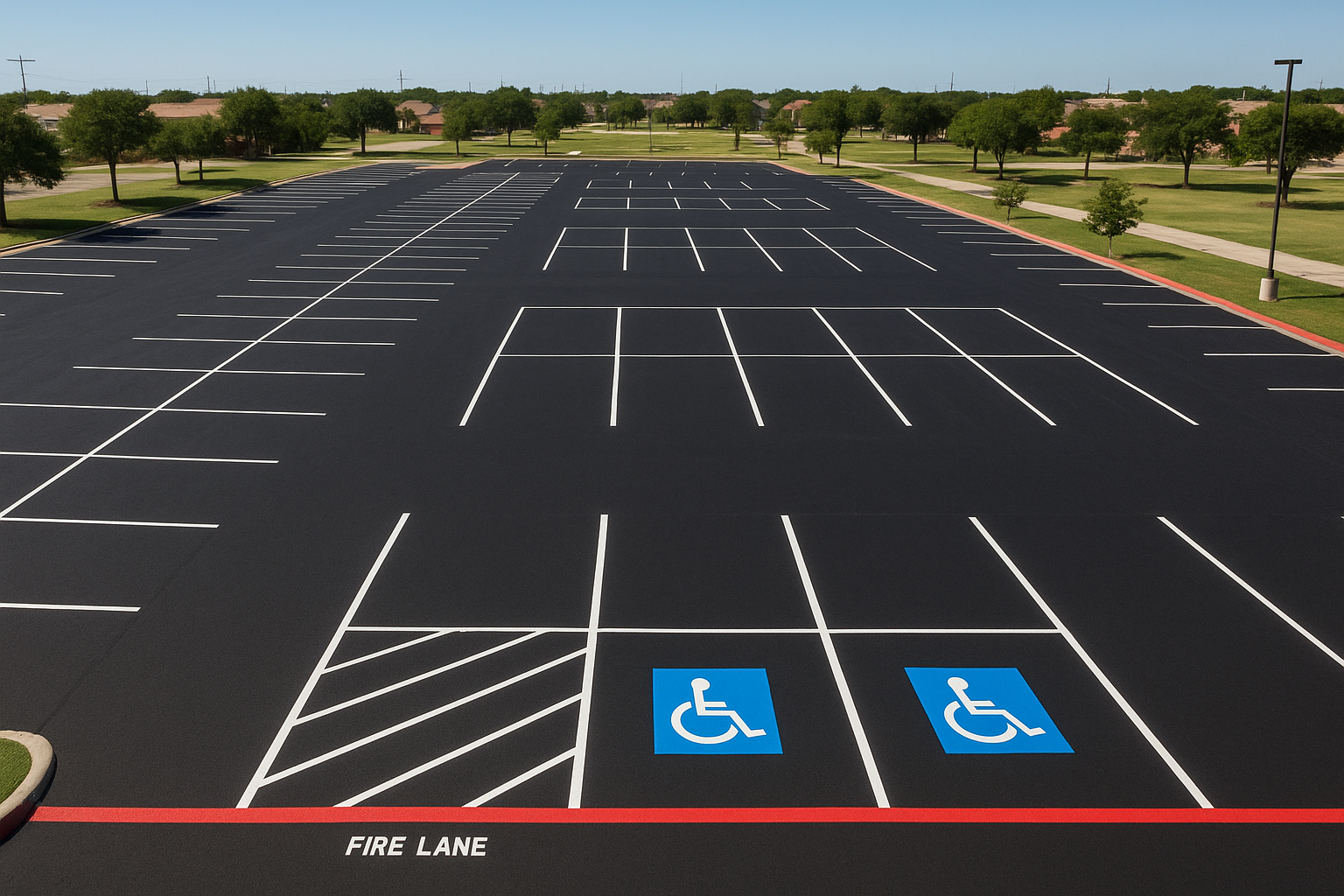
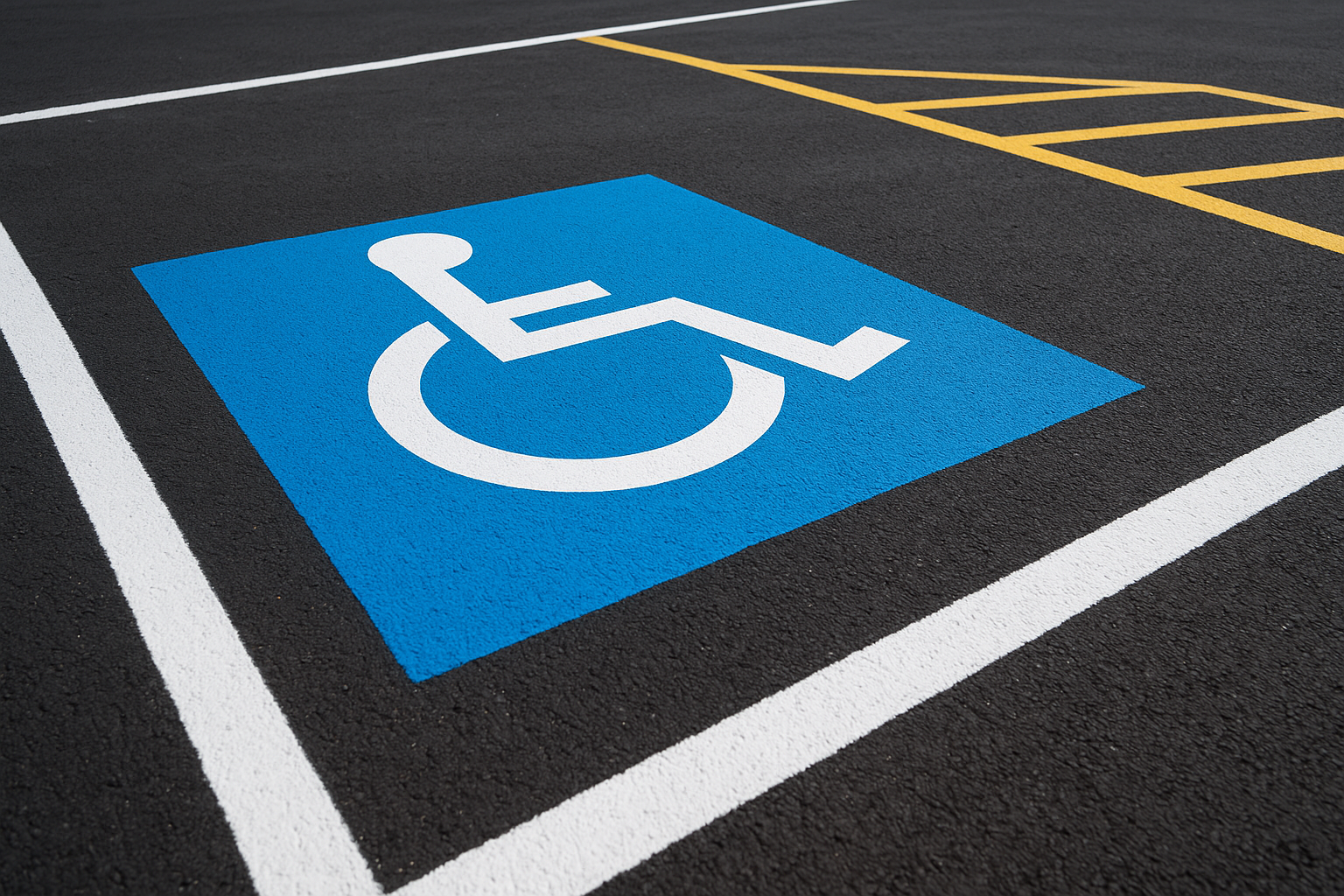
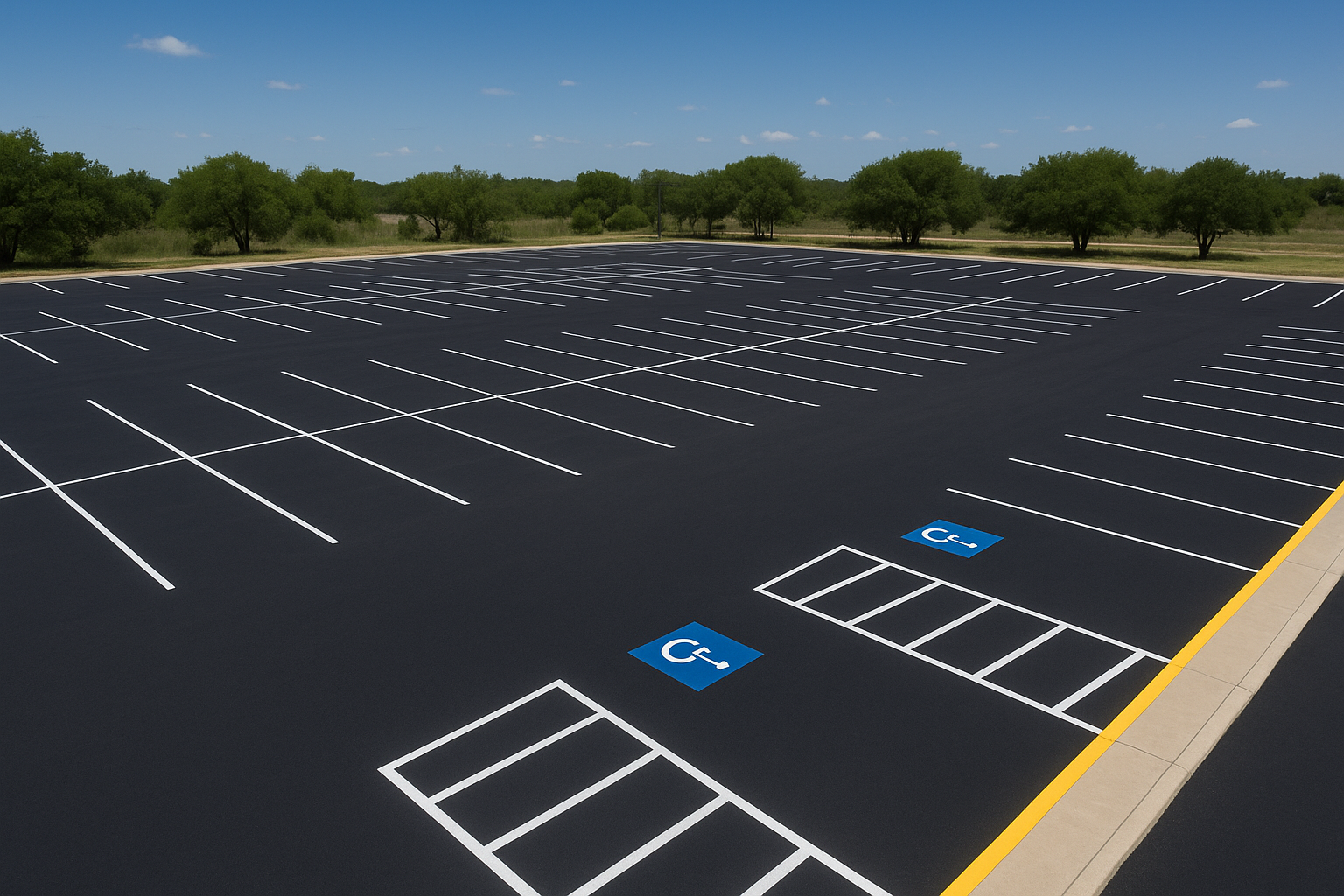
    Freshly completed parking lot striping showing white stall lines, ADA handicap markings, fire lane designations, and directional arrows on a commercial property

    Professional parking lot striping delivers code-compliant markings that organize traffic, protect property owners, and maximize usable space.

    What Is Parking Lot Striping — and Why Does It Matter?

    Parking lot striping is the professional application of painted lines, symbols, and stenciled markings on paved surfaces. These markings define individual parking spaces, guide vehicle traffic through drive aisles, designate fire lanes, and communicate critical safety rules. Specifically, a complete striping project covers standard white stall lines, ADA-compliant handicap spaces, van-accessible stalls, access aisles, directional arrows, crosswalks, curb painting, and specialty stencils like “STOP” text and speed bump indicators.

    Furthermore, professionally designed striping layouts maximize the number of usable spaces within a given footprint. According to parking design guidelines published by the U.S. Department of Transportation, a well-executed layout can fit 10–15% more vehicles than a poorly planned one. For retail businesses, that directly translates to more customers. For property managers, it means fewer headaches and higher tenant satisfaction.

    In addition, clear lot markings reduce the risk of low-speed collisions, pedestrian-vehicle conflicts near building entrances, and unauthorized parking in fire lanes or accessible stalls. The result is a safer, more organized property — and a stronger legal position if an incident ever occurs.


    The Real Cost of Faded or Missing Parking Lot Markings

    Faded markings do far more damage than most property owners realize. When lines are barely visible, drivers park haphazardly, traffic conflicts increase, and your lot begins to look neglected — which reflects directly on your business or tenants. However, the financial risks go well beyond aesthetics.

    ADA Violations and Federal Penalties

    Businesses with unclear or missing ADA markings risk civil complaints under Title III of the Americans with Disabilities Act. Specifically, first-time violations can carry penalties of up to $75,000, and subsequent violations can reach $150,000, per ADA.gov enforcement guidelines. Missing access aisles, incorrect stall widths, and absent International Symbol of Accessibility (ISA) markings are among the most commonly cited violations.

    Liability from Accidents and Traffic Conflicts

    When stall lines, pedestrian crossings, and traffic flow indicators are missing, accidents become more likely. As a result, property owners may face liability claims from drivers or pedestrians injured in avoidable incidents. Consequently, the cost of a routine restriping service is a fraction of what you might spend resolving a single liability claim — making proactive maintenance the smarter financial choice by far.

    Fire Code Citations

    Fire lane markings are not optional. Local fire departments and fire marshals inspect commercial properties for properly maintained fire lane designations. If fire lane curb paint has faded or stenciling is illegible, your property may be cited. Therefore, maintaining visible fire lane markings is essential for both compliance and emergency response readiness.


    How Often Does a Parking Lot Need Restriping?

    Most commercial parking lots need restriping every one to two years. However, several factors determine where your property falls in that range. UV radiation breaks down the binders in traffic paint, causing lines to fade faster in sun-heavy climates. Heavy seasonal rainfall and freeze-thaw cycles further accelerate surface wear. High-traffic lots — such as those at grocery stores, hospitals, or distribution centers — wear out faster than lower-traffic office parks.

    In addition, lots that have been seal-coated recently will need restriping immediately after the sealant cures, since sealcoating covers existing markings entirely. Similarly, any lot undergoing repaving or surface repairs will need a fresh striping job as part of the restoration process.

    A simple rule of thumb: if you can no longer read your lot’s stall lines clearly from a standing height in bright daylight, it’s time to schedule a parking lot restriping service. Proactive restriping is always more affordable than reactive repairs, compliance fines, or accident liability.


    ADA-Compliant Parking Lot Striping: What Every Property Owner Must Know

    ADA compliance is federal law — not a suggestion. The ADA Standards for Accessible Design specify minimum requirements for accessible parking spaces based on total lot capacity. Understanding these standards is essential for every commercial property owner.

    Required Number of Accessible Spaces

    The table below summarizes the minimum accessible space requirements under federal ADA guidelines:

    Total Lot Spaces Minimum Accessible Spaces Van-Accessible Required
    1 – 25 1 1
    26 – 50 2 1
    51 – 75 3 1
    76 – 100 4 1
    101 – 150 5 1

    Dimensional Requirements for Accessible Stalls

    Each accessible stall must meet precise dimensional standards. A standard accessible space must be at least 8 feet wide with a 5-foot access aisle alongside it. Van-accessible spaces require a wider 8-foot access aisle. Additionally, every accessible stall must display a correctly sized and positioned International Symbol of Accessibility (ISA) and include appropriate vertical signage.

    Moreover, accessible spaces must be located on the shortest accessible route to the building’s accessible entrance. This means placement matters — not just dimensions and symbols. A professional striping team will assess your entire lot layout to ensure placement, dimensions, and markings all meet current federal requirements.
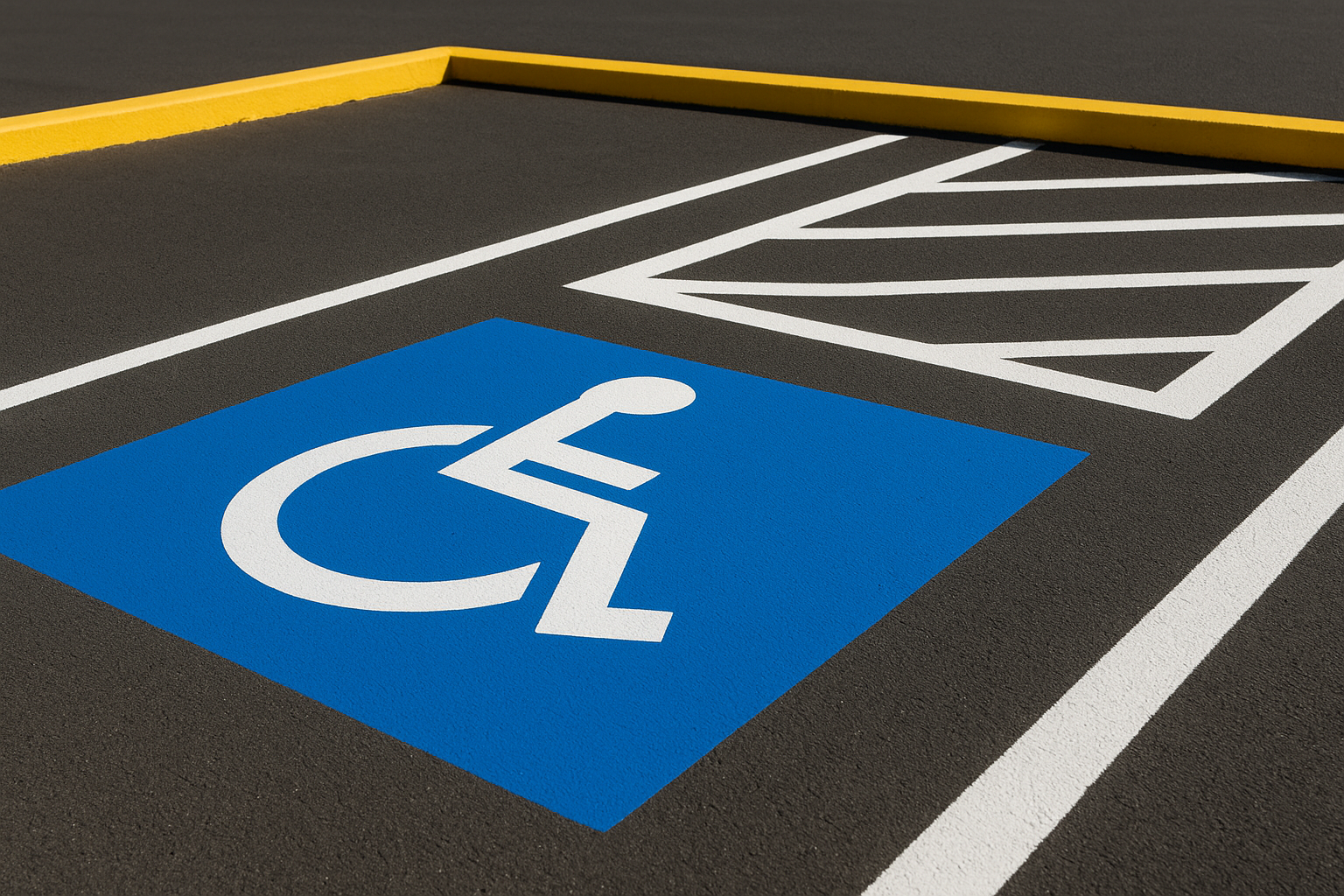
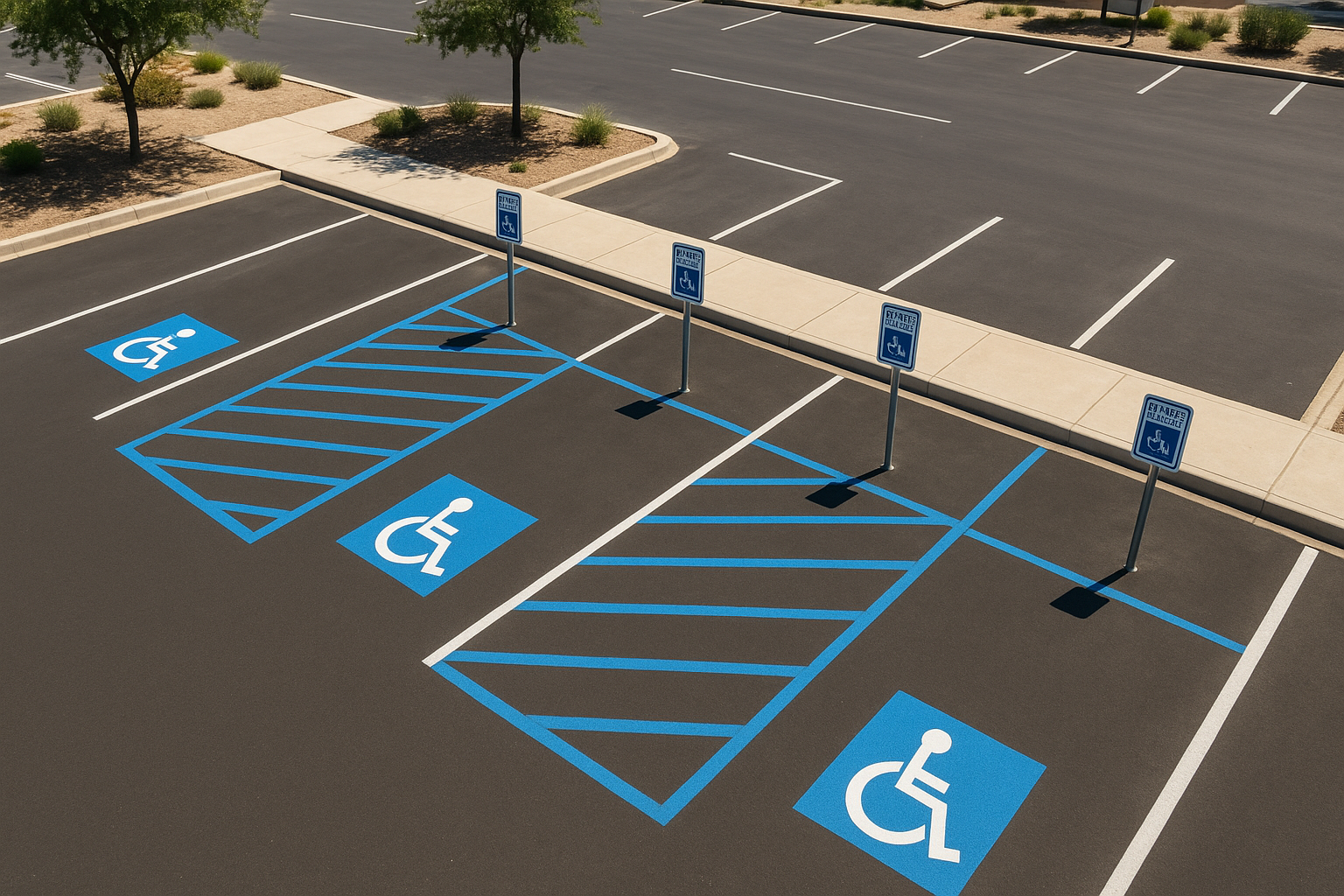
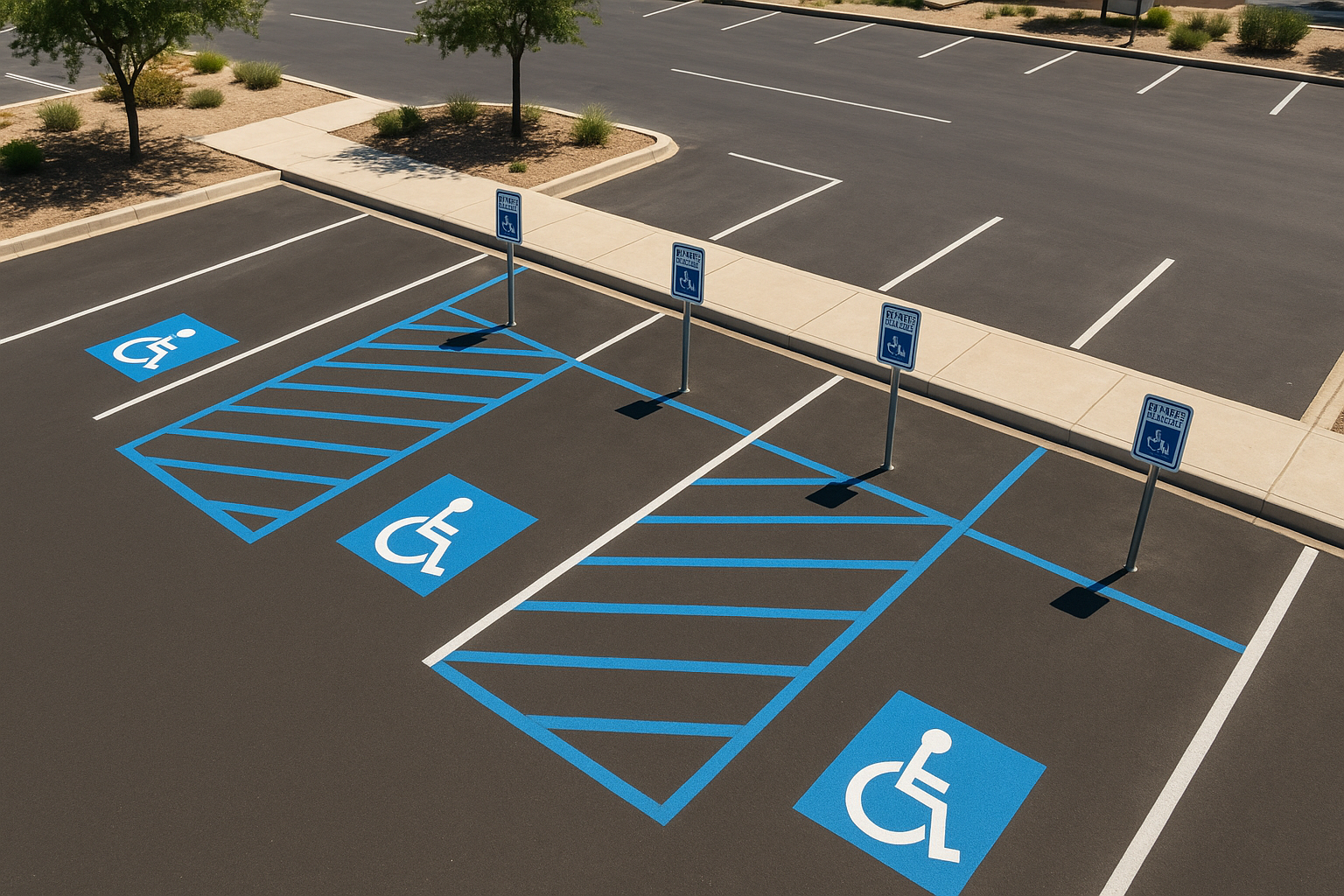
    ADA-compliant handicap parking stall with blue ISA symbol, white access aisle lines, and van-accessible designation as part of a full parking lot striping project

    ADA-compliant handicap stalls require precise dimensions, correct symbols, proper access aisle placement, and appropriate signage to meet federal standards.


    Complete Parking Lot Striping Services: What Is Typically Included

    A full-service parking lot striping project covers several interconnected services. Understanding each one helps you plan your budget and communicate clearly with your contractor before the job begins.

    Standard Stall Lines and Lot Layout Design

    Standard stall lines form the backbone of every parking lot. Professional stripers use precision line striping machines to ensure consistent 4-inch line widths, proper stall dimensions (typically 8.5 to 9 feet wide by 18 to 20 feet deep), and straight, parallel rows. A well-designed layout also accounts for drive aisle widths — typically 24 feet for two-way traffic and 18 to 20 feet for one-way aisles.

    Furthermore, an experienced crew will evaluate your lot’s geometry to maximize space count without sacrificing safety. In some cases, angling stalls at 60 or 90 degrees — depending on aisle orientation — can meaningfully increase capacity.

    ADA Handicap Stalls and Access Aisle Markings

    ADA markings are among the most critical and closely scrutinized elements of any parking lot striping project. These include the ISA symbol painted in the stall, access aisle hash marks, and “VAN ACCESSIBLE” stenciling where required. Additionally, the color of the ISA symbol — typically blue with white contrast — must be legible and properly sized for compliance.

    Fire Lane Marking and Red Curb Painting

    Fire lane markings are required by the International Fire Code and enforced by local fire marshals. These markings typically include red-painted curbs and stenciled “FIRE LANE – NO PARKING” text along designated emergency access zones. Specifically, fire lane widths, clearances, and placement relative to building access points are all governed by code. Maintaining these markings ensures emergency vehicles can always reach your building quickly — and keeps your property free of fire code citations.

    Directional Arrows, Crosswalks, and Specialty Stencils

    Directional arrows, “STOP” text, pedestrian crosswalk stripes, speed bump markings, reserved space designations, and numbered stall markers all contribute to a safe, well-organized lot. These elements are especially important in larger lots where visitors may be unfamiliar with the layout. Moreover, clear pedestrian crosswalk markings near building entrances significantly reduce the risk of pedestrian-vehicle conflicts — a key liability concern for retail and healthcare properties.

    New Lot Layouts vs. Restriping Existing Lots

    New parking lot striping — applied to freshly paved or bare asphalt — requires careful planning and measurement to establish the layout from scratch. In contrast, restriping refreshes faded or worn markings on an existing lot. Both require professional equipment and expertise, but new layout jobs additionally involve a design phase where the contractor maps out stall placement, aisle widths, ADA stall locations, and traffic flow patterns before a single line is painted.

    For a detailed look at everything included, visit the parking lot striping services page at stripespls.com.

    Parking lot striping crew operating a professional line marking machine on a large commercial lot, applying fresh white stall lines with precision

    A professional striping crew uses precision equipment to deliver straight, durable, code-compliant lines on commercial and municipal parking surfaces.


    Types of Paint Used for Parking Lot Striping

    Not all parking lot paint is the same. The two most common types are water-based latex traffic paint and oil-based alkyd paint, and each has distinct trade-offs worth understanding before your project begins.

    • Water-based latex traffic paint — dries in as little as 15 to 30 minutes, is lower in VOCs (volatile organic compounds — airborne chemicals released during drying), and is easier to apply in varying temperatures. It is the most common choice for standard commercial restriping projects.
    • Oil-based alkyd paint — dries more slowly (typically 1 to 2 hours) but offers superior durability in high-traffic, high-wear environments. It is often used on busy drive lanes or lots exposed to heavy vehicle turning loads.
    • Epoxy or thermoplastic coatings — premium options used in specialty applications such as parking garages, airport aprons, or lots requiring extremely long service life. These are more expensive but can last 5 to 7 years under ideal conditions.

    Your striping contractor should recommend the right paint type based on your lot’s traffic volume, surface condition, climate, and budget. In particular, lots in regions with intense UV exposure or heavy rainfall may benefit from premium paint formulations that resist fading and moisture penetration more effectively.


    How to Get Your Parking Lot Striped: A Step-by-Step Guide

    Getting professional line marking service is straightforward when you follow a clear process. Here is a step-by-step guide to arranging parking lot striping for your commercial property:

    1. Assess your lot’s current condition. Walk the entire surface and note faded stall lines, missing ADA symbols, worn fire lane markings, and any areas where traffic flow is unclear. Take photos for reference — these will help your contractor assess scope and price the job accurately.
    2. Request a free, itemized quote. Contact a professional striping company with your lot dimensions, approximate number of spaces, and any specific needs — such as ADA compliance updates, fire lane work, or a complete new layout. Reach out to stripespls.com for a no-obligation estimate tailored to your property.
    3. Review the proposed layout plan. Before any paint is applied, work with the crew to confirm stall dimensions, traffic flow direction, ADA stall placement, fire lane zones, and any curb or signage requirements. A good contractor provides a written layout plan — insist on seeing it in advance.
    4. Prepare the surface and schedule the work. Coordinate a time when the lot can be fully or partially closed. Ensure the surface is clean, dry, and free of debris — dust, oil stains, and moisture prevent proper paint adhesion. If the lot has recently been seal-coated, confirm the sealant has fully cured before striping begins.
    5. Inspect the completed work before reopening. After the paint cures, walk the lot with the crew to verify all lines are straight and correctly spaced, ADA symbols and access aisles are properly placed, fire lanes are clearly designated, and no touch-ups are needed. Document the completed work with photos for your records.

    Following this process reduces the chance of costly rework. Additionally, documented proof of professional striping work is valuable if you ever face an ADA audit, fire code inspection, or insurance claim.


    How Much Does Parking Lot Striping Cost?

    Parking lot striping costs vary based on lot size, number of spaces, services required, and local labor rates. However, the following general ranges give a useful starting point for budgeting purposes:

    • Basic restripe (small lot, 20–50 spaces): $200 – $500
    • Mid-size commercial lot (50–150 spaces) with ADA markings: $500 – $1,500
    • Large commercial property with ADA, fire lanes, and directional work: $1,500 – $4,000+
    • New lot layout from scratch (including design and measurement): Priced per project scope — request a custom quote
    • Individual ADA stall additions or fire lane stenciling: $50 – $200 per stall or zone

    These figures are general estimates only. The most accurate pricing always comes from an on-site or photo-based assessment. Moreover, the cost of professional striping is almost always lower than the cost of a single ADA violation fine — making it one of the best-value preventive maintenance investments available to property owners. Request a free custom quote from stripespls.com to get exact pricing for your property.


    How to Choose the Right Parking Lot Striping Company

    Not all striping contractors deliver the same quality. Choosing the wrong crew can mean uneven lines, incorrect ADA dimensions, or paint that fades within months. Therefore, vetting your contractor carefully before signing anything is essential.

    Key Questions to Ask Before Hiring a Striping Contractor

    • Do you carry general liability insurance and workers’ compensation coverage?
    • What type and brand of traffic paint do you use, and how long does it last in this climate?
    • Will you provide a written layout plan before work begins?
    • Are you familiar with current ADA Standards for Accessible Design and local fire code requirements?
    • Do you offer a satisfaction guarantee or warranty on your work?
    • Can you provide references from similar commercial projects in this area?

    What Sets a Professional Striping Company Apart

    A professional operation uses commercial-grade line striping machines — not handheld rollers or spray cans. These machines deliver consistent line widths, precise paint application rates, and straight results even on large lots. Additionally, professional crews source traffic-grade paint formulated for the specific climate and surface type — not generic hardware store paint.

    Stripespls.com is a locally operated, full-service parking lot marking company based in Texas, serving property owners across the region. The company brings expertise in ADA compliance, fire lane designation, new lot layouts, and restriping — all backed by a reputation for reliability and attention to detail. Property managers, retail centers, schools, healthcare facilities, and municipal organizations trust the team for precise, durable results. Visit the stripespls.com blog for additional tips on parking lot maintenance and compliance.


    Common Parking Lot Striping Mistakes — and How to Avoid Them

    Even experienced property owners make avoidable mistakes when it comes to parking lot markings. Specifically, the following errors are the most common — and the most costly:

    • Waiting until lines are completely invisible — Striping is far easier and more accurate over faded but visible lines. When markings are gone entirely, the crew must re-measure from scratch, which takes longer and costs more.
    • Failing to update ADA markings after code changes — ADA standards are updated periodically. A lot striped to 2010 standards may not meet current requirements. A professional contractor will ensure your markings reflect the current version of the ADA Standards for Accessible Design.
    • Using the wrong paint type for the surface or climate — Applying water-based paint over an oily or poorly prepared surface leads to premature peeling. Similarly, using interior-grade paint outdoors causes rapid fading.
    • Striping over a wet or recently sealed surface — Paint applied to a surface that is damp or not fully cured will not bond correctly, leading to bubbling, peeling, and rapid wear.
    • Hiring the lowest bidder without vetting credentials — Unlicensed or underinsured contractors may cut corners on materials, line accuracy, or ADA compliance — costing you far more in the long run.
    • Skipping the post-project inspection — Always walk the completed lot with the crew before they leave. Errors are much easier and cheaper to fix immediately than after the contractor has packed up and left the site.

    Parking Lot Striping for Different Property Types

    Parking lot striping requirements vary significantly depending on the type of property. Each use type has specific needs — from ADA ratios to fire lane configurations to traffic flow priorities. Understanding these differences helps property managers ask the right questions and set the right expectations.

    Retail and Shopping Center Parking Lots

    Retail lots prioritize maximum space count, clear pedestrian crosswalk markings, fire lane compliance near storefronts, and prominent cart return area designations. High turnover means these lots experience significant paint wear. As a result, restriping every 12 to 18 months is often appropriate for busy shopping centers.

    Medical and Healthcare Facilities

    Healthcare properties typically require a higher ratio of accessible spaces than standard commercial lots, given the patient population they serve. In addition, patient drop-off zones, ambulance access areas, and clearly marked emergency vehicle lanes must all be factored into the striping plan. Compliance is especially critical at facilities serving patients with mobility limitations.

    Schools, Universities, and Municipal Properties

    Educational and government-owned properties often require clearly marked bus lanes, parent pick-up and drop-off zones, visitor spaces, and accessible parking areas — all while meeting the same federal ADA requirements as private commercial properties. Furthermore, these lots often serve large volumes of pedestrian traffic, making crosswalk visibility a top priority.

    Office Parks and Multi-Tenant Commercial Properties

    Office park striping often involves numbered stalls, reserved executive spaces, visitor zones, and EV charging area designations — an increasingly common request as electric vehicle adoption grows. Specifically, EV charging spaces must be positioned to allow charger cable reach without creating trip hazards across driving lanes.


    Frequently Asked Questions About Parking Lot Striping

    What is parking lot striping and what does it include?

    Parking lot striping is the professional application of painted lines, symbols, and stencils on paved surfaces to define stalls, guide traffic, and ensure ADA and fire lane compliance. A complete project typically includes stall lines, ADA handicap markings, fire lane designations, directional arrows, crosswalks, and specialty stencils.

    How often should a parking lot be restriped?

    Most commercial parking lots need restriping every 1 to 2 years. High-traffic lots or those in regions with intense sun and weather exposure may need annual attention. After sealcoating, restriping is always required since sealant covers existing markings completely.

    What ADA requirements apply to parking lot striping?

    The ADA requires a specific number of accessible spaces based on total lot capacity, along with minimum stall widths of 8 feet, 5-foot access aisles (8 feet for van-accessible stalls), International Symbol of Accessibility placement, and proper signage. Non-compliance can result in fines up to $75,000 for a first violation.

    How much does parking lot striping cost?

    Costs depend on lot size, number of spaces, and services required. A basic restripe for a small lot may start around $200 to $500. Larger commercial lots with ADA markings, fire lanes, and directional work can range from $1,500 to $4,000 or more. Contact stripespls.com for a free custom quote.

    How long does parking lot striping take to dry?

    Water-based traffic paint typically dries in 15 to 30 minutes under normal conditions. However, most professionals recommend keeping vehicles off freshly painted lines for at least 1 hour to ensure full adhesion and a clean, durable finish.

    What types of paint are used for parking lot striping?

    The two most common options are water-based latex traffic paint (fast-drying, lower VOCs, ideal for most restripe projects) and oil-based alkyd paint (slower-drying but more durable in high-wear areas). Epoxy and thermoplastic coatings are premium options used in specialty applications like parking garages.

    Do I need a permit for parking lot striping?

    Routine restriping of existing markings typically does not require a permit. However, new lot layouts or significant changes to traffic patterns may require local municipality approval. A professional striping contractor can advise you on requirements specific to your area.

    What is the difference between new striping and restriping?

    New striping refers to applying markings on a freshly paved or bare surface for the first time, which requires full layout planning and measurement. Restriping means refreshing faded or worn markings on an existing lot to restore visibility, compliance, and organization.

    Can parking lot striping improve traffic flow and safety?

    Yes — significantly. Well-planned parking lot striping improves traffic flow by clearly defining drive aisles, entry and exit points, turning areas, and pedestrian crossings. Directional arrows and clear stall markings reduce confusion, lower the risk of low-speed collisions, and improve the overall experience for drivers and pedestrians alike.

    What are fire lane markings and why are they required?

    Fire lane markings are painted curbs and stenciled zones that designate areas where parking is prohibited to ensure emergency vehicle access. They are mandated by the International Fire Code and enforced by local fire marshals. Failing to maintain them can result in citations and, more critically, delayed emergency response.

    What are the most common parking lot striping mistakes property owners make?

    The most common mistakes include delaying restriping until lines are completely invisible, failing to update ADA markings after code revisions, using the wrong paint type for the climate or surface, striping over a wet or uncured sealcoated surface, and hiring unvetted contractors who cut corners on materials or compliance. A professional striping company eliminates all of these risks.


    Conclusion: Why Professional Parking Lot Striping Is Worth Every Dollar

    Parking lot striping is far more than a cosmetic upgrade — it is a practical, legally required investment in safety, compliance, and the professional image of your property. Fresh, precise markings protect you from ADA liability and fire code citations, improve traffic flow, reduce accident risk, and demonstrate that your property is well-managed and safe for every visitor. Furthermore, proactive restriping is always more affordable than addressing violations, accidents, or enforcement actions after the fact.

    Whether you need a complete new layout, an ADA compliance update, fire lane marking, or a simple refresh of faded lines, working with an experienced professional ensures the job is done right — with the right materials, accurate dimensions, and full code compliance. According to the National Fire Protection Association, maintaining clear fire access markings is among the most important ongoing responsibilities for commercial property owners.

    Take the first step today. Visit stripespls.com to learn more about available services, or request your free quote and give your parking lot the professional finish it deserves — and that your customers, tenants, and visitors expect.
  • Parking Lot Striping Denton TX: Expert Line Marking

    Parking Lot Striping Denton TX: Expert Line Marking

    Parking lot striping is the professional application of durable painted lines, symbols, and pavement markings to organized paved surfaces — defining stalls, directing traffic, and keeping commercial properties safe, compliant, and fully functional. If you manage a retail center, office park, school, or healthcare facility in Denton TX, clean and precise striping is one of the highest-impact, lowest-cost investments you can make in your property.

    Faded stall lines, missing ADA markings, and unclear fire lanes are not merely cosmetic problems. Specifically, they create real liability exposure, frustrate drivers, and can trigger code violations from local authorities. Fortunately, a professional striping crew can transform a worn lot into a crisp, organized, fully compliant parking facility — often completing the work in a single day with zero permanent disruption to your operations.

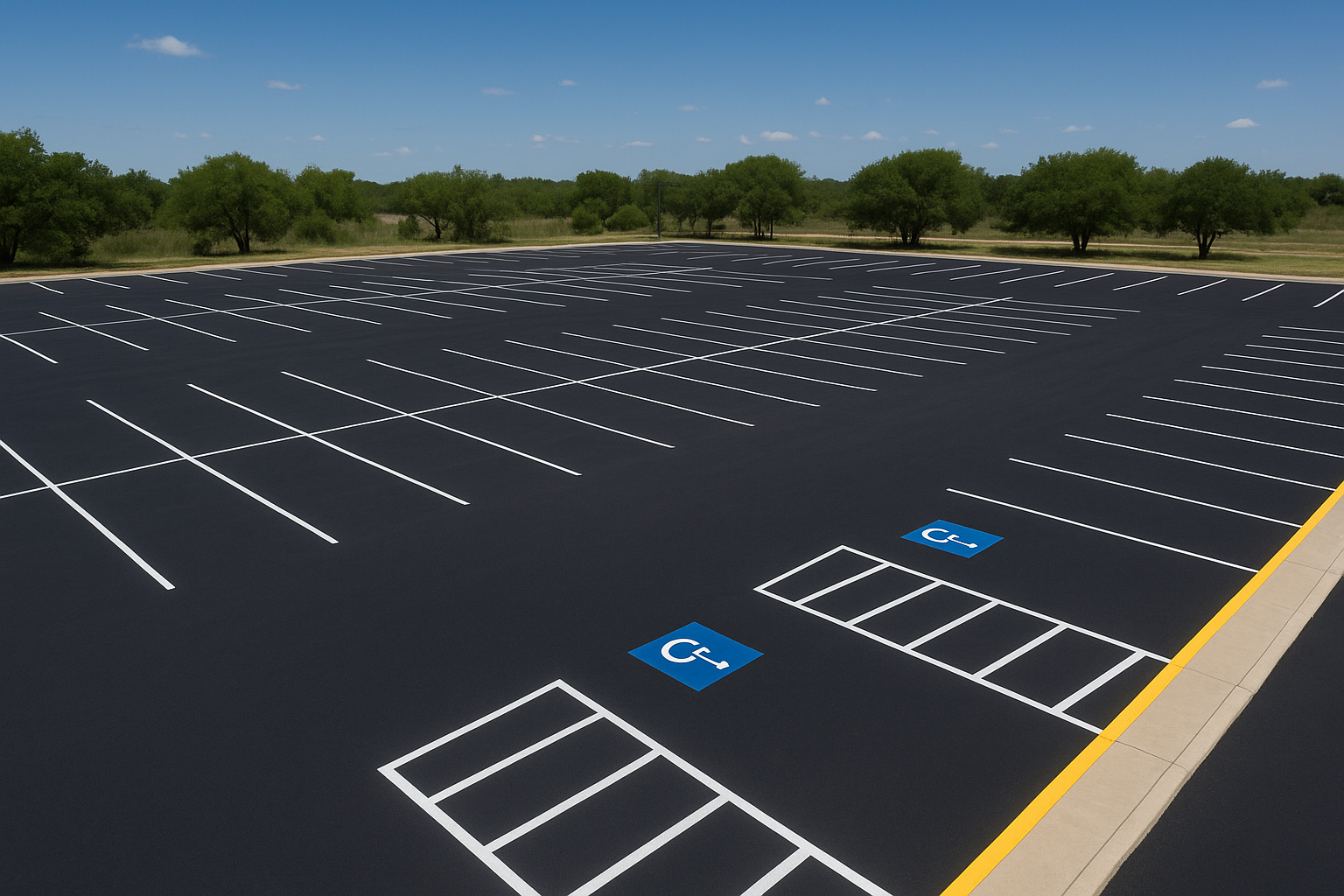
    Aerial view of freshly completed parking lot striping in Denton TX showing bright white stall lines, ADA symbols, and yellow fire lane markings

    Professional parking lot striping in Denton TX delivers crisp, durable markings that improve traffic flow and meet ADA and fire code requirements.


    What Is Parking Lot Striping and Why Does It Matter?

    Parking lot striping is the precise layout and painting of traffic lines, symbols, and zone designations on asphalt or concrete surfaces. It forms the foundation of every safe, organized, and legally compliant parking facility. Without clear markings, drivers face confusion, usable capacity shrinks, and the risk of accidents rises significantly.

    According to the U.S. Department of Justice ADA resource center, every property open to the public is legally required to provide accessible parking spaces that meet specific size and signage standards. Non-compliance can result in federal fines and civil liability claims. Therefore, proper striping is not optional — it is a legal obligation with real financial consequences.

    Furthermore, research consistently links organized, well-marked parking to higher customer satisfaction scores. A freshly striped lot communicates professionalism and attention to detail — qualities that reflect directly on every business operating within that property.

    The Business Case for Well-Maintained Lot Markings

    Beyond compliance, sharp parking lot markings actively protect your revenue. When stall lines are clear, drivers park faster and more efficiently — meaning more vehicles served per hour. In addition, well-defined pedestrian crosswalks reduce slip-and-fall incidents that could expose property owners to costly litigation. The return on investment for professional striping is measurable in both safety outcomes and reduced liability premiums.


    Complete Services Included in Professional Parking Lot Line Marking

    A full-service striping company in Denton TX offers far more than simple stall lines. In fact, a comprehensive parking lot marking project typically covers every element below:

    • Parking stall lines — Standard, compact, and angled layouts engineered to maximize capacity on any lot shape
    • ADA handicap stall markings — International Symbol of Access, access aisles, van-accessible stalls, and compliant signage
    • Fire lane striping — Red curb painting, “No Parking — Fire Lane” lettering, and pavement markings per local fire code
    • Directional arrows — One-way and two-way traffic flow indicators placed at every key decision point
    • Crosswalks and pedestrian safety zones — High-visibility walkway markings connecting buildings to parking areas
    • No-parking zones and curb markings — Clearly defined restricted areas that prevent unauthorized parking
    • Speed bump and speed limit markings — Pavement legends that reinforce traffic-calming installations
    • Reserved and specialty stalls — EV charging zones, loading zones, visitor stalls, and employee-only designations
    • Stop bars and yield markings — Intersection control markings that reduce internal traffic conflicts

    Stripespls.com provides all of these services across Denton, Plano, and greater North Texas. You can explore the full range of parking lot striping services available for commercial and residential properties throughout the region.


    ADA Compliance: A Non-Negotiable Part of Parking Lot Striping

    The Americans with Disabilities Act (ADA) establishes strict federal requirements for accessible parking. In Texas, these standards apply to virtually every commercial property open to the public. Specifically, the law mandates a minimum ratio of accessible spaces to total spaces, with at least one van-accessible stall per accessible cluster.

    ADA Space Ratios by Lot Size

    The table below summarizes the minimum accessible space requirements under the current ADA Standards for Accessible Design:

    Total Lot Spaces Min. Accessible Stalls Min. Van-Accessible
    1 – 25 1 1
    26 – 50 2 1
    51 – 75 3 1
    76 – 100 4 1
    101 – 150 5 1
    151 – 200 6 1
    201 – 300 7 2

    Access aisles — the striped buffer zones beside accessible stalls — must be at least 60 inches wide for standard accessible spaces and 96 inches wide for van-accessible spaces. In addition, signage must be mounted at a height of 60 inches minimum above the ground and must display the International Symbol of Access. Missing or undersized markings are among the most cited ADA violations during property inspections.

    A professional parking lot striping team familiar with Denton-area properties ensures your lot meets every current requirement — protecting you from liability and making your facility genuinely welcoming to all visitors.

    Close-up of ADA compliant handicap parking stall markings with access aisle and International Symbol of Access applied during Denton TX parking lot striping

    ADA-compliant handicap stall markings — including access aisles and van-accessible designations — are a required component of any complete parking lot striping project.


    Types of Paint Used in Professional Parking Lot Striping

    Not all striping materials perform equally. The paint or material used in your parking lot striping project directly affects how long the markings last, how quickly the lot can reopen, and the overall quality of the finished result. Here is a breakdown of the most common options:

    Water-Based Traffic Paint

    Water-based latex traffic paint is the most widely used material for standard commercial parking lots. It dries quickly — typically within 30 to 60 minutes — emits low levels of volatile organic compounds (VOCs), and applies cleanly through professional striping machines. However, in very high-traffic areas, water-based paint may begin fading within 12 to 18 months.

    Oil-Based Traffic Paint

    Oil-based paint bonds more aggressively to asphalt and concrete surfaces, resulting in better durability in harsh conditions. The tradeoff is longer drying time and higher VOC content, which may be a consideration for enclosed or partially covered parking structures.

    Thermoplastic Pavement Markings

    Thermoplastic — a heat-applied plastic compound — is the most durable option available for parking lot striping. It bonds to the pavement surface as it cools and can last three to seven years even under heavy daily traffic. As a result, thermoplastic is often the preferred choice for high-volume lots such as shopping centers, hospitals, and airports. The material is more expensive upfront, but the extended lifespan typically delivers a lower cost per year than repeated repainting.


    How to Get Professional Parking Lot Striping: Step-by-Step

    The process of hiring a striping company and getting your lot professionally marked is straightforward. Follow these five steps to ensure a smooth project from start to finish:

    1. Assess your lot’s current condition. Walk the entire property and identify faded stall lines, missing ADA markings, unclear fire lanes, or worn directional arrows. Note whether you need a completely new layout or a restripe of existing markings. Photographing problem areas helps during your contractor conversation.
    2. Request a free, itemized quote from a local striping company. Provide your lot’s square footage, stall count, surface type, and a list of required markings. A reputable company will deliver a clear, line-itemized estimate — with no obligation — so you can compare options accurately.
    3. Review the layout plan and confirm ADA and fire code compliance. Before any work begins, verify that the proposed stall layout maximizes usable capacity and satisfies all current ADA dimensional requirements and local fire lane regulations. Ask your contractor to walk you through the plan on-site if necessary.
    4. Schedule work during low-traffic hours. Coordinate with your contractor to minimize disruption to tenants, employees, and customers. Overnight work, early morning starts, and weekend scheduling are all common for commercial properties in Denton TX.
    5. Allow paint to cure fully, then conduct a walkthrough inspection. Keep the lot closed to vehicles for at least one hour after completion. Then walk the entire lot with your contractor to confirm every line, symbol, directional marking, and ADA designation meets the agreed specifications before you sign off.

    Moreover, working with an experienced local crew means fewer surprises, faster scheduling, and results that hold up through North Texas summers, heavy rainfall, and year-round commercial traffic.


    When Does a Parking Lot Need Restriping?

    Most commercial parking lots need restriping every one to two years, though high-traffic properties may require attention more frequently. In North Texas specifically, intense summer UV exposure accelerates paint fading at a rate faster than in cooler climates. As a result, markings that looked sharp in spring can appear significantly washed out by early fall.

    Clear Signs Your Lot Needs Restriping Now

    • Stall lines are difficult to distinguish in low light or after rain
    • Drivers routinely park outside marked stall boundaries
    • ADA symbols and access aisle stripes are no longer clearly visible
    • Fire lane lettering or curb paint has faded significantly
    • Directional arrows are worn to the point where drivers ignore them
    • A fresh seal coat or new asphalt overlay has covered existing markings
    • You have received a complaint or citation from a code enforcement officer

    If any of these apply to your property, it is time to schedule a professional restriping service before the situation escalates into a safety or compliance issue. Additionally, restriping after a seal coat is always required — new sealant covers existing markings entirely, so fresh lines must be applied to restore visibility.


    Fire Lane Striping: Safety and Code Compliance in Denton TX

    Fire lanes are designated access corridors that must remain clear at all times to allow emergency vehicles to reach a building without obstruction. Local fire codes in Denton — and throughout Texas — require these zones to be clearly marked with painted curbs, pavement lettering, and in some cases additional pavement markings visible from both directions.

    Failure to maintain visible fire lane markings can result in citations from the local fire marshal and create dangerous delays during emergencies. Furthermore, property owners can face direct liability if an obstruction in an unmarked or illegible fire lane contributes to injury or property damage during an emergency response.

    A professional parking lot striping company ensures fire lane markings meet current local standards — including correct paint color, minimum lettering height, and precise placement along curb faces and pavement surfaces. The result is a property that is safe, code-compliant, and protected against enforcement action.


    Parking Lot Striping for Every Property Type

    Different property types have different striping requirements. Understanding how striping needs vary by use helps property managers plan more accurately and budget more effectively:

    Retail Centers and Shopping Plazas

    High customer turnover means retail lots experience among the fastest paint wear of any property type. In addition to standard stall lines, retail centers commonly require fire lane markings along building perimeters, cart return designations, crosswalk corridors to storefronts, and clearly separated delivery and service zones.

    Healthcare Facilities and Medical Offices

    Medical facilities typically require a higher ratio of accessible stalls relative to lot size, along with clear patient drop-off zones and ambulance access corridors. Furthermore, the striping must be highly legible because many visitors have physical or visual impairments that make unclear markings especially problematic.

    Schools and Educational Campuses

    School parking lots serve multiple user groups simultaneously — staff, parents, buses, and emergency vehicles — often within tight schedules. As a result, clearly defined drop-off/pickup lanes, bus-only zones, pedestrian crossings, and visitor stalls are all critical components of a school striping plan.

    Office Parks and Corporate Campuses

    Office properties benefit from reserved stall designations, visitor zones, and EV charging markings in addition to standard striping. Similarly, large campuses may require numbered stall systems to assist employees, security staff, and visitors in locating specific areas efficiently.

    Municipal and Government Properties

    Government-owned facilities are subject to the same ADA requirements as private commercial properties. However, because public facilities often serve a higher proportion of elderly or disabled visitors, ADA-compliant striping is especially critical. Professional striping teams familiar with municipal requirements ensure full compliance on every public property project.


    How Much Does Parking Lot Striping Cost?

    The cost of parking lot striping depends on several variables: lot size, total stall count, types of markings required, surface condition, material choice, and whether the project is a new layout or a restripe. Below is a general cost framework to help you plan:

    Typical Parking Lot Striping Cost Ranges

    • Small lot restripe (under 30 stalls): $200 – $500
    • Mid-size lot restripe (30–100 stalls): $500 – $1,500
    • Large commercial lot restripe (100+ stalls): $1,500 – $4,000+
    • New full layout (fresh asphalt): $1,000 – $5,000+ depending on complexity
    • ADA stall upgrades (per stall): $50 – $150 per accessible stall, including symbol and access aisle
    • Fire lane marking (per linear foot): $1 – $3 per foot of curb lettering
    • Thermoplastic markings: 2–4× the cost of paint but lasts 3–7 years

    These figures are general estimates. Surface condition, complexity, and material selection all affect your actual cost. For context, ADA requirements mandate that lots with 100 to 150 total spaces include at least five accessible stalls, with one van-accessible. Ensuring those stalls are correctly configured adds both material and labor costs that vary by property.

    The best way to understand your exact investment is to request a free quote at stripespls.com. The team provides transparent, itemized estimates so you know exactly what you are paying for before a single line is painted.


    Choosing the Right Parking Lot Striping Company in Denton TX

    Not all striping companies deliver the same results. When evaluating providers, consider their experience with commercial properties of similar size and complexity, their demonstrated knowledge of ADA and fire code requirements, and the quality of equipment and materials they use. A company that invests in professional-grade, self-propelled striping machines will consistently produce sharper, straighter, longer-lasting lines than one relying on outdated or undersized equipment.

    What to Ask Before Hiring a Striping Contractor

    • Are you fully licensed and insured for commercial pavement marking work?
    • Can you provide a site-specific layout plan before work begins?
    • Do you have documented experience with ADA-compliant striping projects?
    • What type of paint or material do you recommend for this lot’s traffic volume?
    • Can you accommodate overnight or weekend scheduling to minimize disruption?
    • Do you offer a quality guarantee on your work?

    Stripespls.com is a locally operated, full-service parking lot striping company serving Denton, Plano, and the greater North Texas region. The team brings expertise in new lot layouts, restriping, ADA compliance, and fire lane marking to every project. Property managers, retail centers, schools, healthcare facilities, and municipal organizations throughout the area consistently trust this crew for reliable, precision work.

    You can learn more about what sets this team apart by visiting the professional parking lot striping services in Denton TX page, or contact the team directly to request a free, no-obligation quote for your property.

    Parking lot striping crew using professional self-propelled striping machine to apply precise white stall lines on a commercial lot in Denton TX

    A professional parking lot striping crew uses precision equipment to deliver sharp, durable line markings on commercial lots across Denton TX. For a deeper walkthrough, see our Parking Lot Striping Dallas TX: Pro Line Marking Guide.


    Frequently Asked Questions About Parking Lot Striping

    What is parking lot striping and what does it include?

    Parking lot striping is the professional application of painted lines, symbols, and pavement markings on asphalt or concrete surfaces. A complete project typically includes stall lines, directional arrows, ADA handicap symbols, access aisles, fire lane designations, crosswalks, curb painting, and no-parking zones. The exact scope depends on the property’s size, use type, and applicable local codes.

    How often should a parking lot be restriped?

    Most commercial parking lots need restriping every one to two years. However, high-traffic properties — such as retail centers or medical facilities — may need annual touch-ups. In North Texas, intense UV exposure can accelerate fading, so annual inspections are a good practice regardless of traffic volume.

    What are the ADA parking lot requirements in Texas?

    Texas follows the federal ADA Standards for Accessible Design. These standards require a minimum number of accessible spaces proportional to total lot size, at least one van-accessible stall per accessible cluster, access aisles of at least 60 inches for standard accessible spaces and 96 inches for van-accessible spaces, and signage mounted at least 60 inches above the ground. Non-compliance can result in federal fines and civil liability.

    How much does parking lot striping cost in Denton TX?

    Costs vary significantly based on lot size, stall count, marking complexity, surface condition, and material type. As a general guide, small lot restripes start around $200–$500, while large commercial lots can run $1,500–$4,000 or more. Thermoplastic markings cost more upfront but last significantly longer. Always request an itemized, site-specific quote for the most accurate figure.

    How long does parking lot striping take to dry?

    Standard water-based traffic paint typically dries to the touch within 30 to 60 minutes under normal weather conditions. However, it is recommended to keep vehicles off the lot for at least one hour after completion to allow the paint to cure fully and maintain sharp edges. Thermoplastic markings cool and set faster — often within 10 to 15 minutes.

    What is the difference between restriping and new striping?

    New striping involves laying out a fresh parking lot layout from scratch — measuring stall dimensions, planning traffic flow, and marking an unpainted surface. Restriping refreshes faded or worn markings on an existing layout, which is faster and generally less expensive. Restriping is commonly needed after a seal coat application, which covers all existing markings completely.

    Why is fire lane striping required for commercial properties?

    Fire lane striping is required by local fire codes to guarantee emergency vehicles have clear, unobstructed access to building entrances and fire suppression systems. Properties with missing or illegible fire lane markings can receive citations from the local fire marshal and may face liability if an obstruction delays emergency response. Properly marked fire lanes must include curb paint, lettering, and in some jurisdictions, pavement symbols.

    What type of paint is used for parking lot striping?

    Professional striping companies use water-based latex traffic paint, oil-based traffic paint, or thermoplastic materials. Water-based paint is the most common choice for standard lots due to fast drying time and low VOC content. Thermoplastic is the most durable option and is preferred for high-volume locations. Oil-based paint offers stronger adhesion but requires longer drying time and has higher VOC emissions.

    Can parking lot striping be done on existing asphalt or concrete?

    Yes. Striping can be applied to both existing asphalt and concrete surfaces. For best results, the surface should be clean, dry, and structurally sound. If the existing pavement has significant cracking, raveling, or surface damage, repairs are recommended before striping to ensure proper paint adhesion and a longer-lasting result.

    Does parking lot striping improve property value?

    Well-maintained parking lot markings enhance a property’s curb appeal, operational organization, and safety profile — all of which positively influence perceived and appraised property value. For commercial properties, a clean, clearly marked lot also improves customer experience, supports higher tenant retention rates, and reduces liability exposure that could otherwise result in costly claims.

    How do I know if my parking lot needs restriping?

    Key indicators include lines that are difficult to see in low light or after rain, drivers routinely parking outside stall boundaries, ADA symbols that are no longer clearly legible, fire lane lettering that has faded significantly, and fresh sealcoat that has completely covered existing markings. If any of these conditions apply, professional restriping should be scheduled promptly.

    Is parking lot striping required by law?

    Yes. Commercial properties open to the public are legally required to maintain ADA-compliant accessible parking markings under the Americans with Disabilities Act. Fire lane markings are required by local fire codes enforced by the fire marshal. While general stall line visibility is not federally mandated, many local jurisdictions incorporate minimum pavement marking standards into their building and property maintenance codes.


    Conclusion: Make Your Parking Lot Work Harder for Your Property

    Investing in professional parking lot striping is one of the most practical, high-return steps a property owner or manager can take. Fresh, precise markings improve traffic flow, maximize stall capacity, reduce liability, ensure ADA and fire code compliance, and signal to every visitor that your property is well-managed and welcoming. Whether your lot needs a complete new layout, a restripe of faded lines, or targeted ADA and fire lane upgrades, an experienced local crew makes all the difference in the outcome.

    Explore the full range of services at stripespls.com’s Denton TX striping page, browse the stripespls.com blog for more parking lot maintenance tips, or get in touch today to request your free, no-obligation quote and take the first step toward a safer, sharper, fully compliant parking facility.

  • ADA Parking Lot Compliance Texas: Complete Guide

    ADA Parking Lot Compliance Texas: Complete Guide

    ADA parking lot compliance Texas is a legal obligation that applies to virtually every commercial, retail, and public parking facility in the state. Failing to meet it exposes property owners to federal lawsuits, TDLR enforcement actions, and expensive retrofits. This guide covers every requirement — from space counts and dimensions to signage, slope, and maintenance — so you can protect your business and serve every customer safely.

    The Americans with Disabilities Act (ADA) — signed into federal law in 1990 — sets nationwide minimum standards for accessible parking. However, Texas also enforces the Texas Accessibility Standards (TAS) through the Texas Department of Licensing and Regulation (TDLR). In some cases, TAS goes further than federal requirements. Together, these two frameworks define what a fully compliant parking lot must look like in the Lone Star State.

    ADA parking lot compliance Texas showing accessible spaces with correct striping, access aisles, and signage

    A properly striped Texas parking lot with ADA-compliant accessible spaces, access aisles, and van-accessible signage. For a deeper walkthrough, see our ADA compliant parking lot.


    What Is ADA Parking Lot Compliance in Texas?

    ADA parking lot compliance in Texas means satisfying both the federal ADA Standards for Accessible Design and the state’s Texas Accessibility Standards. In practice, this covers six core areas: the number of accessible spaces, their dimensions, surface slope, access aisles, signage, and proximity to building entrances.

    Both sets of rules apply to new construction and to alterations. Furthermore, Title III of the ADA requires existing facilities to remove barriers when doing so is “readily achievable” — meaning businesses cannot claim an older lot is exempt simply because it predates the law. As a result, even properties built decades ago carry ongoing compliance obligations.

    Who Must Comply?

    Title III of the ADA applies to places of public accommodation — retail stores, restaurants, medical offices, hotels, shopping centers, and most other commercial facilities open to the public. State and local government facilities fall under Title II and face equally strict — sometimes stricter — requirements. In Texas, TAS enforcement covers most new construction and renovation projects regardless of ownership type.

    Religious organizations are largely exempt from Title III. However, private nonprofits without a religious affiliation must still comply. Additionally, Texas state building codes and TAS may apply to construction and renovation work regardless of federal exemption status.


    How Many Accessible Spaces Does Your Texas Lot Require?

    The required number of accessible spaces scales directly with the total size of the parking facility. The table below reflects the minimums established by the ADA Standards for Accessible Design — which are also incorporated into TAS:

    Total Parking Spaces Minimum Accessible Spaces Van-Accessible Required
    1 – 25 1 1
    26 – 50 2 1
    51 – 75 3 1
    76 – 100 4 1
    101 – 150 5 1
    151 – 200 6 1
    201 – 300 7 2
    301 – 400 8 2
    401 – 500 9 2
    501 – 1,000 2% of total 1 in 6 accessible spaces

    For lots exceeding 1,000 spaces, 20 accessible spaces are required plus 1 for each additional 100 over 1,000. At least 1 in every 6 accessible spaces must be van-accessible — regardless of total lot size.

    Special-Use Facilities: Higher Ratios May Apply

    Standard ratios apply to most parking lots, but certain facility types require more accessible spaces. Specifically, outpatient medical facilities must provide 10% of total spaces as accessible. Facilities that primarily serve people with mobility disabilities — such as rehabilitation centers — must make 20% of spaces accessible. Therefore, if your facility has a medical or specialized use, confirm which ratio applies before finalizing your layout.


    Dimensions, Access Aisles, and Surface Slope Requirements

    Getting the dimensions exactly right is non-negotiable for ADA parking lot compliance in Texas. Standard accessible spaces must be at least 8 feet wide with a 5-foot access aisle on one side. Van-accessible spaces require either an 11-foot-wide space with a 5-foot aisle, or an 8-foot space with a wider 8-foot aisle. Both configurations provide enough room for a side-deploying wheelchair lift or ramp to operate safely.

    Access Aisle Rules

    Access aisles must be marked with bold diagonal striping so that drivers cannot mistake them for parking spaces. Furthermore, they must connect directly to an accessible pedestrian route leading to the building entrance — not a route that forces wheelchair users into traffic lanes. Two adjacent accessible spaces may share one access aisle, which allows lot designers to maximize overall space efficiency.

    Access aisles must be kept clear at all times. Shopping cart corrals, utility equipment, landscaping planters, and temporary signage placed inside an aisle all create an immediate compliance failure — even if the parking space itself is correctly marked.

    Surface Slope: The Most Overlooked Requirement

    Surface slope is a critical and frequently overlooked detail. Both the parking space itself and its access aisle must have a slope no greater than 1:48 in any direction — approximately 2%. Even a slightly steeper grade can cause a wheelchair to roll unexpectedly, creating a serious safety hazard and an immediate violation.

    In practice, many Texas lots require regrading before they can achieve full compliance. Parking areas that appear flat to the eye can still exceed 2% when measured accurately with a digital level or slope meter. Consequently, professional measurement — not visual estimation — is always recommended before certifying slope compliance.

    Overhead Clearance for Van-Accessible Spaces

    Van-accessible spaces — and the vehicle route leading to them — must provide at least 98 inches (approximately 8 feet, 2 inches) of overhead clearance. This is particularly relevant in covered parking structures and garages where low-hanging beams, pipes, or signage can obstruct high-roof wheelchair-equipped vans. Many Texas garages that appear compliant fail this requirement at the entry gate or approach ramp.


    Required Signage for Accessible Parking in Texas

    Proper signage is a distinct component of ADA parking lot compliance in Texas — and it is one of the easiest areas for inspectors to cite violations. Every accessible space must display the International Symbol of Accessibility (ISA) on a sign mounted at least 60 inches above the ground, measured from the bottom of the sign to the finished grade. This height keeps the sign visible even when a large pickup truck or SUV occupies an adjacent space.

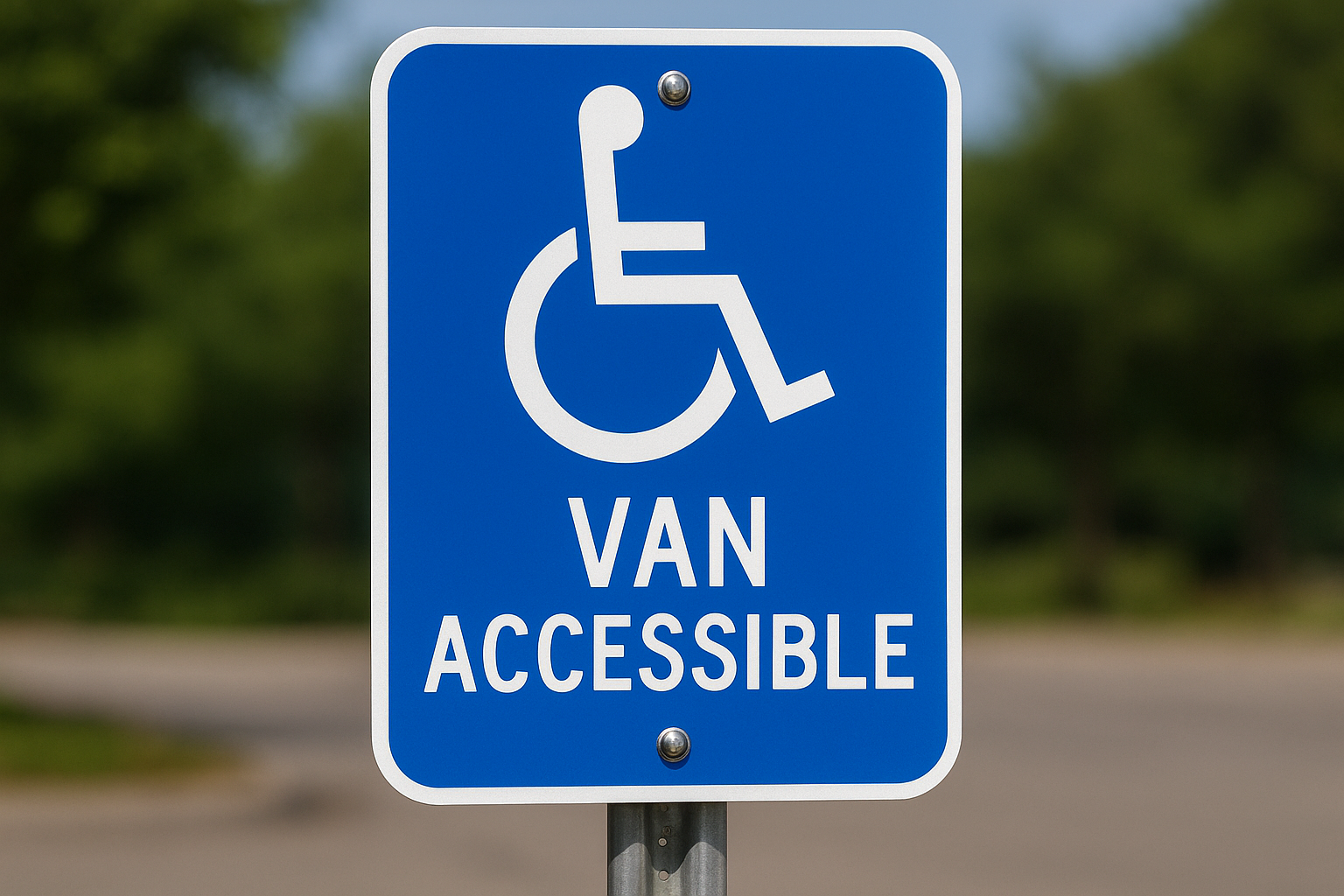
    Van-accessible ADA parking sign in Texas mounted at correct 60-inch height with International Symbol of Accessibility

    Correct van-accessible ADA signage mounted at the required 60-inch minimum height with the International Symbol of Accessibility.

    Van-Accessible Signage Requirements

    Van-accessible spaces need an additional sign reading “Van Accessible” mounted directly below the main ISA sign. This separate placard — not simply text added to the existing sign — is required by both federal ADA standards and TAS.

    Texas Fine-Amount Notice Requirement

    Texas state law adds an extra signage obligation that goes beyond federal requirements. Signs near accessible spaces must display the fine amount for illegal parking — currently ranging from $500 to $1,250 for a first offense under Texas Transportation Code §681.011. Many property owners overlook this state-specific rule entirely, which creates a separate, citable violation independent of the federal ADA sign requirements.

    Pavement Symbol Marking

    In addition to vertical signs, the International Symbol of Accessibility should be painted on the pavement surface of each accessible space. While the ADA primarily mandates vertical signage, TAS and most Texas local jurisdictions also require or strongly recommend the pavement ISA symbol. Painting it in white or blue on the asphalt provides a redundant visual cue and demonstrates a good-faith commitment to compliance.


    Location Requirements: Where Must Accessible Spaces Be Placed?

    Having the correct number of accessible spaces means nothing if they are placed incorrectly. Both the ADA and TAS require accessible parking spaces to be located on the shortest accessible route to the building entrance or facility they serve. This route must be accessible — meaning it must connect via a curb ramp, level walkway, or other compliant path rather than forcing users to cross traffic lanes.

    Multiple Entrances and Dispersed Spaces

    When a facility has multiple accessible entrances, accessible parking spaces must be dispersed among those entrances. You cannot cluster all accessible spaces near one entrance when other entrances are also accessible and regularly used. Similarly, if a parking structure serves multiple buildings, accessible spaces must be distributed to serve each building proportionally.

    Passenger Loading Zones

    When a facility provides a passenger loading zone — a designated drop-off area — at least one must be ADA-compliant. Compliant loading zones require an access aisle at least 60 inches wide and 20 feet long adjacent to the vehicle pull-up space. Furthermore, the vehicle pull-up area must have at least 114 inches of vertical clearance to accommodate high-roof vans. Many Texas facilities overlook loading zone requirements entirely, even when they carefully comply with parking space rules.


    Texas Accessibility Standards (TAS) vs. Federal ADA: Key Differences

    Texas enforces its own Texas Accessibility Standards through the TDLR for most new construction and renovation projects. While TAS closely mirrors the federal ADA Standards for Accessible Design, several important differences affect how Texas property owners must approach compliance.

    • Plan Review Requirement: Under TAS, projects meeting certain cost thresholds must have plans reviewed and approved by a registered accessibility specialist before construction begins. The federal ADA does not impose a pre-construction review mandate.
    • Inspection Requirement: TAS also requires post-construction inspection by a TDLR-registered accessibility specialist to confirm that the built project matches the approved plans. Federal ADA enforcement is complaint-driven and reactive; TAS enforcement is proactive.
    • Cost Thresholds: Projects with a construction cost exceeding $50,000 generally trigger TAS plan review and inspection requirements. Smaller projects may be exempt, but it is the owner’s responsibility to determine applicability.
    • TDLR Registration: Accessibility specialists who perform TAS reviews in Texas must be registered with the TDLR. Engaging an unregistered consultant does not satisfy the TAS requirement — even if that consultant is technically knowledgeable.

    In contrast, existing lots not undergoing renovation are primarily governed by the federal barrier removal obligation under Title III. However, because TAS enforcement is active and serial ADA litigation is common in Texas, proactive compliance is always the safer and more cost-effective path.

    For more detail on TAS requirements, the TDLR Architectural Barriers Program publishes current forms, fee schedules, and registered specialist directories on its official website.


    Accessible Route from Parking to Building Entrance

    Accessible parking spaces are only one part of the picture. The path from those spaces to your building entrance must itself be fully accessible. Specifically, the accessible route must:

    • Be at least 36 inches wide (60 inches preferred at turn areas)
    • Have a running slope no greater than 1:20 (5%) and a cross slope no greater than 1:48 (2%)
    • Include curb ramps wherever the route crosses a curb — with detectable warning surfaces (truncated dome tiles) at transitions
    • Have a stable, firm, and slip-resistant surface free of gaps, cracks, or level changes greater than ½ inch
    • Not pass through a space used for parking or vehicle maneuvering

    Many Texas properties correctly stripe their accessible spaces but then route wheelchair users across uneven concrete, through a landscaped area, or around a vehicle travel lane — all of which constitute separate ADA violations. Therefore, the accessible route must be evaluated alongside the parking spaces as one integrated system.


    6 Steps to Bring Your Texas Parking Lot Into Full Compliance

    Achieving full ADA parking lot compliance in Texas is entirely manageable when approached in a systematic order. Follow these six steps to address the most common deficiencies efficiently: For a deeper walkthrough, see our ADA Compliance Markings – Stripes Parking Lot Servies, Inc..

    1. Count your total spaces and calculate the required number of accessible spaces. Use the ADA ratio table above to determine the minimum count. Confirm whether your facility type — such as a medical office — triggers a higher ratio. Document the calculation for your records.
    2. Select and verify compliant locations. Position accessible spaces on the shortest accessible route to the building entrance, prioritizing spots that avoid routes crossing active traffic lanes. For facilities with multiple accessible entrances, distribute spaces proportionally among them.
    3. Measure dimensions and surface slope precisely. Use a tape measure to confirm each space and aisle meets minimum width requirements. Use a digital slope meter or level to verify the surface grade does not exceed 2% in any direction — including diagonal measurements. Do not rely on visual estimation alone.
    4. Evaluate and clear the accessible route. Walk the full path from each accessible space to the building entrance. Look for curb ramp presence and condition, surface gaps or cracks, cross-slope issues, and any obstructions. Address deficiencies before restriping — otherwise you risk creating a compliant space attached to a non-compliant route.
    5. Apply professional parking lot striping. Engage a qualified parking lot striping contractor — such as Stripes PLS — to paint accessible space markings, access aisle diagonal hash lines, and the ISA pavement symbol using durable, high-visibility paint that meets Texas heat and UV conditions. For a deeper walkthrough, see our Asphalt Striping: Guide to Parking Lot Line Marking.
    6. Install and verify all required signage. Mount the ISA sign at a minimum of 60 inches above grade. Add a “Van Accessible” placard below the ISA sign on qualifying spaces. Confirm that fine-amount notices required by Texas law are posted. Photograph all installed signs as documentation of compliance.

    Common ADA Compliance Mistakes Texas Property Owners Make

    Even well-intentioned property owners repeatedly fall into the same compliance traps. Knowing the most common mistakes in advance makes them far easier to avoid.

    Faded accessible parking markings in a Texas parking lot illustrating common ADA parking lot compliance failures

    Faded pavement markings are among the most frequently cited ADA compliance deficiencies in Texas parking lots. For a deeper walkthrough, see our Accessible Parking Marking: ADA Compliance Guide for Lots.

    • Incorrect space placement: Many lots have the correct number of accessible spaces but position them far from the entrance — a direct violation of proximity requirements. The accessible space closest to the entrance must always be designated accessible, not the one that is simply most convenient to stripe.
    • Faded striping: Texas sun and UV exposure degrade paint quickly. Faded access aisle hash lines and ISA symbols are among the most cited deficiencies during inspections. Repainting every one to two years is a practical necessity, not optional maintenance.
    • Missing or incorrect van-accessible spaces: Many lots lack a proper van-accessible space entirely. Others have one that doesn’t meet the 98-inch overhead clearance requirement on the vehicle approach route — a particularly common problem in covered parking structures.
    • Blocked access aisles: Shopping cart corrals, seasonal displays, delivery pallets, landscaping planters, and utility equipment placed in access aisles create an immediate compliance failure — even when the parking space itself is correctly marked and dimensioned.
    • Missing Texas fine-amount signage: Omitting the state-required fine-amount notice is a distinct, separately citable violation under Texas Transportation Code — one that federal ADA rules alone do not address.
    • Non-compliant accessible routes: Correct parking space striping is meaningless if the route to the entrance crosses traffic, lacks a curb ramp, or has surface defects. Inspectors and ADA plaintiffs evaluate the entire accessible path — not just the painted spaces. For a deeper walkthrough, see our Curb Painting – Stripes Parking Lot Servies, Inc..

    Addressing these issues proactively — with a professional striping service that understands both federal and TAS requirements — is far less expensive than defending an ADA lawsuit. In Texas, demand letters from serial ADA plaintiffs often arrive without prior warning, making preventive compliance the only reliable protection.


    Enforcement, Penalties, and Litigation Risk in Texas

    Understanding who enforces ADA parking lot compliance in Texas — and what the consequences are — is essential for every property owner and manager. For a deeper walkthrough, see our customized parking solutions.

    Federal Enforcement: DOJ and Private Lawsuits

    The U.S. Department of Justice enforces federal ADA requirements and can bring civil actions against non-compliant businesses. More commonly, however, enforcement comes from private lawsuits filed under Title III. Private plaintiffs can seek injunctive relief (a court order to fix the violations) and attorney’s fees. Because plaintiffs can recover legal costs, ADA litigation is financially attractive for plaintiff’s attorneys — particularly in Texas, which has a well-documented pattern of serial ADA filings.

    TDLR Enforcement of TAS

    The TDLR enforces TAS for new construction and renovation projects through its Architectural Barriers Program. Violations discovered during or after plan review can result in required design changes, construction delays, and administrative penalties. Additionally, the TDLR can receive and investigate complaints from members of the public about existing barriers — making ongoing compliance equally important after construction.

    Parking Violation Fines for Unauthorized Parking

    Local law enforcement handles citations for unauthorized parking in accessible spaces. Under Texas Transportation Code §681.011, first-offense fines range from $500 to $1,250. Subsequent violations carry higher penalties. Property owners are not fined for unauthorized drivers parking in their accessible spaces — but they are responsible for ensuring those spaces are correctly marked and signed to support citation and enforcement.


    Why Ongoing Maintenance Is Part of ADA Compliance

    Compliance is not a one-time event. In Texas, the combination of intense UV radiation, extreme heat, freeze-thaw cycles in northern regions, and heavy vehicle traffic degrades pavement markings faster than in most other states. A parking lot that passes inspection today can develop citable deficiencies within 18 months without proper maintenance.

    A practical maintenance schedule should include:

    • Annual visual inspection of all accessible space markings, access aisle striping, ISA pavement symbols, and signage condition For a deeper walkthrough, see our asphalt striping services.
    • Repainting every 1 to 2 years in high-UV Texas environments, or sooner if markings become faded or unclear
    • Slope re-verification after any pavement resurfacing or patching that could alter surface grade
    • Sign replacement whenever panels are damaged, faded, or obscured by vegetation growth
    • Accessible route inspection to identify new surface cracks, settlement, or obstructions that may have developed since the last review

    Working with a professional parking lot striping company — such as Stripes PLS — that understands both federal ADA requirements and Texas-specific TAS rules ensures your markings meet current standards every time. Proactive maintenance is consistently cheaper than reactive litigation. For a deeper walkthrough, see our commercial parking lot maintenance.


    ADA Compliance for Parking Lots: New Construction vs. Existing Facilities

    The compliance obligations differ somewhat depending on whether your facility is newly constructed, undergoing renovation, or simply an existing property with no current construction activity.

    New Construction

    New construction must be fully compliant with both federal ADA standards and TAS from the outset. There is no “phase-in” period and no cost-based exception. Full plan review and inspection by a TDLR-registered specialist is required for projects above the applicable cost threshold.

    Alterations and Renovations

    When a parking lot is altered — including resurfacing, restriping, or reconfiguring spaces — the altered areas must be brought into full compliance. Furthermore, the ADA’s “path of travel” obligation means that alterations to the lot may also trigger a requirement to upgrade the accessible route to the building entrance, even if you are not directly touching that route. As a result, renovation budgets should always include an accessible route evaluation component.

    Existing Facilities Without Current Renovation

    Existing facilities that are not currently under construction must still remove accessibility barriers when doing so is “readily achievable” — that is, when removal can be accomplished without much difficulty or expense. The ADA provides no blanket exemption for older lots. Specifically, restriping faded markings, installing a missing curb ramp, or correcting signage height are all generally considered readily achievable — and therefore required.


    Conclusion: ADA Parking Lot Compliance in Texas Is an Ongoing Responsibility

    ADA parking lot compliance Texas requires sustained attention to space count, dimensions, slope, access aisles, accessible routes, signage, and regular maintenance. The stakes for getting it wrong are significant — federal lawsuits, TDLR enforcement actions, construction delays, and reputational damage are all real risks for non-compliant facilities. However, full compliance is entirely achievable with the right knowledge, a systematic approach, and a qualified striping contractor who understands both federal ADA standards and the Texas-specific TAS requirements that apply to your property.

    Start with a thorough audit of your current lot, address deficiencies in the order outlined above, and schedule annual maintenance to keep your accessible parking spaces safe, visible, and legally sound for every visitor. Proactive compliance is always less expensive than reactive litigation — and it demonstrates a genuine commitment to making your facility welcoming for everyone.


    Frequently Asked Questions About ADA Parking Lot Compliance Texas

    What is ADA parking lot compliance in Texas?

    ADA parking lot compliance in Texas means satisfying both the federal ADA Standards for Accessible Design and the state’s Texas Accessibility Standards for accessible spaces, signage, surface slopes, access aisles, and accessible routes. Both frameworks apply to most commercial and public parking facilities in the state, with TAS adding plan review and inspection requirements for qualifying construction projects.

    How many accessible parking spaces are required in a Texas lot?

    The required number scales with lot size. A lot with 1 to 25 spaces needs at least 1 accessible space; 26 to 50 spaces requires 2; and the ratio continues upward. At least 1 in every 6 accessible spaces must be van-accessible. Outpatient medical facilities must designate 10% of total spaces as accessible.

    What is the minimum width for an ADA parking space in Texas?

    Standard accessible spaces must be at least 8 feet wide with a 5-foot access aisle. Van-accessible spaces need either an 11-foot space with a 5-foot aisle, or an 8-foot space with an 8-foot aisle to accommodate wheelchair lift deployment.

    Are van-accessible spaces required in every Texas parking lot?

    Yes. At least one in every six accessible spaces must be van-accessible and must provide at least 98 inches of overhead clearance on the vehicle route leading to the space. This requirement applies to surface lots, structured garages, and covered parking facilities alike.

    What slope is allowed for accessible parking spaces in Texas?

    The maximum allowable slope is 1:48 — approximately 2% — in any direction for both the parking space and its access aisle. Steeper slopes create safety hazards for wheelchair users and constitute a compliance violation that must be corrected through regrading.

    What signage is required for accessible parking spaces in Texas?

    Each space must have a sign bearing the International Symbol of Accessibility mounted at least 60 inches above grade. Van-accessible spaces require an additional “Van Accessible” sign below the ISA sign. Texas law also requires fine-amount notices ($500 to $1,250 for a first offense) to be posted near accessible spaces — a state-specific requirement beyond federal ADA rules.

    What fines apply for illegal parking in accessible spaces in Texas?

    Under Texas Transportation Code §681.011, drivers who illegally park in an accessible space face fines from $500 to $1,250 for a first offense, with higher penalties for subsequent violations. Business owners with non-compliant lots separately risk federal civil lawsuits and injunctive relief under Title III of the ADA.

    Does Texas have its own accessibility standards beyond the federal ADA?

    Yes. The Texas Accessibility Standards, enforced by the TDLR, apply to most new construction and renovations. TAS mirrors federal ADA standards but adds mandatory pre-construction plan review and post-construction inspection by a TDLR-registered accessibility specialist for projects above certain cost thresholds.

    How often should accessible parking striping be repainted in Texas?

    There is no fixed legal interval, but best practice in Texas is to repaint every one to two years given intense UV exposure and heat. Faded access aisle hash lines and ISA pavement symbols are among the most frequently cited compliance deficiencies during inspections and in ADA demand letters.

    Can a Texas business be sued for non-compliant accessible parking?

    Yes. Under Title III of the ADA, individuals can file federal lawsuits seeking injunctive relief and attorney’s fees. Texas has a well-documented pattern of serial ADA litigation targeting parking lot deficiencies. Demand letters often arrive without warning, making proactive compliance the most reliable protection.

    What is an access aisle and why is it required for ADA compliance?

    An access aisle is a marked, level zone beside an accessible parking space that allows wheelchair users to safely exit and enter their vehicle without being blocked by adjacent parked cars. Without a correctly sized and clearly marked access aisle — free of obstructions — the parking space does not meet ADA or TAS compliance standards.

    Who enforces ADA parking lot compliance in Texas?

    The U.S. Department of Justice enforces federal ADA requirements and can bring civil actions against violators. The TDLR enforces TAS through its Architectural Barriers Program for new construction and renovations. Local law enforcement handles accessible parking violation citations under Texas Transportation Code.

    Do churches and nonprofits need ADA-compliant parking in Texas?

    Religious organizations are largely exempt from Title III of the ADA. However, private nonprofits without a religious affiliation must comply. Additionally, Texas state building codes and TAS may still apply to construction and renovation work at religious facilities regardless of federal exemption status.

    Does restriping a parking lot trigger ADA compliance requirements in Texas?

    Yes. Restriping — even without structural changes — is considered an alteration under ADA and TAS rules. Therefore, the restriped areas must be brought into full compliance. Additionally, the “path of travel” obligation may require upgrading the accessible route to the building entrance as part of the same project.

  • Why Fresh Parking Lot Striping Matters for Your Property

    Parking lot striping is one of the most cost-effective investments a commercial property owner can make. Clear, professional pavement markings improve safety, maximize usable space, and create the kind of organized first impression that builds trust before a customer ever steps inside. Whether you manage a shopping center, office complex, warehouse, or medical facility, the condition of your parking lot speaks volumes about your property.

    In this complete guide, we cover everything you need to know — from how parking lot striping works and when to schedule it, to layout planning, paint types, ADA compliance requirements, and how to choose the right professional striping contractor.

    Quick Navigation: Use the headings below to jump to the section most relevant to your property. This guide covers the full scope of commercial parking lot striping — from basics to compliance.


    What Is Parking Lot Striping and Why Does It Matter?

    Parking lot striping refers to the process of applying painted lines, symbols, and markings to a paved surface to organize vehicle flow, define parking spaces, and communicate safety rules. Furthermore, it encompasses everything from standard stall lines and directional arrows to fire lane markings, ADA-compliant accessible spaces, and pedestrian crosswalks.

    Most people overlook pavement markings until they fade. However, faded lines lead directly to driver confusion, inefficient use of space, liability exposure, and code violations. In contrast, a freshly striped lot communicates professionalism, reduces accidents, and helps your property operate at peak efficiency every single day.

    The Business Case for Professional Striping

    Specifically, well-executed parking lot striping delivers measurable benefits for commercial properties of every size:

    • Improved curb appeal — clean lines signal a well-maintained, professional property
    • Safer traffic flow — directional arrows and designated lanes reduce conflicts between vehicles and pedestrians
    • Maximum space efficiency — a properly designed layout captures every usable stall
    • ADA compliance — correctly marked accessible spaces protect you from fines and lawsuits
    • Fire code adherence — visible fire lanes keep emergency access open and your property code-compliant
    • Liability reduction — clear markings help establish reasonable standards of care if an accident occurs

    According to the National Safety Council, parking lot accidents account for thousands of injuries each year in the United States. Therefore, clear and consistent pavement markings are not a cosmetic luxury — they are a fundamental safety measure.


    Types of Parking Lot Striping and Pavement Markings

    Not all parking lot markings serve the same purpose. In addition, different marking types carry specific regulatory requirements depending on your property type and local codes. Here is a breakdown of the most common categories:

    Standard Parking Stall Lines

    Standard stall lines define individual parking spaces. Typically, a standard parking space measures 8.5 to 9 feet wide and 18 to 20 feet deep, though dimensions vary by local code. Angled stalls (45° or 60°) are common in one-way traffic aisles, while 90° perpendicular stalls work best in two-way traffic layouts. Proper stall sizing prevents door-ding damage and keeps traffic moving efficiently.

    ADA Accessible Parking Space Markings

    ADA-compliant accessible spaces require specific dimensions, signage, and access aisles as defined by the Americans with Disabilities Act (ADA) Design Standards. Specifically, a standard accessible space must be at least 8 feet wide with a 5-foot adjacent access aisle. Van-accessible spaces require an 8-foot access aisle. Furthermore, the number of required accessible spaces is proportional to the total number of stalls in your lot. Non-compliance can result in significant fines from federal or local enforcement agencies.

    Fire Lane Markings

    Fire lanes must remain clear at all times for emergency vehicle access. As a result, they are typically painted red with “FIRE LANE – NO PARKING” text stenciled along the curb or pavement surface. Most municipalities require fire lane striping to meet specific width and placement requirements. Faded fire lane markings are a common code violation that property owners often discover during fire marshal inspections.

    Directional Arrows and Traffic Flow Markings

    Directional arrows guide drivers through your lot safely, particularly in one-way traffic aisles or complex multi-entrance layouts. In addition, “STOP” stencils, yield markings, and speed bump notifications all contribute to a well-organized traffic flow pattern that reduces accidents and improves the visitor experience.

    Pedestrian Crosswalks and Safety Zones

    Crosswalk striping clearly delineates safe paths for pedestrians moving between their vehicles and building entrances. Consequently, well-marked crosswalks significantly reduce the risk of pedestrian-vehicle conflicts. Safety hatching (diagonal lines within restricted zones) and curb markings further reinforce boundaries that keep both drivers and pedestrians safe.

    Loading Zones, Reserved Spaces, and Specialty Markings

    Loading docks, delivery zones, reserved employee spaces, visitor parking, EV charging station bays, and no-parking curb markings are all specialty striping categories. Similarly, stenciled text like “RESERVED,” “COMPACT,” “NO PARKING,” or tenant names help manage lot usage and reduce unauthorized parking disputes.


    Parking Lot Striping Paint: Which Type Is Right for Your Lot?

    The paint or coating material used for parking lot striping has a direct impact on durability, visibility, and long-term cost. There are three primary options used in commercial applications:

    Water-Based Latex Paint

    Water-based latex is the most widely used parking lot striping paint in the United States. It dries quickly (typically within 30 minutes), produces low VOC (volatile organic compound) emissions, and is easy to apply with standard line-striping equipment. However, it has a shorter lifespan than other options — usually 1 to 2 years under heavy traffic conditions. It is best suited for moderate-traffic lots or properties that restripe on a regular schedule.

    Oil-Based Alkyd Paint

    Oil-based alkyd paint offers greater durability and a richer color saturation than latex alternatives. As a result, it is commonly used for high-traffic commercial and industrial lots. The trade-off is longer dry time and higher VOC content, which means it may be restricted or require permits in certain jurisdictions. In addition, it typically costs more per gallon than water-based products.

    Thermoplastic Pavement Markings

    Thermoplastic is a hot-applied material that melts onto the pavement surface and bonds much more permanently than paint. Consequently, it is the most durable option available — lasting 5 to 7 years or longer even under heavy traffic. Furthermore, thermoplastic can incorporate glass beads for retroreflectivity (enhanced nighttime visibility). It is the preferred choice for crosswalks, fire lane markings, and high-wear areas. The upfront cost is higher, but the long lifespan often makes it more economical over time.

    Pro Tip: In high-heat climates like Texas, water-based latex paint can degrade faster due to UV exposure and extreme surface temperatures. Ask your striping contractor about paint formulations specifically rated for hot-climate performance.


    When to Schedule Parking Lot Striping or Restriping

    Knowing when to restripe is just as important as knowing how it is done. Several conditions signal that your parking lot markings need attention:

    • Lines are faded, cracked, or barely visible from a standing position
    • Directional arrows and stenciled text have worn away
    • You have recently had the lot seal coated or repaved
    • Your ADA-accessible space count or layout no longer meets current code requirements
    • You are reconfiguring the lot layout to add spaces or improve traffic flow
    • Fire lane markings are faded and have triggered inspection concerns
    • You have received complaints from tenants, customers, or delivery drivers about confusion in the lot

    How Often Should a Parking Lot Be Restriped?

    For most commercial lots with standard latex paint, restriping every 1 to 2 years is a reasonable maintenance cycle. High-traffic lots — such as grocery store parking lots, shopping malls, or busy office complexes — may need restriping annually or even more frequently. In contrast, thermoplastic markings can last 5 to 7 years before requiring replacement. Therefore, matching the paint type to your traffic volume is critical for long-term cost efficiency.

    In Texas specifically, the intense summer heat and UV radiation accelerate paint degradation. As a result, many Texas commercial property owners find that annual restriping keeps their lots looking sharp and code-compliant year-round.


    Parking Lot Layout Design and Space Planning

    Effective parking lot striping starts with thoughtful layout design. A poorly designed layout wastes usable space, creates traffic bottlenecks, and frustrates visitors. Conversely, a well-planned layout maximizes every square foot and makes navigation intuitive.

    Key Layout Factors to Consider

    • Stall angle: 90° stalls maximize density; 45° and 60° angled stalls improve flow in one-way aisles
    • Aisle width: Standard two-way aisles should be 24 feet wide; one-way aisles typically require 12 to 18 feet
    • Entry and exit placement: Entrances and exits should align with natural traffic patterns to minimize conflicts
    • Pedestrian pathways: Safe walking routes from parking to building entry should be clearly marked and unobstructed
    • ADA space placement: Accessible spaces must be located on the shortest accessible route to building entrances
    • Reserved and specialty zones: Loading docks, EV charging stations, and reserved areas should be positioned to minimize interference with general parking

    In many cases, a professional parking lot striping contractor will assess your lot dimensions and help you develop a layout that adds stalls, improves flow, and meets all applicable codes — all before a single line is painted.


    ADA Compliance and Parking Lot Striping: What You Must Know

    ADA compliance is not optional. The Americans with Disabilities Act establishes legally binding requirements for accessible parking spaces at any commercial facility open to the public. Failing to meet these requirements can expose your property to federal complaints, lawsuits, and mandatory remediation costs.

    ADA Accessible Space Requirements at a Glance

    • 1 to 25 total spaces: 1 accessible space required
    • 26 to 50 total spaces: 2 accessible spaces required
    • 51 to 75 total spaces: 3 accessible spaces required
    • 76 to 100 total spaces: 4 accessible spaces required
    • 101 to 150 total spaces: 5 accessible spaces required
    • For every 6 accessible spaces required, at least 1 must be van-accessible

    Additionally, accessible spaces must be marked with the International Symbol of Accessibility (ISA) — the familiar blue wheelchair symbol — both on the pavement surface and on a vertical sign posted at the front of the space. The access aisle must be marked with diagonal striping and labeled “NO PARKING.” These requirements are non-negotiable and are enforced independently of local building codes.


    The Parking Lot Striping Process: Step by Step

    Understanding the striping process helps you plan effectively and set realistic expectations. Professional parking lot striping typically follows a clear sequence of steps:

    1. Site Assessment and Measurement — The contractor walks the entire lot, measures dimensions, identifies existing markings, notes code requirements, and discusses layout goals with the property owner or manager.
    2. Layout Planning and Design — A scaled layout is developed showing stall placement, aisle widths, ADA space locations, traffic flow arrows, and specialty zones. This step ensures the final striping maximizes space and meets all applicable codes.
    3. Surface Cleaning and Preparation — The pavement surface is cleaned thoroughly using blowers and/or pressure washing to remove debris, dirt, and loose material. Clean surfaces are essential for paint adhesion and line sharpness.
    4. Layout Transfer and Chalk Lines — Key reference points are measured and marked on the pavement with chalk lines or paint dots to guide the striping machine precisely. This step prevents crooked or misaligned lines.
    5. Line Striping Application — A professional line striping machine applies paint in clean, consistent passes. Standard stall lines are typically applied at a 4-inch width. The operator follows the layout plan closely to maintain alignment and spacing throughout the lot.
    6. Stenciling and Specialty Markings — Directional arrows, ADA symbols, “FIRE LANE,” “STOP,” “RESERVED,” and other stenciled markings are applied by hand using pre-made stencil templates after the main line work is complete.
    7. Drying and Final Inspection — Water-based latex paint typically dries within 20 to 30 minutes under normal conditions. The crew then performs a final walk-through to check alignment, coverage, and completeness before opening the lot to traffic.

    Note on Timing: Most parking lot striping projects can be completed during off-peak hours or overnight to minimize disruption to your business operations. Coordinate with your contractor in advance to arrange a schedule that works for your tenants and customers.


    How Much Does Parking Lot Striping Cost?

    Cost is one of the most common questions property managers have about parking lot striping. Pricing varies based on several factors, but here is a general framework to help you plan your budget:

    Factors That Affect Striping Cost

    • Lot size and number of stalls: Larger lots with more stalls naturally cost more. Most contractors price by the linear foot or per stall.
    • Paint type: Thermoplastic costs more upfront than water-based latex but lasts significantly longer.
    • Scope of work: Simple restriping over existing lines costs less than a full new layout with fresh measurements and layout design.
    • Number of specialty markings: ADA symbols, fire lane stenciling, directional arrows, and custom text add to total labor time and cost.
    • Surface condition: Heavily degraded pavement may require crack filling or surface prep before striping can begin.
    • Scheduling and access: Overnight or weekend work may carry a premium depending on the contractor.

    Typical Parking Lot Striping Price Ranges

    As a general reference, here are ballpark ranges commonly cited in the industry:

    • Per stall (restripe): $2 to $5 per stall with standard latex paint
    • New layout per stall: $5 to $10 per stall including layout measurement
    • ADA space with symbol: $75 to $200 per accessible space including symbol and aisle striping
    • Fire lane striping (per linear foot): $1 to $3 per linear foot
    • Full lot restripe (small-medium lot): $500 to $2,000+ depending on size and complexity

    Always request a detailed written quote from your contractor before work begins. Specifically, ensure the quote breaks out labor, materials, stall count, and any specialty markings separately so you can compare bids accurately.


    New Lot Striping vs. Restriping: What Is the Difference?

    Property owners often ask whether their project counts as new striping or restriping. Understanding the difference helps set accurate expectations for scope, cost, and timeline.

    New striping applies to freshly paved or seal-coated lots with no existing lines, or to lots being reconfigured with a completely new layout. It requires full measurement, layout design, and careful planning. Therefore, it is the more complex and time-intensive option.

    Restriping follows existing line locations on a lot where the layout is staying the same. The contractor simply paints over faded lines to restore visibility. As a result, restriping is faster, simpler, and less expensive than a full new layout — provided the original layout was well-designed and code-compliant.

    If your original layout had flaws — awkward angles, insufficient ADA spaces, or inefficient aisle widths — restriping over old lines simply preserves those problems. In that case, a full layout redesign may be the smarter long-term investment.


    Choosing the Right Parking Lot Striping Contractor

    Not all striping contractors deliver the same quality. Furthermore, a poor striping job can create compliance issues, safety hazards, and an unprofessional appearance that reflects badly on your property. Here is what to look for when evaluating candidates:

    What to Look for in a Striping Contractor

    • Experience with commercial properties: Look for contractors who specialize in commercial parking lots, not just residential driveways.
    • Knowledge of ADA and local code requirements: Your contractor should be able to confirm ADA space counts and dimensions without you having to look them up.
    • Professional equipment: High-quality striping machines produce cleaner, more consistent lines than low-end sprayers. Ask about the equipment they use.
    • Proof of insurance: General liability and workers’ compensation coverage are non-negotiable for any contractor working on your property.
    • Portfolio of completed projects: Ask to see before-and-after photos of similar commercial properties they have striped.
    • Clear written estimates: A professional contractor provides a detailed written quote, not a verbal ballpark figure.
    • References: Ask for references from property managers or commercial clients they have worked with previously.

    In addition, confirm that the contractor will handle all required permits if your municipality requires them for pavement marking work. Some jurisdictions require traffic control plans or permit applications for work in publicly accessible lots.


    Parking Lot Striping for Different Property Types

    Different commercial property types have distinct striping needs. Consequently, a one-size-fits-all approach rarely works. Here is a look at how requirements vary by property type:

    Retail Shopping Centers

    Retail lots handle high vehicle turnover throughout the day. Therefore, they benefit from wide aisles, clearly marked crosswalks near store entrances, designated fire lanes, and a generous allocation of accessible spaces near anchor tenants. Cart return zones and loading areas also require clear delineation.

    Office Complexes and Corporate Campuses

    Office parking lots often have reserved spaces for management, visitors, or specific tenants. Furthermore, structured layouts with clear directional flow support the predictable morning and evening traffic peaks typical at office properties. EV charging station markings are increasingly common at corporate campuses.

    Industrial and Warehouse Facilities

    Industrial sites require durable markings that can withstand heavy truck traffic, forklift movement, and harsh conditions. In addition, loading dock delineation, truck apron markings, and clearly defined pedestrian safety corridors are essential for worker safety and operational efficiency at warehouses and distribution centers.

    Healthcare Facilities and Medical Offices

    Medical facilities typically require a higher ratio of ADA-accessible spaces than many other property types due to their patient demographics. Similarly, patient drop-off zones, ambulance access lanes, and emergency vehicle routes all require precise, well-maintained striping. Clarity is especially important here because visitors are often stressed and unfamiliar with the facility.


    Frequently Asked Questions About Parking Lot Striping

    How long does parking lot striping take to dry?

    Water-based latex paint used for most parking lot striping dries to the touch within 20 to 30 minutes under normal temperature and humidity conditions. However, in cooler weather or high humidity, drying can take longer. Thermoplastic markings cool and harden within minutes of application. Your contractor will advise on when the lot can safely reopen to traffic.

    Can parking lot striping be done in the rain?

    No — paint will not adhere properly to a wet pavement surface. Specifically, water-based latex requires a dry surface and ideally temperatures above 50°F for proper adhesion and curing. Most professional contractors monitor weather forecasts closely and reschedule if rain is expected. Similarly, striping should not be applied to a freshly seal-coated surface until it has fully cured (typically 24 to 48 hours minimum).

    What is the standard width of parking lot striping lines?

    Standard parking stall lines are typically 4 inches wide. However, some municipalities or property types require 6-inch lines for enhanced visibility. Fire lane lines and curb markings are often wider — sometimes 6 to 8 inches — to ensure they stand out clearly. Your contractor will confirm the correct width specifications for your location and lot type.

    Do I need a permit for parking lot striping?

    In most cases, restriping a private commercial parking lot does not require a permit. However, when changing the layout significantly — such as adding or removing spaces — or when the lot is adjacent to a public right-of-way, a permit may be required. Additionally, ADA modifications may trigger a plan review requirement in some jurisdictions. Always verify with your local building or zoning department before beginning work.

    What color paint is used for parking lot striping?

    White is the standard color for most parking stall lines, directional arrows, and pedestrian markings. Yellow is commonly used for fire lane curbs, no-parking zones, and safety warnings. Blue is reserved exclusively for ADA-accessible spaces and their access aisles. Red is used for fire lane pavement markings where required by local code. These color conventions are widely recognized and help drivers quickly interpret lot markings.

    How do I maintain my parking lot stripes between restriping cycles?

    Regular sweeping and debris removal extend the life of parking lot striping by preventing abrasion from grit and gravel. In addition, applying a quality sealcoat to the pavement every 2 to 3 years before lines become severely faded can protect both the asphalt and the markings. When sealcoating is done, plan for immediate restriping afterward since sealcoat covers all existing lines.


    Professional Parking Lot Striping Services for Commercial Properties

    At Stripes Parking Lot Services, Inc., we specialize in professional parking lot striping for commercial properties across Texas. Our team handles everything from fresh layouts on newly paved lots to routine restriping cycles, ADA compliance updates, fire lane markings, and specialty stenciling — all with the precision and durability your property deserves.

    We serve retail centers, office complexes, industrial facilities, healthcare campuses, and multi-family residential properties. Furthermore, we coordinate scheduling to minimize disruption to your operations — including after-hours and weekend availability. Every project includes a thorough site assessment, a detailed written quote, and a final inspection to make sure the work meets your expectations.

    Learn more about our complete pavement marking services or explore our parking lot maintenance resources to understand how regular striping fits into a comprehensive lot care program. You can also contact our team to schedule a free on-site estimate for your property.


    Conclusion: Get the Most From Your Parking Lot Striping Investment

    Parking lot striping is far more than a cosmetic touch-up. It is a critical component of property safety, ADA compliance, efficient space utilization, and professional appearance. Specifically, well-executed striping reduces accidents, satisfies legal requirements, maximizes your available stalls, and tells every visitor that your property is managed with care and attention to detail.

    Whether you need a complete new layout, a routine restripe, or targeted compliance updates, understanding the process — paint types, layout principles, ADA requirements, contractor selection, and cost factors — puts you in the best position to make smart decisions for your property. Above all, regular, professional parking lot striping is one of the highest-return maintenance investments available to commercial property owners. Do not wait until your lines disappear entirely — schedule your striping service before your lot starts working against you.