Category: Uncategorized

  • Parking Lot Line Painting Guide: Cost & Compliance

    Parking Lot Line Painting Guide: Cost & Compliance

    Parking Lot Line Painting Guide: Cost & Compliance

    Parking lot line painting is the process of applying durable painted markings—stall lines, ADA-compliant symbols, fire lanes, and directional arrows—onto asphalt or concrete surfaces to organize traffic flow and meet safety codes. For property owners in Denton and Plano, TX, this service protects drivers and pedestrians while keeping a facility legally compliant. In this guide, we’ll walk through the process, typical costs, and compliance requirements so you know exactly what to expect before hiring a striping crew.

    Quick Answer: Parking lot line painting involves cleaning the pavement, measuring stall layouts, and applying acrylic or thermoplastic traffic paint to create stalls, ADA markings, and fire lanes. Most commercial lots are restriped every 12 to 24 months to stay visible and code-compliant.

    What Is Parking Lot Line Painting?

    At its core, parking lot line painting is a maintenance and safety service. A crew cleans the surface, measures stall dimensions to code, and applies traffic-grade paint to define parking spaces, drive aisles, and pedestrian pathways.

    Beyond stalls, the scope often includes handicap-accessible markings, fire lane designation, curb painting, and directional arrows. As a result, a single restriping visit can address several compliance requirements at once, which is why many property managers schedule it as part of routine upkeep.
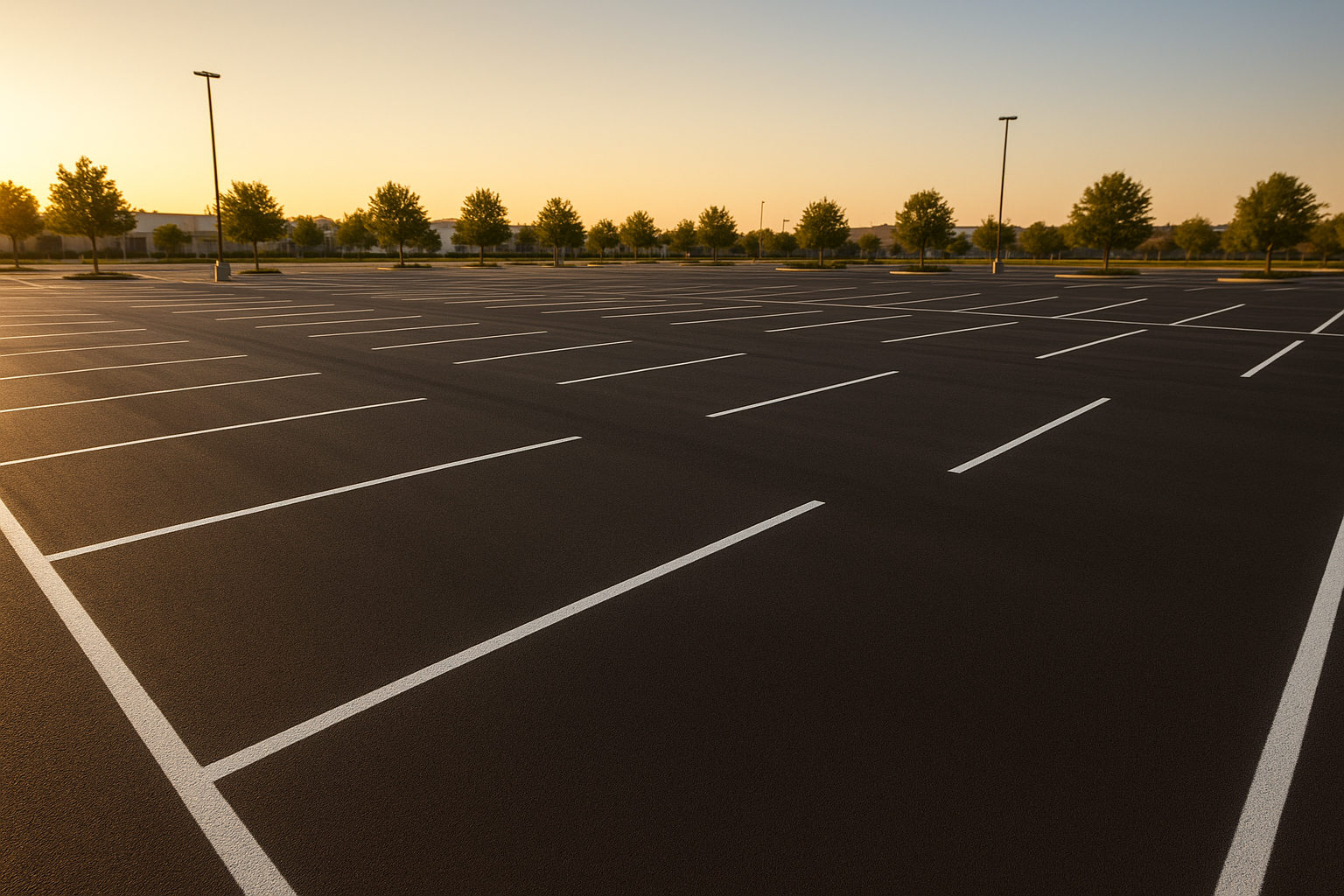
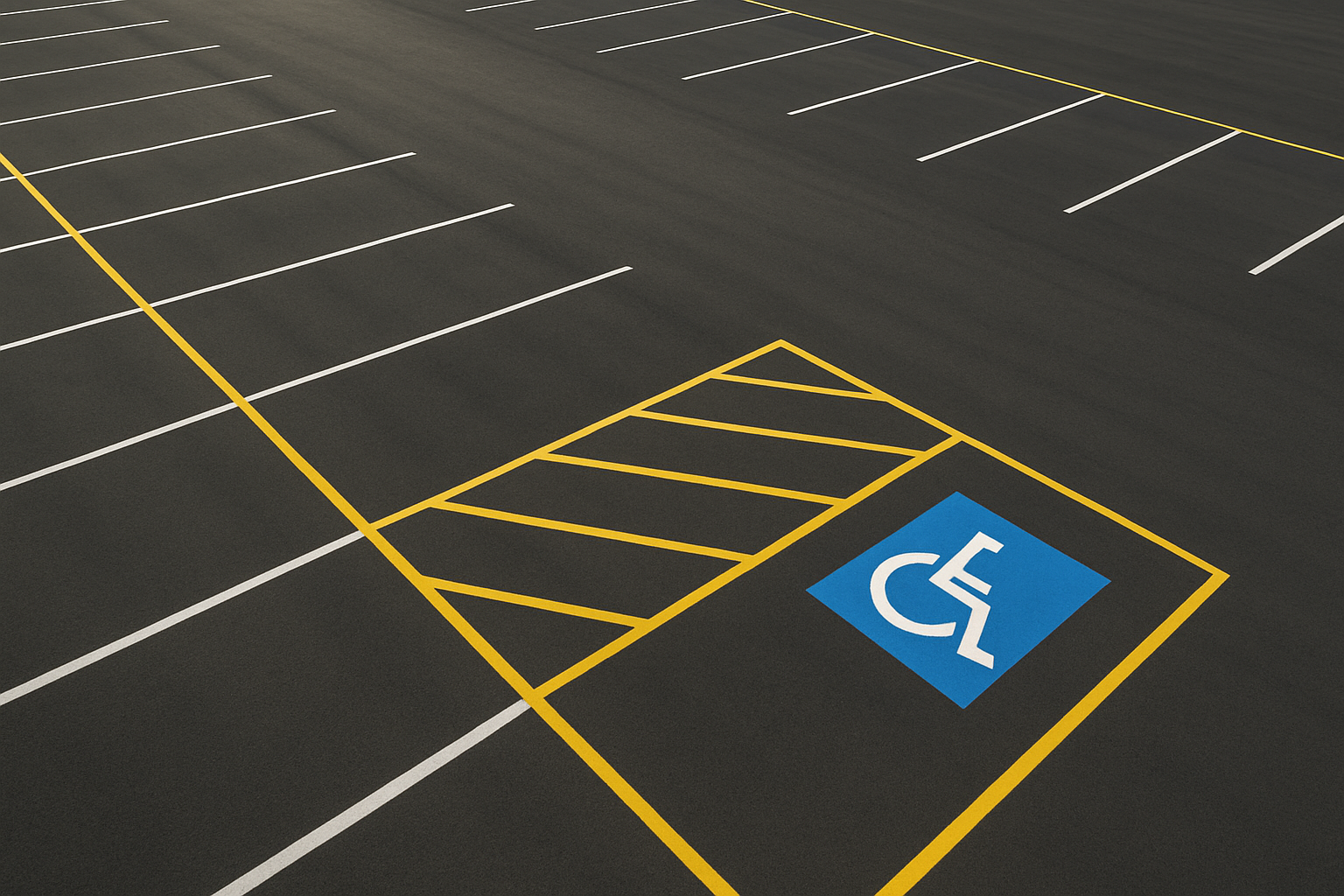
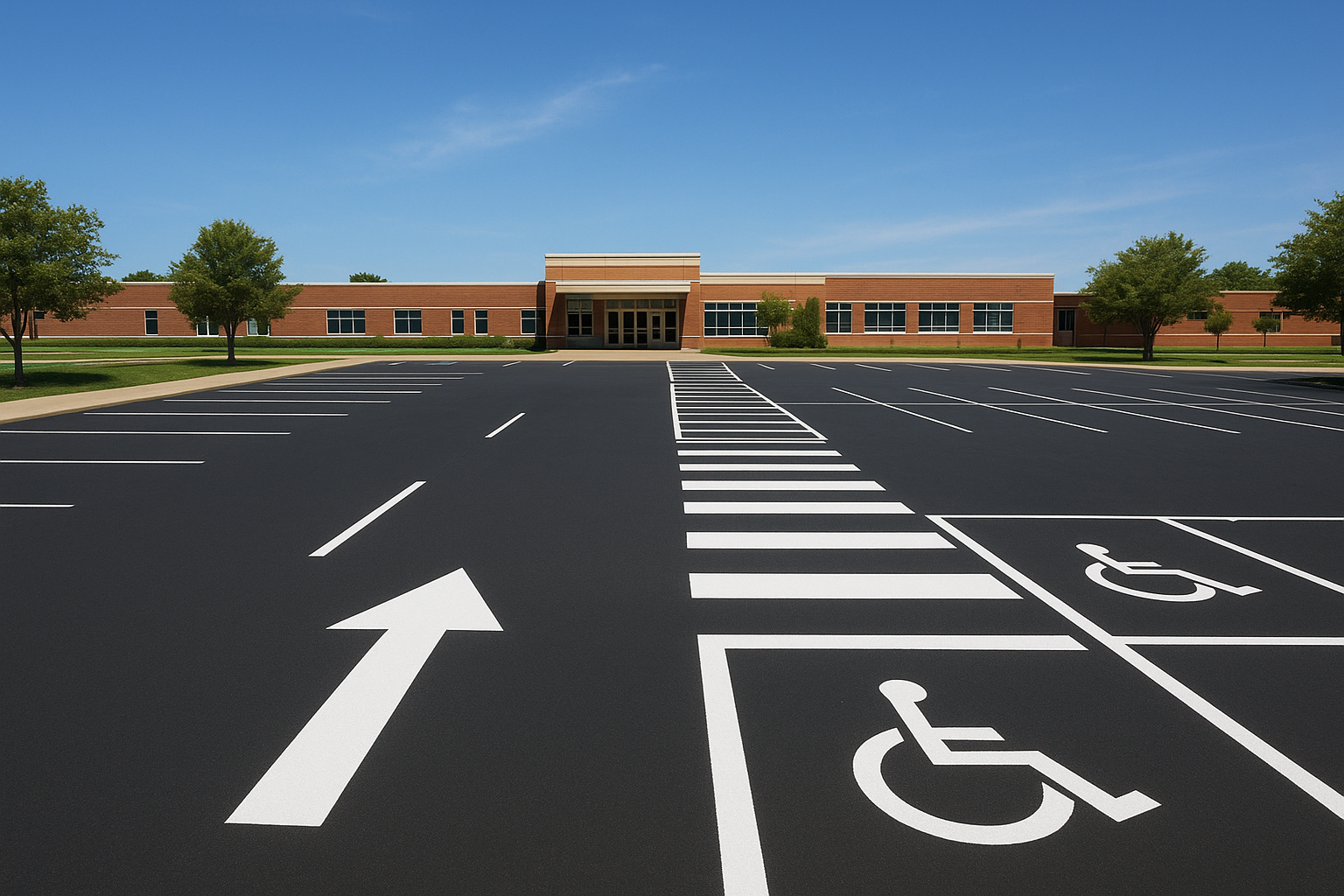
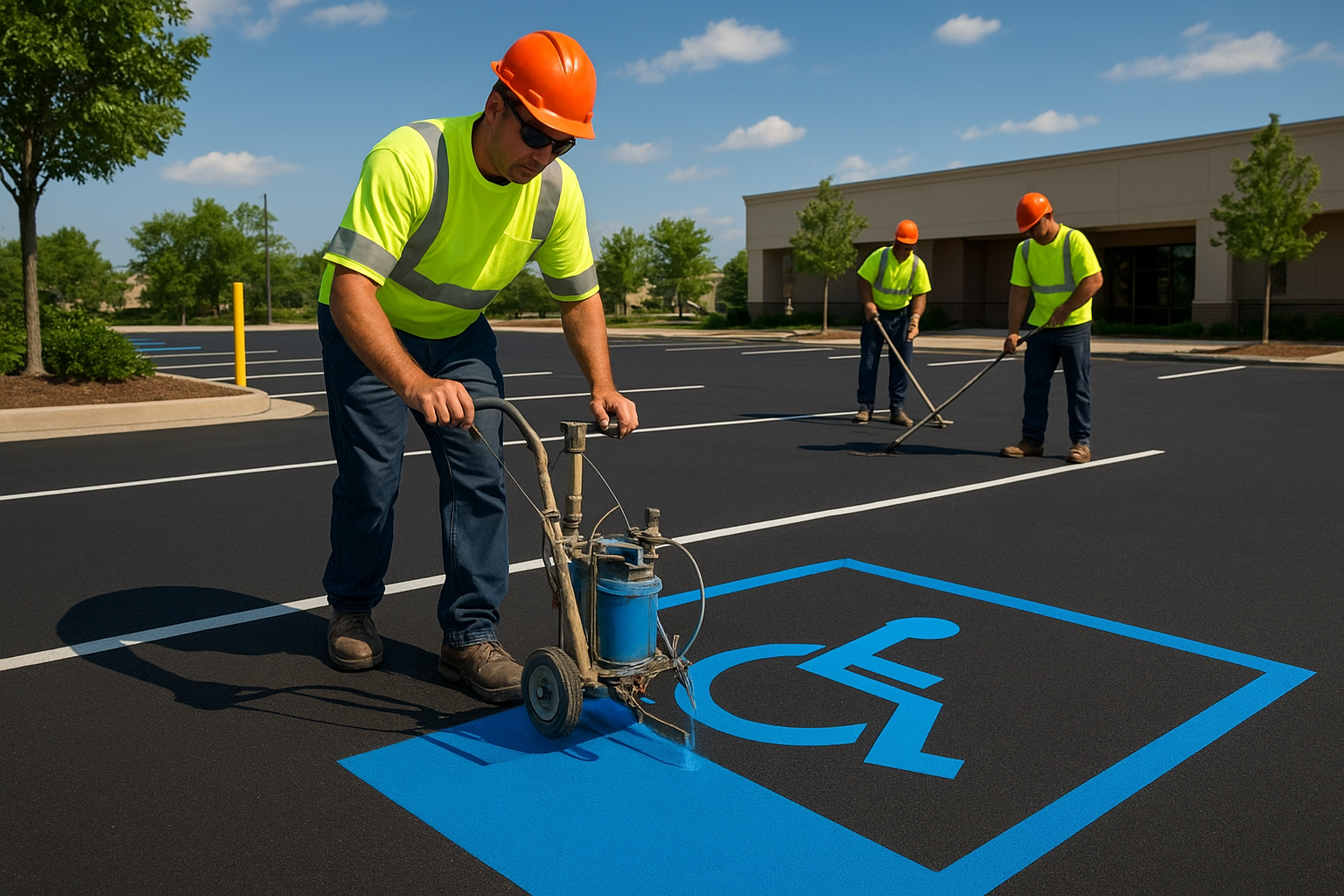
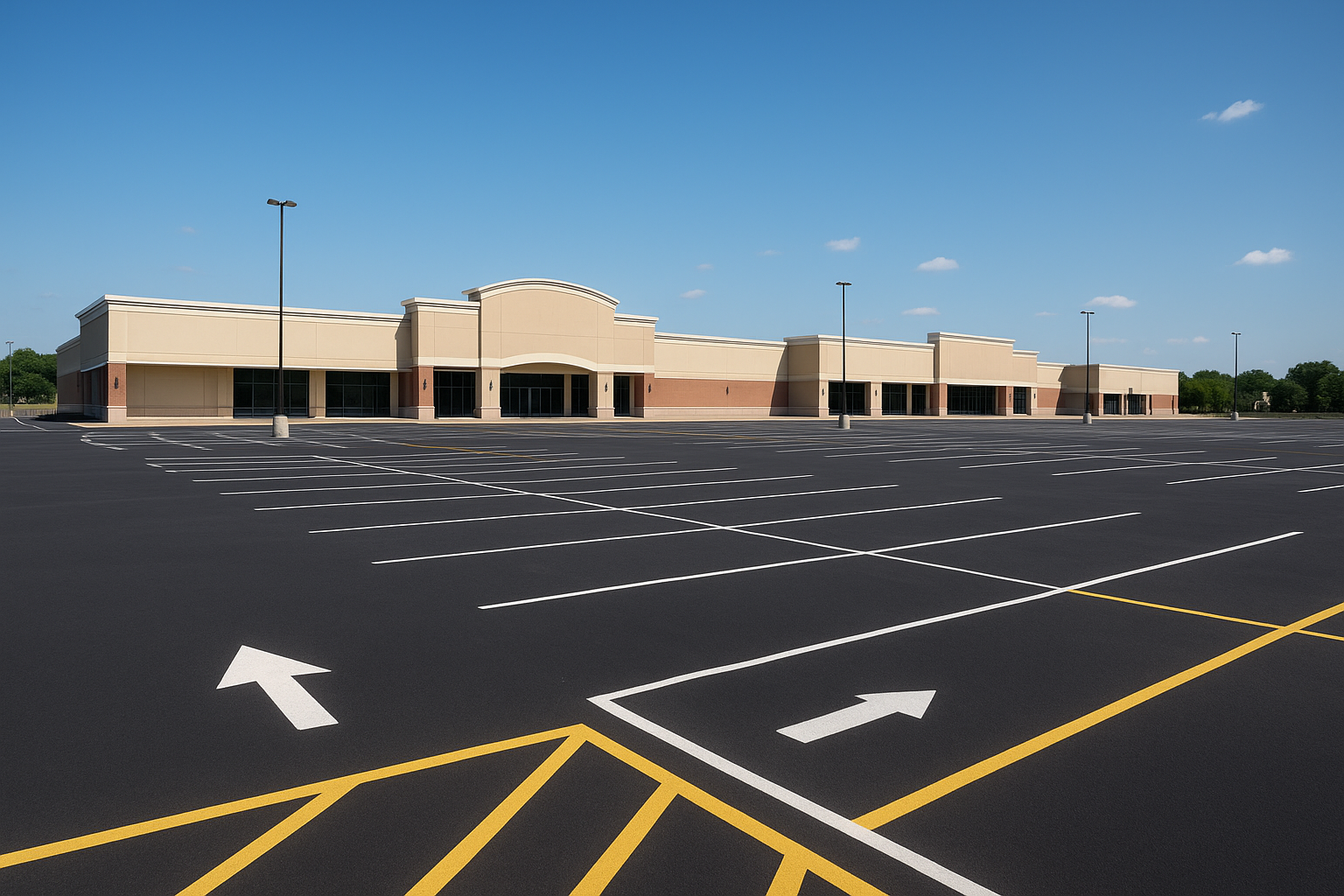
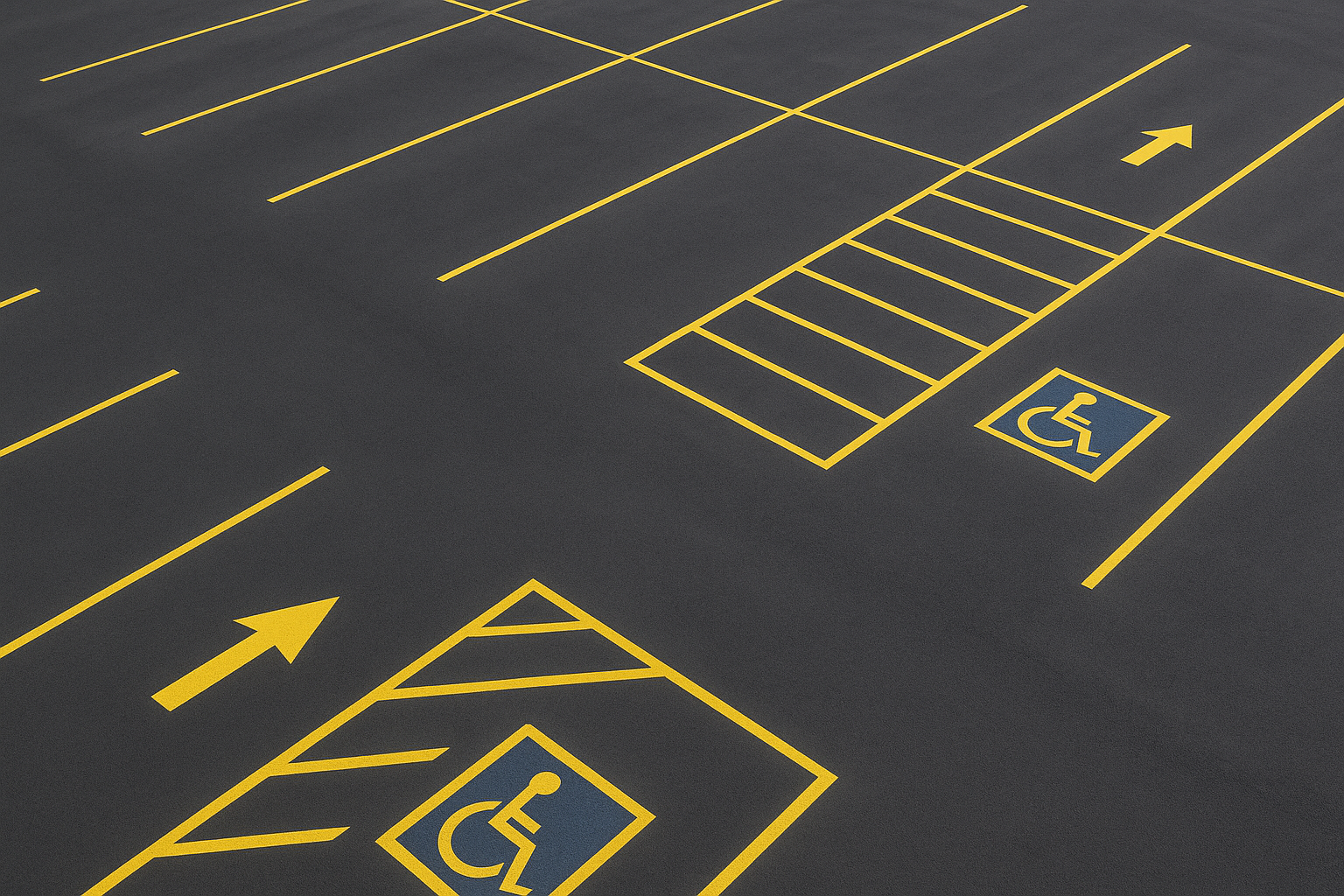
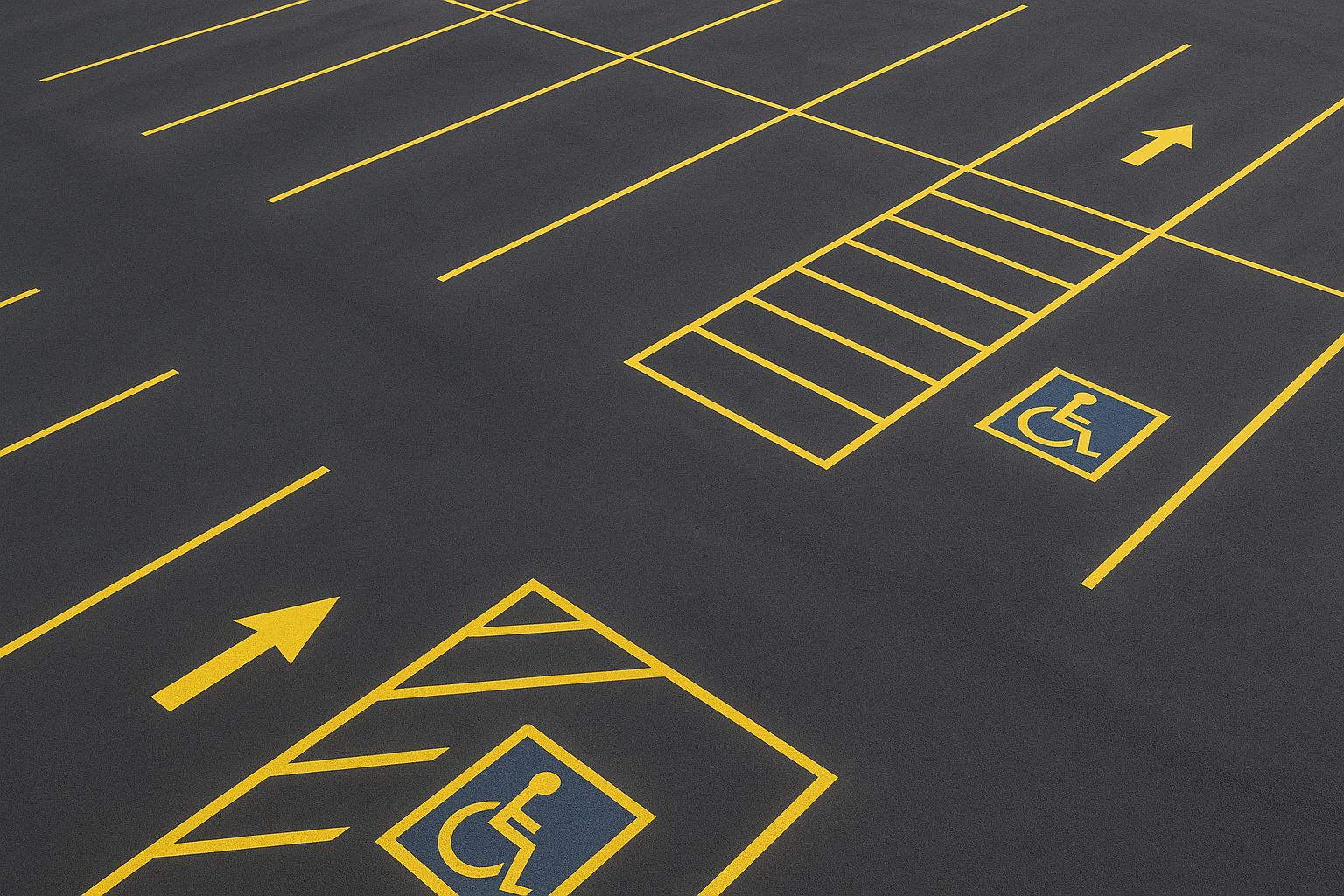
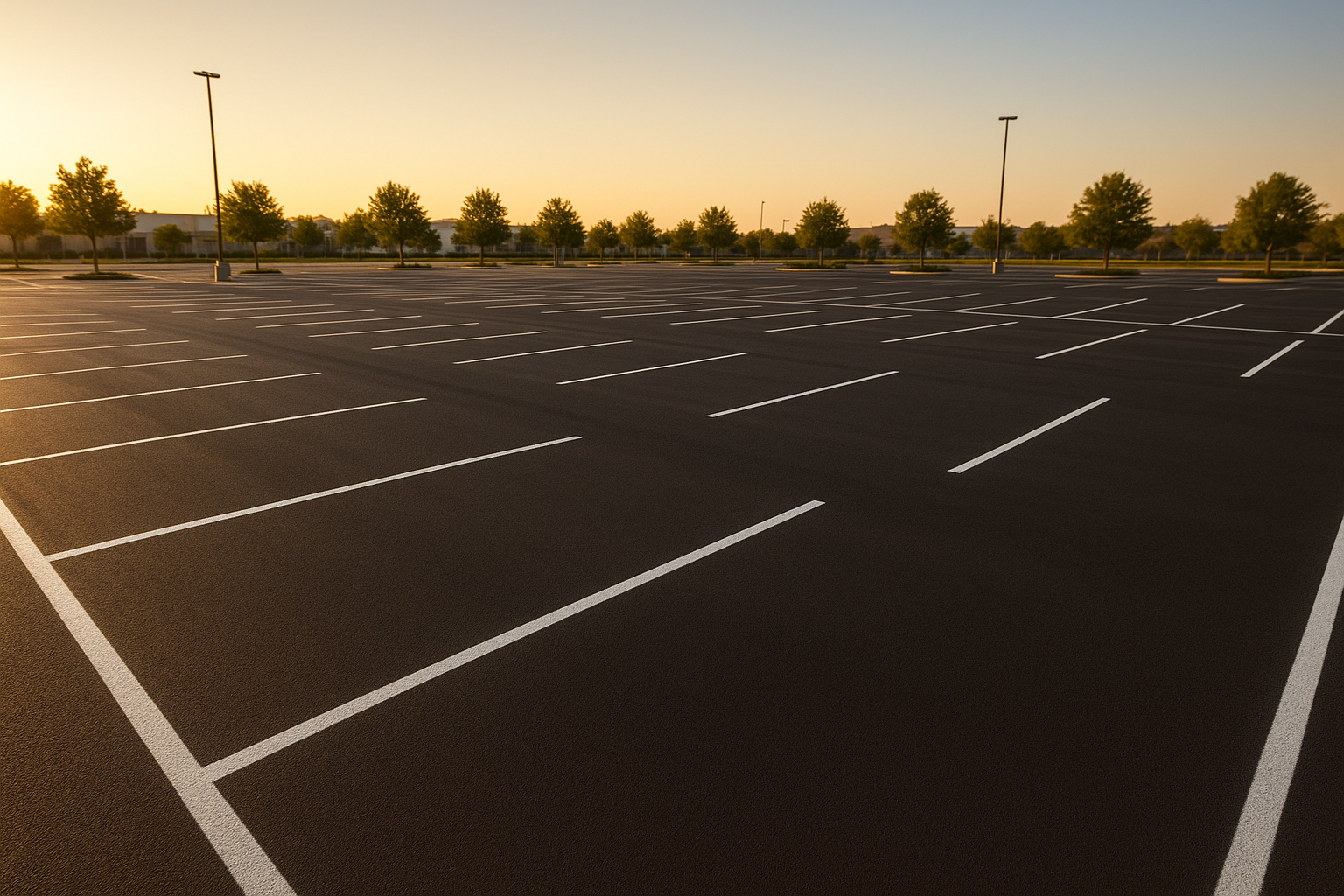
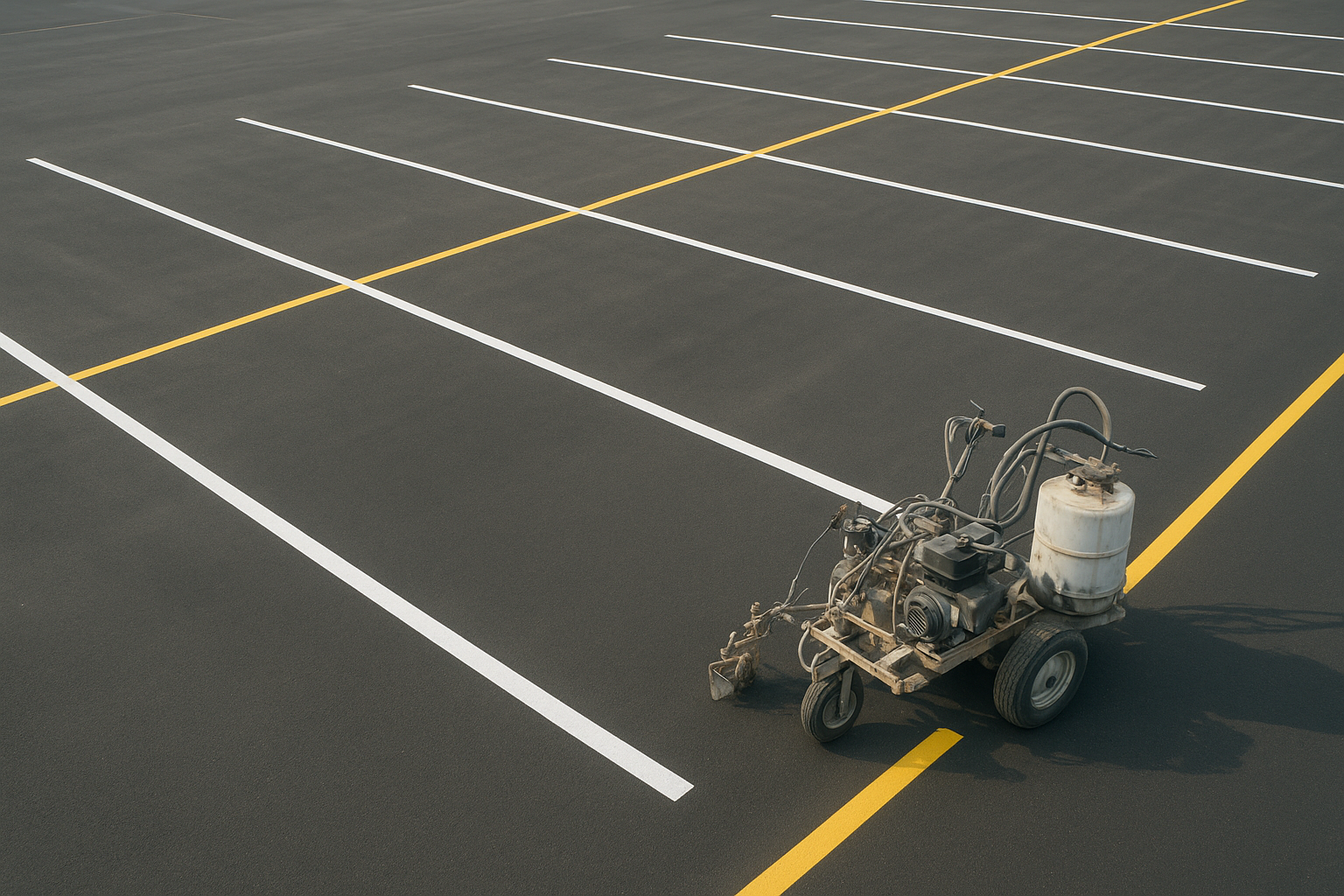
    Freshly completed parking lot line painting with white stall markings on dark asphalt

    Freshly applied parking lot line painting creates clear, organized stalls that improve traffic flow.

    Why Professional Parking Lot Striping Matters

    Faded or uneven lines do more than look unkempt; they create confusion, increase fender-bender risk, and can leave a property out of compliance. Consequently, many insurance and liability concerns trace back to poorly maintained lots.

    Professional parking lot striping services use calibrated equipment and code-accurate measurements, so stalls, aisles, and accessible spaces meet current standards. In contrast, DIY paint jobs often drift out of spec within a season, requiring rework sooner than expected.

    According to the U.S. Access Board, accessible parking requirements are tied directly to total lot capacity, meaning even small miscalculations can trigger compliance issues. That’s why precise layout work matters just as much as the paint itself.

    The Parking Lot Line Painting Process, Step by Step

    Every reputable crew follows a similar sequence to ensure lasting results. Here’s what typically happens on project day:

    1. Inspect and clean the surface. The crew sweeps and pressure washes the pavement so dirt and oil don’t interfere with paint adhesion.
    2. Measure and layout the design. Technicians chalk-line stall widths, drive aisles, and ADA spaces according to local code.
    3. Mask and prep special markings. Stencils go down for handicap symbols, arrows, and lettering.
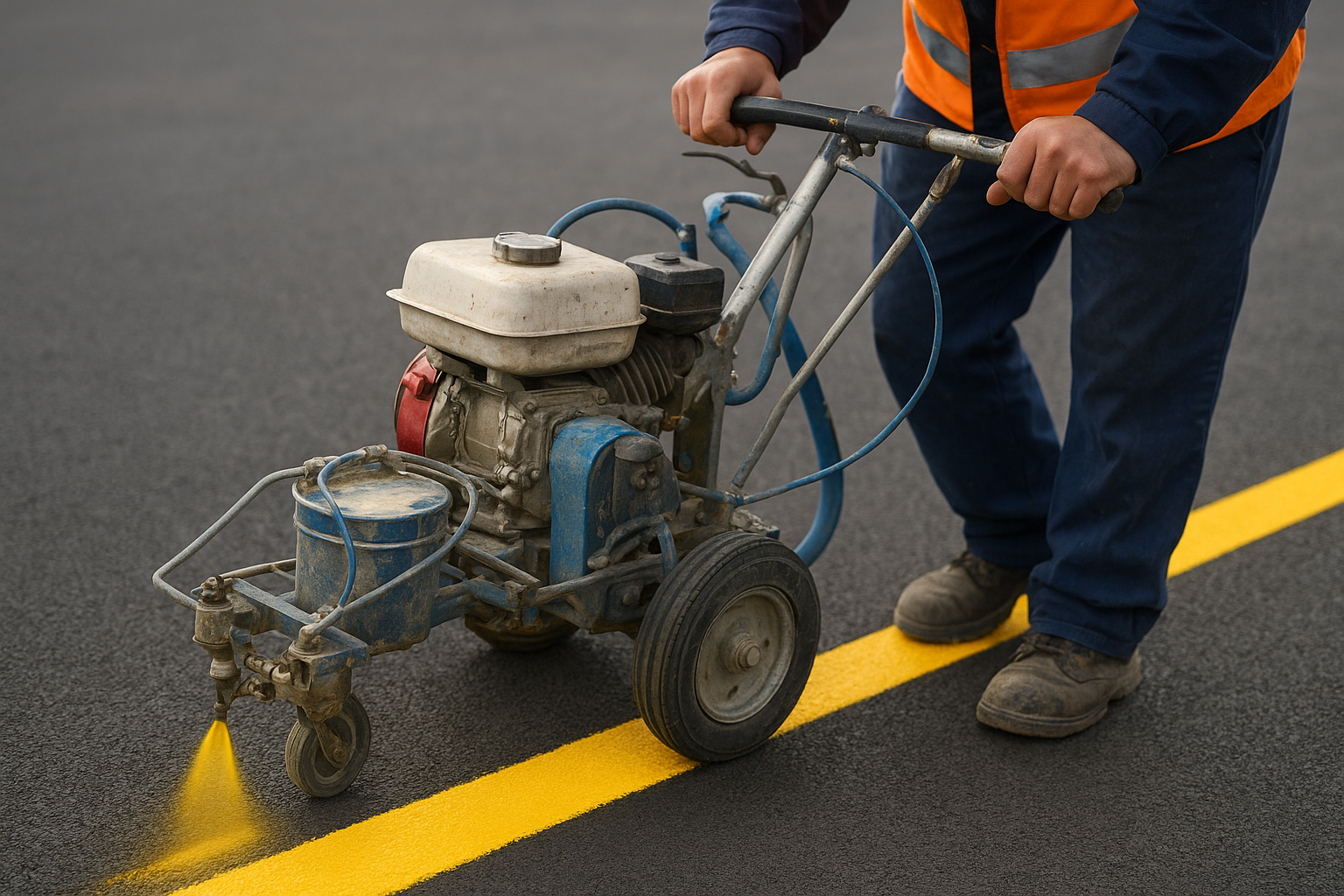
    4. Apply the traffic paint. Striping machines lay even, consistent lines using acrylic or thermoplastic paint.
    5. Cure and final inspection. The paint sets before traffic returns, and the crew checks every line against spec.

    Because most paints are dry to the touch within 30 minutes, lots are often back in service the same day. However, full curing can take up to 24 hours depending on humidity and temperature.

    ADA Compliance and Fire Lane Marking Requirements

    Federal law requires commercial parking facilities to provide a minimum number of accessible spaces, with exact ratios detailed by the Americans with Disabilities Act. Specifically, the number of required van-accessible and standard accessible stalls scales with total lot size.

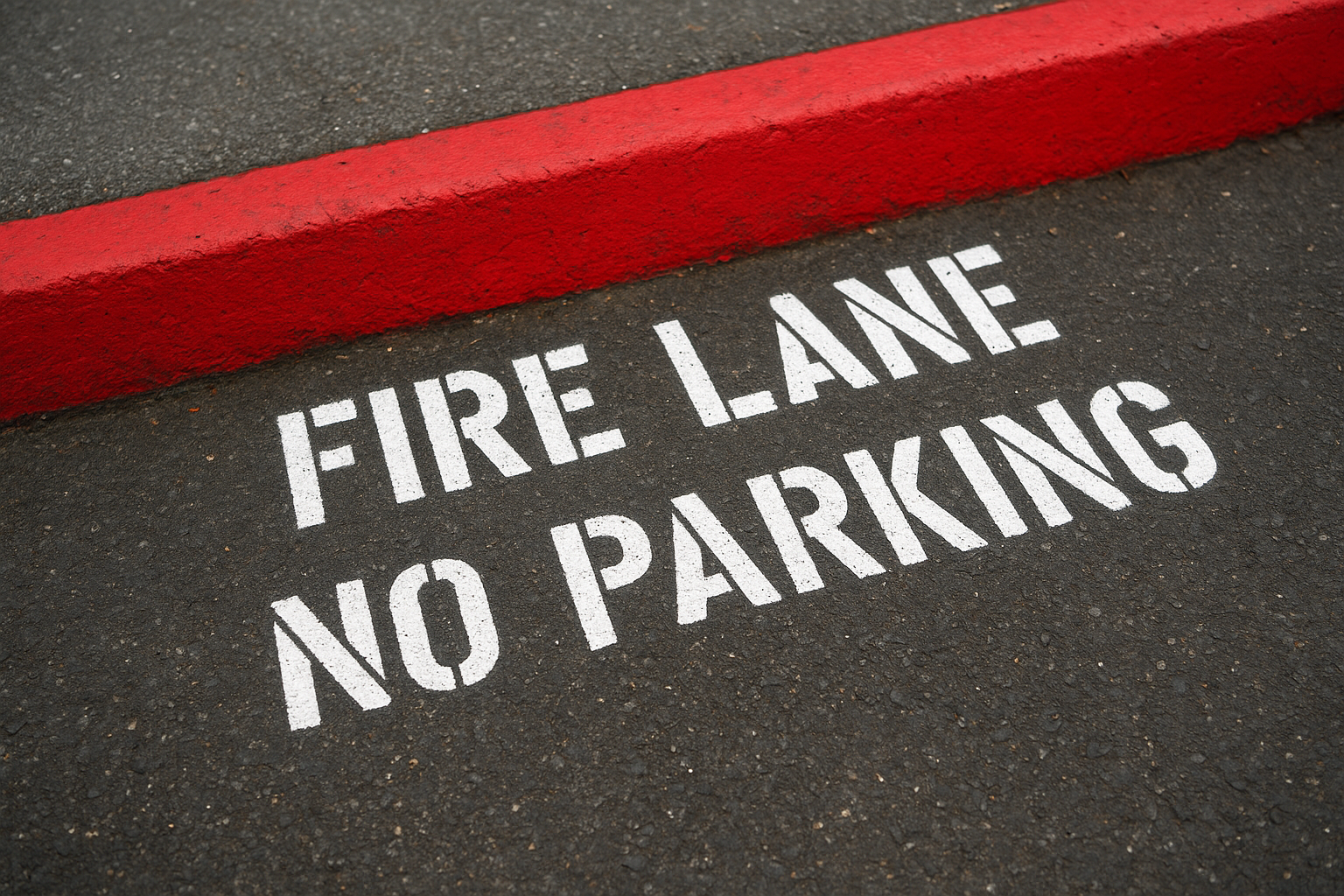
    In addition to ADA markings, most municipalities enforce fire lane rules based on guidance from the Manual on Uniform Traffic Control Devices. Fire lanes are typically painted red with white lettering and must remain clear for emergency vehicle access at all times.

    Property owners in North Texas can review a dedicated line marking service for parking lots in Texas to understand regional code nuances before scheduling work.
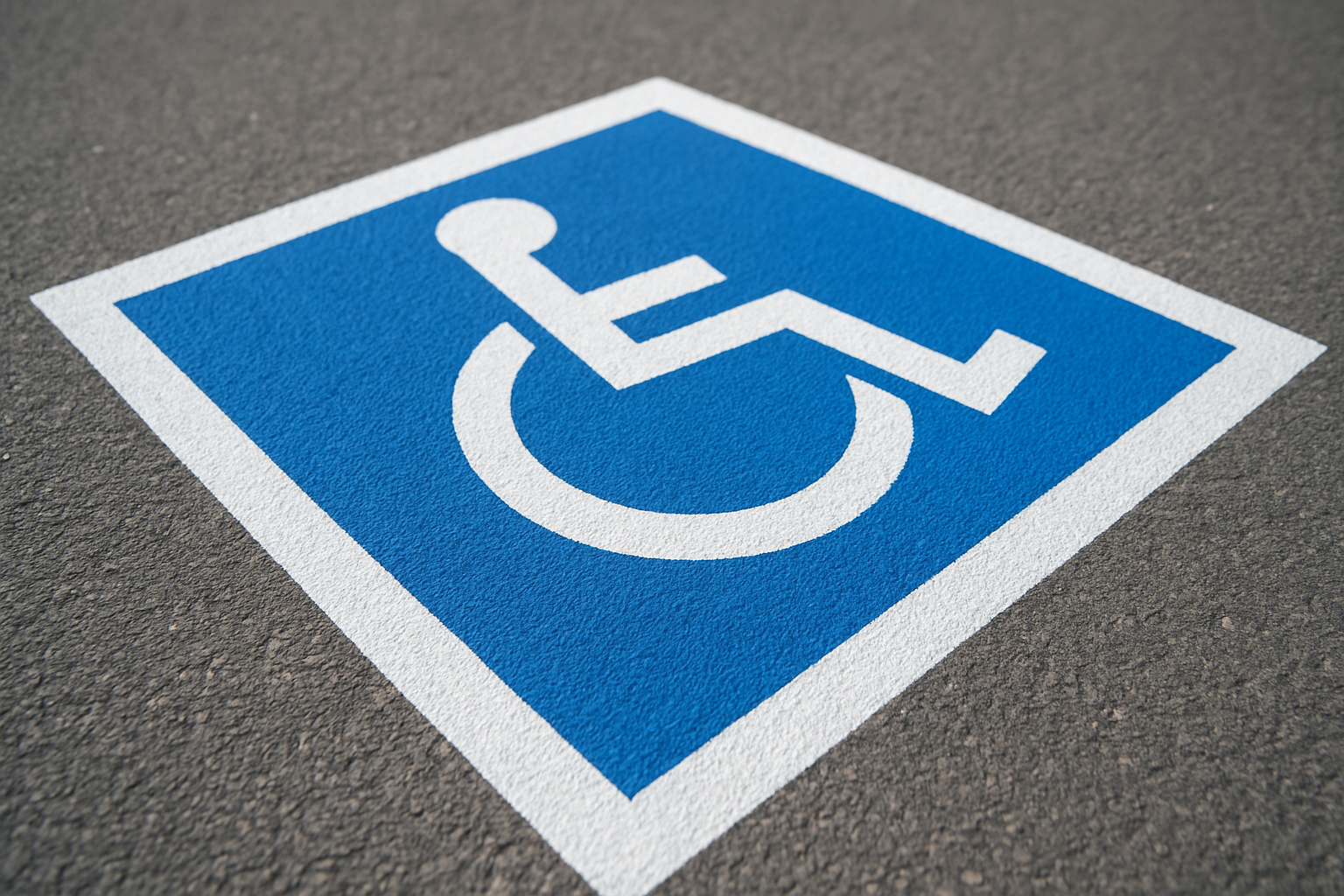
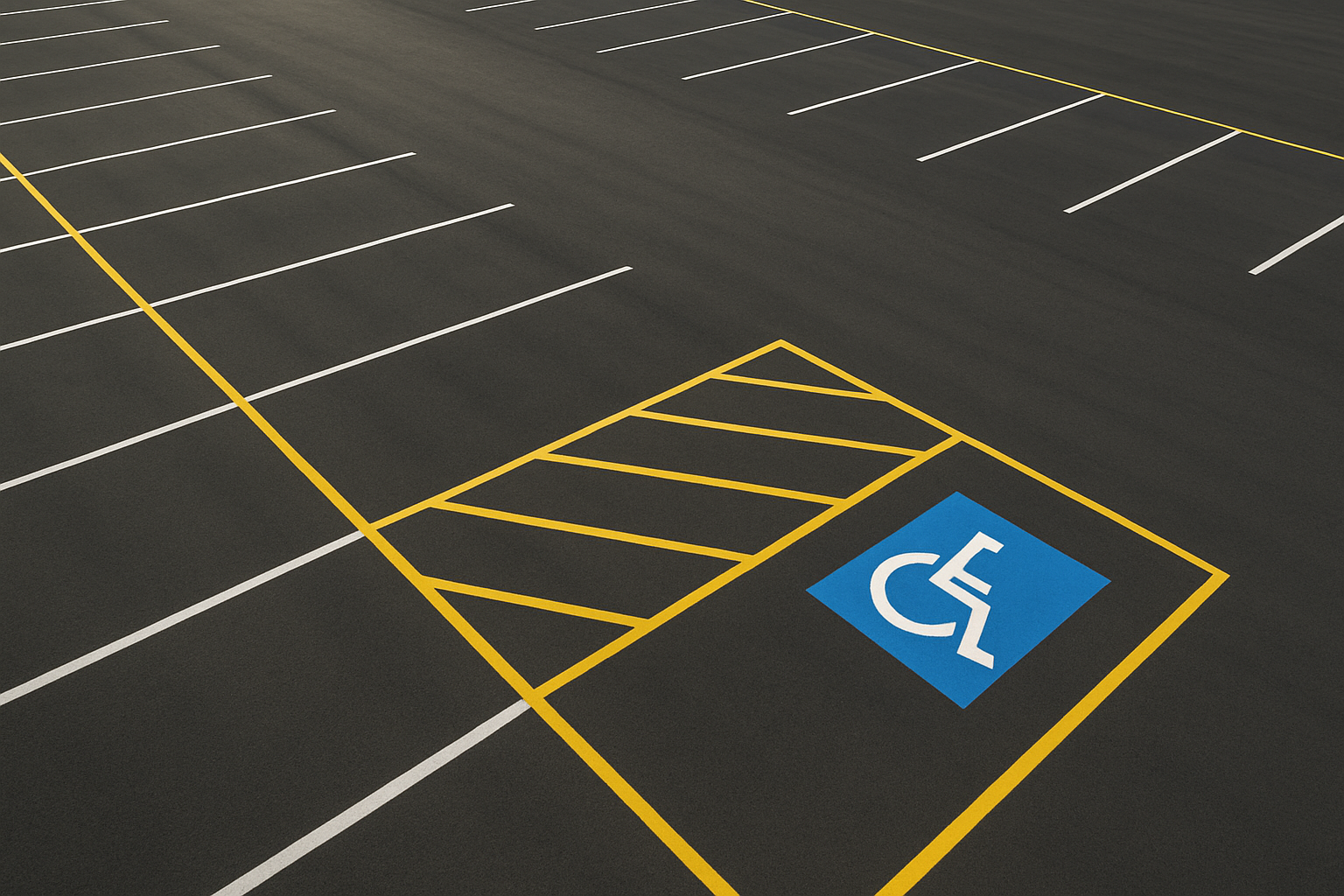
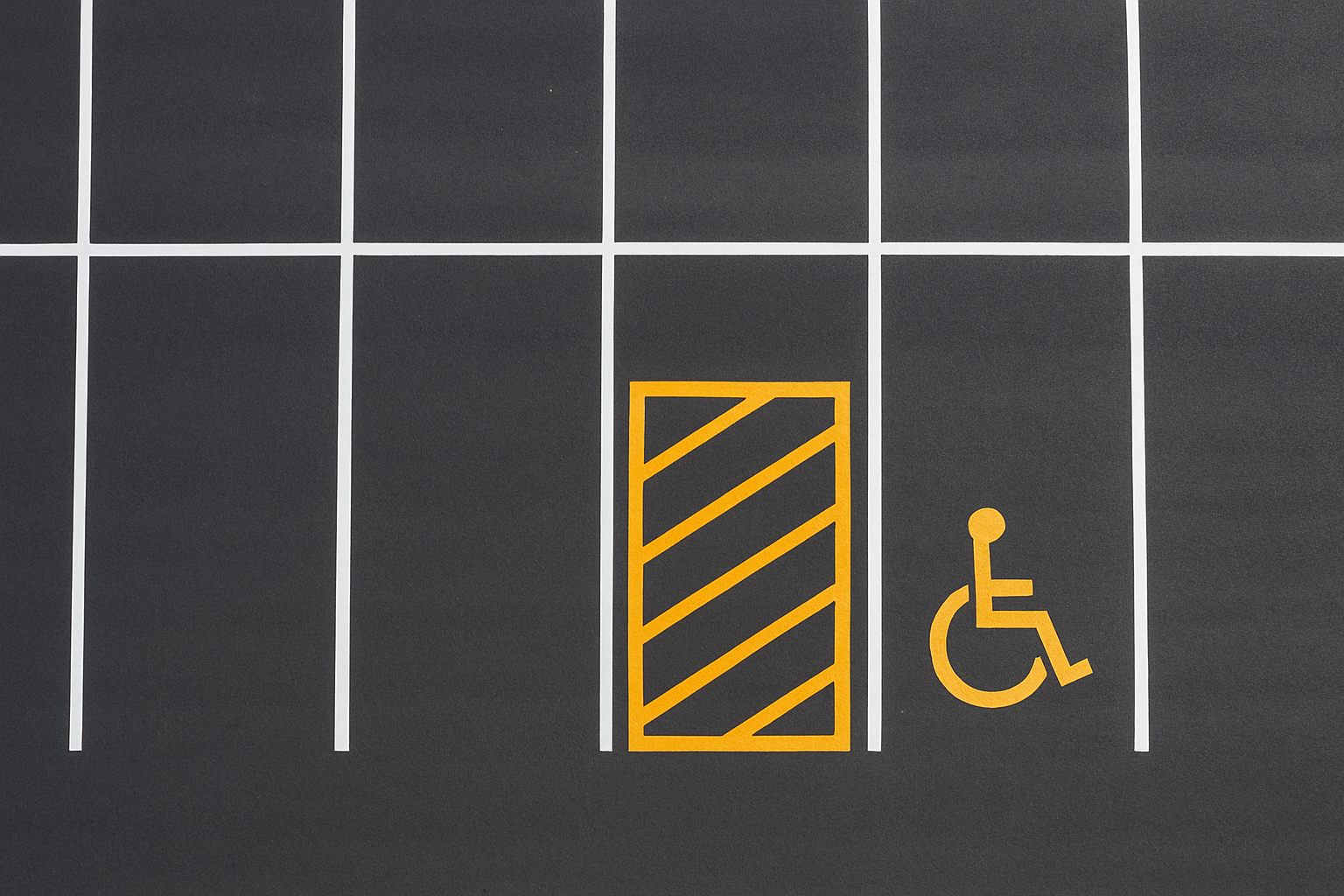
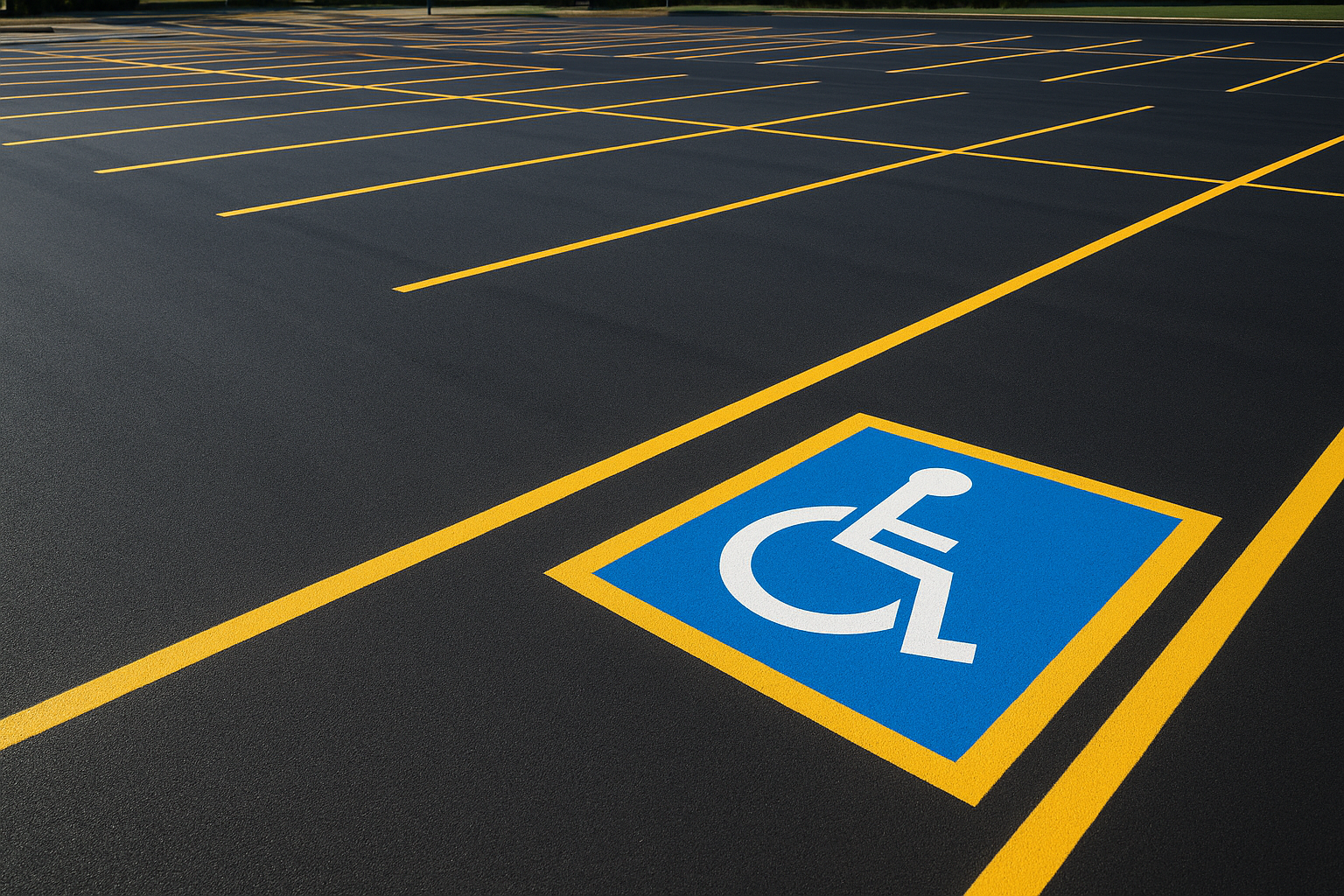
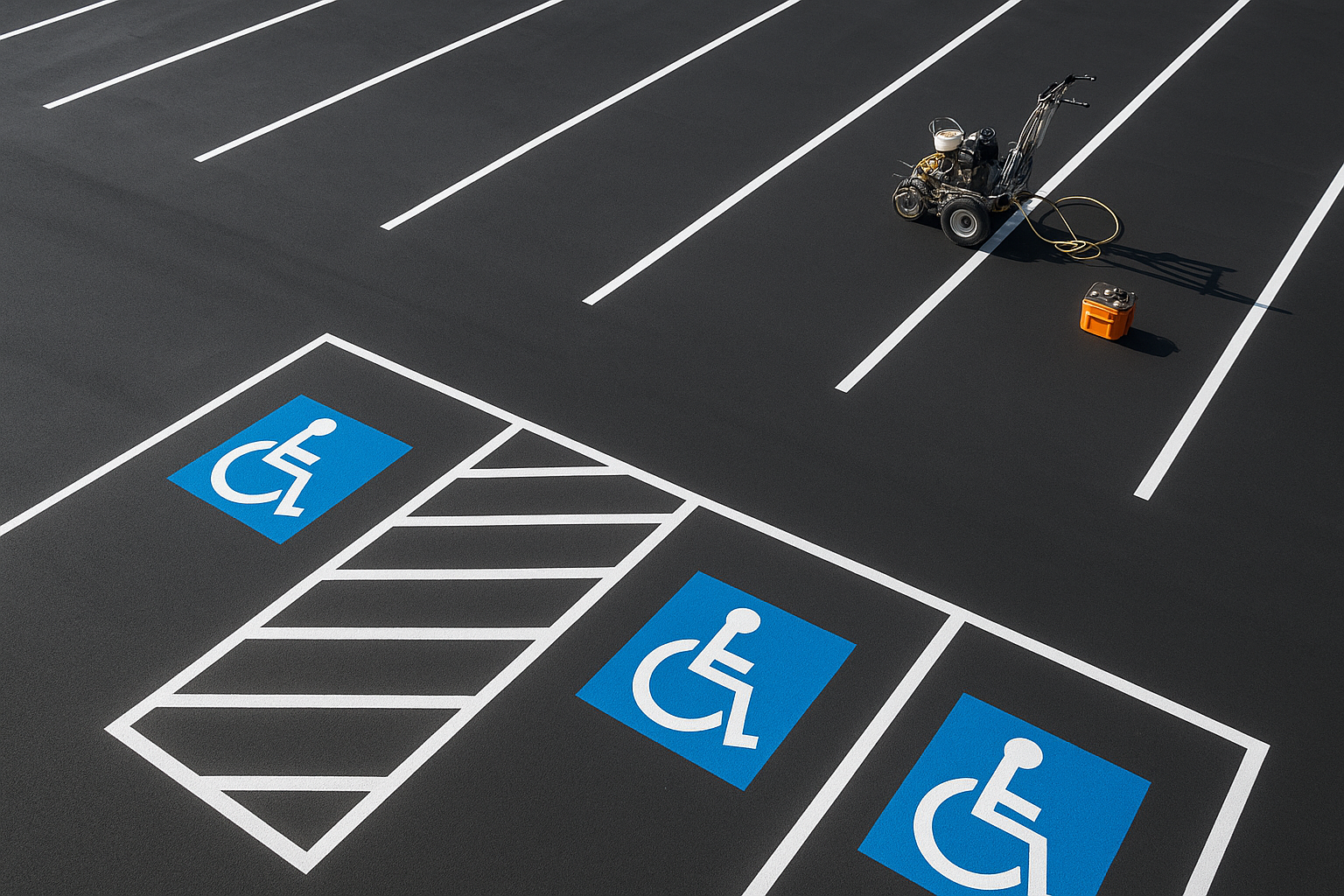
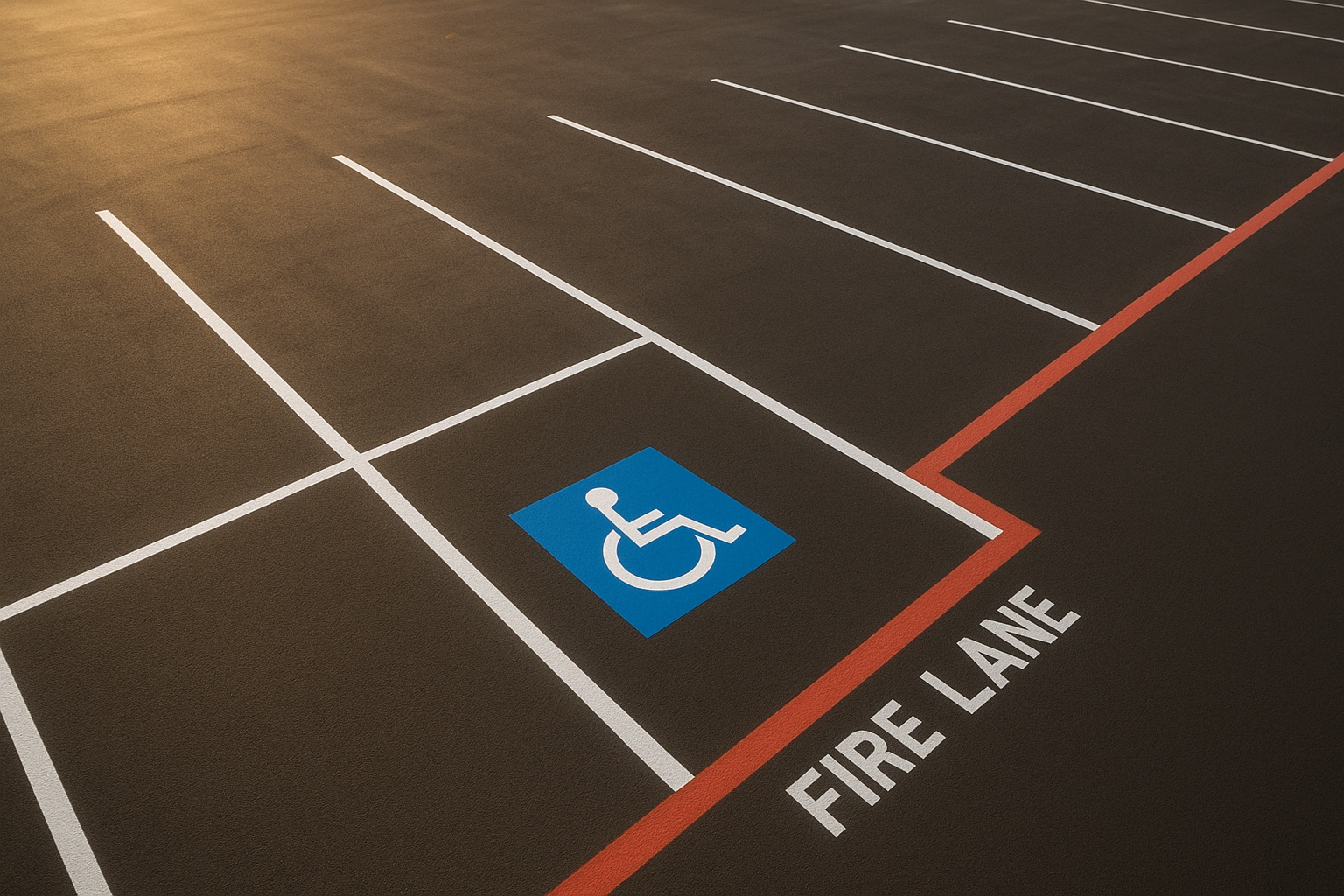
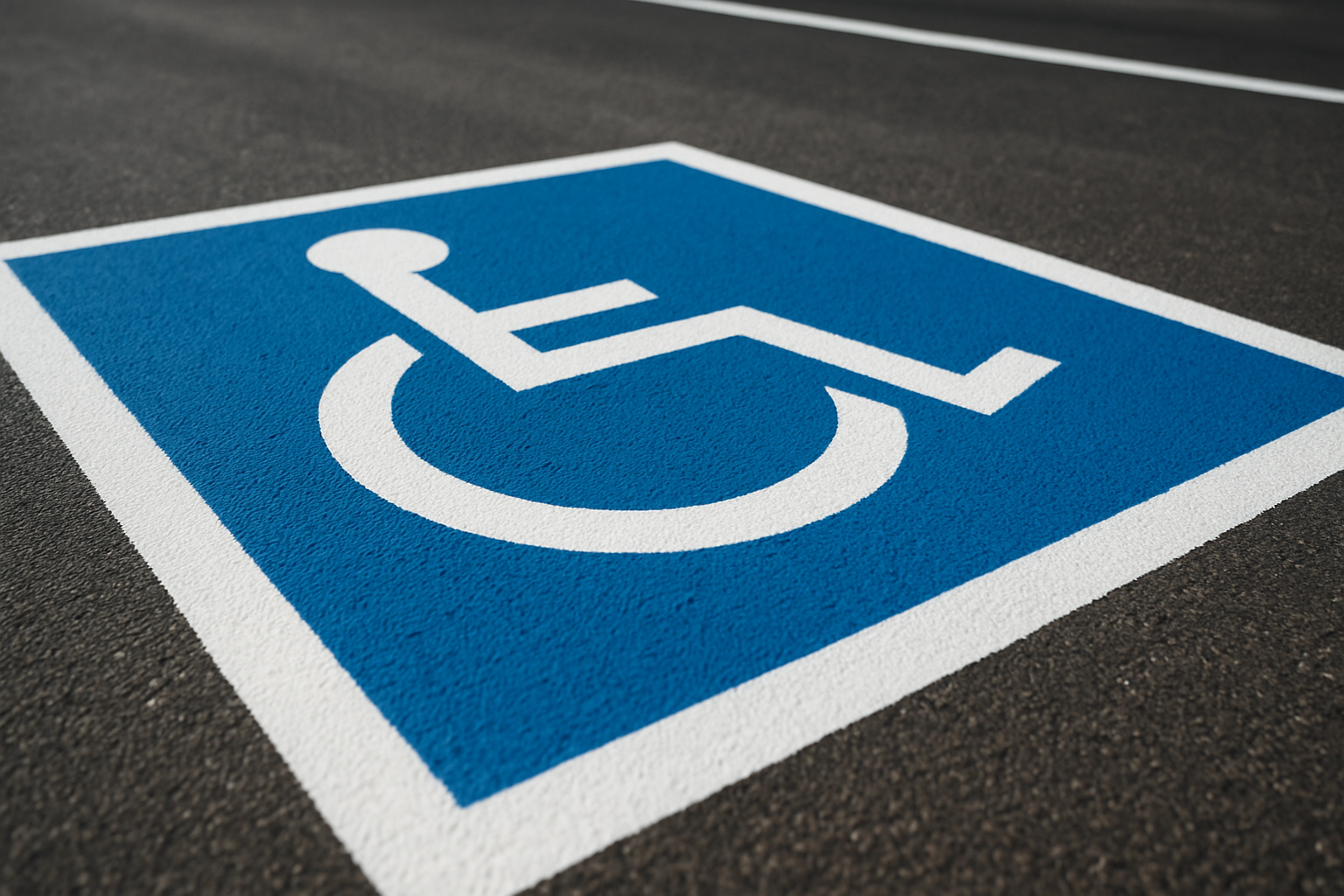
    ADA compliant handicap parking symbol as part of parking lot line painting project

    ADA-compliant stall markings are a critical part of any parking lot line painting project.

    How Much Does Parking Lot Line Painting Cost?

    Pricing depends on lot size, the number of stalls, and the complexity of required markings like fire lanes or ADA symbols. Small lots may cost only a few hundred dollars, while large retail or municipal properties can run into the thousands.

    For a full breakdown of pricing factors, see our detailed guide on how much parking lot line painting usually costs. Generally speaking, bundling restriping with other maintenance, such as sealcoating, can reduce the overall per-square-foot rate.

    As an industry benchmark, the American Society for Testing and Materials notes that pavement markings typically need refreshing every one to two years in high-traffic climates, which helps property managers budget proactively rather than reactively.

    Choosing a Parking Lot Striping Company in North Texas

    Not every contractor understands local fire codes or ADA nuances specific to Denton and Plano. Therefore, it’s worth confirming a company’s experience with municipal inspections before signing a contract.

    Stripespls.com, a full-service parking lot marking company based in Texas, specializes in professional striping, ADA compliance solutions, and fire lane marking for commercial and residential properties throughout the Denton and Plano areas. The team serves property managers, retail centers, schools, healthcare facilities, and municipal organizations across North Texas, offering everything from new lot layouts to complete restriping refreshes.

    Prospective clients can browse the company’s full range of striping services or visit stripespls.com to request a free quote for an upcoming project.
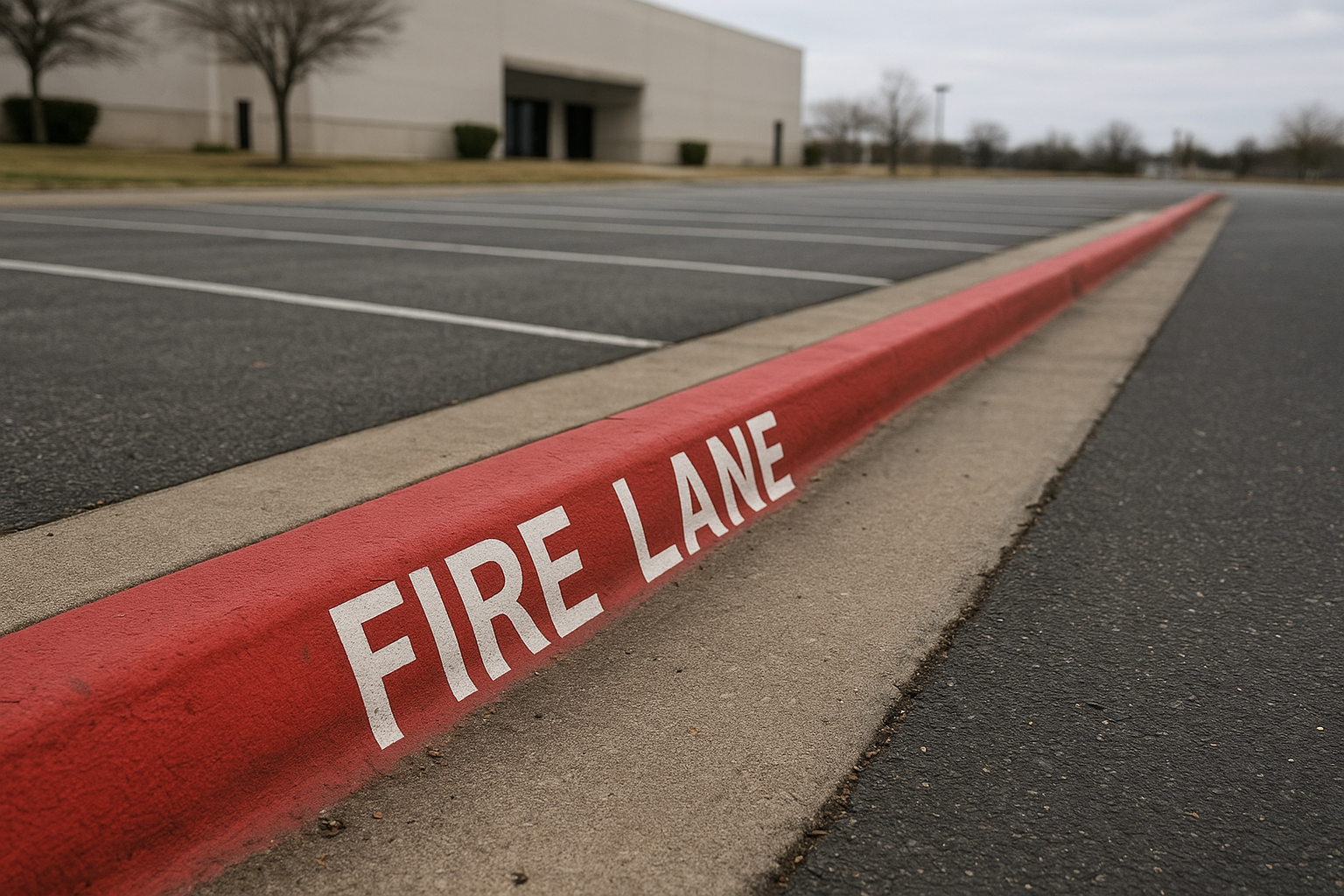
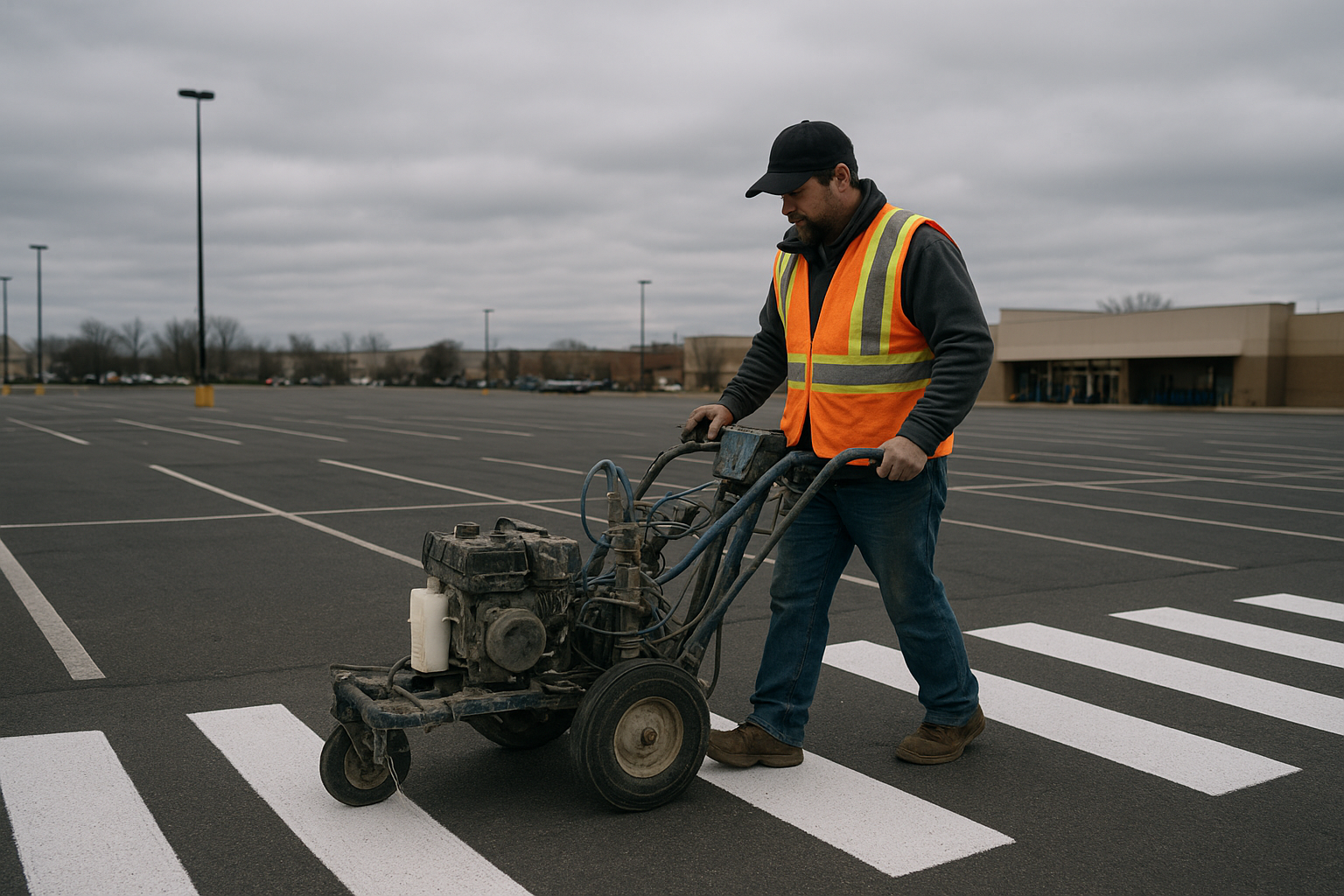
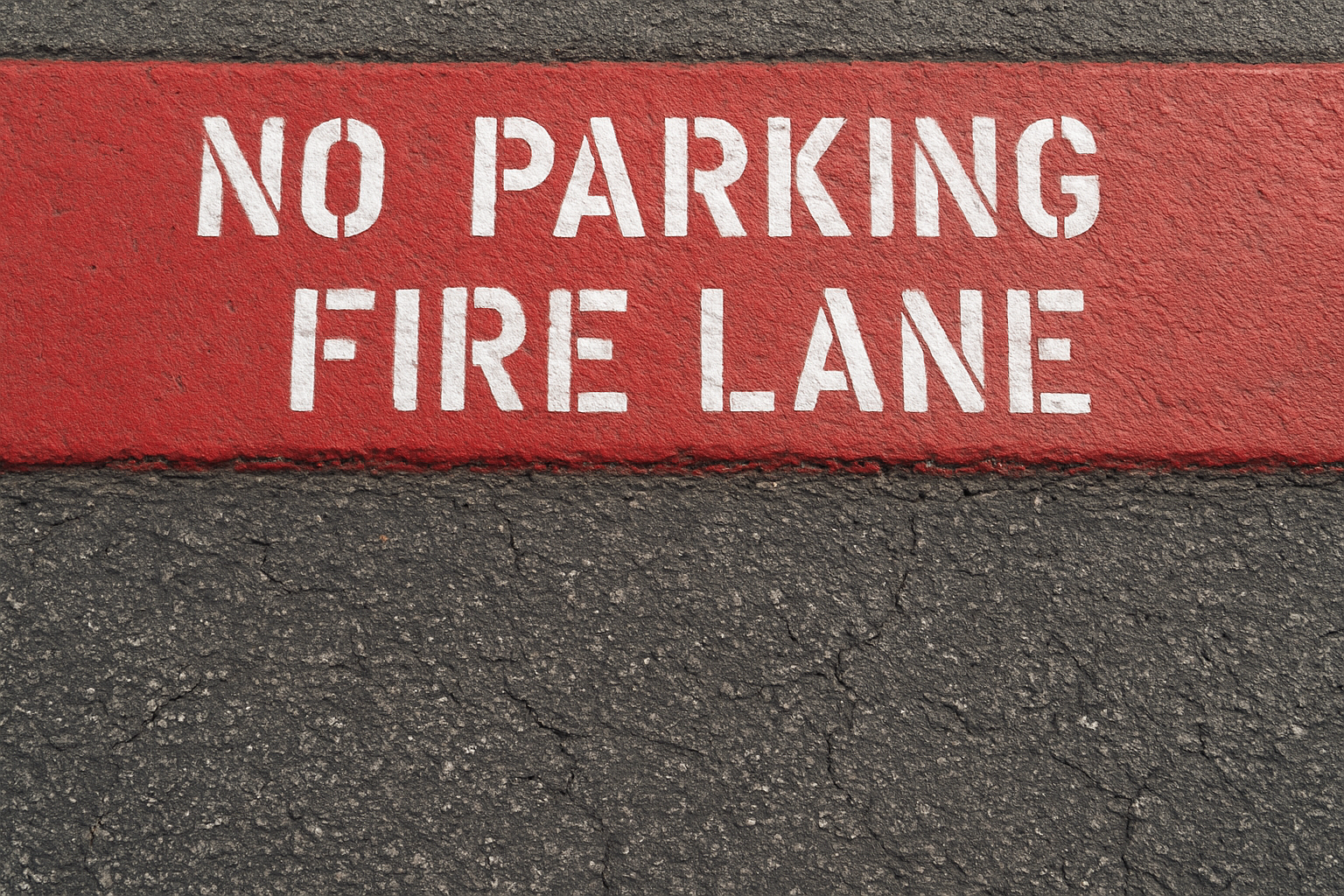
    Red fire lane markings painted along a curb during a commercial striping project

    Fire lane markings help keep emergency access routes clear at all times.

    Common Mistakes to Avoid

    Some property owners try to save money by delaying restriping until lines are nearly invisible. Unfortunately, this often backfires, since worn markings can lead to disputed parking, safety incidents, or failed inspections.

    Similarly, hiring based on price alone without checking insurance or code knowledge can result in inaccurate ADA layouts that require costly rework. In particular, always request a written, itemized quote and ask about recent local project experience.

    Frequently Asked Questions

    What is parking lot line painting?
    Parking lot line painting is the process of marking stalls, drive lanes, fire lanes, and ADA-compliant symbols on a paved surface using durable traffic paint. It organizes traffic flow and keeps properties in line with safety codes.

    How long does parking lot line painting take?
    Most standard commercial lots are completed in a single day, though larger properties may take two to three days. Weather, lot size, and prep work needed affect the timeline.

    How much does parking lot line painting cost?
    Costs typically range from a few hundred dollars for a small lot to several thousand for large commercial properties. Pricing depends on square footage and the markings required.

    How often should parking lot lines be repainted?
    Most lots need restriping every 12 to 24 months, depending on traffic volume and climate exposure. High-traffic retail centers often need touch-ups annually.

    What paint is used for parking lot striping?
    Water-based acrylic traffic paint and thermoplastic materials are the two most common choices. Acrylic dries quickly, while thermoplastic offers longer-lasting durability.

    Is ADA compliance required for all parking lots?
    Yes, commercial and public facilities must provide a minimum number of accessible spaces under the Americans with Disabilities Act. The exact count depends on total parking space count.

    What is a fire lane and why does it need marking?
    A fire lane is a designated access route reserved for emergency vehicles, typically marked with red paint and signage. Local fire codes require these lanes to remain clear at all times.

    Can parking lot line painting be done in cold weather?
    Most traffic paints require surface and air temperatures above 50°F to cure properly. Contractors often schedule work for spring through early fall in colder climates.

    What’s the difference between latex and thermoplastic striping paint?
    Latex paint is more affordable and easier to apply, while thermoplastic bonds more permanently for busy commercial lots. The right choice depends on traffic volume and budget.

    Do I need a permit for parking lot striping?
    In most municipalities, restriping an existing lot does not require a permit unless the layout is changing significantly. New construction or reconfiguration projects may need local approval.

    How long does striping paint take to dry?
    Traffic paint is typically dry to the touch within 30 minutes and safe for vehicles within one to two hours. Full curing can take up to 24 hours depending on conditions.

    What mistakes should I avoid when hiring a striping contractor?
    Common mistakes include skipping surface cleaning, choosing the lowest bid without checking experience, and ignoring ADA measurement standards. Always ask for insurance proof and recent references.

    Can faded parking lot lines affect liability?
    Yes, faded or missing lines can contribute to accidents, disputed parking, and non-compliance citations. Keeping markings fresh reduces risk and shows reasonable property maintenance.

    What is the standard width for parking space lines?
    Standard stall lines are usually painted four inches wide, though municipalities may specify slightly different widths. Stall dimensions generally range from 8.5 to 9 feet wide.

    How do I choose a reliable parking lot striping company?
    Look for a contractor with local experience, proper insurance, and up-to-date knowledge of ADA and fire code requirements. Reading reviews and requesting a written quote helps avoid surprises.

    Final Thoughts

    In summary, parking lot line painting is a straightforward but detail-heavy service that keeps properties safe, organized, and legally compliant. From ADA-accessible stalls to fire lane designation, precise markings protect both visitors and property owners from unnecessary risk.

    Ultimately, scheduling regular restriping every one to two years, paired with a contractor who understands local code, is the simplest way to avoid costly compliance issues down the road. For property managers throughout Denton and Plano, working with an experienced local team ensures the job is measured, painted, and inspected correctly the first time.
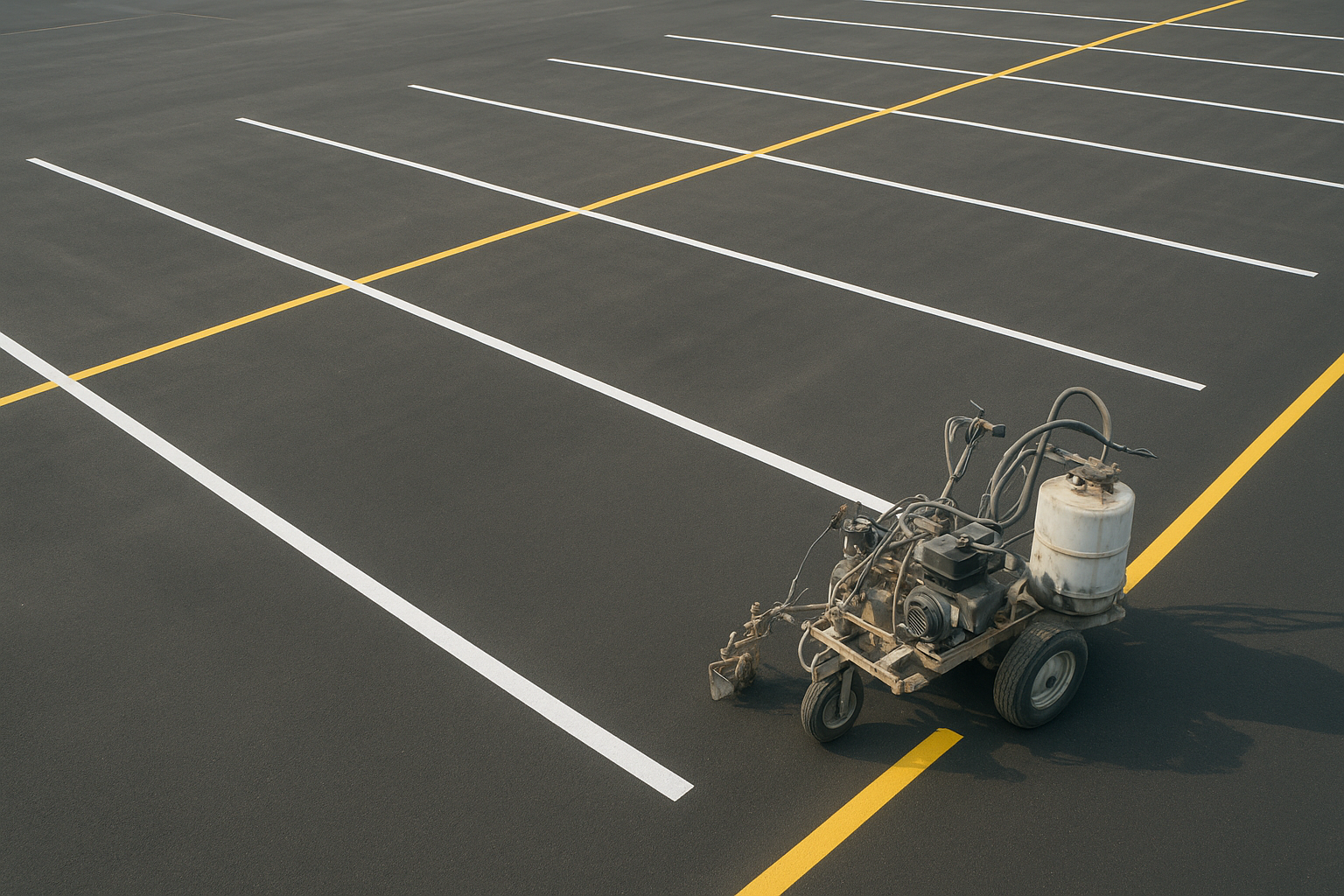
  • Texas Lot Painting Company: Denton & Plano Striping

    Texas Lot Painting Company: Denton & Plano Striping

    Texas Lot Painting Company: Denton & Plano Striping

    A Texas lot painting company like StripesPls specializes in professional parking lot striping, ADA compliance markings, and fire lane designation for commercial and residential properties. Property owners across Denton and Plano rely on these specialists to keep parking areas safe, organized, and legally compliant. Because faded or missing lines create real liability risks, hiring an experienced striping contractor protects drivers, pedestrians, and property owners alike. In this guide, we’ll break down what a professional pavement marking crew actually does, what it costs, and how to pick the right team for your next project.

    Quick Answer: A Texas lot painting company provides line striping, ADA-compliant stall markings, fire lane painting, and ongoing pavement marking maintenance for parking lots throughout North Texas. Most jobs, from a simple restripe to a full new layout, take one to two days and are priced per stall or per linear foot.

    Texas lot painting company crew finishing fresh parking lot striping

    Fresh, precise lines like these are the signature of an experienced Texas lot painting company.

    What Is a Texas Lot Painting Company?

    A Texas lot painting company is a licensed contractor that applies, repairs, and maintains the painted lines, symbols, and text found in parking lots. This includes standard stall lines, ADA-compliant accessible spaces, fire lanes, directional arrows, and curb markings. In short, these businesses keep parking facilities organized, legible, and code-compliant year after year.

    Most companies in this trade also handle related pavement work, such as sealcoating, crack filling, and wheel-stop installation. However, striping and marking remain the core specialty. Because Texas weather, from intense summer heat to occasional freezes, wears down paint faster than in milder climates, ongoing maintenance is a normal part of property upkeep rather than a one-time expense.

    Why Denton and Plano Properties Need Professional Striping

    Parking lots in Denton and Plano see heavy traffic from retail centers, schools, healthcare facilities, and municipal buildings. As a result, lines wear down faster than many owners expect, especially in high-turnover areas like grocery store lots or hospital drop-off zones. Faded striping isn’t just unattractive; it directly contributes to confused traffic flow and parking disputes.

    In particular, unclear ADA markings can expose property owners to complaints or fines, while missing fire lane paint can delay emergency response. Consequently, many property managers schedule restriping on a regular cycle rather than waiting until lines disappear completely. StripesPls offers professional parking lot striping services in Denton designed specifically around this kind of proactive maintenance schedule.

    Core Services From a Parking Lot Striping Company

    Most full-service line striping contractors offer a similar core menu, though quality and attention to detail vary widely between companies. Understanding these services helps property owners ask better questions during the quoting process.

    ADA Compliance Striping

    ADA-compliant striping includes properly sized accessible stalls, access aisles, and the international symbol of accessibility painted in the correct location and color. Specifically, the Americans with Disabilities Act sets minimum requirements for the number of accessible spaces based on total lot size. Above all, getting this wrong can result in complaints, fines, or costly rework, so experienced crews measure carefully before painting a single line.

    Fire Lane Marking and Directional Arrows

    Fire lane marking uses red paint and stenciled lettering to keep emergency access routes clear at all times. Meanwhile, directional arrows and stop bars help guide traffic flow safely through busy lots, particularly around building entrances and loading zones. Local fire codes typically dictate exact wording, color, and placement, so a knowledgeable contractor will already be familiar with North Texas requirements.

    Freshly painted fire lane marking on a commercial parking lot curb

    Fire lane marking is one of the most requested safety services from any parking lot marking business.

    Beyond ADA and fire lane work, most contractors also offer general restriping, new lot layout design, curb painting, and wheel-stop or bollard installation. StripesPls covers this full range through its line marking services for parking lots, tailored to whatever a property currently needs.

    How Much Does Parking Lot Striping Cost in Texas?

    Pricing for a line striping project depends primarily on lot size, layout complexity, and the type of paint used. As a general benchmark, most jobs fall somewhere between fifteen and seventy-five cents per linear foot, though small lots often carry a flat minimum fee. For a detailed breakdown, StripesPls has published a full guide on how much parking lot line painting usually costs.

    Notably, thermoplastic markings cost more upfront than standard traffic paint but last significantly longer, which can make them a better long-term value for high-traffic commercial lots. Therefore, it’s worth requesting pricing on both options before deciding.

    The Step-by-Step Striping Process

    While every property is different, most professional crews follow a consistent process from start to finish:

    1. Site assessment: The crew measures the lot and reviews ADA and fire lane requirements before providing a quote.
    2. Surface preparation: Debris, oil stains, and loose material are cleared so paint adheres properly.
    3. Layout and chalk lines: Exact stall widths and drive aisles are marked out before any paint is applied.
    4. Striping application: A striping machine applies paint or thermoplastic along the marked layout, including symbols and text.
    5. Cure time and inspection: The paint cures fully, and the crew inspects every line for coverage and code compliance.

    According to the Federal Highway Administration’s MUTCD guidelines, consistent marking standards help reduce driver confusion and improve overall lot safety. Following a proven process like this one helps ensure those standards are met on every project.

    Line striping machine applying fresh paint across an empty commercial parking lot

    A striping machine ensures even, consistent lines across even the largest commercial lots.

    How to Choose the Right Parking Lot Marking Company

    Not every contractor delivers the same level of quality, so it pays to compare a few options before committing. In particular, look for local experience, clear written pricing, and demonstrated knowledge of ADA and fire code requirements. Reading independent reviews is also worthwhile; for example, StripesPls has published an honest breakdown of what to know before hiring a traffic services company that can help property managers ask better questions during the bidding process.

    Similarly, a reputable pavement marking contractor should be willing to provide references from similar properties, such as retail centers, schools, or healthcare facilities. Above all, avoid choosing solely on the lowest bid, since rushed prep work often leads to premature fading and repeat costs.

    Serving Denton, Plano, and the Greater North Texas Region

    StripesPls operates as a locally based Texas lot painting company serving property managers, retail centers, schools, and municipal organizations throughout Denton, Plano, and the surrounding North Texas area. As a result, clients benefit from crews who already understand local code requirements and typical weather scheduling challenges. Property owners farther from the core service area sometimes look for coverage elsewhere too; for instance, this guide on whether there’s a parking lot striping service in Amarillo can help those outside the immediate Denton-Plano footprint find a suitable contractor.

    For more information or to request a free quote, visit stripespls.com directly. More broadly, the concept of standardized pavement marking is well documented on Wikipedia’s road surface marking overview, which offers useful background for property owners new to the topic.

    Frequently Asked Questions

    What does a Texas lot painting company actually do?
    A Texas lot painting company applies and maintains parking lot lines, ADA-compliant stall markings, fire lane paint, and directional arrows. Many also handle new lot layouts, curb painting, and pavement stenciling.

    How much does parking lot striping cost in Texas?
    Most projects cost between $0.15 and $0.75 per linear foot, depending on lot size, paint type, and layout complexity. Small lots may carry a minimum service fee, while large properties are usually quoted per project.

    How long does parking lot paint take to dry?
    Standard traffic paint usually dries to the touch within 30 to 60 minutes in warm, dry weather. Full cure before heavy traffic resumes is often recommended at around 24 hours.

    How often should a parking lot be restriped?
    Most commercial lots need restriping every 18 to 24 months, though high-traffic properties may need it annually. Faded, hard-to-see lines are the clearest sign it’s time for a refresh.

    What type of paint do professional striping crews use?
    Most contractors use water-based traffic paint or thermoplastic material rated for asphalt and concrete. Traffic paint is more affordable, while thermoplastic lasts longer but costs more upfront.

    Is ADA-compliant striping legally required?
    Yes, the Americans with Disabilities Act requires a specific number of accessible spaces with proper markings based on total lot size. Non-compliant lots can face fines and legal complaints.

    What’s the difference between fire lane marking and regular striping?
    Fire lane marking uses red paint and stenciled text to keep emergency access clear, while regular striping simply organizes stalls and traffic flow. Fire lanes are often required by local fire codes.

    Can striping be done during cold or rainy weather?
    Paint needs a dry surface and temperatures generally above 50°F to cure properly, so most contractors schedule around the forecast. Rescheduling due to weather is common and prevents premature peeling.

    How do I choose the best Texas lot painting company for my property?
    Look for local experience, clear pricing, ADA knowledge, and references from similar properties. Comparing two or three quotes helps ensure fair pricing and quality work.

    What is the standard size of a parking stall in Texas?
    Most standard stalls measure 9 feet wide by 18 feet long, though many municipalities allow slightly narrower compact spaces. Accessible stalls require extra width plus an access aisle per ADA guidelines.

    Do I need a permit to restripe my parking lot?
    Simple restriping that follows the existing layout usually does not require a permit, but new layouts may need municipal approval. Checking with your local planning department first can prevent delays.

    Is thermoplastic striping worth the extra cost compared to paint?
    Thermoplastic can last three to five times longer than standard paint, making it a good value for high-traffic lots. Smaller or lower-budget properties still get great results from standard traffic paint.

    Final Thoughts on Hiring a Texas Lot Painting Company

    Ultimately, choosing the right Texas lot painting company comes down to experience, clear communication, and a genuine understanding of ADA and fire code requirements. Whether a property needs a simple restripe or a full new layout, professional striping keeps parking areas safe, organized, and compliant with current regulations. In addition, regular maintenance protects property owners from liability while making a strong first impression on every visitor.

    For property managers, business owners, and municipal organizations across Denton, Plano, and the wider North Texas region, working with an experienced local team like StripesPls simplifies the entire process. As a next step, request a free quote to see exactly how affordable a professional refresh can be.

  • Professional Parking Lot Striping in Denton & Plano

    Professional Parking Lot Striping in Denton & Plano

    Professional Parking Lot Striping in Denton & Plano

    Professional parking lot striping is the process of painting clean, code-compliant lines, symbols, and markings onto a paved lot to organize traffic, define parking stalls, and meet accessibility regulations. For property owners across Denton and Plano, TX, faded or missing lines are not just a cosmetic issue — they create real safety and liability risks. This guide breaks down what professional line marking involves, why it matters, and how to choose the right crew for the job.

    Quick answer: Professional parking lot striping uses commercial paint, precision layout tools, and ADA-trained technicians to mark stalls, fire lanes, and accessible parking accurately. It typically needs refreshing every 18 to 24 months to stay compliant and visible.

    What Is Professional Parking Lot Striping?

    Professional parking lot striping is more than painting straight lines. It is a planned service that combines pavement measurement, code research, and precise application to produce a lot layout that is safe, organized, and legally compliant.

    In particular, a qualified crew accounts for ADA (Americans with Disabilities Act) requirements, local fire codes, and traffic flow patterns before a single drop of paint is applied. As a result, the finished lot works better for drivers, pedestrians, and emergency responders alike.

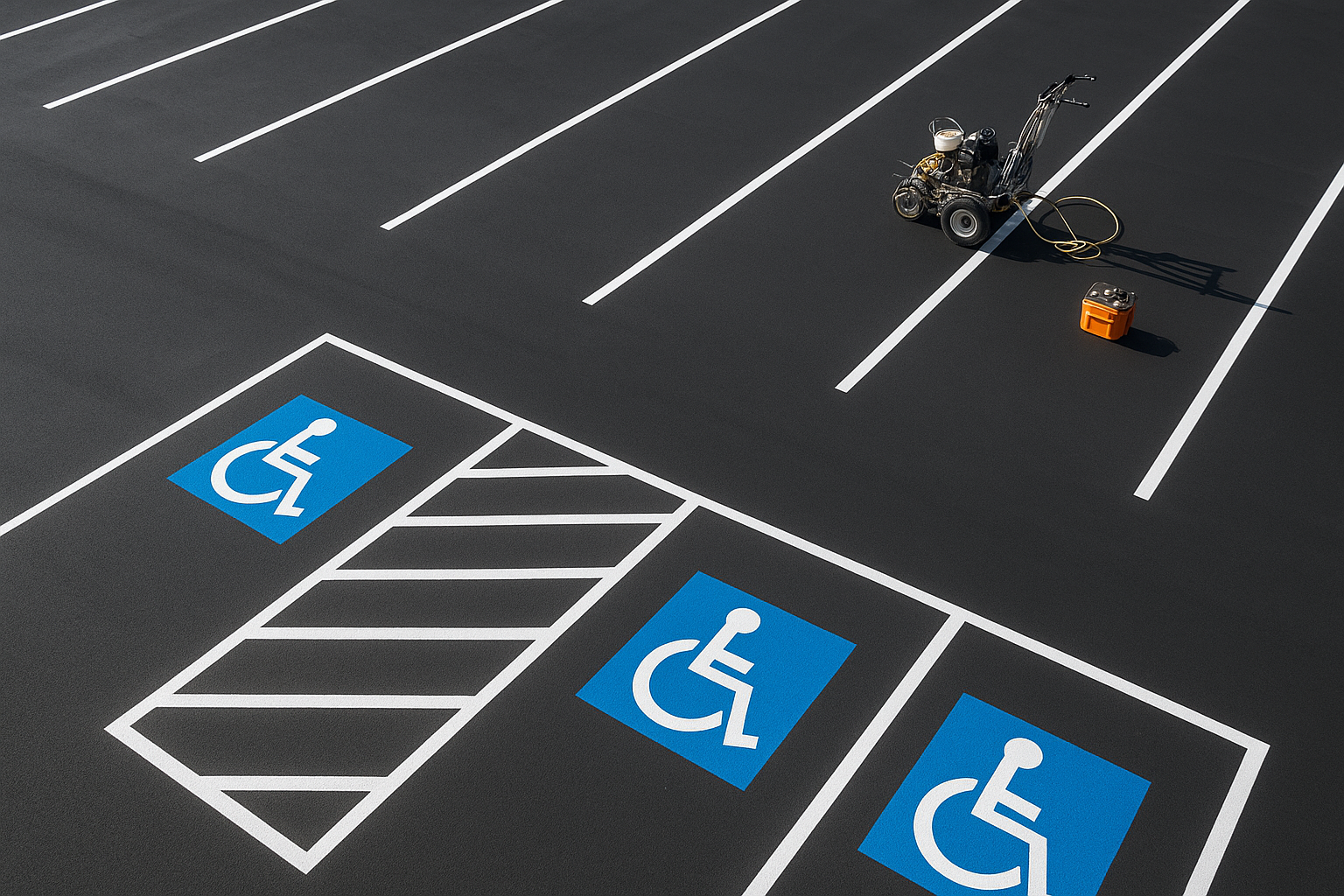
    Aerial view of professional parking lot striping with ADA accessible parking symbol

    An aerial view showing the precision of professional parking lot striping, including ADA-marked stalls.

    Why Professional Line Striping Matters for Your Property

    Faded lines do more than look unkempt. Specifically, they confuse drivers, waste usable parking space, and can even increase the risk of accidents between vehicles and pedestrians.

    In contrast, a freshly striped lot communicates order at a glance. Consequently, tenants, customers, and visitors move through the property more efficiently, and property managers reduce the chance of complaints or liability claims.

    Furthermore, according to the U.S. Access Board, accessible parking design directly affects whether a property meets federal civil rights obligations under the Americans with Disabilities Act. That single factor alone makes striping quality a compliance issue, not just an aesthetic one.

    Key Benefits of Investing in Line Marking

    • Improved traffic flow and reduced congestion during peak hours
    • Maximized parking capacity through optimized stall layout
    • Lower liability risk from clearly marked fire lanes and ADA spaces
    • A cleaner, more professional first impression for visitors

    ADA Compliance and Fire Lane Marking Essentials

    ADA compliance is one of the most technical parts of any striping project. For instance, the Access Board specifies exact stall widths, van-accessible space dimensions, and signage placement that must be followed precisely.

    According to federal accessibility guidelines, lots with up to 100 total spaces generally need at least one accessible space for every 25 regular spaces, with additional van-accessible stalls required as lot size increases. Getting this wrong can trigger costly corrections or fines.

    Similarly, fire lane marking follows local fire code rules, typically requiring red paint with white lettering that reads “FIRE LANE — NO PARKING.” Above all, these lanes must stay clear so emergency vehicles can respond without delay.

    How the Professional Parking Lot Striping Process Works

    Understanding the workflow helps property owners know what to expect before, during, and after a project. Below is the typical sequence a professional crew follows.

    1. Site assessment and layout planning: A technician measures the lot and designs a layout that maximizes capacity while meeting ADA and fire code rules.
    2. Surface cleaning and preparation: The crew removes debris, dirt, and old paint flakes so new lines bond properly to the asphalt or concrete.
    3. Layout marking: Chalk lines, string, or laser-guided tools establish precise stall widths and aisle spacing before painting begins.
    4. Paint application: Commercial striping machines apply traffic paint or epoxy in consistent, straight lines for stalls, arrows, and symbols.
    5. Curing and final inspection: Fresh lines are barricaded while curing, and the team performs a final walkthrough to confirm accuracy and compliance.

    Technician operating professional line striping equipment on a parking lot

    Precision equipment ensures professional parking lot striping lines stay straight and durable.

    Choosing a Striping Company in Denton and Plano

    Not every crew handles ADA math or fire code stencils correctly, so experience matters. Therefore, it helps to ask about past commercial projects, paint types used, and turnaround time before hiring anyone.

    Locally, stripespls.com’s parking lot striping services cover property managers, retail centers, schools, healthcare facilities, and municipal clients throughout North Texas. In addition, the team offers a dedicated Plano line marking service for properties needing new layouts or full restriping.

    For readers weighing whether the expense is worthwhile, this breakdown of whether professional parking lot striping is worth the investment compares costs against long-term benefits in more detail.

    Cost Factors for Parking Lot Line Marking

    Pricing depends on several variables, including lot size, paint type, and how many symbols or fire lanes need stenciling. Generally speaking, epoxy coatings cost more upfront than standard traffic paint but last considerably longer.

    However, the most reliable way to know actual pricing is a site-specific quote. Property owners can request a free quote directly through stripespls.com to get an accurate estimate based on their lot’s exact dimensions and needs.

    For a deeper technical resource on layout standards, Otto’s guide on professional lot striping best practices covers additional layout considerations worth reviewing.

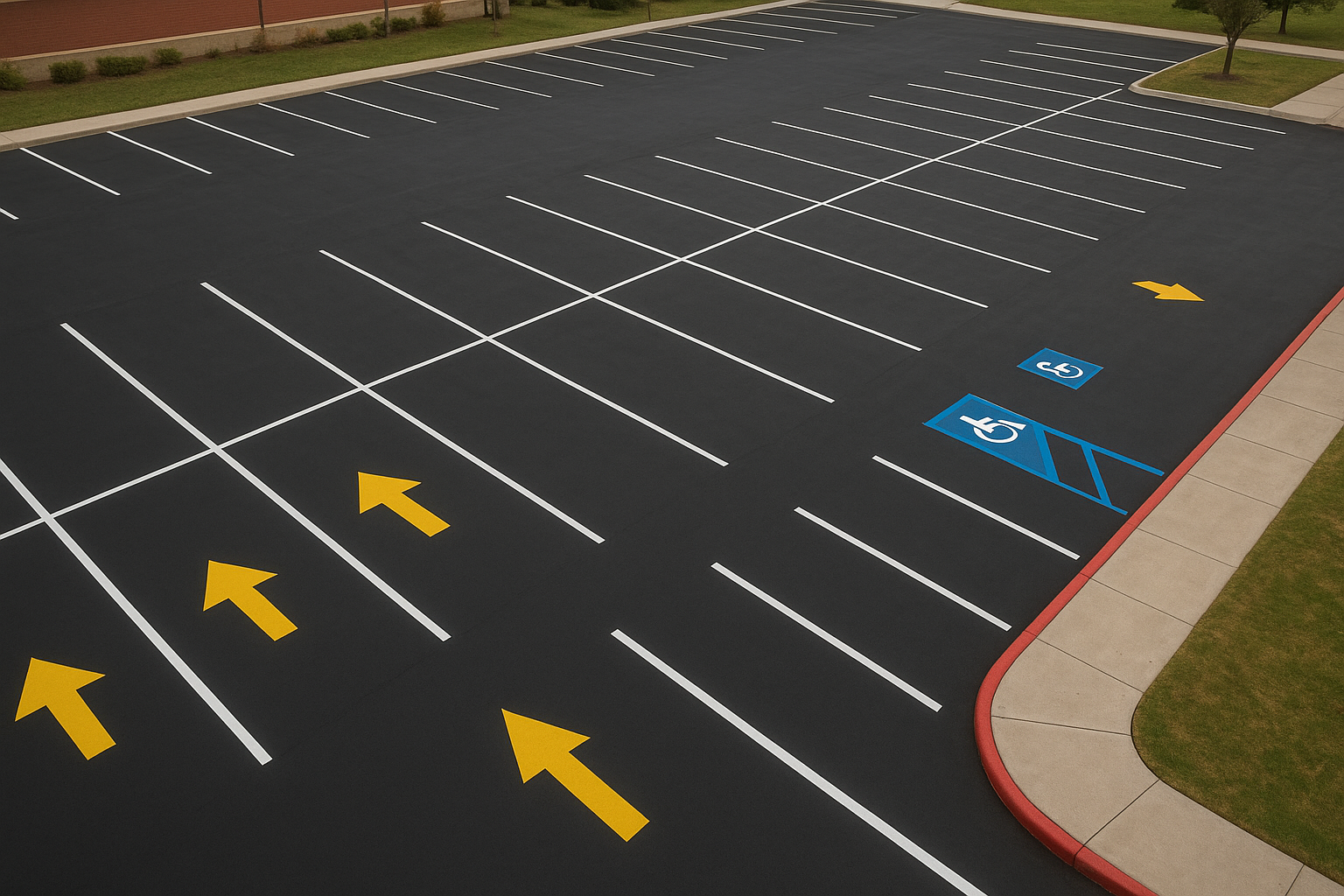
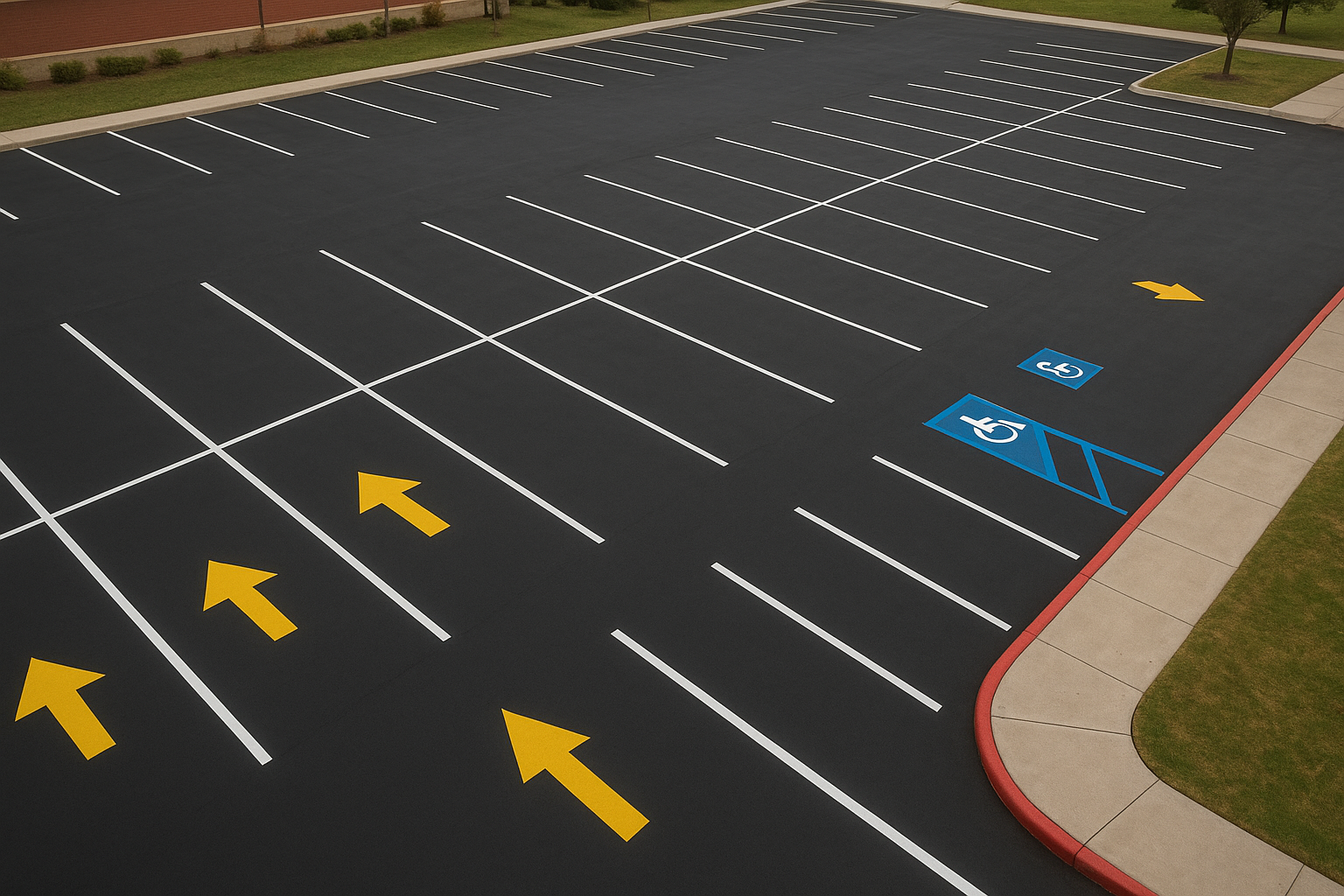
    Newly painted parking lot markings including directional arrows and crosswalk at a school property

    Directional arrows and crosswalks are common elements included in professional parking lot striping projects.

    Frequently Asked Questions About Professional Parking Lot Striping

    What is professional parking lot striping?

    Professional parking lot striping is the process of applying durable painted lines, symbols, and markings to a paved lot using commercial-grade equipment and trained technicians. It defines parking stalls, drive lanes, ADA spaces, and fire lanes to keep traffic organized and code-compliant.

    How often should a parking lot be restriped?

    Most commercial lots need restriping every 18 to 24 months. High-traffic Texas properties may need it annually because sun exposure and vehicle traffic fade paint faster.

    Why is ADA-compliant striping important for property owners?

    ADA-compliant striping ensures accessible parking spaces meet federal size, signage, and placement rules. Non-compliance can lead to fines, complaints, or legal action.

    How much does professional parking lot striping cost?

    Costs vary by lot size and paint type, generally ranging from a few hundred to several thousand dollars for commercial properties. Requesting a free quote is the most accurate way to get exact pricing.

    What type of paint is used for parking lot line marking?

    Most crews use water-based traffic paint or durable epoxy coatings built for outdoor pavement. Epoxy costs more but typically lasts longer under heavy traffic.

    How long does parking lot striping take to dry?

    Standard traffic paint usually dries to the touch within 30 minutes and handles light traffic within a few hours. Full curing can take up to 24 hours depending on weather.

    What is the difference between DIY and professional striping?

    DIY striping often results in uneven lines and incorrect ADA measurements because it skips proper surface prep and layout tools. Professional parking lot striping uses precision equipment and code knowledge for lasting, compliant results.

    What common mistakes do property owners make with lot striping?

    Common mistakes include skipping surface cleaning, ignoring ADA stall dimensions, and waiting too long to restripe faded lines. Each of these shortens paint life and raises compliance risk.

    Do fire lanes need to be repainted separately from parking stalls?

    Yes, fire lanes use red paint with white lettering and follow separate local fire code rules. They are typically stenciled as a distinct step from standard stall lines.

    What is the best time of year to restripe a parking lot in Texas?

    Late spring through early fall works best because warm, dry weather helps paint cure evenly. Avoiding rainy stretches prevents washout and patchy lines.

    How can striping improve parking lot safety?

    Clear lines and arrows reduce driver confusion and help prevent collisions with pedestrians. Visible ADA and fire lane markings also let emergency vehicles respond faster.

    Does professional parking lot striping increase property value?

    A well-marked, organized lot boosts curb appeal and signals strong property maintenance to tenants and buyers. Many managers see striping as a low-cost upgrade with a solid return.

    What areas does stripespls.com serve?

    Stripespls.com provides professional parking lot striping across Denton, Plano, and the greater North Texas region. Services cover commercial, residential, retail, school, healthcare, and municipal properties.

    How do I get a quote for parking lot striping services?

    Property owners can request a free quote directly through stripespls.com by sharing basic lot details. A representative typically follows up to schedule a site assessment.

    Final Thoughts on Professional Parking Lot Striping

    In summary, professional parking lot striping keeps properties safe, organized, and legally compliant while improving the overall impression a lot makes on visitors. From ADA-compliant stalls to fire lane markings, precise line work protects both drivers and property owners from unnecessary risk.

    Ultimately, faded or missing lines are worth addressing sooner rather than later. Property owners throughout Denton, Plano, and the surrounding North Texas region can request a free quote at stripespls.com to get a lot properly assessed and restriped by an experienced crew.

  • Non-Slip Parking Lot Markings: Guide for Property Owners

    Non-Slip Parking Lot Markings: Guide for Property Owners

    Non-Slip Parking Lot Markings: Guide for Property Owners

    Non-slip parking lot markings are specially formulated line striping materials designed to reduce slip-and-fall hazards on crosswalks, ramps, and pedestrian paths within commercial parking areas. For property owners across Denton, Plano, and the greater North Texas region, these markings do more than direct traffic — they protect visitors and help facilities meet safety codes. In this guide, we’ll explain exactly what non-slip parking lot markings are, how they’re applied, and why nearly every commercial property should have them.

    Whether you manage a retail center, a school campus, or a healthcare facility, understanding this simple upgrade can prevent injuries and reduce liability. Let’s start with the basics before moving into materials, cost, and the step-by-step application process.

    What Are Non-Slip Parking Lot Markings?

    Non-slip parking lot markings are pavement striping products — usually thermoplastic, epoxy, or paint — blended with anti-skid additives such as silica sand or ground glass beads. Unlike standard striping paint, these materials create a textured surface that grips foot traffic even when wet.

    In particular, this texture matters most on crosswalks, curb ramps, and ADA-accessible paths where foot traffic is heaviest. Because the added grit sits slightly above the coating’s surface, it channels water away from shoes rather than letting it pool into a slick film, similar in concept to the road surface marking textures used on public roadways.

    Worker applying non-slip parking lot markings across a commercial crosswalk

    Applying non-slip parking lot markings requires a textured additive layered into the base coating.

    Why Slip-Resistant Pavement Markings Matter for Property Safety

    Slip-and-fall incidents remain one of the most common liability claims property owners face. According to the Occupational Safety and Health Administration (OSHA), slips, trips, and falls account for a significant share of nonfatal workplace injuries every year in the United States.

    Consequently, adding slip-resistant pavement markings to high-traffic pedestrian zones is a straightforward way to reduce that risk. In addition to safety, well-maintained markings signal to visitors, inspectors, and insurance adjusters that a property is actively maintained and code-conscious.

    Quick takeaway: Non-slip parking lot markings combine standard line striping paint or thermoplastic with an anti-skid aggregate, creating a textured, safer surface for pedestrians in wet or high-traffic areas.

    Materials Used for Anti-Slip Line Striping

    Three materials dominate this space: epoxy, thermoplastic, and traction-additive paint. Epoxy cures at ambient temperature and bonds tightly to asphalt or concrete, making it a popular mid-range choice. Thermoplastic, on the other hand, is heat-applied and generally holds up longer under heavy vehicle and foot traffic.

    Standard traffic paint can also be upgraded with an anti-skid additive broadcast into the wet coating. For example, many property managers choose this route for smaller budgets since it delivers meaningful traction improvement without the higher material cost of full thermoplastic installation.

    How Non-Slip Parking Lot Markings Support ADA Compliance

    The Americans with Disabilities Act (ADA) requires accessible routes to be stable, firm, and slip-resistant. While the ADA doesn’t specify a particular additive, non-slip parking lot markings are a practical way to satisfy that standard on ramps, curb cuts, and van-accessible stalls.

    Above all, pairing slip-resistant texture with properly sized handicap stalls and signage creates a complete, defensible compliance package. Our team’s professional parking lot striping services incorporate both elements as standard practice for Texas properties.

    ADA accessible parking stall with textured slip-resistant handicap markings

    ADA-compliant stalls often pair handicap symbols with textured, slip-resistant coatings.

    Step-by-Step: How Professionals Apply Non-Slip Markings

    Installing non-slip parking lot markings correctly requires more than just paint and a spray gun. Here is the general process a qualified crew follows:

    1. Clean and prep the surface. Crews sweep, pressure wash, and degrease the pavement so the new coating bonds properly.
    2. Measure and lay out lines. Technicians mark stall widths, drive aisles, and ADA zones before striping begins.
    3. Apply the base striping material. A striping machine lays down an even coat of epoxy, paint, or thermoplastic.
    4. Add the anti-skid additive. While the base coat is still workable, aggregate is broadcast over the line for texture.
    5. Cure, inspect, and reopen the lot. The markings cure fully before the property reopens to traffic.

    Similarly, fire lane marking and directional arrows are often completed during the same visit, since crews are already set up with equipment and materials on-site.

    Common Mistakes to Avoid With Slip-Resistant Striping

    Even experienced crews can run into trouble if they rush surface prep. In contrast to a quick paint refresh, non-slip coatings require thorough cleaning; otherwise, the additive won’t bond and will wear away within months.

    Another frequent mistake is using too little aggregate, which leaves the surface only slightly textured. As a result, the markings look correct at first but fail to provide real traction once foot traffic wears them down. For a deeper look at vetting contractors, this guide on what to know before you hire a striping contractor covers red flags to watch for.

    How Much Do Non-Slip Parking Lot Markings Cost?

    Pricing for non-slip parking lot markings depends on lot size, material choice, and how much of the property needs the upgrade. Generally, thermoplastic with aggregate costs more upfront than epoxy or paint-based options, but it lasts significantly longer.

    Therefore, the most reliable way to budget accurately is to request a site-specific quote rather than rely on a generic per-square-foot estimate. Property owners can request a free quote from stripespls.com to get exact numbers for their lot.

    Choosing a Parking Lot Striping Company in Texas

    Not every striping company offers slip-resistant material, so it’s worth confirming this capability before hiring. Specifically, ask whether the crew has experience matching additive ratios to your local climate, since Texas humidity and heat behave differently than a drier region.

    stripespls.com serves property managers, retail centers, schools, healthcare facilities, and municipal clients throughout Denton and Plano with striping, ADA compliance solutions, and fire lane marking. For a broader overview of the full striping process, see this complete lot striping guide, and for a checklist of vetting questions, review what to consider when hiring a line marking service.

    Technician using line striping machine to install slip-resistant crosswalk markings

    A professional striping machine ensures even coverage before the anti-skid additive is applied.

    Frequently Asked Questions About Non-Slip Parking Lot Markings

    What are non-slip parking lot markings?

    Non-slip parking lot markings are line striping materials mixed with anti-skid additives like silica sand or glass beads that create a textured, high-traction surface. They are commonly used on crosswalks, ramps, and pedestrian walkways to reduce slip-and-fall risk.

    Why do parking lots need slip-resistant pavement markings?

    Slip-resistant pavement markings reduce fall hazards in high-traffic pedestrian zones, especially when surfaces are wet, icy, or covered in debris. They also lower a property owner’s liability exposure after an injury claim.

    How much do non-slip parking lot markings cost?

    Costs typically run higher than standard striping because of the added anti-skid material, often ranging from a modest per-linear-foot premium to a flat project fee depending on lot size. Requesting a free quote is the most reliable way to know exact pricing.

    Are non-slip markings required for ADA compliance?

    The ADA does not mandate a specific texture additive, but it does require accessible routes to be stable, firm, and slip-resistant. Many property owners choose non-slip parking lot markings on ramps and crosswalks to meet this standard reliably.

    What materials are used to make striping slip-resistant?

    Common options include thermoplastic blended with aggregate, epoxy paint with silica sand, and specialty traction additives mixed into standard striping paint. Each material offers a different balance of durability, texture, and cost.

    How long do non-slip parking lot markings last?

    Thermoplastic-based non-slip markings can last three to five years under normal traffic, while paint-based versions typically need reapplication every one to two years. Climate, traffic volume, and surface prep all affect longevity.

    Can non-slip markings be applied to existing faded striping?

    Yes, faded lines can be restriped with slip-resistant material once the old surface is cleaned and properly prepped. Skipping surface prep is one of the most common reasons anti-slip coatings fail early.

    Do non-slip markings work in rain and cold weather?

    Yes, that is their primary purpose. The textured surface channels water and provides traction that smooth paint cannot, which is especially valuable during North Texas storms and occasional icy mornings.

    What is the difference between epoxy and thermoplastic non-slip striping?

    Epoxy cures at ambient temperature and bonds well to asphalt and concrete, while thermoplastic is heat-applied and generally more durable under heavy traffic. Both can be formulated with anti-skid additives for slip resistance.

    Where should non-slip parking lot markings be prioritized?

    Priority areas include ADA ramps, crosswalks, curb cuts, and any pedestrian path near building entrances. These are the spots where foot traffic is heaviest and slip risk is highest.

    How often should a parking lot be inspected for slip hazards?

    A visual inspection every three to six months helps catch worn or faded markings before they become a liability. Property managers in high-traffic retail or healthcare settings often inspect monthly.

    What common mistakes reduce the effectiveness of anti-slip striping?

    The most frequent mistakes are skipping surface cleaning, applying too little aggregate, and choosing the wrong material for the climate. As a result, the coating can peel, smooth out quickly, or fail to bond properly.

    Final Thoughts on Non-Slip Parking Lot Markings

    In summary, non-slip parking lot markings are a practical, cost-effective way to protect pedestrians, support ADA compliance, and reduce liability across commercial properties. From material selection to proper surface prep, every step in the process affects how long the markings last and how well they perform in wet weather.

    Property owners throughout Denton, Plano, and the surrounding North Texas region who want durable, code-compliant results can reach out to stripespls.com for a free, no-obligation quote on non-slip parking lot markings tailored to their property’s specific traffic patterns and layout.

  • Striping and Signage Solutions for Texas Parking Lots

    Striping and Signage Solutions for Texas Parking Lots

    Striping and Signage Solutions for Texas Parking Lots

    Striping and signage solutions cover everything from crisp parking lines to code-required fire lane markings, and they form the backbone of a safe, well-organized commercial parking lot. For property owners and managers across Denton, Plano, and the greater North Texas region, choosing the right striping and signage solutions can determine whether a lot flows smoothly or invites confusion, liability, and costly fines. In this guide, we’ll break down what these services include, why they matter, and how to select a provider you can trust, such as the team behind StripesPls.

    Quick answer: Striping and signage solutions combine professional line striping, ADA-compliant markings, and required signage like fire lane designations into one coordinated service. Together, they keep a parking lot organized, legally compliant, and safer for both drivers and pedestrians.

    What Are Striping and Signage Solutions?

    Striping and signage solutions are the combined services of painting parking lot lines and installing the signs a property is required to have. This typically includes standard parking stalls, ADA accessible spaces, fire lanes, directional arrows, and curb markings. In short, it’s the full package that keeps traffic flowing and helps a property stay on the right side of local codes.

    Unlike a one-time paint job, professional striping and signage solutions are usually planned around the property’s actual traffic patterns. As a result, a well-executed layout can improve safety, reduce liability, and even increase the usable number of parking spaces on a given lot.

    Freshly painted parking lot showing striping and signage solutions in action

    Well-executed striping and signage solutions keep lots organized and easy to navigate.

    Why Parking Lot Marking Services Matter for Texas Properties

    Faded lines and missing signage are more than a cosmetic issue. In fact, they create real safety hazards, from confused drivers backing into pedestrians to blocked fire lanes that slow emergency response. According to the Americans with Disabilities Act (ADA), commercial properties must provide a minimum ratio of accessible parking stalls based on total lot size, and failing to comply can lead to fines or legal complaints.

    Beyond compliance, clear parking lot marking services also protect a property’s reputation. Property managers at retail centers, schools, and healthcare facilities in particular need dependable striping and signage solutions because their lots see constant, high-volume traffic every day.

    Consequently, investing in professional striping isn’t just about appearance. It directly affects liability exposure, insurance considerations, and how safely visitors move through a property.

    Key Components of Professional Line Striping and Signage

    A complete striping and signage package generally includes several distinct elements working together. Below are the core components most Texas commercial properties need.

    ADA Compliance Markings

    ADA compliance markings identify accessible parking stalls and the access aisles beside them, ensuring people with mobility challenges can safely enter and exit vehicles. Specifically, the international symbol of accessibility must be painted clearly, and van-accessible spaces need wider aisles per federal guidelines.

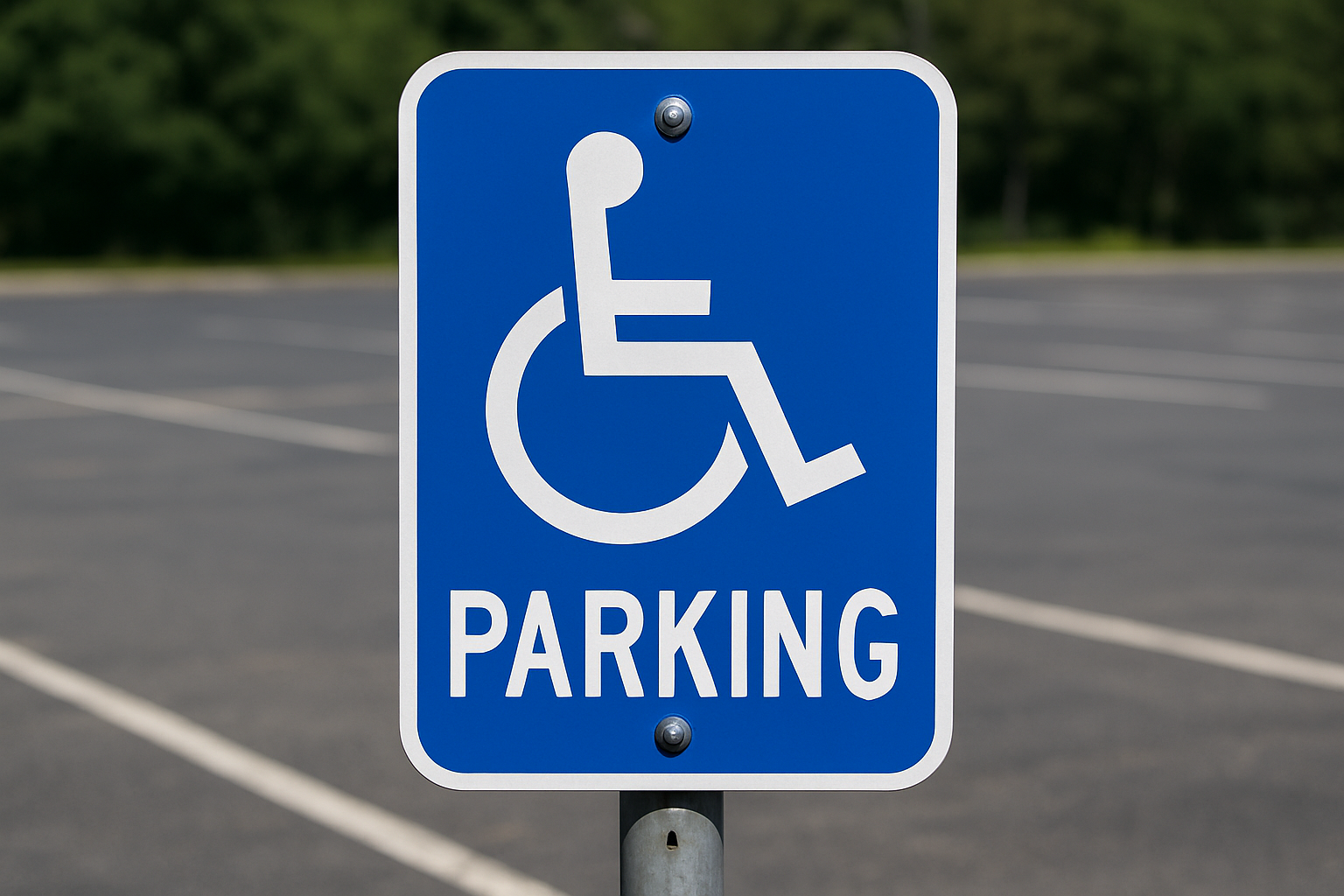
    ADA compliant handicap parking sign installed in a commercial lot

    ADA signage is a core part of any reliable striping and signage solutions package.

    Fire Lane Marking and Signage

    Fire lanes are typically painted red with white “Fire Lane, No Parking” lettering, following guidelines similar to those outlined in the Manual on Uniform Traffic Control Devices. These lanes must stay clear at all times so emergency vehicles can access buildings without delay.

    Local fire marshals often inspect these lanes, so property owners should work with a contractor who understands city-specific requirements in Denton and Plano.

    Thermoplastic Striping and Decals

    For properties wanting longer-lasting results, thermoplastic striping is a heated material that bonds directly to asphalt. Although it costs more upfront than paint, it can last three to five years, which often makes it the more economical choice over time. You can review specific thermoplastic striping and decal options to see how this material compares to standard paint for a specific property.

    How to Choose a Reliable Striping and Signage Solutions Provider

    Not every contractor delivers the same level of quality, so it helps to evaluate providers using a consistent process. The steps below outline what property owners should check before hiring anyone.

    1. Verify licensing and insurance. Confirm the contractor carries proper business licensing and liability insurance before allowing any work on the property, since this protects owners from unexpected costs.
    2. Ask about materials used. Request details on whether the company uses standard traffic paint or thermoplastic striping, because material choice directly affects durability and long-term cost.
    3. Confirm ADA compliance expertise. Ask how the provider calculates accessible stall ratios and van-accessible spacing, since incorrect ADA layouts can expose property owners to legal risk.
    4. Review past commercial projects. Look at photos or references from similar properties, such as retail centers or schools, to gauge the quality and consistency of previous striping work.
    5. Compare free quotes and timelines. Request written quotes from a couple of providers and compare turnaround time, warranty terms, and total pricing before signing any agreement.

    For a deeper look at vetting contractors, this resource on what to look for in a reliable striping service covers additional red flags to avoid.

    Striping and Signage Solutions: Cost and Timeline Expectations

    Pricing for striping and signage solutions depends on lot size, layout complexity, and the materials chosen. As a general guideline, standard paint striping tends to be more affordable per square foot, while thermoplastic carries a higher upfront cost but a longer lifespan.

    Most projects are completed within a single day for smaller lots, though larger retail or municipal properties may need two to three days. In addition, paint typically needs a short curing period, often just a few hours, before the lot reopens to traffic.

    One industry estimate suggests that well-maintained lot markings can improve parking efficiency by up to 10 to 15 percent simply by making stall boundaries clearer and reducing wasted space. This makes routine restriping a practical investment rather than just a cosmetic upgrade.

    Serving Denton, Plano, and the North Texas Region

    Property managers, retail centers, schools, healthcare facilities, and municipal organizations throughout Denton and Plano rely on local expertise because regional weather and traffic patterns affect how long markings last. Consequently, working with a contractor familiar with North Texas conditions tends to produce more durable results.

    Whether a property needs a brand-new layout or a simple refresh of faded lines, exploring dedicated parking lot striping services is a practical first step. From there, a site visit and free quote can clarify exact timelines and costs.

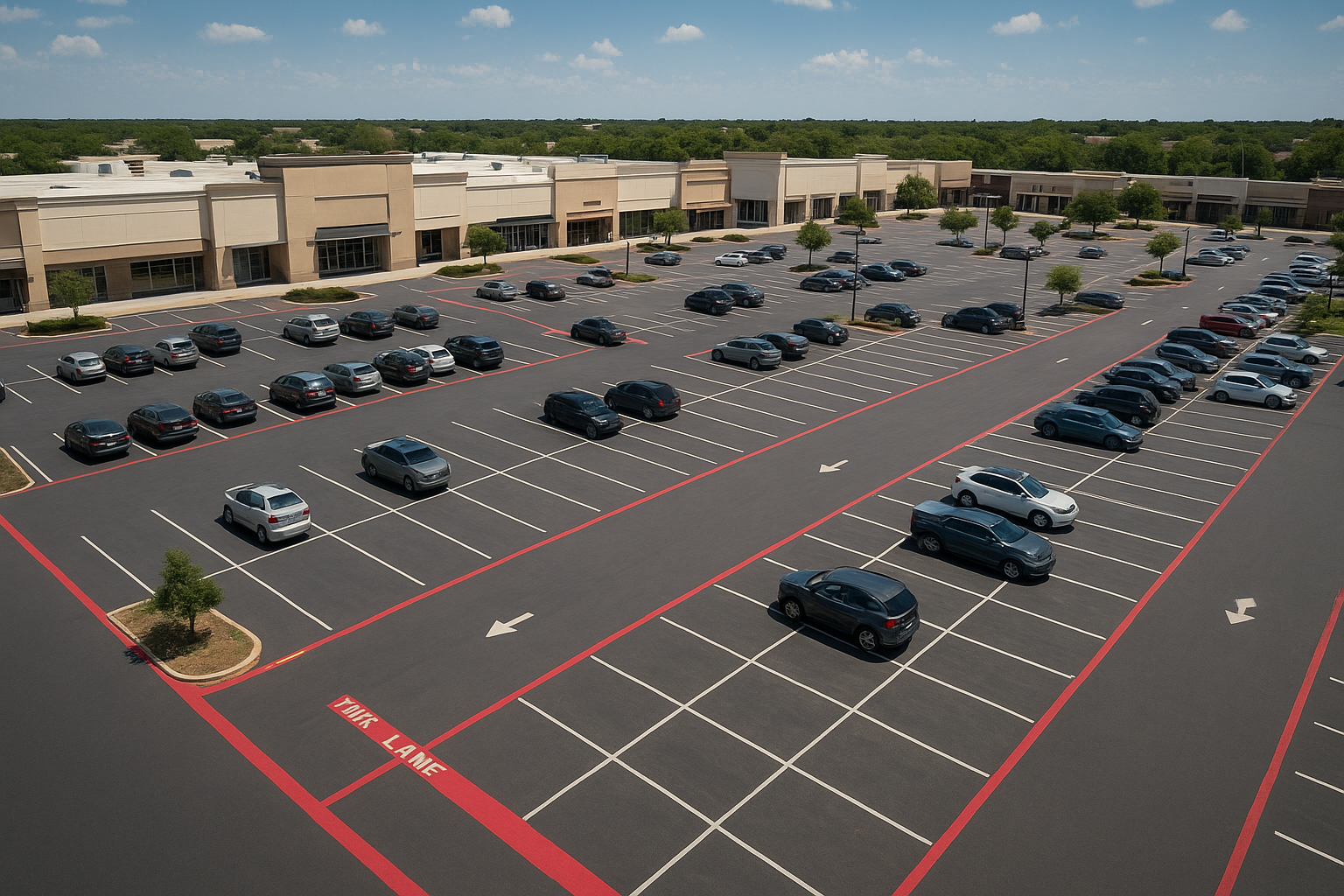
    Aerial view of fire lane markings and directional arrows in a parking lot

    Clear fire lane markings are a critical piece of any striping and signage solutions plan.

    Frequently Asked Questions

    What are striping and signage solutions?

    Striping and signage solutions are the combined services of painting parking lot lines and installing required signs, such as ADA handicap markings, fire lane designations, and directional arrows. Together, they keep a lot organized, safe, and compliant with local codes.

    How much do striping and signage solutions typically cost?

    Costs vary based on lot size, layout complexity, and material type, but most commercial projects range from a few hundred to several thousand dollars. Requesting a free, on-site quote is the most accurate way to get pricing for a specific property.

    How long does parking lot striping take to complete?

    Most parking lots can be striped in a single day, though larger properties or multi-phase projects may take two to three days. Curing time for paint adds a few extra hours before the lot can reopen to traffic.

    What is the difference between paint and thermoplastic striping?

    Traditional paint is more affordable and dries quickly, while thermoplastic striping is a heated, durable material that bonds to asphalt and lasts significantly longer. Thermoplastic costs more upfront but reduces how often restriping is needed.

    Why is ADA compliant striping important for property owners?

    ADA compliant striping ensures accessible parking stalls, van-accessible spaces, and access aisles meet federal accessibility law. Non-compliance can lead to fines, lawsuits, and denied access for people with disabilities.

    How often should a commercial parking lot be restriped?

    Most lots need restriping every 12 to 24 months, depending on traffic volume, climate, and the material originally used. High-traffic retail centers often need more frequent touch-ups than low-traffic office lots.

    What color are fire lane markings required to be in Texas?

    Fire lanes in Texas are typically marked with red paint and white lettering that reads “Fire Lane, No Parking,” following local fire marshal requirements. Specific rules can vary slightly by city, so checking with local authorities is recommended.

    Do old parking lot markings need to be removed before restriping?

    In most cases, old lines do not need full removal since fresh paint or thermoplastic can be applied directly over faded markings. However, if the layout is changing significantly, grinding or blacking out old lines helps avoid driver confusion.

    What common mistakes do property owners make with striping and signage solutions?

    Common mistakes include ignoring ADA stall ratios, using low-quality paint that fades quickly, and skipping fire lane signage entirely. Hiring an experienced contractor helps property owners avoid these costly, code-related errors.

    Do I need a permit for new parking lot signage?

    Permit requirements depend on the municipality and the scope of the signage project, especially for fire lanes and accessible parking. A local striping contractor familiar with Denton and Plano regulations can confirm what is needed before work begins.

    How do I choose a reliable striping and signage solutions provider?

    Look for a provider with proper licensing, insurance, ADA knowledge, and a portfolio of completed commercial projects. Comparing quotes and asking about materials used also helps ensure long-lasting results.

    What is included in a professional striping and signage solutions package?

    A typical package includes parking stall lines, ADA accessible markings, fire lane painting, directional arrows, curb painting, and required signage installation. Many providers also offer layout consulting to maximize available parking spaces.

    How long does striping paint last on average?

    Standard traffic paint generally lasts 12 to 18 months under normal weather and traffic conditions before it noticeably fades. Thermoplastic alternatives can last three to five years or longer in the same conditions.

    Final Thoughts on Striping and Signage Solutions

    Ultimately, striping and signage solutions are not a one-time expense but an ongoing part of responsible property management. From ADA compliance to fire lane visibility, each element plays a role in keeping visitors safe and a property free of avoidable liability.

    Whether a lot needs a full layout redesign or a simple refresh, working with an experienced local team makes the process straightforward. Property owners throughout Denton and Plano can request a free quote to get started, or explore more resources at stripespls.com to see how professional striping and signage solutions can improve a specific property’s safety and organization.

  • Accessible Parking Marking: ADA Compliance Guide for Lots

    Accessible Parking Marking: ADA Compliance Guide for Lots

    Accessible Parking Marking: The Complete ADA Compliance Guide for Property Owners

    Accessible parking marking is the painted system of ADA-compliant stalls, access aisles, wheelchair symbols, and signage that tells drivers exactly where reserved handicap spaces sit in a lot. However, getting this layout right is far more than a cosmetic choice — it is a legal obligation tied directly to federal accessibility law, and mistakes can trigger fines, lawsuits, and denied occupancy permits. In this guide, we go further than any competing resource by covering every dimension, material, cost factor, maintenance cycle, and compliance nuance that property owners in Denton and Plano, TX — and anywhere else in the country — need to understand before hiring a striping crew.

    Quick Answer: Accessible parking marking refers to the ADA-required stall widths, access aisles, painted symbols, and signage that designate handicap parking. Properties must meet minimum dimensions, van-accessible ratios, and route requirements — and faded or incorrect markings are one of the leading causes of ADA complaints against commercial lots.

    What Is Accessible Parking Marking?

    Accessible parking marking is the combination of painted stall lines, access aisles, the International Symbol of Accessibility, and posted signage that identifies ADA-reserved parking spaces. Specifically, these markings must follow dimension standards set out in the Americans with Disabilities Act, as well as any additional Texas building codes that apply on top of the federal minimum.

    Because these spaces serve people who use wheelchairs, walkers, or have limited mobility, precision matters enormously. A misaligned stall or an access aisle that is only a few inches too narrow can make a space effectively unusable, even though it looks compliant from a distance. For a broader overview of the disability rights framework behind these rules, the Wikipedia entry on the ADA offers useful historical context.

    Accessible parking marking with blue ADA stalls and access aisle in commercial lot

    Clear accessible parking marking helps drivers identify ADA stalls at a glance.

    Accessible Parking Marking vs. Standard Stall Striping

    Standard parking stalls only need to meet basic width and length guidelines set by local zoning code. ADA parking markings, in contrast, require specific access aisles, van-accessible ratios, and visible symbols that standard stalls never need. In addition, accessible stalls must connect to an unobstructed accessible route — a requirement that has no equivalent in ordinary striping work.


    Why Accessible Parking Marking Matters for Every Property

    Commercial properties nationwide face scrutiny from both state regulators and federal enforcement. As a result, outdated or faded ADA parking markings remain one of the most common triggers for accessibility complaints filed against retail centers, healthcare facilities, schools, and municipal buildings.

    Furthermore, well-executed accessible parking marking improves traffic flow and reduces liability. For example, clearly defined stalls and aisles reduce the risk of vehicle-to-vehicle contact and help drivers with mobility devices exit safely. Consequently, properties that invest in quality striping tend to see fewer complaints and smoother day-to-day operations.

    According to guidance published by the U.S. Access Board, roughly one in four adults in the United States lives with some form of disability. That statistic alone underscores why accurate accessible parking marking is not a minor detail — it directly affects a large share of visitors, customers, and employees every single day.

    The Legal Framework Behind ADA Parking Markings

    The dimensional rules for accessible parking marking trace back to the 2010 ADA Standards for Accessible Design, specifically Section 502 (parking spaces) and Section 208 (scoping requirements). Title III of the ADA applies these standards to nearly every commercial facility open to the public, while Title II covers state and local government lots. In Texas, the state building code layers on additional requirements enforced by the Texas Department of Licensing and Regulation, so properties technically answer to two overlapping sets of rules at once.

    What Happens When Accessible Parking Marking Fails

    When accessible parking marking is missing, faded, or incorrectly sized, three things typically follow. First, a visitor or advocacy group may file a formal complaint with the Department of Justice. Second, local building inspectors may flag the lot during a routine occupancy or renewal inspection. Third, and most costly, a property may face a private lawsuit under Title III, since the ADA allows individuals to sue for injunctive relief and attorney’s fees even without proof of injury.


    Key ADA Requirements for Handicap Parking Stripe Markings

    Handicap parking stripe markings must follow several dimensional rules. Below are the core requirements most commercial properties need to meet, regardless of state:

    • Standard accessible stalls: minimum 96 inches wide with a 60-inch access aisle.
    • Van-accessible stalls: 96-inch aisle or an 11-foot-wide stall, required at a ratio of roughly one in every six accessible spaces.
    • International Symbol of Accessibility painted in a contrasting, durable color within the stall.
    • Accessible route connecting stalls to the building entrance without curbs, steps, or obstructions.
    • Signage mounted at a specified height, visible even when a vehicle is parked in the space.
    • Running slope no greater than 1:48 (2.08%) in any direction across the accessible stall and aisle.

    Similarly, the number of required accessible stalls scales with total lot size. A lot with 500 to 1,000 spaces, for instance, typically needs at least 2% of its stalls to be accessible, per federal accessibility tables, while smaller lots under 25 spaces need only one accessible stall.

    Van-Accessible Space Ratio Explained

    Van-accessible spaces exist because wheelchair lifts and ramps need extra clearance to deploy safely beside a vehicle. Therefore, for every six accessible stalls painted in a lot, at least one must be van-accessible with either a wider 96-inch aisle or an 11-foot-wide stall paired with a standard 60-inch aisle. Skipping this ratio is one of the most frequently cited violations during accessibility audits.

    Accessible Route and Signage Standards

    Beyond the stall itself, accessible parking marking must connect to an unobstructed path leading to the building entrance. In particular, this accessible route cannot include a curb without a ramp cut, and it must be at least 36 inches wide. Signage, meanwhile, must sit high enough to remain visible even when a large vehicle occupies the adjacent space — typically 60 inches from the ground to the bottom of the sign.


    Step-by-Step Process for Accessible Parking Marking Installation

    Above all, a consistent process helps ensure every stall meets code the first time. Here is how a professional striping crew approaches an accessible parking marking project from start to finish:
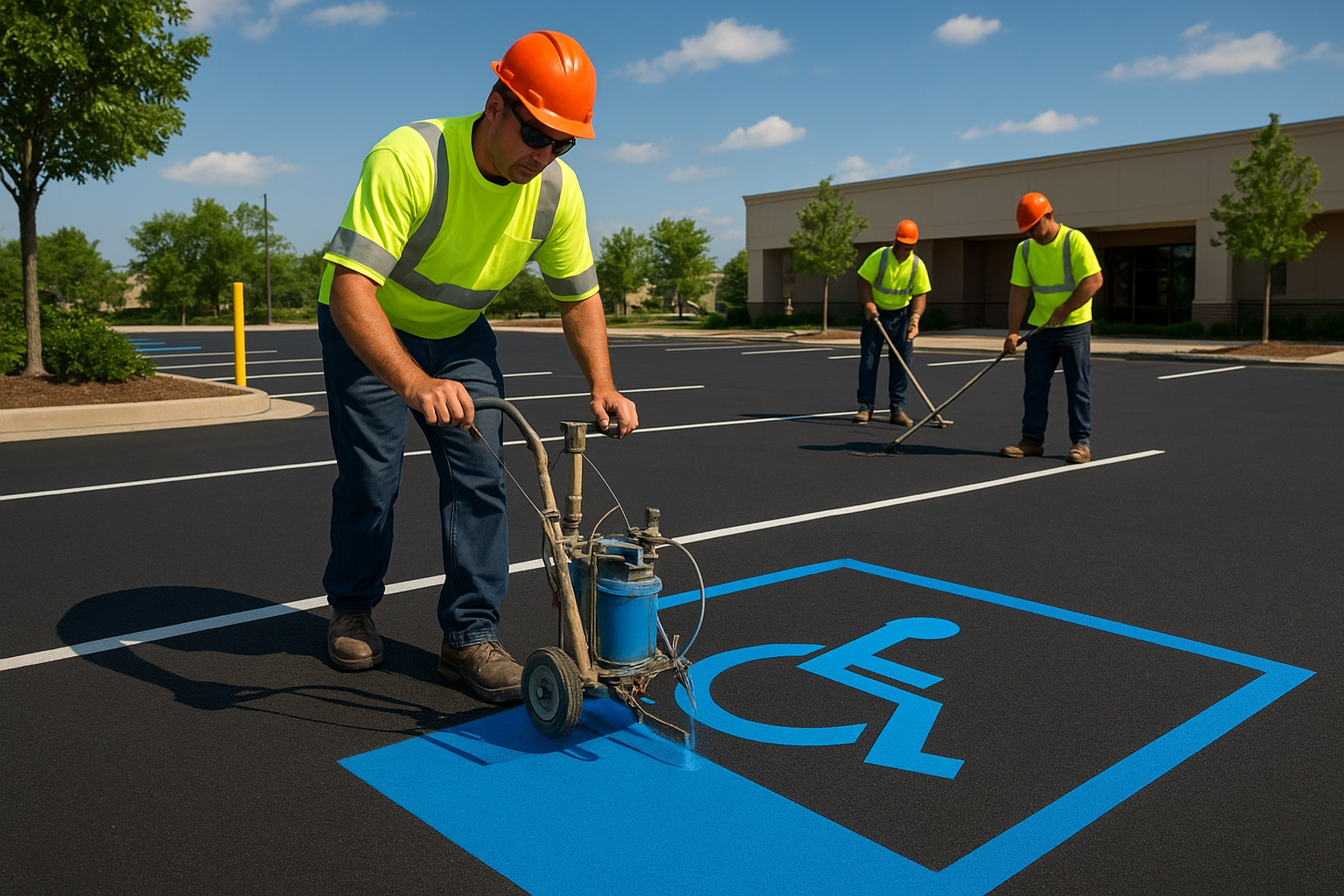
    1. Survey the lot and review code requirements. A technician measures the property and checks local, state, and ADA rules to determine the exact number of accessible and van-accessible stalls required.
    2. Calculate stall counts and placement. The crew positions accessible stalls as close as possible to accessible building entrances, following required ratios and slope limits.
    3. Lay out chalk lines for approval. Before any paint goes down, the layout is marked in chalk so property managers can confirm placement and raise concerns early.
    4. Prepare and clean the surface. Old paint, debris, and oil residue are removed so new markings adhere properly and resist premature fading.
    5. Apply stencils and premix traffic paint. Durable, reflective traffic paint is measured and mixed to spec before application to guarantee consistent coverage and color accuracy.
    6. Paint stalls, symbols, and signage. Crews paint the stall borders, access aisles, and wheelchair symbols, followed by proper signage installation at code-compliant height.
    7. Conduct a final compliance walkthrough. A last inspection confirms every dimension, ratio, and symbol meets ADA and local accessibility standards before the crew leaves the site.

    Materials Used in Accessible Parking Marking

    Not all paint performs the same way, so material choice affects how long accessible parking marking stays visible. Water-based traffic paint is the most common option because it is affordable and cures quickly, though it typically lasts 18 to 24 months in high-traffic Texas heat. Thermoplastic markings, by contrast, are heat-fused into the pavement and can last three to five years, making them a smart choice for high-traffic accessible stalls near hospital or retail entrances. Preformed tape markings offer a fast, low-odor alternative for indoor garages or properties that cannot tolerate paint fumes during business hours.


    Common Mistakes in Accessible Parking Space Markings

    Even well-intentioned property owners run into trouble with accessible parking space markings. In particular, watch for these frequent issues.

    First, undersized access aisles are among the most cited violations, since a few missing inches can render a stall noncompliant. Second, many older lots lack the required ratio of van-accessible spaces, especially after expansions or remodels changed the total stall count. Third, faded blue paint and worn symbols often go unnoticed until an inspection or complaint brings them to light. Fourth, property owners sometimes place accessible stalls on a slope steeper than 1:48, which makes wheelchair transfer dangerous even when the stall dimensions are technically correct.

    Therefore, routine inspection paired with a restriping schedule helps catch these problems before they become liabilities.

    Self-Audit Checklist for Property Managers

    Before an official inspection ever happens, property managers can walk the lot themselves using this quick checklist:

    • Measure at least one stall and aisle with a tape measure to confirm 96-inch minimums.
    • Count total accessible stalls against total lot capacity to confirm the correct percentage.
    • Verify at least one van-accessible stall exists for every six accessible spaces.
    • Check that painted symbols and borders are fully visible from a moving vehicle.
    • Confirm signage is present, upright, and readable at the required mounting height.

    What Accessible Parking Marking Costs

    Costs vary by lot size, paint type, and number of stalls, but most commercial properties pay between $75 and $250 per stall for full ADA marking, including symbols and signage. Thermoplastic markings cost more upfront — often two to three times the price of paint — but their longer lifespan can lower the total cost of ownership over five years. In addition, some businesses may qualify for a federal tax incentive: the IRS Disabled Access Credit (Form 8826) allows eligible small businesses to claim a credit for accessibility improvements, including ADA parking upgrades.

    Choosing a Professional Striping Company in Denton and Plano

    When it comes to accessible parking marking, precision and local code knowledge matter just as much as paint quality. Stripespls.com, based in Texas, specializes in professional striping, ADA compliance markings, and fire lane marking for commercial and residential properties throughout the Denton and Plano areas.

    The company works with property managers, retail centers, schools, healthcare facilities, and municipal organizations across North Texas. Whether a property needs a brand-new layout through parking lot striping services or a refresh of faded lines, requesting a free quote through the stripespls.com website is the fastest way to get an accurate assessment.

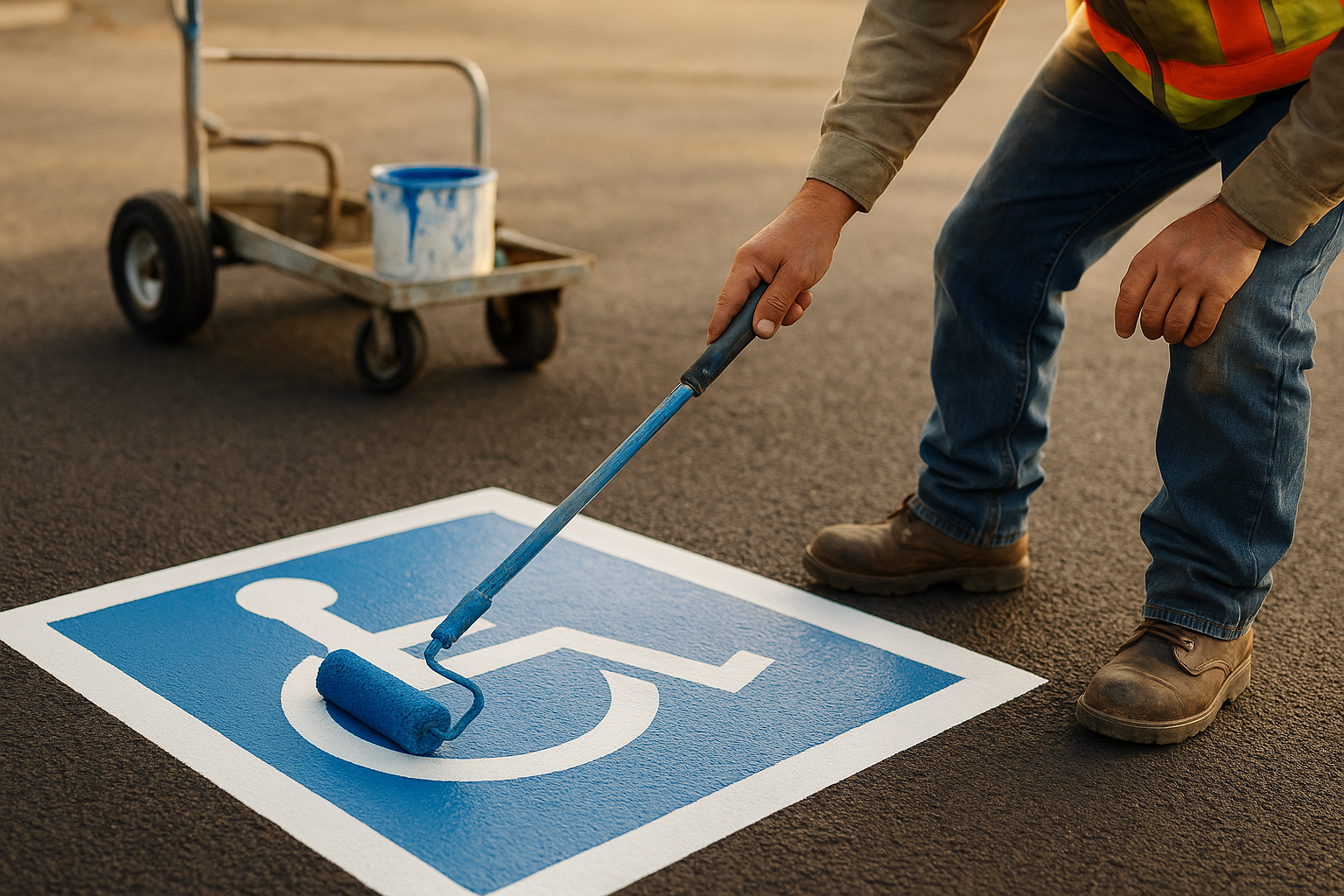
    Worker painting ADA compliant handicap symbol as part of accessible parking marking project

    Professional crews follow strict dimension and color standards for every accessible parking marking project.

    Maintaining Accessible Parking Markings Over Time

    Texas heat and UV exposure fade paint faster than in cooler climates. As a result, most commercial lots need touch-ups or full restriping every 18 to 24 months to keep accessible parking markings clearly visible and compliant.

    In addition, regular sweeping and periodic inspections help property owners catch fading or damage early, well before it becomes a compliance issue during an audit or complaint.


    Accessible Parking Marking Standards Beyond Texas

    While this guide focuses on Denton and Plano requirements, the underlying framework applies nationwide. Consequently, properties in Ohio, California, or any other state follow the same core 2010 ADA Standards for stall width, aisle size, and van ratios — states simply layer their own building code amendments on top. As a result, a property owner comparing quotes across regions should always confirm that a contractor understands both the federal minimum and the specific state or municipal code that applies to their address.


    Frequently Asked Questions

    What is accessible parking marking?
    Accessible parking marking is the painted layout of handicap stalls, access aisles, and symbols that comply with ADA and local building codes. It identifies reserved spaces for people with disabilities and directs safe pedestrian movement.

    Why is accessible parking marking required by law?
    Federal and state codes require accessible parking marking so properties remain compliant with the Americans with Disabilities Act. Noncompliant lots risk fines, lawsuits, and denied occupancy permits.

    How wide must an ADA accessible parking space be?
    A standard accessible stall must be at least 96 inches wide, paired with a 60-inch access aisle. Van-accessible spaces need a wider 96-inch access aisle or an 11-foot stall.

    What color paint is used for accessible parking markings?
    International Symbol of Accessibility markings are typically blue, while stall borders are often blue or white depending on local code. Municipalities may specify exact shades in their accessibility ordinances.

    How much does accessible parking marking cost?
    Costs vary by lot size, number of stalls, and paint type, but most properties pay between $75 and $250 per stall for full ADA marking. A free on-site quote gives the most accurate estimate.

    How long does it take to install accessible parking markings?
    Most commercial lots finish accessible parking marking within one day, though larger properties may take two. Weather and paint cure time also affect the final schedule.

    What’s the difference between accessible parking marking and fire lane marking?
    Accessible parking marking designates ADA stalls for people with disabilities, while fire lane marking keeps emergency access routes clear. Both are required separately and use different colors and signage.

    How often should accessible parking markings be repainted?
    Most parking lots need restriping every 18 to 24 months, though high-traffic lots in hot climates may fade sooner due to heat and UV exposure. Faded ADA lines should be refreshed immediately to avoid violations.

    What are common mistakes in accessible parking space markings?
    Common errors include undersized access aisles, missing van-accessible stalls, incorrect stall-to-total-space ratios, excessive slope, and faded symbols. These mistakes often surface during accessibility audits or complaints.

    Do residential properties need accessible parking markings?
    Multi-family residential properties, HOAs, and apartment complexes generally must provide accessible parking marking if they offer designated parking. Single-family homes typically are not required to comply.

    Can faded accessible parking markings result in fines?
    Yes, faded or missing ADA markings can trigger citations, civil complaints, and even lawsuits under the Americans with Disabilities Act. Regular inspection and prompt restriping help property owners avoid these penalties.

    What is the van-accessible parking space requirement?
    Van-accessible spaces require extra width or a wider access aisle to accommodate wheelchair lifts. Building codes typically require at least one van-accessible stall for every six accessible spaces.

    Who enforces ADA parking marking compliance in Texas?
    The Texas Department of Licensing and Regulation oversees accessibility compliance for public and commercial buildings statewide. Local municipalities and the U.S. Department of Justice may also enforce federal ADA standards, as outlined by the Texas Department of Licensing and Regulation.

    How do I request an accessible parking marking quote in Denton or Plano?
    Property owners in Denton and Plano can request a free quote directly through the stripespls.com website. A site assessment typically follows within a few business days.

    Is there a tax credit available for accessible parking marking upgrades?
    Yes, eligible small businesses may claim the IRS Disabled Access Credit using Form 8826 for qualifying accessibility improvements, which can include ADA parking marking upgrades.

    What ADA Standards section governs accessible parking marking?
    Section 502 of the 2010 ADA Standards for Accessible Design sets the dimensional rules for accessible parking marking, while Section 208 determines how many accessible stalls a lot needs overall.

    Do accessible parking marking requirements differ by state?
    The core federal ADA rules apply nationwide, but states and cities can add stricter local amendments. As a result, a compliant layout in one state may need small adjustments to meet another state’s building code.


    Final Thoughts on Accessible Parking Marking

    Ultimately, accessible parking marking protects both property owners and the people who rely on ADA-designated stalls every day. From correct stall widths to visible symbols, signage, and slope compliance, every detail plays a role in keeping a lot safe and legally sound.

    Consequently, routine inspections, a clear maintenance schedule, and timely restriping are the simplest ways to avoid fines and accessibility complaints. For property managers, retail centers, schools, and healthcare facilities across Denton and Plano, partnering with an experienced local striping team makes accessible parking marking one less thing to worry about. Above all, a clean, code-compliant lot reflects well on any property and supports every visitor who depends on those marked spaces.

  • School Parking Lot Striping: Complete Safety Guide for TX

    School Parking Lot Striping: Complete Safety Guide for TX

    School parking lot striping is the process of painting durable, code-compliant lines, symbols, and lettering across a campus lot to organize traffic, mark accessible parking, and protect fire lanes. For administrators in Denton, Plano, and across North Texas, this service directly shapes student safety, staff efficiency, and legal compliance every single school day. In addition, faded or missing pavement markings turn pickup and drop-off into a guessing game, right when dozens of vehicles, buses, and pedestrians converge on the same asphalt. This guide goes further than a typical overview — it breaks down ADA rules, fire lane codes, paint choices, real costs, and a full compliance checklist so campus leaders can plan with confidence.

    Direct answer: School parking lot striping combines ADA-compliant accessible stalls, fire lane marking, bus queuing lanes, directional arrows, and crosswalks into one coordinated layout. Done correctly, it reduces congestion at arrival and dismissal, keeps emergency access open at all times, and helps a campus satisfy federal and Texas accessibility law.

    What Is School Parking Lot Striping?

    School parking lot striping refers to the painted lines, symbols, and text applied to a school’s pavement to define parking stalls, traffic lanes, crosswalks, and fire lanes. It is a specialized branch of general parking lot striping services, adapted for the traffic patterns unique to K-12 and university campuses.

    Unlike a typical retail lot, school properties see concentrated bursts of activity twice a day. As a result, layouts must account for buses, parent vehicles, staff parking, and pedestrians moving through the same corridors within a narrow window — often 15 to 30 minutes at a time.

    Aerial view of school parking lot striping with ADA stalls, fire lane, and directional arrows

    A well-planned school parking lot striping layout separates bus lanes, ADA stalls, and staff parking for safer daily traffic.

    How School Lots Differ From Retail or Office Parking

    In a retail lot, cars come and go throughout the day at a steady, predictable pace. On a school campus, however, hundreds of vehicles arrive or leave within minutes, which is why layout precision matters so much more. Consequently, a striping plan built for a shopping center rarely transfers well to a school without significant redesign.


    Why Parking Lot Line Marking Matters for Student Safety

    Clear parking lot line marking reduces the risk of accidents during the busiest moments of the school day. Specifically, well-defined lanes keep pedestrians separated from moving vehicles and give drivers a predictable path through the lot.

    According to the National Highway Traffic Safety Administration, pedestrian fatalities in parking-related settings remain a persistent concern nationwide, which underscores why visible markings matter around schools. Furthermore, faded or absent lines force drivers to guess where to stop, turn, or yield, and that hesitation increases the chance of a collision near crosswalks.

    Above all, a striped lot communicates expectations without requiring a staff member to direct every vehicle by hand. Consequently, crossing guards and staff can focus on watching pedestrians rather than managing basic traffic direction, which is a far better use of their attention during dismissal.

    Bus Loading Zones and Pedestrian Walkways

    Buses need their own dedicated lane, physically separated from parent drop-off, with clearly painted boundary lines and stop bars. In particular, a marked pedestrian walkway leading from the bus zone to the building entrance keeps students out of moving traffic entirely. Similarly, staggering bus and parent drop-off times combined with distinct striped zones reduces the single biggest cause of campus traffic backups.


    ADA Compliance Requirements for School Parking Areas

    Every school parking lot must include a minimum number of accessible stalls based on total parking capacity, along with at least one van-accessible space. These requirements come from the Americans with Disabilities Act (ADA), a federal civil rights law that sets minimum accessibility standards for public and commercial facilities.

    In practice, this means accessible stalls need proper width, a marked access aisle, and vertical signage in addition to painted symbols. Similarly, curb ramps and crosswalks near accessible spaces must connect to a clear, unobstructed path of travel that leads directly into the building.

    Total Parking Spaces Minimum Accessible Stalls
    1 – 25 1
    26 – 50 2
    51 – 75 3
    76 – 100 4
    101 – 150 5
    151 – 200 6

    Ratios based on general ADA guidance; always confirm exact figures with the U.S. Access Board and local Texas code before finalizing a layout.

    Because ADA guidelines can be technical, many property managers rely on a specialist familiar with local Denton and Plano code overlays. For a deeper breakdown of layout standards, the asphalt striping guide to parking lot line marking covers stall dimensions and spacing in more detail.


    Fire Lane Marking and Traffic Flow at School Campuses

    Fire lane marking keeps emergency vehicle routes open at all times, which is critical during an evacuation or medical emergency on campus. Local fire codes, often based on National Fire Protection Association (NFPA) standards, typically require red curb paint paired with white lettering that reads “Fire Lane, No Parking,” positioned at intervals set by the authority having jurisdiction.

    In addition to fire lanes, thoughtful directional arrows and stop bars help guide buses and parent vehicles through separate paths. This separation is one of the most effective ways line striping can improve traffic flow, since it removes the guesswork that leads to gridlock during dismissal.

    For campuses experiencing regular backups at pickup time, reviewing how line striping can improve traffic flow in parking lots offers practical layout ideas beyond basic restriping.


    Paint and Material Options for School Parking Lot Striping

    Not all striping paint performs the same way under daily bus and vehicle traffic. Choosing the right material affects both durability and long-term cost, so it is worth comparing the three most common options before a project begins.

    Material Typical Lifespan Best Use
    Water-based acrylic 1–2 years Standard stalls, arrows, crosswalks
    Solvent-based paint 2–3 years Higher-traffic drive lanes
    Thermoplastic 4–7 years Bus lanes, crosswalks, ADA symbols

    Thermoplastic vs. Painted Lines for High-Traffic Zones

    Thermoplastic markings are melted onto the pavement rather than sprayed, which creates a thicker, more reflective surface. Because of this, thermoplastic holds up far longer under bus tires and heavy braking, making it the smarter long-term choice for bus lanes even though the upfront cost runs higher than standard paint.


    How to Plan a School Parking Lot Striping Project

    Planning ahead helps schools avoid rushed work and unnecessary disruption to daily operations. The following steps outline a practical, sequential approach that most North Texas campuses can follow from start to finish.

    1. Assess the current lot. Walk the entire property to note faded lines, cracked pavement, missing ADA stalls, and any blocked or obstructed fire lane access before writing a scope of work.
    2. Review local code requirements. Confirm current ADA stall ratios and fire lane rules specific to Denton or Plano municipal code before finalizing any new layout or design change.
    3. Request a professional site evaluation. An experienced contractor can measure the lot precisely and recommend a layout that improves both pedestrian safety and daily vehicle flow.
    4. Schedule during low-traffic periods. Weekends, evenings, or school breaks allow paint to cure fully without interference from daily bus routes or parent traffic on campus.
    5. Inspect and maintain the markings. Plan for restriping every one to two years to keep lines visible, reflective, and fully code-compliant year-round.

    Cost Factors for School Parking Lot Striping

    Pricing for school parking lot striping depends on several variables, so no two campuses pay exactly the same rate. Understanding these factors in advance helps administrators budget more accurately.

    • Lot size and stall count — larger lots require more paint and labor hours.
    • Paint material — thermoplastic costs more upfront than water-based paint but lasts longer.
    • Old paint removal — restriping projects with heavy grinding or blasting add labor time.
    • Signage and ADA symbols — vertical signs and stenciled symbols add to the total scope.
    • Scheduling window — night or weekend work can affect crew rates depending on the contractor.

    In short, most school projects range from a few hundred dollars for a small restriping touch-up to several thousand dollars for a full campus redesign. Requesting a free, itemized quote remains the most accurate way to budget a specific project.


    Signs a School Parking Lot Needs Restriping

    Over time, sun exposure, weather, and constant vehicle traffic wear down even high-quality paint. Recognizing the warning signs early helps a school avoid safety gaps before they become a genuine liability.

    Common indicators include chalky or barely visible stall lines, faded crosswalks near pedestrian entrances, and fire lane lettering that has worn away completely. Likewise, ADA symbols that have thinned or shifted out of alignment with the access aisle should be addressed right away, since misaligned markings can create a compliance violation even if the stall itself is still usable.

    Comparison of faded parking lines versus fresh striping showing why restriping is needed

    Comparing faded lines to fresh paint highlights why timely restriping keeps a lot safe and compliant.

    Schools that catch these signs early can schedule a simple restriping project rather than a full lot redesign, which typically saves both time and budget.


    School Parking Lot Striping Compliance Checklist

    Use this quick checklist during a walkthrough to spot compliance gaps before an inspector or parent notices them first.

    • ✅ Accessible stalls match the required ratio for total lot capacity
    • ✅ At least one van-accessible space with a wide access aisle is marked
    • ✅ Fire lane curbs are painted red with legible “Fire Lane, No Parking” lettering
    • ✅ Crosswalks near entrances and bus zones remain highly visible
    • ✅ Bus loading lanes are physically separated from parent drop-off
    • ✅ Directional arrows and stop bars guide one-way traffic flow
    • ✅ Restriping is scheduled at least every one to two years

    Choosing a Contractor for School Parking Lot Striping in North Texas

    Not every striping company understands the layout demands specific to school campuses, such as bus queuing lanes, staggered pickup zones, and strict ADA symbol placement. Therefore, it helps to work with a contractor that has direct experience serving educational properties in the region rather than one that primarily handles retail lots.

    StripesPLS, based in Texas, provides school parking lot striping, ADA compliance solutions, and fire lane marking for properties throughout the Denton and Plano areas. The team works with property managers, school districts, and healthcare facilities to deliver layouts tailored to each site’s traffic patterns rather than a one-size-fits-all template. For general background on how pavement markings function as a traffic control device, see this overview of road surface marking.

    Property managers can request a free quote directly through stripespls.com to get project-specific pricing before committing to a scope of work.


    Frequently Asked Questions About School Parking Lot Striping

    What is school parking lot striping?

    School parking lot striping is the process of painting traffic lines, ADA stalls, fire lanes, and directional markings on a campus lot. It organizes vehicle and pedestrian movement while keeping the property compliant with accessibility and fire codes.

    How often should a school restripe its parking lot?

    Most schools should restripe every 1 to 2 years, since heavy daily traffic from buses and parent pickup lines wears down paint faster than typical commercial lots. Faded lines should be repainted immediately once visibility drops.

    Why is fire lane marking required at schools?

    Fire lane marking is required so emergency vehicles have unobstructed access during evacuations or medical emergencies. Local fire codes typically mandate red curb paint and lettering that clearly states “Fire Lane, No Parking.”

    What ADA requirements apply to school parking lots?

    ADA rules require a minimum number of accessible stalls based on total parking count, van-accessible spaces with wider access aisles, and proper signage. The Americans with Disabilities Act sets the federal baseline, though some Texas municipalities add stricter local rules.

    How much does school parking lot striping cost?

    Costs vary by lot size, layout complexity, and paint type, but most school projects range from a few hundred to several thousand dollars. Requesting a free quote is the most accurate way to get a price specific to a campus.

    What paint is best for school parking lot striping?

    Water-based traffic paint and durable acrylic formulas are the most common choices because they dry quickly and resist fading. Thermoplastic markings last longer but cost more, making them better suited to high-traffic bus lanes.

    How long does a school parking lot striping project take?

    Most school lots are completed within one to two days, depending on size and the number of markings needed. Scheduling during weekends or school breaks helps avoid disrupting drop-off and pickup routines.

    What is the difference between striping and restriping?

    Striping refers to applying markings to a new or freshly paved lot, while restriping means repainting existing lines that have faded or shifted. Both require the same layout precision, but restriping often needs old paint removal first.

    Can school parking lot striping improve traffic flow?

    Yes, clearly marked lanes, arrows, and stop bars reduce confusion during high-volume pickup and drop-off periods. Well-planned striping separates bus lanes from parent vehicles, which lowers the risk of collisions and pedestrian incidents.

    What common mistakes happen with school parking lot markings?

    Common mistakes include undersized ADA stalls, missing van-accessible spaces, faded crosswalks near pedestrian zones, and fire lanes that are too narrow. Working with an experienced striping contractor helps avoid these compliance gaps.

    Do schools need a permit for parking lot striping?

    Permit requirements depend on the municipality and whether the project changes the existing traffic layout. Many restriping jobs that follow the original design do not require a new permit, but it is worth confirming with the local building department.

    What is the best time of year for school parking lot striping?

    Warmer, dry months allow paint to cure properly and reduce delays, making spring and summer breaks ideal in North Texas. Scheduling during a school holiday also minimizes disruption to daily campus operations.

    What is the difference between thermoplastic and painted striping?

    Thermoplastic markings are heat-applied and bond to the pavement surface, lasting four to seven years compared to one to two years for standard paint. Because of this durability, thermoplastic works best on bus lanes and crosswalks that see constant, heavy contact.

    Who enforces fire lane and ADA compliance at schools?

    Local fire marshals typically enforce fire lane compliance, while ADA accessibility falls under federal civil rights law with local building departments handling permitting. Schools should confirm both requirements with their municipality before a striping project begins.


    Final Thoughts on School Parking Lot Striping

    In summary, school parking lot striping is far more than a cosmetic upgrade. It plays a direct role in student safety, ADA compliance, fire code adherence, and smoother traffic flow during the busiest parts of the school day.

    Ultimately, schools that stay proactive about restriping avoid the safety gaps that come with faded lines and unclear fire lanes. For campuses throughout Denton and Plano, TX, requesting a professional evaluation is a straightforward first step toward a safer, well-organized lot. As referenced throughout this guide, resources at stripespls.com can help property managers get started with a free, no-obligation quote for their next school parking lot striping project.

  • Local ADA Striping Experts in Denton & Plano, Texas

    Local ADA Striping Experts in Denton & Plano, Texas

    ADA striping experts are the specialists property owners in Denton, Plano, and across North Texas rely on to keep parking lots safe, legally accessible, and free of costly compliance headaches. Faded blue paint, an undersized access aisle, or a missing van-accessible sign might seem minor, however these small details are exactly what trigger fines, lawsuits, and frustrated visitors. Therefore, this guide walks through everything a property manager needs to know before hiring ADA striping experts — from federal requirements and stall dimensions to real pricing, timelines, and the mistakes that cost the most to fix later.

    Unlike a typical service brochure, this resource goes deep. As a result, you will find technical specifications, cost breakdowns, paint comparisons, maintenance schedules, and a full FAQ built specifically to answer the questions property managers ask before signing a contract. In particular, we also cover how national ADA standards interact with state-level programs like California’s CASp inspections, so this guide is useful no matter where your property sits.

    Local ADA striping experts painting a handicap accessible parking space in Texas

    ADA striping experts measure stall widths and access aisles precisely before a single line goes down.

    What Are ADA Striping Experts?

    ADA striping experts are contractors who specialize in painting accessible parking stalls, access aisles, curb ramps, and van-accessible loading zones according to the Americans with Disabilities Act, a federal civil rights law that guarantees equal access for people with disabilities. Specifically, they combine three things a general painting crew usually lacks: precise field measurement, code-grade knowledge, and durable traffic paint rated for heavy vehicle use.

    In contrast, an untrained crew might paint a stall that looks perfectly fine to the eye yet still fails inspection because the access aisle is two inches too narrow or the signage sits at the wrong height. Consequently, hiring true ADA striping experts protects property owners long before a complaint or inspection ever happens.

    How ADA Striping Experts Differ From General Painting Crews

    General painting crews typically focus on aesthetics — clean lines, fresh color, and quick turnaround. ADA striping experts, however, layer compliance on top of aesthetics. For example, they verify stall counts against the total parking spaces, confirm slope tolerances so wheelchairs and walkers can move safely, and check that signage meets exact mounting height requirements. Above all, this dual focus is what separates a compliant lot from one that merely looks compliant.

    You can review the exact federal specifications these professionals follow inside the 2010 ADA Standards for Accessible Design, published by the U.S. Department of Justice.

    Why ADA Compliance Matters for Every Parking Lot

    ADA compliance is not optional guidance; it is a legal requirement for most commercial properties, including retail centers, schools, medical offices, and municipal buildings. According to the Centers for Disease Control and Prevention, roughly 1 in 4 adults in the United States lives with some type of disability. Therefore, accessible parking directly affects a significant share of every property’s visitors, employees, and customers every single day.

    In addition, non-compliant lots can trigger complaints filed with the Department of Justice or spark expensive civil lawsuits. Similarly, local fire codes require clearly marked fire lanes so emergency vehicles can respond without delay. Above all, an inaccessible parking lot sends the wrong message to every community a business serves.

    For background on the underlying legislation itself, see Wikipedia’s overview of the Americans with Disabilities Act.

    Federal Law, State Programs, and CASp Inspections

    Although ADA is a federal law that applies in every state, some states layer additional programs on top of it. In California, for instance, properties often undergo a Certified Access Specialist (CASp) inspection, a state-recognized review confirming accessibility compliance. In contrast, Texas relies primarily on the federal standard alongside local fire marshal and building code review.

    Either way, the underlying stall dimensions, slope limits, and signage rules trace back to the same source: the federal ADA Standards. Consequently, whether a property sits in Plano, Texas or anywhere else in the country, hiring ADA striping experts who understand both the federal baseline and any regional add-on program is the safest path to full compliance.

    Core ADA Parking Lot Requirements Explained

    Specifically, four elements determine whether a parking lot passes inspection: stall count, stall dimensions, slope, and signage. First, the number of required accessible stalls scales with total lot size — larger lots need proportionally more accessible and van-accessible spaces. Second, standard accessible stalls generally measure 96 inches wide with a 60-inch access aisle, though exact figures can shift based on local amendments.

    Third, surface slope cannot exceed 2 percent in any direction, since a steeper grade makes it unsafe for wheelchairs and walkers to travel across. Fourth, signage must be mounted at a minimum height, be reflective for nighttime visibility, and clearly indicate any van-accessible designation.

    Quick reference: Federal code requires at least one van-accessible space for every six accessible stalls. Skipping this ratio is one of the most common — and most expensive — mistakes property owners make.

    Standard vs. Van-Accessible Spaces

    Van-accessible spaces include a wider access aisle — typically 96 inches — to accommodate wheelchair lifts and ramps. Standard accessible spaces, on the other hand, use a narrower 60-inch aisle. Therefore, a lot that only paints standard stalls without any van-accessible spaces is not compliant, regardless of how fresh the paint looks.

    How to Choose the Right ADA Striping Experts

    Choosing the right contractor takes more than a quick online search. Instead, follow this five-step process to compare candidates fairly before signing anything.

    1. Verify ADA and local code knowledge. Confirm the contractor understands current federal ADA Standards along with any city-specific fire lane and signage codes in your area, since local rules often add requirements on top of the federal baseline.
    2. Check licensing, insurance, and local experience. Ask for proof of insurance and examples of completed commercial projects nearby, because local experience helps crews anticipate inspection quirks before they become problems.
    3. Request a written measurement and paint plan. A qualified crew should provide a written layout showing accessible stall counts, van-accessible spaces, slope notes, and the exact traffic-grade paint being used on your surface.
    4. Ask for references or completed project photos. Reviewing before-and-after photos or speaking with past clients confirms the contractor consistently delivers clean, code-compliant results across different property types.
    5. Compare free quotes and warranty terms. Requesting multiple free quotes and comparing warranty coverage helps property owners choose confidently, and it also reveals which contractors are transparent about their pricing structure.

    For a deeper dive into vetting contractors, this resource on what to look for in a reliable striping service covers additional red flags worth watching for before you sign.

    Freshly painted ADA compliant handicap parking symbol on commercial asphalt lot

    Crisp, durable paint keeps accessible parking symbols visible for months after installation.

    Full Range of Services Provided by ADA Striping Experts

    Beyond accessible stall painting, most ADA striping experts offer a full menu of related services. For example, this typically includes fire lane marking, directional arrows, curb painting, wheel stop installation, and complete lot layout redesigns for freshly paved surfaces. For a deeper walkthrough, see our Road Marking Services Texas: Expert Striping Guide.

    • Accessible stall and access-aisle painting with wheelchair symbols
    • Van-accessible space marking and required signage installation
    • Fire lane painting and “No Parking Fire Lane” lettering
    • Directional arrows, crosswalks, and pedestrian pathway markings
    • Full lot layout design for new construction and repaving projects

    If you are comparing regional options, this breakdown of companies offering parking lot striping across DFW is a helpful starting point, and property owners near Dallas can also check this guide on what to know about parking lot striping in Dallas.

    Signs You Need Certified ADA Striping Contractors Now

    Faded blue paint, peeling wheelchair symbols, and worn stall lines are the most obvious signals. However, less obvious issues include incorrect access aisle widths, a missing van-accessible sign, or a slope that has shifted after years of asphalt settling.

    In these cases, hiring certified ADA striping contractors sooner rather than later reduces the odds of a surprise fine during a city inspection. For more technical background, this asphalt striping guide to parking lot line marking explains paint types and layout basics in more detail.

    What Does ADA-Compliant Striping Cost?

    Pricing depends on lot size, the number of accessible stalls required, and current surface condition. Generally speaking, though, professional ADA striping costs far less than the fines or legal fees tied to non-compliance. Specifically, most projects are priced per stall or per linear foot, with signage and fire lane lettering quoted separately.

    As a result, most property managers find it more cost-effective to schedule regular restriping every 18 to 24 months rather than waiting for a complaint to force the issue. If you are curious who handles this work well locally, see this guide on who does the best parking lot striping in Denton, TX.

    Paint Types Compared: Acrylic vs. Thermoplastic

    Most ADA striping experts use one of two paint systems. Traffic-grade acrylic paint dries quickly and costs less upfront, making it popular for standard restriping cycles. Thermoplastic, in contrast, is heated and fused directly into the asphalt, lasting considerably longer under heavy traffic and intense sun exposure.

    Therefore, high-traffic properties — think grocery stores, hospitals, and schools — often benefit from thermoplastic despite the higher initial cost, since fewer repaint cycles offset the price difference over time.

    How Long Does the Striping Process Take?

    Most commercial lots can be striped in a single day, though larger properties or complete restriping projects may take one to two days. Weather and paint cure time can also affect the schedule, so ADA striping experts typically plan around dry, mild conditions to guarantee a clean, durable finish.

    Aerial view of a fully striped commercial parking lot with ADA compliant markings

    A well-organized, fully striped lot improves both safety and accessibility for every visitor.

    Maintenance Schedule: How Often to Restripe

    Most parking lots need restriping every 18 to 24 months, though high-traffic Texas properties exposed to intense sun may need it sooner. Faded blue paint or peeling symbols are a clear sign it’s time to call ADA striping experts back for a refresh.

    In addition, property managers should schedule a quick visual inspection every quarter. This way, small fading issues get caught early, well before they turn into a full compliance failure during a city or insurance walkthrough.

    Common ADA Layout Mistakes to Avoid

    Common mistakes include placing accessible spaces too far from building entrances, using incorrect stall widths, and forgetting van-accessible aisle requirements. Similarly, some properties paint the correct number of stalls overall but forget to distribute van-accessible spaces evenly across multiple building entrances.

    Working with experienced ADA striping experts helps property owners avoid these costly errors, since a trained eye catches problems a standard walkthrough often misses.

    Why Property Managers Choose stripespls.com’s ADA Striping Experts

    As a full-service parking lot marking company based in Texas, stripespls.com specializes in professional striping, ADA compliance solutions, and fire lane marking for commercial and residential properties throughout Denton and Plano. In particular, the team serves property managers, retail centers, schools, healthcare facilities, and municipal organizations across the greater North Texas region. For a deeper walkthrough, see our Line Marking Services for Parking Lots | stripespls.com.

    Whether a client needs handicap stall markings, fire lane designation, directional arrows, or a full lot refresh, the crew tailors each project to the property’s specific needs. Above all, prospective clients can request a free quote directly through stripespls.com.

    You can also review official accessibility guidance from the U.S. Access Board, the federal agency responsible for developing ADA accessibility standards, to compare against any quote you receive.

    Service Areas We Cover

    ADA striping experts from stripespls.com typically serve the greater North Texas region, including Denton, Plano, and surrounding DFW communities. Coverage areas usually include commercial centers, schools, healthcare facilities, and municipal properties, with scheduling flexible enough to accommodate after-hours work when lots need to stay open during the day.

    Frequently Asked Questions About ADA Striping Experts

    What is ADA compliant parking lot striping?

    ADA compliant parking lot striping refers to line markings, symbols, and signage that meet accessibility requirements set by the Americans with Disabilities Act. This includes properly sized accessible stalls, access aisles, and van-accessible spaces painted with approved dimensions and colors.

    How do ADA striping experts determine the number of accessible spaces needed?

    ADA striping experts calculate required accessible spaces based on the total number of parking spots, following the ratio table published in the 2010 ADA Standards for Accessible Design. Larger lots need a higher number of accessible and van-accessible stalls.

    How much does ADA striping cost in Denton and Plano, TX?

    Pricing varies by lot size, number of accessible stalls, and paint condition, but most Denton and Plano properties pay a modest amount per space compared to potential non-compliance fines. Requesting a free quote is the fastest way to get an accurate number.

    How long does ADA parking lot striping take to complete?

    Most commercial lots can be striped in a single day, though larger properties or complete restriping projects may take one to two days. Weather and paint cure time can also affect the schedule.

    What happens if my parking lot isn’t ADA compliant?

    Non-compliant lots can expose property owners to civil rights complaints, lawsuits, and fines from state or federal agencies. In addition, non-compliance can create real safety hazards for visitors with mobility challenges.

    How often should ADA parking markings be repainted?

    Most parking lots need restriping every 18 to 24 months, though high-traffic properties exposed to intense sun may need it sooner. Faded blue paint or peeling symbols are a clear sign it’s time.

    What’s the difference between van-accessible and standard accessible spaces?

    Van-accessible spaces include a wider access aisle to accommodate wheelchair lifts, while standard accessible spaces have a narrower aisle. Federal code requires at least one van-accessible space for every six accessible stalls.

    Can I stripe my own parking lot instead of hiring ADA striping experts?

    While general striping can sometimes be done in-house, ADA-specific work requires precise measurements, signage placement, and code knowledge that most property staff don’t have. Hiring ADA striping experts reduces the risk of costly compliance mistakes.

    What paint is used for ADA-compliant striping?

    Most contractors use durable traffic-grade acrylic or thermoplastic paint designed to withstand vehicle traffic, UV exposure, and weather. These paints hold color and visibility far longer than standard exterior paint.

    Do fire lanes need to be marked separately from ADA spaces?

    Yes, fire lanes are a separate safety requirement, typically marked with red curb paint and “No Parking Fire Lane” lettering per local fire code. They serve a different purpose than ADA accessible parking markings.

    What areas do ADA striping experts serve near Denton and Plano?

    ADA striping experts typically serve the greater North Texas region, including Denton, Plano, and surrounding DFW communities. Coverage areas usually include commercial centers, schools, healthcare facilities, and municipal properties.

    How do I get a free quote for ADA striping?

    Most striping companies, including stripespls.com, offer a simple online form or phone call to request a free quote. Property owners typically just need to share the lot size and current condition of existing markings.

    What mistakes should I avoid when planning ADA parking layouts?

    Common mistakes include placing accessible spaces too far from building entrances, using incorrect stall widths, and forgetting van-accessible aisle requirements. Working with experienced contractors helps property owners avoid these costly errors.

    Are ADA striping requirements different for new construction vs. existing lots?

    New construction must fully meet current ADA Standards, while existing lots generally follow a “readily achievable” standard for updates. However, any major renovation or restriping project usually triggers full compliance requirements.

    Does a CASp inspection replace the need for ADA striping experts?

    No, a CASp inspection identifies compliance issues, but it does not fix them. Property owners still need experienced ADA striping experts to repaint stalls, correct signage, and address any violations the inspection uncovers.

    Final Thoughts

    In summary, ADA striping experts help property owners avoid fines, protect visitors, and maintain a professional appearance across their parking facilities. From accurate stall measurements to durable traffic-grade paint, the right contractor turns accessibility compliance into a straightforward, predictable process rather than a stressful one.

    Ultimately, whether you’re refreshing faded lines or planning a brand-new lot layout in Denton or Plano, working with experienced ADA striping experts ensures the job gets done right the first time. For a tailored quote, visit stripespls.com and take the next step toward a fully compliant, well-marked property.
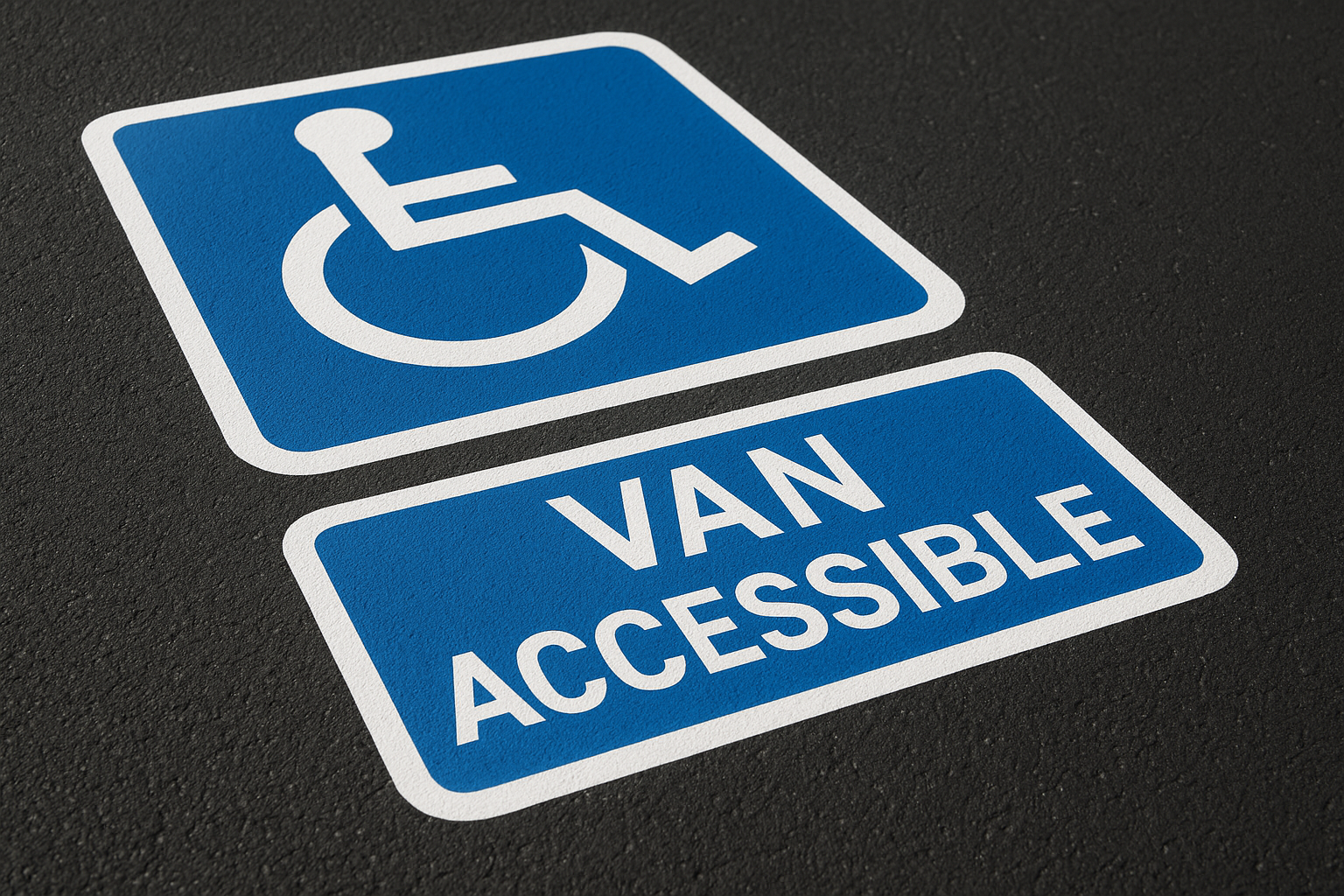
  • Safety Compliance Parking Lot Striping: Complete Guide

    Safety Compliance Parking Lot Striping: Complete Guide

    Safety compliance parking lot striping is the process of measuring, painting, and maintaining ADA-compliant stalls, fire lanes, and directional markings so a commercial property meets current accessibility and fire-safety codes. For property owners, this single line of work touches everything from visitor safety and emergency access to municipal inspections and insurance liability. In this guide, you will learn exactly what compliant striping requires, how the dimension and color standards work, what the project typically costs, how often lines need refreshing, and how to choose a contractor who gets every measurement right the first time.
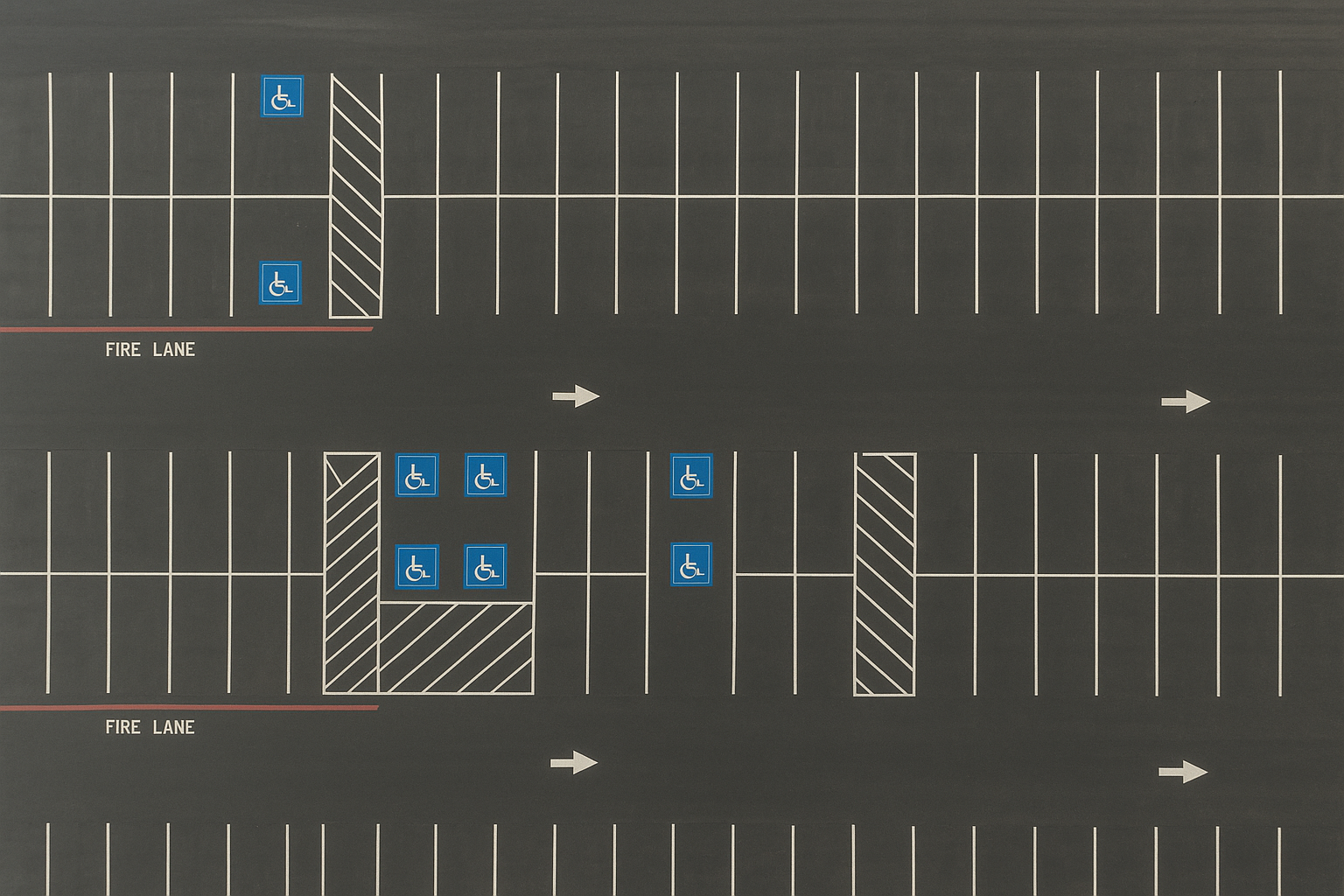
    Quick Answer: Safety compliance parking lot striping combines ADA-required accessible stalls, correctly marked fire lanes, and clearly painted traffic lines that meet exact dimension and color standards. Most commercial lots need this refreshed every 18 to 24 months, and the required number of accessible stalls, fire lane width, and paint colors are all set by specific federal and local codes covered in detail below.


    What Is Safety Compliance Parking Lot Striping?

    Safety compliance parking lot striping refers to painted markings — stall lines, accessible parking symbols, fire lane borders, wheel stops, and directional arrows — that satisfy federal and local codes at the same time. Specifically, it includes ADA (Americans with Disabilities Act, the federal civil rights law requiring accessible facilities) accessible stalls, fire lane designations required by local fire marshals, and traffic-flow markings such as arrows and stop bars.

    In addition, compliant striping must meet exact dimension and color standards, not just look tidy. For example, a stall that looks fine visually can still fail an inspection if it is two inches too narrow, uses the wrong blue, or is missing a required access aisle. Because of this, safety compliance parking lot striping is really a technical discipline, not a cosmetic one.

    Why Parking Lot Striping Compliance Matters for Every Property Owner

    However, compliance is not just a box to check. Poorly marked lots create real hazards: cars parked too close together, blocked fire lanes that delay emergency response, and confusing traffic patterns that lead to fender-benders or worse.

    As a result, property owners who neglect striping face more than safety risks. Fines, lawsuits under the ADA, and failed municipal inspections are all common consequences of ignoring parking lot striping compliance. A well-maintained parking lot striping plan also improves how a property looks and functions for every visitor, employee, and delivery driver who uses it.

    Aerial view of safety compliance parking lot striping with ADA accessible space and fire lane markings

    Clear, code-compliant striping keeps traffic flow organized and ensures safety compliance parking lot striping standards are met.


    ADA Requirements for Compliant Parking Lot Striping

    The ADA sets specific, non-negotiable rules for accessible parking, and these requirements scale directly with the total number of spaces in a lot. In particular, lots with 1 to 25 total spaces need at least one accessible stall, while larger lots require proportionally more, including van-accessible spaces with wider access aisles.

    Accessible Stall Ratios by Lot Size

    Because inspectors check this ratio first, it is worth memorizing. The table below summarizes the federal minimums that apply to most commercial lots.

    Total Parking Spaces Minimum Accessible Stalls
    1–25 1
    26–50 2
    51–75 3
    76–100 4
    101–150 5
    151–200 6
    501–1000 2% of total

    At least one out of every six accessible spaces, and never fewer than one, must be van-accessible with a wider access aisle. Consequently, small lots cannot skip this requirement just because they only need a single accessible stall.

    Van-Accessible Stalls and Access Aisle Widths

    Furthermore, accessible stalls must be painted blue with the International Symbol of Accessibility and located on the shortest accessible route to the building entrance. Standard accessible aisles must be at least 60 inches wide, while van-accessible aisles need at least 96 inches, or 132 inches where a lot uses shared aisles between two stalls.

    For a deeper breakdown of layout standards, our asphalt striping guide covers dimension specifics in detail. You can also review official guidance directly through ADA.gov for the latest federal standards, or the International Symbol of Access on Wikipedia for background on the accessibility symbol itself.


    Fire Lane Striping and Local Fire Code Requirements

    Fire lanes are typically painted red with white lettering that reads “Fire Lane — No Parking,” and most local fire codes require a minimum clear width of 20 feet. Consequently, blocked or faded fire lanes can delay emergency vehicle access, which is precisely why fire marshals routinely inspect commercial properties.

    Local requirements vary, so it is worth checking with the municipality or referencing OSHA’s general safety guidance at OSHA.gov when planning a layout. Similarly, the federal Manual on Uniform Traffic Control Devices (MUTCD) outlines standard colors and layouts used nationwide, while the National Fire Protection Association (NFPA) publishes the fire lane and access standards most local codes are built on.

    Above all, lettering height matters as much as color. Most jurisdictions require letters at least 3 inches tall spaced no more than 25 feet apart along the curb or pavement edge, so drivers see the warning well before they park.

    Red fire lane pavement marking demonstrating parking lot fire safety compliance

    Properly marked fire lanes keep emergency access clear at all times.

    Traffic Flow Markings: Arrows, Stop Bars, and Lane Lines

    In particular, directional arrows, stop bars, crosswalks, and yield triangles guide vehicles and pedestrians safely through a lot. Without them, drivers guess at right-of-way, and guessing near a busy entrance is where most parking lot fender-benders happen.

    Specifically, one-way arrows should be repeated every 100 feet in long drive aisles, stop bars belong 4 feet before any stop sign or crosswalk, and pedestrian crosswalks near building entrances should use high-visibility ladder-style striping rather than two plain parallel lines. Similarly, speed bumps and speed humps should always be paired with painted warning triangles or hatching so drivers see them at night.


    Paint, Thermoplastic, and Equipment Used in Compliant Striping

    Materials matter almost as much as layout. Standard waterborne traffic paint is the most common choice because it is affordable and dries quickly, but it typically lasts only 12 to 18 months under heavy traffic.

    In contrast, thermoplastic pavement marking — a heat-applied material that bonds directly into the asphalt surface — can last 5 to 8 years and holds up far better against snowplows, sun, and constant tire wear. Consequently, many high-traffic properties choose thermoplastic for fire lanes and accessible stall symbols even though the upfront cost is higher, because the long-term durability protects compliance between inspections.

    Professional crews also rely on specific equipment to guarantee accuracy: layout chalk lines and lasers for measurement, airless striping machines for clean paint edges, and stencils for accessibility symbols, arrows, and fire lane lettering. Therefore, a contractor’s equipment list is a fair predictor of how precise the finished markings will be.

    Parking Lot Striping Layout Standards and Stall Dimensions

    Beyond ADA and fire lane rules, standard stall dimensions still need to meet local zoning and code minimums. The table below shows the dimensions most municipalities expect for standard, compact, and accessible stalls.

    Stall Type Typical Width Typical Length
    Standard stall 9 feet 18 feet
    Compact stall 8 feet 16 feet
    Accessible stall 8 feet + 5 or 8 ft aisle 18 feet
    Van-accessible stall 8 feet + 8 ft aisle 18 feet

    These figures are typical minimums; some municipalities require slightly wider stalls or additional drive-aisle clearance, so it is worth double-checking with a local building department before finalizing a layout.


    How to Achieve Safety Compliance Parking Lot Striping: Step-by-Step

    Bringing a lot into compliance is straightforward once it is broken into clear steps. Below is the process professional crews follow from initial assessment to final inspection.

    1. Assess current markings. Walk the property with a compliance checklist, measuring existing stall widths, fire lane clearances, and ADA stall counts against current codes and noting any faded or missing lines.
    2. Calculate accessible space requirements. Determine the exact number of ADA and van-accessible stalls required based on the lot’s total parking capacity, using the federal ratio table as a baseline.
    3. Design the layout on paper first. Map stall dimensions, drive-aisle widths, fire lane routes, and accessible paths before any paint touches the asphalt, so mistakes get caught on a drawing instead of on the pavement.
    4. Select durable materials. Choose high-grade traffic paint or thermoplastic rated for the correct colors, including blue for accessible stalls, red for fire lanes, and yellow or white for standard traffic lines.
    5. Apply markings to code. Follow MUTCD standards for stall dimensions, access aisle widths, fire lane lettering height and spacing, and directional arrow placement throughout the lot.
    6. Schedule follow-up inspections. Set a recurring restriping schedule every 12 to 24 months so markings stay visible, legible, and fully inspection-ready year-round.

    Above all, consistency matters more than perfection on the first pass. Therefore, many property owners partner with a specialist rather than tackling this in-house — our restriping services page outlines what that process looks like from start to finish.

    Cost of Safety Compliance Parking Lot Striping

    Pricing varies by lot size, layout complexity, and material choice, but most commercial striping projects run from a few hundred to several thousand dollars. In general, per-stall pricing gives a useful ballpark for budgeting.

    Project Element Typical Cost Range
    Standard stall line (paint) $2 – $7 per stall
    ADA accessible stall with symbol $75 – $150 per stall
    Fire lane striping and lettering $1.50 – $3 per linear foot
    Full lot restriping (mid-size lot) $800 – $3,500

    Because every lot is different, getting a free quote is still the most accurate way to estimate cost. To understand the full impact of timing on cost and appearance, see why fresh striping matters for your property.


    Common Mistakes That Break Parking Lot Striping Compliance

    Even well-intentioned property managers make avoidable errors. In particular, too few accessible stalls, missing access aisles, and faded fire lane paint are the most frequent violations found during inspections.

    • Incorrect stall widths that fail local zoning minimums
    • Access aisles painted too narrow for van-accessible stalls
    • Faded or peeling fire lane lettering that is no longer legible from a vehicle
    • Confusing or missing directional arrows near entrances and exits
    • Accessible stalls placed too far from the building’s accessible entrance

    Regular audits, ideally paired with a professional walk-through, catch these problems before an inspector does.

    How Often Should Compliant Striping Be Refreshed?

    Most commercial lots need restriping every 18 to 24 months, though high-traffic retail centers or schools may need it annually. Sun, heat, and general wear all accelerate fading faster than many owners expect.

    In fact, one industry estimate suggests that pavement markings can lose up to 50% of their reflectivity within the first year of heavy traffic exposure. That is why routine visual checks matter as much as the calendar.

    Large commercial parking lot with fresh line striping and directional arrows for traffic flow

    Fresh, well-maintained lines support both safety compliance parking lot striping goals and smoother traffic flow.


    DIY Striping vs Hiring a Professional Contractor

    Small lots can technically be striped with rented equipment and store-bought paint. However, most commercial properties need professional-grade layout accuracy to meet code, and a single miscalculated aisle width can trigger a failed inspection.

    In contrast, a licensed contractor carries liability insurance, understands current ADA and fire code ratios, and uses commercial-grade paint or thermoplastic rated for heavy traffic. Consequently, the labor savings of a DIY project rarely offset the risk of a compliance failure, a re-do, or a liability claim down the road.

    State and Local Code Variations Property Owners Should Know

    While the ADA sets a federal floor, states and municipalities can add stricter requirements on top of it. For example, some cities require wider fire lanes than the federal 20-foot minimum, additional signage at accessible stalls, or specific paint reflectivity ratings for night visibility.

    Therefore, it is never safe to assume that meeting the federal minimum automatically satisfies a local fire marshal or building inspector. Similarly, some counties require a licensed contractor’s stamped layout plan before a certificate of occupancy is issued, so checking with the local permitting office early saves time and rework later.

    Choosing a Professional Striping Contractor in Denton and Plano

    Because compliance details are precise, hiring an experienced local crew reduces risk significantly. A contractor familiar with North Texas municipal codes, like the team at stripespls.com, understands both ADA rules and local fire marshal expectations.

    Property managers, retail centers, schools, and healthcare facilities across Denton and Plano rely on professional crews for consistent results. For a broader look at how proper markings affect vehicle and pedestrian movement, review this guide on how line striping improves traffic flow.


    Frequently Asked Questions About Safety Compliance Parking Lot Striping

    What is safety compliance parking lot striping?
    It is the practice of painting stall lines, ADA accessible spaces, fire lanes, and directional arrows so a property meets federal and local accessibility and fire codes. It protects visitors and reduces the property owner’s legal liability.

    How often should a parking lot be restriped for compliance?
    Most commercial lots need restriping every 18 to 24 months, though high-traffic properties may need it annually. Faded lines are a common cause of compliance failure during inspections.

    What are the ADA requirements for parking lot striping?
    ADA rules require a minimum number of accessible stalls based on total spaces, van-accessible spaces with wider access aisles, and blue paint with the International Symbol of Accessibility. The exact ratio scales with lot size.

    How wide should a fire lane be marked?
    Fire lanes are typically marked with red paint and lettering, and most local fire codes require a minimum clear width of 20 feet. Local fire marshals can require additional width for specific building types.

    What color paint is required for handicap parking spaces?
    Blue paint is the standard color for ADA accessible stalls and the accessibility symbol, while access aisles are usually striped in blue or white diagonal lines.

    How much does compliant parking lot striping cost?
    Pricing varies by lot size and layout complexity, but most commercial striping projects run from a few hundred to several thousand dollars. Getting a free quote is the most accurate way to estimate cost.

    How long does new striping take to dry?
    Standard traffic paint typically dries to the touch within 30 minutes but should not be driven on for at least an hour. Full cure time can take up to 24 hours.

    What happens if a parking lot is not ADA compliant?
    Non-compliant lots can face fines, lawsuits, and failed inspections, along with real safety risks for disabled visitors. Property managers are ultimately responsible for correcting violations promptly.

    Can I stripe my own parking lot instead of hiring a professional?
    Small lots can technically be striped with rented equipment, but most commercial properties need professional-grade layout accuracy to meet code. A licensed contractor also carries liability coverage that DIY work does not.

    What is the difference between restriping and a new layout?
    Restriping repaints existing lines in their current positions, while a new layout redesigns the lot for better traffic flow or updated code requirements.

    What are common mistakes that cause compliance failures?
    Common mistakes include too few accessible stalls, missing access aisles, faded fire lane paint, and incorrect stall widths. Regular audits catch these issues before an inspector does.

    How many ADA spaces does my parking lot need?
    The required number scales with total parking spaces, starting at one accessible stall for lots with 1 to 25 spaces. Larger lots need proportionally more, including van-accessible stalls.

    Does weather affect the durability of parking lot striping?
    Yes, extreme heat, heavy rain, and UV exposure all accelerate paint fading. Choosing high-quality, durable paint or thermoplastic extends the life of the markings.

    Who enforces parking lot safety compliance codes?
    Local fire marshals enforce fire lane codes, while ADA compliance can be enforced through federal civil rights complaints and local building inspections. Municipalities often conduct routine property inspections.

    Is safety compliance parking lot striping required by law?
    Yes, accessible stall requirements come from the federally mandated ADA, and fire lane markings are typically required under state and local fire codes. Together, these make safety compliance parking lot striping a legal obligation, not an optional upgrade.

    What is the MUTCD and how does it apply to parking lot striping?
    The Manual on Uniform Traffic Control Devices is the federal standard for pavement marking colors, shapes, and placement. Many local codes for arrows, stop bars, and lane lines are based directly on MUTCD specifications.

    Can faded striping affect insurance claims after an accident?
    Yes, faded or missing markings can be used as evidence of property owner negligence in an accident claim. Maintaining clear, compliant lines helps limit liability exposure if an incident occurs on the property.


    Final Thoughts on Staying Compliant

    In summary, safety compliance parking lot striping is not a one-time task — it is an ongoing responsibility that protects visitors, keeps emergency access clear, and shields property owners from fines and liability. From ADA-accessible stalls to fire lane paint, traffic arrows, and precise stall dimensions, every detail plays a role in a property’s overall safety.

    Therefore, regular inspections paired with a reliable restriping schedule remain the simplest way to stay ahead of code changes and everyday wear. Whether you manage a retail center, school, or healthcare facility in Denton or Plano, working with an experienced local team makes safety compliance parking lot striping far easier to maintain over the long run. You can request a free quote anytime through stripespls.com to get started.

  • Customized Parking Solutions Texas: ADA & Striping Guide

    Customized Parking Solutions Texas: ADA & Striping Guide

    Customized Parking Solutions Texas: Complete Guide

    Customized parking solutions Texas is exactly what property owners in Denton, Plano, and across North Texas start searching for the moment a generic striping template fails to match their lot’s shape, traffic flow, or ADA (Americans with Disabilities Act) obligations. Rather than stamping the same cookie-cutter layout onto every property, a truly customized approach studies the site first and builds the plan around it. Below, we go further than the typical striping overview: this guide covers layout design, ADA compliance, fire lanes, materials, real cost ranges, maintenance schedules, and even how modern parking guidance technology fits into a fully tailored plan. By the end, you will know exactly what to request, what to expect, and how to pick a provider who gets it right the first time.
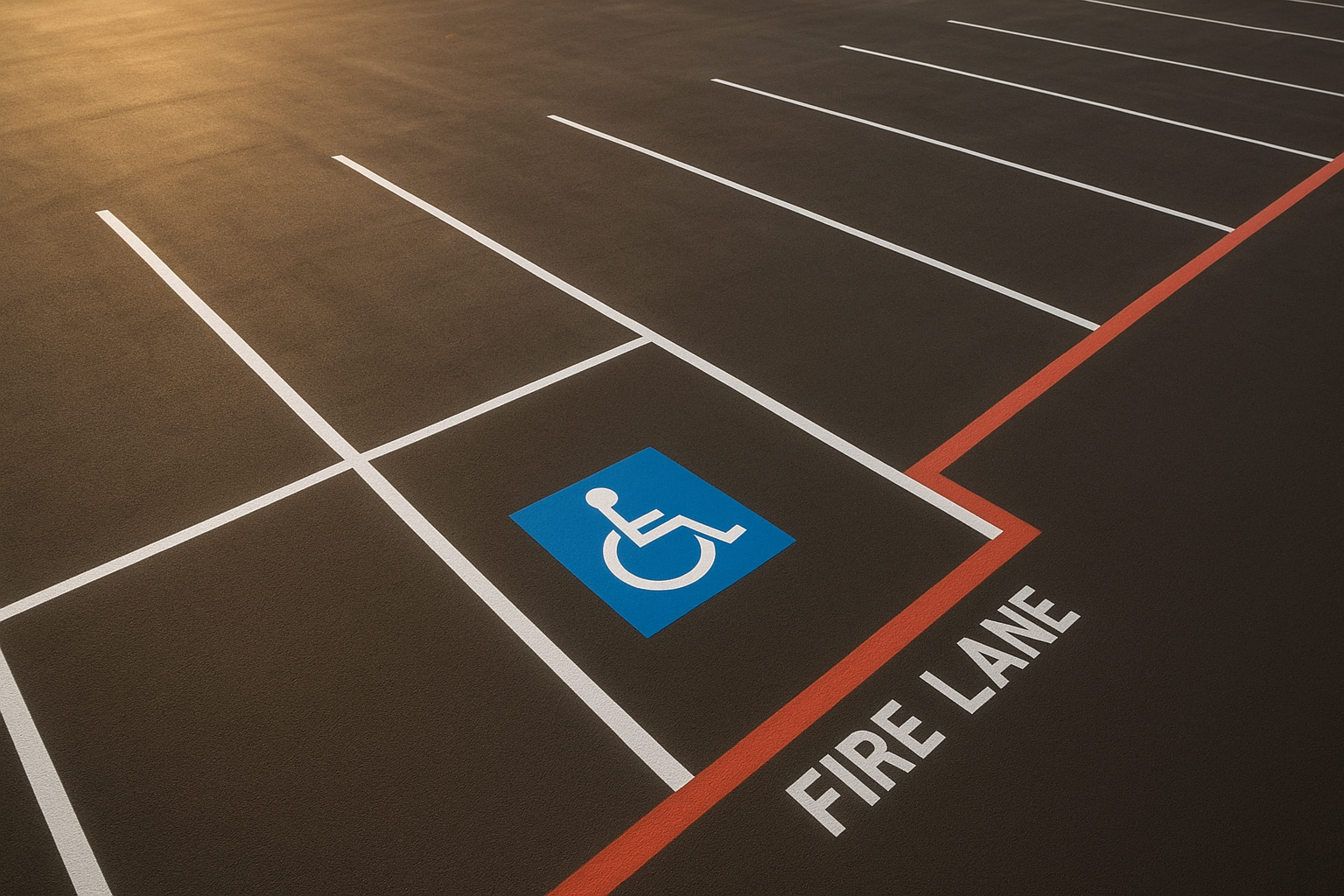
    Quick answer: Customized parking solutions Texas refers to site-specific striping, ADA-compliant stall layouts, fire lane marking, and (increasingly) guidance signage designed around a property’s exact dimensions, traffic patterns, and local code requirements — instead of a generic template applied to every lot. Property owners in Denton and Plano typically get these plans from local contractors who walk the site in person before drafting a design.

    Customized Parking Solutions Texas: What the Term Really Means

    At its core, a customized parking solution starts with a professional site assessment rather than a pre-made template. A contractor measures the lot, studies existing traffic patterns, and reviews any prior markings before drawing a single line.

    This matters because every property serves a different purpose. For example, a retail center needs wide travel lanes and clear directional arrows so shoppers flow smoothly during peak hours. A school, however, prioritizes dedicated pickup and drop-off zones to keep children safe. Similarly, a hospital lot usually needs extra ADA-compliant stalls positioned as close to entrances as possible. Consequently, no two customized parking lot designs look exactly alike, even when the properties sit a few miles apart in Denton or Plano.

    In short, “customized” is not a marketing label — it is a design methodology. It means the striping crew works backward from your property’s specific traffic, code, and safety needs, rather than forward from a generic parking template.

    Why Generic Striping Templates Fail Texas Properties

    Generic striping often overlooks code changes, drainage issues, or updated ADA ratios that only a site-specific plan catches. In addition, poorly planned layouts waste valuable parking capacity and create real liability risks for property owners.

    The Hidden Costs of a One-Size-Fits-All Parking Lot

    A tailored plan helps property managers squeeze more usable value out of every available square foot. Specifically, it can increase compliant handicap stalls, sharpen fire lane visibility, and reduce driver confusion during busy hours. As a result, businesses that switch to a customized approach typically see fewer complaints, fewer code violations, and a measurably safer lot for both employees and customers. Property owners ready to move forward can request customized parking solutions for their business before their next inspection cycle arrives.

    Freshly striped commercial parking lot showing customized parking solutions Texas businesses rely on

    A newly completed layout reflecting customized parking solutions Texas property managers request for busy commercial lots.

    Core Elements of Every Customized Parking Solution in Texas

    Every tailored parking lot solution includes several core elements, each adjusted to fit the property’s needs. Above all, these components must function as one cohesive system rather than a collection of unrelated additions.

    • ADA-compliant accessible stalls and van-accessible spaces sized to current federal and Texas code
    • Fire lane marking and curb painting for unobstructed emergency vehicle access
    • Directional arrows and lane dividers that manage one-way and two-way traffic flow
    • Wheel stops and pedestrian safety features positioned for maximum visibility
    • Custom signage placement coordinated directly with the striping layout
    • Optional parking guidance technology, such as sensors or space-count displays, layered on top of the striped layout

    For a closer look at how these pieces come together in practice, this professional line marking services overview breaks down each option in detail.

    ADA Compliance and Custom Parking Lot Design in Denton and Plano

    ADA compliance is one of the most important pieces of any custom parking lot design. According to the U.S. Department of Justice’s ADA guidelines, federal rules require at least one van-accessible space for roughly every six accessible stalls provided. However, exact stall counts and spacing can shift based on total parking capacity and local Texas code amendments.

    Van-Accessible Stalls and Ratios Explained

    In practical terms, a 60-stall lot typically needs a minimum of three accessible spaces, and at least one of those must be van-accessible with extra aisle width. Therefore, a contractor must calculate this ratio before finalizing any layout, not after.

    Texas-Specific Code Overlays in Denton and Plano

    Working with a contractor familiar with both federal ADA standards and North Texas municipal requirements is essential. For instance, Denton and Plano properties may face additional inspection steps tied to occupancy type, particularly for healthcare facilities and schools. In contrast, a small retail lot may only need a handful of compliant stalls to meet the threshold. State-level accessibility standards are further outlined by the Texas Department of Licensing and Regulation, which reviews accessibility compliance for many commercial buildings statewide. Learn more about specialized ADA compliant striping services available across the region.

    Close-up of a freshly painted ADA accessible parking stall symbol on a Texas commercial lot

    Precise ADA stall placement is a core part of any custom parking lot design.

    Beyond Paint: How Parking Guidance Systems Fit Into a Customized Plan

    Striping is the foundation, but larger properties increasingly layer digital parking guidance technology on top of it. In particular, sensor-based systems and LED indicators can turn a well-striped lot into a fully guided one.

    Sensor-Based Space Counters and LED Indicators

    Ultrasonic or camera-based sensors mounted above each stall detect occupancy in real time and feed that data to overhead LED lights or entrance displays. As a result, drivers see green or red indicators long before they reach a full row, which cuts down on wasted circling and idling. However, these systems only work well when they are mounted on a layout that already accounts for lane width, sightlines, and stall spacing — which is exactly what a customized striping plan provides first.

    Digital Wayfinding Signage vs Painted Directional Arrows

    Digital wayfinding signs can display real-time available-space counts by zone, while painted directional arrows remain the reliable, low-maintenance backbone of traffic flow. Consequently, most Texas properties benefit most from combining both: durable painted markings for everyday guidance, plus optional sensor displays for high-traffic zones like hospitals, stadiums, or large retail centers. This layered approach is what separates a genuinely customized parking solution from either a basic restripe or a stand-alone technology install.

    Crew member operating a line striping machine while applying fresh markings to a Texas parking lot

    Precision equipment ensures straight, durable lines during every striping project — the physical foundation any guidance technology depends on.

    Step-by-Step: How Customized Parking Lot Striping Works

    It helps to understand the general process from start to finish. Most projects follow the same core sequence, even though the details shift for every property.

    1. Site Assessment and Consultation: A licensed technician visits the property to measure the lot, review existing markings, and note drainage or surface issues that could affect the new layout.
    2. Custom Layout Design: The team drafts a striping plan that incorporates ADA-compliant stalls, fire lanes, and directional flow tailored specifically to the property’s traffic patterns and daily use.
    3. Surface Preparation: Crews clean the pavement, remove or grind out faded lines, and repair minor cracks so the new striping adheres properly and lasts longer.
    4. Precision Striping Application: Using professional-grade equipment, the crew applies durable, reflective paint in straight, evenly spaced lines according to the approved layout, following standards similar to the Federal Highway Administration’s Manual on Uniform Traffic Control Devices, the federal reference for road and lot markings.
    5. Final Inspection and Compliance Documentation: The completed project is inspected against ADA and local fire code requirements, and the contractor provides documentation for the property’s records.

    Meanwhile, property owners who want a deeper breakdown of local requirements can review this expert line marking guide for Texas properties. You can also see examples of finished projects directly at stripespls.com.

    What Does Customized Parking Lot Striping Cost in Texas?

    Pricing varies widely because every customized plan is different, but property owners generally want a ballpark range before requesting a quote. Below is a general breakdown based on typical commercial lot sizes.

    Lot Size / Scope Typical Price Range
    Small lot (under 25 stalls), basic restripe $300 – $800
    Mid-size commercial lot with ADA stalls added $800 – $2,500
    Large property with fire lanes, signage, and full redesign $2,500 – $8,000+
    Guidance sensors or digital signage add-on Quoted separately, per zone

    These figures are general estimates only. Therefore, the most reliable way to know your exact cost is a free, on-site quote that accounts for your lot’s current condition, required ADA stall count, and fire lane length.

    Materials and Durability: Choosing Paint That Survives Texas Heat

    Most contractors use water-based traffic paint or durable epoxy coatings designed to withstand Texas heat, intense UV exposure, and heavy vehicle traffic. Reflective additives are sometimes included for improved nighttime visibility, which is particularly useful near fire lanes and pedestrian crossings.

    Epoxy coatings generally last longer than standard traffic paint, though they cost more upfront. In contrast, water-based paint is faster to apply and dries quicker, which suits properties that cannot close their lot for long. Above all, the right material choice depends on your traffic volume, budget, and how soon you need the lot reopened.

    Fire Lanes, Drainage, and Traffic Flow: The Engineering Side of Custom Design

    Fire lane placement and width can be adjusted based on building access points, emergency vehicle routes, and local fire marshal requirements. This flexibility is one of the most common reasons property owners choose a customized plan over a generic one.

    In addition, drainage patterns influence where lines can realistically go. Specifically, a low spot that collects standing water after Texas storms may need re-graded striping so vehicles avoid parking in puddles. Similarly, traffic flow simulations help contractors decide where one-way lanes reduce congestion versus where two-way access works better. For general background on how pavement markings function as a traffic-control tool, see this overview of road surface marking standards.

    Property-Type Playbook: Retail, Healthcare, Schools, and Municipal Lots

    Retail centers typically need wide lanes, clear directional arrows, and enough compliant stalls near entrances to handle weekend traffic surges. Healthcare facilities, on the other hand, usually require a higher ratio of ADA stalls positioned as close to the entrance as physically possible, since patient mobility varies widely.

    Schools often need dedicated pickup and drop-off zones separated from general parking, while municipal lots may follow additional local code requirements beyond standard ADA rules. Consequently, a customized plan accounts for each of these use cases individually rather than applying the same layout everywhere.

    Choosing the Right Provider for Bespoke Parking Solutions

    Selecting a contractor for bespoke parking solutions requires more than comparing quotes. Property managers should look closely at licensing, insurance, experience with ADA projects, and reviews from similar property types.

    Contractor Vetting Checklist

    • Ask for a written scope of work detailing paint type, layout dimensions, and expected timeline
    • Confirm the contractor will walk the site with you before finalizing any design
    • Request proof of licensing, insurance, and prior ADA-compliant project experience
    • Discuss ongoing maintenance plans, such as periodic restriping, upfront to avoid faded lines later
    • Check whether the provider can integrate guidance signage or sensors if you plan to add them later

    These habits are covered further in this guide to best practices for maintaining a commercial parking lot. Consequently, building a relationship with one reliable provider often costs less over time than repeatedly comparing new bids each year.

    Maintenance Schedule: Keeping Your Customized Parking Solution Compliant

    Most lots benefit from restriping every 18 to 24 months, particularly in high-traffic Texas climates where UV exposure fades paint faster than in milder regions. However, ADA stalls and fire lanes often need touch-ups sooner since faded compliance markings carry higher risk than faded standard lines.

    Therefore, schedule a quick visual inspection every six months. If paint has faded more than 50 percent on any ADA symbol, fire lane curb, or directional arrow, prioritize touch-up work immediately rather than waiting for the full restripe cycle.


    Frequently Asked Questions About Customized Parking Solutions Texas

    What are customized parking solutions in Texas?

    Customized parking solutions in Texas usually include ADA-compliant striping, fire lane marking, and directional arrows designed around a property’s specific lot layout and traffic flow. These plans differ from generic striping because they account for the property’s exact code requirements and daily use.

    How much does customized parking lot striping cost in Texas?

    Pricing varies based on lot size, existing condition, and the number of ADA stalls or fire lanes required, but most commercial projects range from a few hundred to several thousand dollars. Getting a free, on-site quote remains the most reliable way to know your exact cost.

    How long does a customized restriping project take?

    Most restriping projects for small to mid-size commercial lots are completed within one to two days. Larger properties, or those requiring extensive surface repair, may take longer to finish.

    What is the difference between standard striping and customized parking solutions?

    Standard striping applies a generic template to any lot, while customized parking solutions are designed around a property’s specific traffic patterns, code requirements, and layout. As a result, customized plans often improve both safety and parking capacity.

    Why does ADA compliance matter for a customized parking lot design?

    ADA compliance ensures people with disabilities have safe, accessible parking and pathways, and it protects property owners from potential fines or complaints. Federal guidelines outline exact stall counts, widths, and signage requirements that a customized design must meet.

    How often should parking lot lines be repainted in Texas?

    Most parking lots need restriping every 18 to 24 months, though high-traffic properties may need it more frequently because of intense Texas sun exposure. Faded lines can create confusion and safety hazards, so regular inspections help catch wear early.

    What mistakes should property owners avoid when planning a parking lot layout?

    Common mistakes include ignoring updated ADA ratios, spacing stalls too tightly, and failing to mark fire lanes clearly. Skipping a professional site assessment often leads to costly corrections later on.

    Can fire lane markings be customized for different property types?

    Yes, fire lane placement and width can be adjusted based on building access points, emergency vehicle routes, and local fire marshal requirements. This is one of the most common reasons property owners choose a customized plan over a generic one.

    What materials hold up best for parking lot striping in Texas heat?

    Most contractors use water-based traffic paint or durable epoxy coatings designed to withstand Texas heat, UV exposure, and heavy traffic. Reflective additives are sometimes included for improved nighttime visibility.

    Do schools and municipal properties need different striping requirements?

    Yes, schools often need dedicated pickup and drop-off zones, while municipal lots may follow additional local code requirements beyond standard ADA rules. A customized plan accounts for these specific use cases from the start.

    Do customized parking solutions in Texas include parking guidance systems or sensors?

    They can. Many larger Texas properties layer sensor-based space counters or LED indicator signage on top of a customized striping plan, particularly at hospitals, stadiums, and large retail centers where real-time occupancy data reduces circling and congestion.

    What permits or inspections are required for parking lot striping in Denton or Plano?

    Requirements vary by occupancy type and project scope, so it is best to confirm directly with the local building or fire department before work begins. Healthcare facilities and schools often face additional inspection steps compared to standard retail properties.

    How do I request a free quote for customized parking solutions in Texas?

    Property owners can request a free quote directly through a local striping company’s website by providing basic property details and photos. Most companies follow up with an on-site visit before finalizing a plan.

    What factors influence the design of a customized parking lot layout?

    Key factors include lot dimensions, expected traffic volume, ADA stall ratios, fire lane placement, and drainage patterns. Property type, such as retail, healthcare, or school, also shapes the final design.

    Final Thoughts on Customized Parking Solutions for Texas Properties

    In summary, customized parking solutions Texas property owners choose are about far more than paint on pavement. They combine ADA compliance, fire lane safety, drainage-aware design, and — increasingly — smart guidance technology to create a parking facility that works as hard as the business it supports. Whether you manage a retail center in Plano, a healthcare campus, or a school in Denton, a tailored striping plan can improve safety, maximize capacity, and keep your property code-compliant for years to come. To get started, request a free quote through stripespls.com and see how a genuinely customized approach compares to a one-size-fits-all restripe.