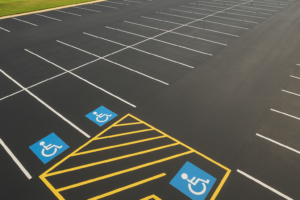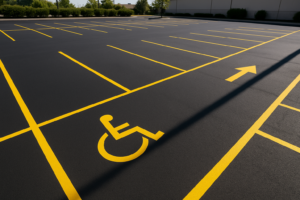
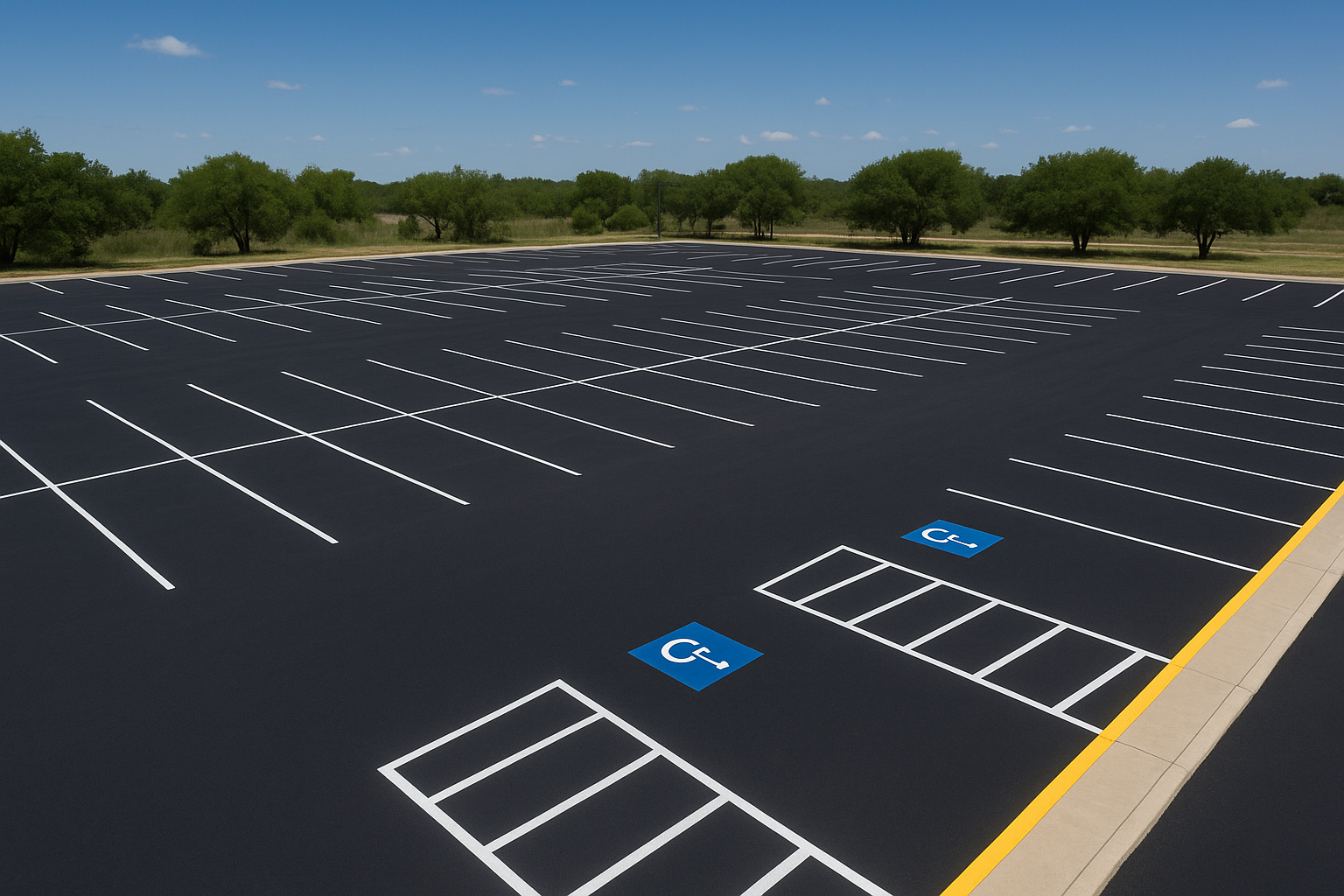
Parking lot striping is the professional application of durable painted lines, symbols, and pavement markings to organized paved surfaces — defining stalls, directing traffic, and keeping commercial properties safe, compliant, and fully functional. If you manage a retail center, office park, school, or healthcare facility in Denton TX, clean and precise striping is one of the highest-impact, lowest-cost investments you can make in your property.
Faded stall lines, missing ADA markings, and unclear fire lanes are not merely cosmetic problems. Specifically, they create real liability exposure, frustrate drivers, and can trigger code violations from local authorities. Fortunately, a professional striping crew can transform a worn lot into a crisp, organized, fully compliant parking facility — often completing the work in a single day with zero permanent disruption to your operations.
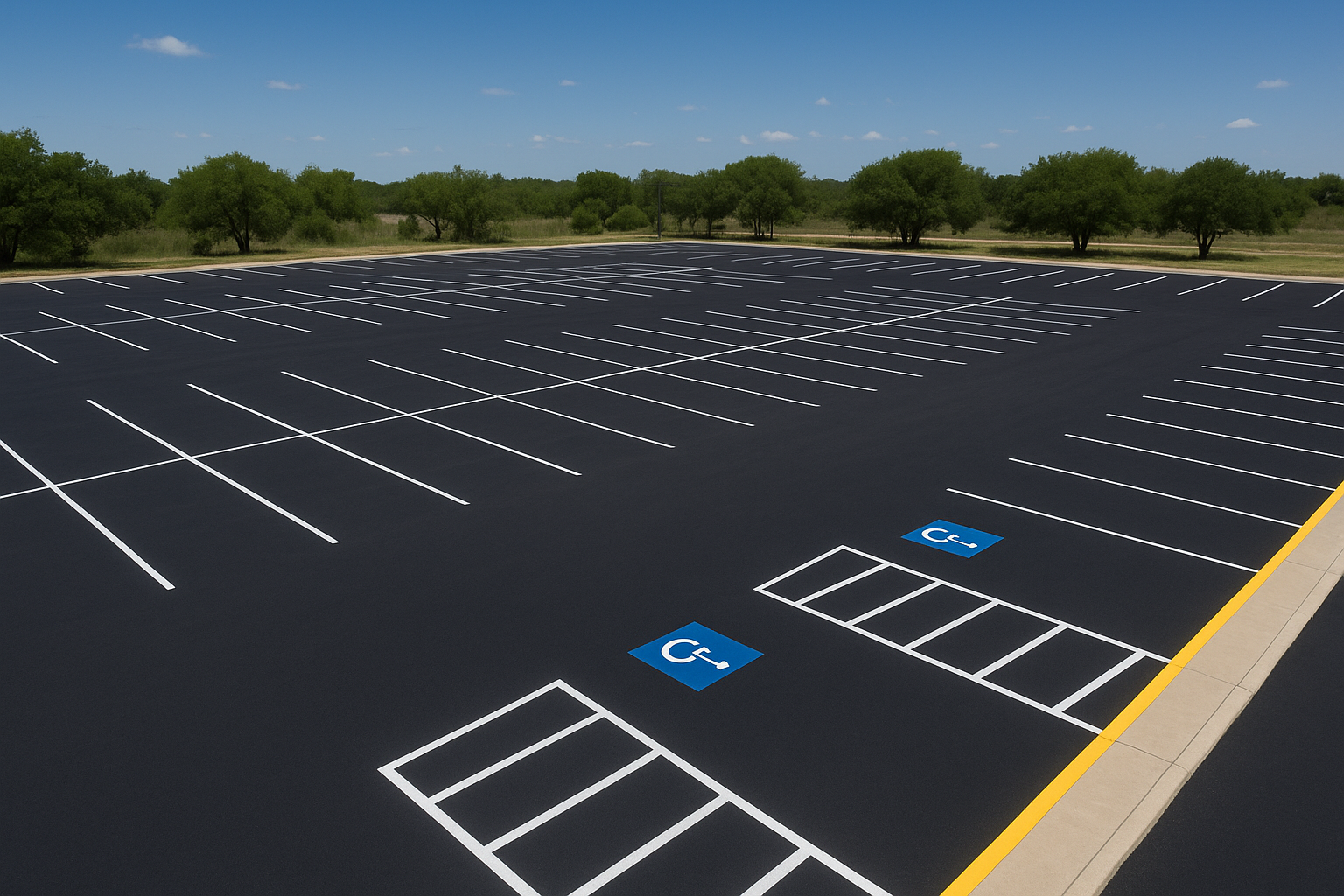
Professional parking lot striping in Denton TX delivers crisp, durable markings that improve traffic flow and meet ADA and fire code requirements.
What Is Parking Lot Striping and Why Does It Matter?
Parking lot striping is the precise layout and painting of traffic lines, symbols, and zone designations on asphalt or concrete surfaces. It forms the foundation of every safe, organized, and legally compliant parking facility. Without clear markings, drivers face confusion, usable capacity shrinks, and the risk of accidents rises significantly.
According to the U.S. Department of Justice ADA resource center, every property open to the public is legally required to provide accessible parking spaces that meet specific size and signage standards. Non-compliance can result in federal fines and civil liability claims. Therefore, proper striping is not optional — it is a legal obligation with real financial consequences.
Furthermore, research consistently links organized, well-marked parking to higher customer satisfaction scores. A freshly striped lot communicates professionalism and attention to detail — qualities that reflect directly on every business operating within that property.
The Business Case for Well-Maintained Lot Markings
Beyond compliance, sharp parking lot markings actively protect your revenue. When stall lines are clear, drivers park faster and more efficiently — meaning more vehicles served per hour. In addition, well-defined pedestrian crosswalks reduce slip-and-fall incidents that could expose property owners to costly litigation. The return on investment for professional striping is measurable in both safety outcomes and reduced liability premiums.
Complete Services Included in Professional Parking Lot Line Marking
A full-service striping company in Denton TX offers far more than simple stall lines. In fact, a comprehensive parking lot marking project typically covers every element below:
- Parking stall lines — Standard, compact, and angled layouts engineered to maximize capacity on any lot shape
- ADA handicap stall markings — International Symbol of Access, access aisles, van-accessible stalls, and compliant signage
- Fire lane striping — Red curb painting, “No Parking — Fire Lane” lettering, and pavement markings per local fire code
- Directional arrows — One-way and two-way traffic flow indicators placed at every key decision point
- Crosswalks and pedestrian safety zones — High-visibility walkway markings connecting buildings to parking areas
- No-parking zones and curb markings — Clearly defined restricted areas that prevent unauthorized parking
- Speed bump and speed limit markings — Pavement legends that reinforce traffic-calming installations
- Reserved and specialty stalls — EV charging zones, loading zones, visitor stalls, and employee-only designations
- Stop bars and yield markings — Intersection control markings that reduce internal traffic conflicts
Stripespls.com provides all of these services across Denton, Plano, and greater North Texas. You can explore the full range of parking lot striping services available for commercial and residential properties throughout the region.
ADA Compliance: A Non-Negotiable Part of Parking Lot Striping
The Americans with Disabilities Act (ADA) establishes strict federal requirements for accessible parking. In Texas, these standards apply to virtually every commercial property open to the public. Specifically, the law mandates a minimum ratio of accessible spaces to total spaces, with at least one van-accessible stall per accessible cluster.
ADA Space Ratios by Lot Size
The table below summarizes the minimum accessible space requirements under the current ADA Standards for Accessible Design:
| Total Lot Spaces | Min. Accessible Stalls | Min. Van-Accessible |
|---|---|---|
| 1 – 25 | 1 | 1 |
| 26 – 50 | 2 | 1 |
| 51 – 75 | 3 | 1 |
| 76 – 100 | 4 | 1 |
| 101 – 150 | 5 | 1 |
| 151 – 200 | 6 | 1 |
| 201 – 300 | 7 | 2 |
Access aisles — the striped buffer zones beside accessible stalls — must be at least 60 inches wide for standard accessible spaces and 96 inches wide for van-accessible spaces. In addition, signage must be mounted at a height of 60 inches minimum above the ground and must display the International Symbol of Access. Missing or undersized markings are among the most cited ADA violations during property inspections.
A professional parking lot striping team familiar with Denton-area properties ensures your lot meets every current requirement — protecting you from liability and making your facility genuinely welcoming to all visitors.
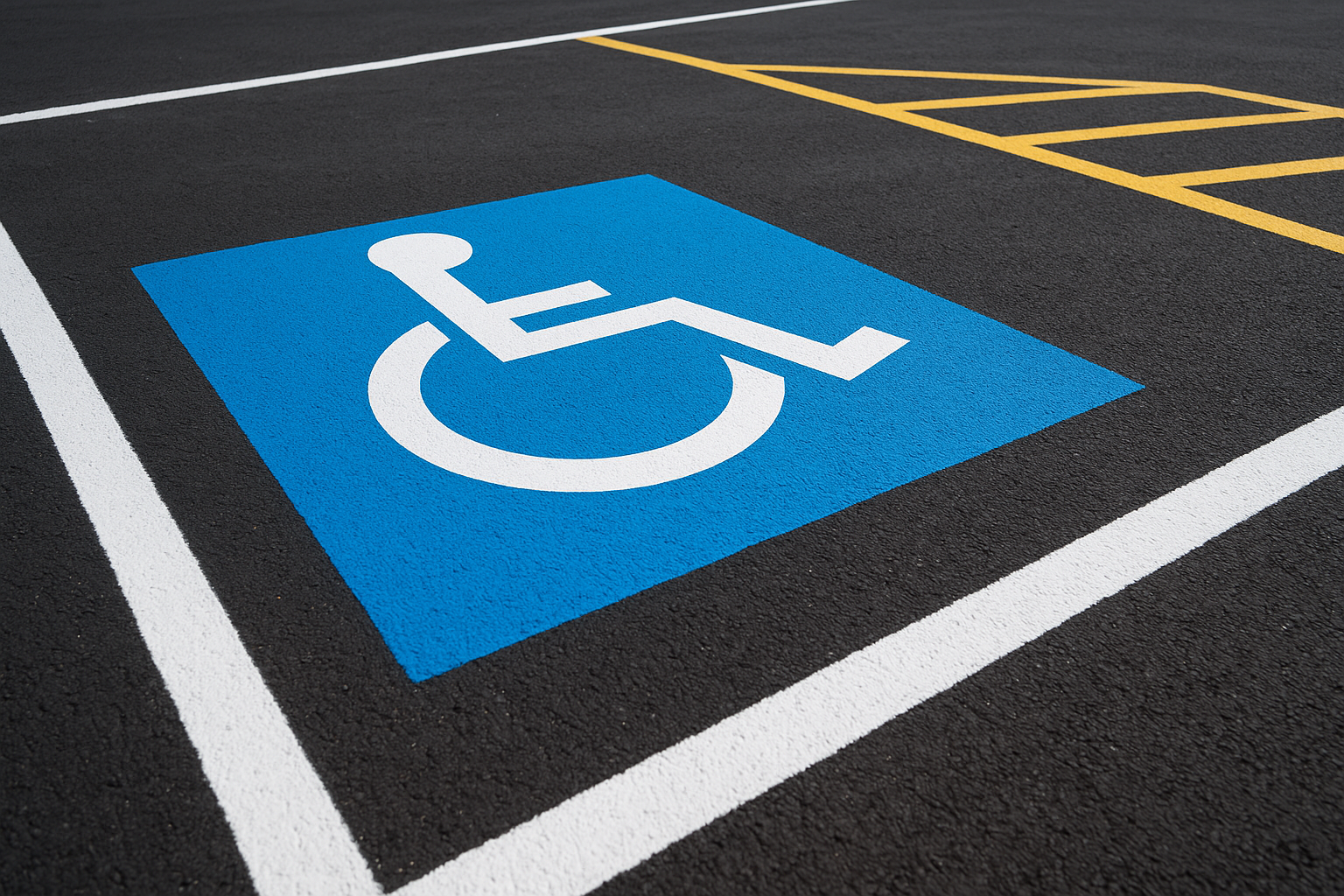
ADA-compliant handicap stall markings — including access aisles and van-accessible designations — are a required component of any complete parking lot striping project.
Types of Paint Used in Professional Parking Lot Striping
Not all striping materials perform equally. The paint or material used in your parking lot striping project directly affects how long the markings last, how quickly the lot can reopen, and the overall quality of the finished result. Here is a breakdown of the most common options:
Water-Based Traffic Paint
Water-based latex traffic paint is the most widely used material for standard commercial parking lots. It dries quickly — typically within 30 to 60 minutes — emits low levels of volatile organic compounds (VOCs), and applies cleanly through professional striping machines. However, in very high-traffic areas, water-based paint may begin fading within 12 to 18 months.
Oil-Based Traffic Paint
Oil-based paint bonds more aggressively to asphalt and concrete surfaces, resulting in better durability in harsh conditions. The tradeoff is longer drying time and higher VOC content, which may be a consideration for enclosed or partially covered parking structures.
Thermoplastic Pavement Markings
Thermoplastic — a heat-applied plastic compound — is the most durable option available for parking lot striping. It bonds to the pavement surface as it cools and can last three to seven years even under heavy daily traffic. As a result, thermoplastic is often the preferred choice for high-volume lots such as shopping centers, hospitals, and airports. The material is more expensive upfront, but the extended lifespan typically delivers a lower cost per year than repeated repainting.
How to Get Professional Parking Lot Striping: Step-by-Step
The process of hiring a striping company and getting your lot professionally marked is straightforward. Follow these five steps to ensure a smooth project from start to finish:
- Assess your lot’s current condition. Walk the entire property and identify faded stall lines, missing ADA markings, unclear fire lanes, or worn directional arrows. Note whether you need a completely new layout or a restripe of existing markings. Photographing problem areas helps during your contractor conversation.
- Request a free, itemized quote from a local striping company. Provide your lot’s square footage, stall count, surface type, and a list of required markings. A reputable company will deliver a clear, line-itemized estimate — with no obligation — so you can compare options accurately.
- Review the layout plan and confirm ADA and fire code compliance. Before any work begins, verify that the proposed stall layout maximizes usable capacity and satisfies all current ADA dimensional requirements and local fire lane regulations. Ask your contractor to walk you through the plan on-site if necessary.
- Schedule work during low-traffic hours. Coordinate with your contractor to minimize disruption to tenants, employees, and customers. Overnight work, early morning starts, and weekend scheduling are all common for commercial properties in Denton TX.
- Allow paint to cure fully, then conduct a walkthrough inspection. Keep the lot closed to vehicles for at least one hour after completion. Then walk the entire lot with your contractor to confirm every line, symbol, directional marking, and ADA designation meets the agreed specifications before you sign off.
Moreover, working with an experienced local crew means fewer surprises, faster scheduling, and results that hold up through North Texas summers, heavy rainfall, and year-round commercial traffic.
When Does a Parking Lot Need Restriping?
Most commercial parking lots need restriping every one to two years, though high-traffic properties may require attention more frequently. In North Texas specifically, intense summer UV exposure accelerates paint fading at a rate faster than in cooler climates. As a result, markings that looked sharp in spring can appear significantly washed out by early fall.
Clear Signs Your Lot Needs Restriping Now
- Stall lines are difficult to distinguish in low light or after rain
- Drivers routinely park outside marked stall boundaries
- ADA symbols and access aisle stripes are no longer clearly visible
- Fire lane lettering or curb paint has faded significantly
- Directional arrows are worn to the point where drivers ignore them
- A fresh seal coat or new asphalt overlay has covered existing markings
- You have received a complaint or citation from a code enforcement officer
If any of these apply to your property, it is time to schedule a professional restriping service before the situation escalates into a safety or compliance issue. Additionally, restriping after a seal coat is always required — new sealant covers existing markings entirely, so fresh lines must be applied to restore visibility.
Fire Lane Striping: Safety and Code Compliance in Denton TX
Fire lanes are designated access corridors that must remain clear at all times to allow emergency vehicles to reach a building without obstruction. Local fire codes in Denton — and throughout Texas — require these zones to be clearly marked with painted curbs, pavement lettering, and in some cases additional pavement markings visible from both directions.
Failure to maintain visible fire lane markings can result in citations from the local fire marshal and create dangerous delays during emergencies. Furthermore, property owners can face direct liability if an obstruction in an unmarked or illegible fire lane contributes to injury or property damage during an emergency response.
A professional parking lot striping company ensures fire lane markings meet current local standards — including correct paint color, minimum lettering height, and precise placement along curb faces and pavement surfaces. The result is a property that is safe, code-compliant, and protected against enforcement action.
Parking Lot Striping for Every Property Type
Different property types have different striping requirements. Understanding how striping needs vary by use helps property managers plan more accurately and budget more effectively:
Retail Centers and Shopping Plazas
High customer turnover means retail lots experience among the fastest paint wear of any property type. In addition to standard stall lines, retail centers commonly require fire lane markings along building perimeters, cart return designations, crosswalk corridors to storefronts, and clearly separated delivery and service zones.
Healthcare Facilities and Medical Offices
Medical facilities typically require a higher ratio of accessible stalls relative to lot size, along with clear patient drop-off zones and ambulance access corridors. Furthermore, the striping must be highly legible because many visitors have physical or visual impairments that make unclear markings especially problematic.
Schools and Educational Campuses
School parking lots serve multiple user groups simultaneously — staff, parents, buses, and emergency vehicles — often within tight schedules. As a result, clearly defined drop-off/pickup lanes, bus-only zones, pedestrian crossings, and visitor stalls are all critical components of a school striping plan.
Office Parks and Corporate Campuses
Office properties benefit from reserved stall designations, visitor zones, and EV charging markings in addition to standard striping. Similarly, large campuses may require numbered stall systems to assist employees, security staff, and visitors in locating specific areas efficiently.
Municipal and Government Properties
Government-owned facilities are subject to the same ADA requirements as private commercial properties. However, because public facilities often serve a higher proportion of elderly or disabled visitors, ADA-compliant striping is especially critical. Professional striping teams familiar with municipal requirements ensure full compliance on every public property project.
How Much Does Parking Lot Striping Cost?
The cost of parking lot striping depends on several variables: lot size, total stall count, types of markings required, surface condition, material choice, and whether the project is a new layout or a restripe. Below is a general cost framework to help you plan:
Typical Parking Lot Striping Cost Ranges
- Small lot restripe (under 30 stalls): $200 – $500
- Mid-size lot restripe (30–100 stalls): $500 – $1,500
- Large commercial lot restripe (100+ stalls): $1,500 – $4,000+
- New full layout (fresh asphalt): $1,000 – $5,000+ depending on complexity
- ADA stall upgrades (per stall): $50 – $150 per accessible stall, including symbol and access aisle
- Fire lane marking (per linear foot): $1 – $3 per foot of curb lettering
- Thermoplastic markings: 2–4× the cost of paint but lasts 3–7 years
These figures are general estimates. Surface condition, complexity, and material selection all affect your actual cost. For context, ADA requirements mandate that lots with 100 to 150 total spaces include at least five accessible stalls, with one van-accessible. Ensuring those stalls are correctly configured adds both material and labor costs that vary by property.
The best way to understand your exact investment is to request a free quote at stripespls.com. The team provides transparent, itemized estimates so you know exactly what you are paying for before a single line is painted.
Choosing the Right Parking Lot Striping Company in Denton TX
Not all striping companies deliver the same results. When evaluating providers, consider their experience with commercial properties of similar size and complexity, their demonstrated knowledge of ADA and fire code requirements, and the quality of equipment and materials they use. A company that invests in professional-grade, self-propelled striping machines will consistently produce sharper, straighter, longer-lasting lines than one relying on outdated or undersized equipment.
What to Ask Before Hiring a Striping Contractor
- Are you fully licensed and insured for commercial pavement marking work?
- Can you provide a site-specific layout plan before work begins?
- Do you have documented experience with ADA-compliant striping projects?
- What type of paint or material do you recommend for this lot’s traffic volume?
- Can you accommodate overnight or weekend scheduling to minimize disruption?
- Do you offer a quality guarantee on your work?
Stripespls.com is a locally operated, full-service parking lot striping company serving Denton, Plano, and the greater North Texas region. The team brings expertise in new lot layouts, restriping, ADA compliance, and fire lane marking to every project. Property managers, retail centers, schools, healthcare facilities, and municipal organizations throughout the area consistently trust this crew for reliable, precision work.
You can learn more about what sets this team apart by visiting the professional parking lot striping services in Denton TX page, or contact the team directly to request a free, no-obligation quote for your property.
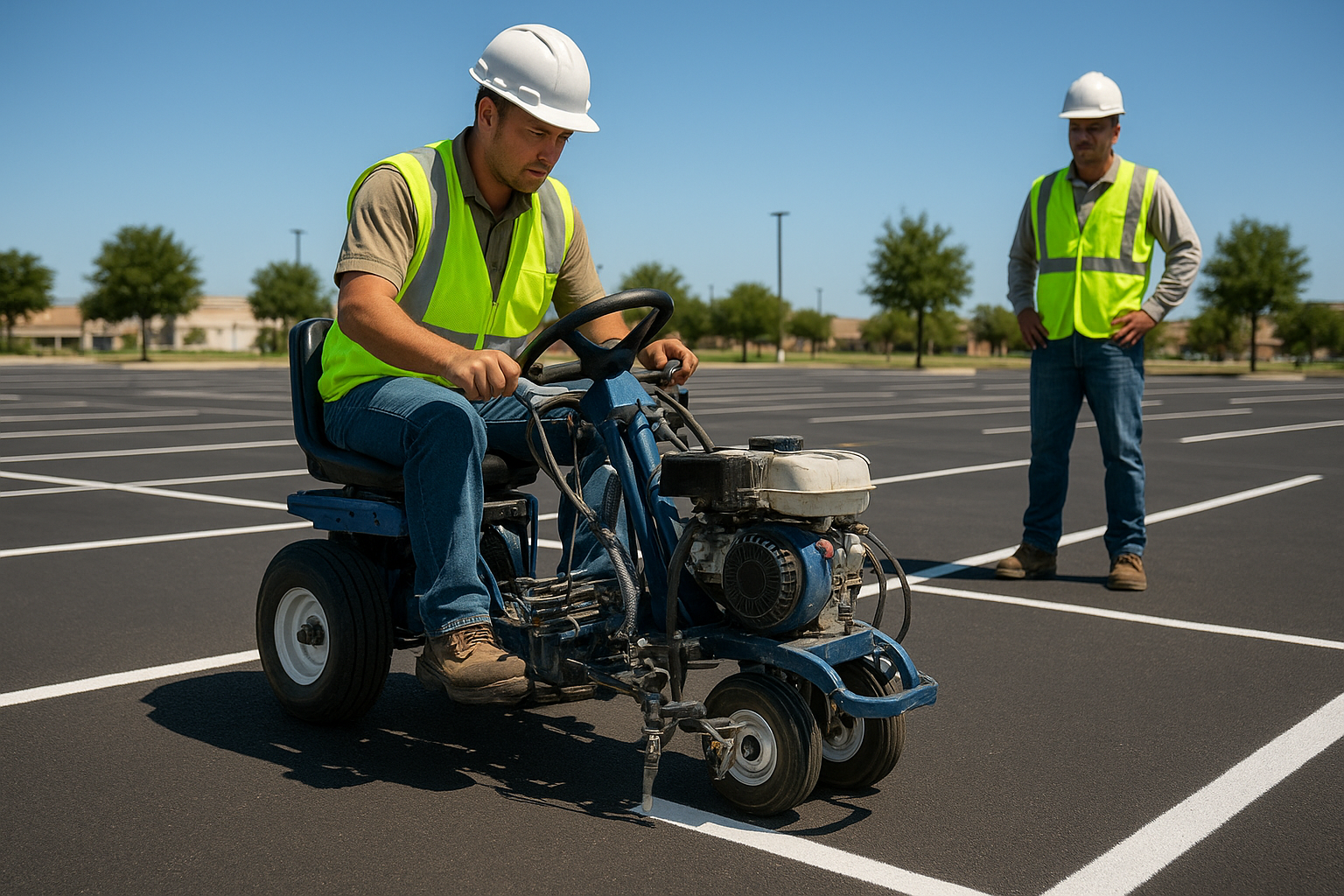
A professional parking lot striping crew uses precision equipment to deliver sharp, durable line markings on commercial lots across Denton TX.
Frequently Asked Questions About Parking Lot Striping
What is parking lot striping and what does it include?
Parking lot striping is the professional application of painted lines, symbols, and pavement markings on asphalt or concrete surfaces. A complete project typically includes stall lines, directional arrows, ADA handicap symbols, access aisles, fire lane designations, crosswalks, curb painting, and no-parking zones. The exact scope depends on the property’s size, use type, and applicable local codes.
How often should a parking lot be restriped?
Most commercial parking lots need restriping every one to two years. However, high-traffic properties — such as retail centers or medical facilities — may need annual touch-ups. In North Texas, intense UV exposure can accelerate fading, so annual inspections are a good practice regardless of traffic volume.
What are the ADA parking lot requirements in Texas?
Texas follows the federal ADA Standards for Accessible Design. These standards require a minimum number of accessible spaces proportional to total lot size, at least one van-accessible stall per accessible cluster, access aisles of at least 60 inches for standard accessible spaces and 96 inches for van-accessible spaces, and signage mounted at least 60 inches above the ground. Non-compliance can result in federal fines and civil liability.
How much does parking lot striping cost in Denton TX?
Costs vary significantly based on lot size, stall count, marking complexity, surface condition, and material type. As a general guide, small lot restripes start around $200–$500, while large commercial lots can run $1,500–$4,000 or more. Thermoplastic markings cost more upfront but last significantly longer. Always request an itemized, site-specific quote for the most accurate figure.
How long does parking lot striping take to dry?
Standard water-based traffic paint typically dries to the touch within 30 to 60 minutes under normal weather conditions. However, it is recommended to keep vehicles off the lot for at least one hour after completion to allow the paint to cure fully and maintain sharp edges. Thermoplastic markings cool and set faster — often within 10 to 15 minutes.
What is the difference between restriping and new striping?
New striping involves laying out a fresh parking lot layout from scratch — measuring stall dimensions, planning traffic flow, and marking an unpainted surface. Restriping refreshes faded or worn markings on an existing layout, which is faster and generally less expensive. Restriping is commonly needed after a seal coat application, which covers all existing markings completely.
Why is fire lane striping required for commercial properties?
Fire lane striping is required by local fire codes to guarantee emergency vehicles have clear, unobstructed access to building entrances and fire suppression systems. Properties with missing or illegible fire lane markings can receive citations from the local fire marshal and may face liability if an obstruction delays emergency response. Properly marked fire lanes must include curb paint, lettering, and in some jurisdictions, pavement symbols.
What type of paint is used for parking lot striping?
Professional striping companies use water-based latex traffic paint, oil-based traffic paint, or thermoplastic materials. Water-based paint is the most common choice for standard lots due to fast drying time and low VOC content. Thermoplastic is the most durable option and is preferred for high-volume locations. Oil-based paint offers stronger adhesion but requires longer drying time and has higher VOC emissions.
Can parking lot striping be done on existing asphalt or concrete?
Yes. Striping can be applied to both existing asphalt and concrete surfaces. For best results, the surface should be clean, dry, and structurally sound. If the existing pavement has significant cracking, raveling, or surface damage, repairs are recommended before striping to ensure proper paint adhesion and a longer-lasting result.
Does parking lot striping improve property value?
Well-maintained parking lot markings enhance a property’s curb appeal, operational organization, and safety profile — all of which positively influence perceived and appraised property value. For commercial properties, a clean, clearly marked lot also improves customer experience, supports higher tenant retention rates, and reduces liability exposure that could otherwise result in costly claims.
How do I know if my parking lot needs restriping?
Key indicators include lines that are difficult to see in low light or after rain, drivers routinely parking outside stall boundaries, ADA symbols that are no longer clearly legible, fire lane lettering that has faded significantly, and fresh sealcoat that has completely covered existing markings. If any of these conditions apply, professional restriping should be scheduled promptly.
Is parking lot striping required by law?
Yes. Commercial properties open to the public are legally required to maintain ADA-compliant accessible parking markings under the Americans with Disabilities Act. Fire lane markings are required by local fire codes enforced by the fire marshal. While general stall line visibility is not federally mandated, many local jurisdictions incorporate minimum pavement marking standards into their building and property maintenance codes.
Conclusion: Make Your Parking Lot Work Harder for Your Property
Investing in professional parking lot striping is one of the most practical, high-return steps a property owner or manager can take. Fresh, precise markings improve traffic flow, maximize stall capacity, reduce liability, ensure ADA and fire code compliance, and signal to every visitor that your property is well-managed and welcoming. Whether your lot needs a complete new layout, a restripe of faded lines, or targeted ADA and fire lane upgrades, an experienced local crew makes all the difference in the outcome.
Explore the full range of services at stripespls.com’s Denton TX striping page, browse the stripespls.com blog for more parking lot maintenance tips, or get in touch today to request your free, no-obligation quote and take the first step toward a safer, sharper, fully compliant parking facility.